
|
Britain faced what many felt was certain defeat. At this time Britain could have made a deal with Hitler. Lord Halifax thought Britain had little choice. Halifax was Britain's Foreign Secretary and had supported Chamberlain's policy of Appeasement to avoid war with Germany. One of the unanswered questions about the War is why Halifax did not replace Chamberlain as prime minister. He was next in line and could have been prime minister rather than Churchill, yet he declined. No one knows why. Some believe he thought he was not up to the task. It may well be that as the German Western offensive fell (May 10) that he did not want to be the prime minister presiding over a defeated Britain. Hitler admired the British. He would have offered an arrangement more attractive than that offered France. Britain could have kept its fleet and much of the Empire. Hitler in the end did not want war with Britain. He wanted to secure his western front so he could focus on the Soviet Union in the east. Churchill refused, however, to treat with Hitler and the NAZIs. He was determined to resist as dire as the circumstances. Halifax and others in the war Cabinet believed that Britain should deal with Hitler. Churchill was narrowly able to bring the War Cabinet with him. There would be no British Vichy. There was some support in Britain for reaching an understanding with Hitler. Some of the moneyed class saw Hitler and the NAZIs as a way of controlling the working class and confronting Bolshevism. In the end Britain would be saved, not by the gentry, but the minors, workers, and common people often living in squalid city slums. [Jesson] That commitment was to be shown by London's East End when the Blitz commenced. Churchill after the RAF had defeated the Luftwaffe and defeat was no longer eminent, replaced Halifax with a close ally, Anthony Eden. Halifax was disposed of by being made ambassador to the United States, a deft political move.
Prime minister Chamberlain who has pursued the policy of Appeasement with Hitler, proved to be an ineffective war leader. This came to a head after the loss of Norway. The Labour Party demanded a debate on the Norwegian campaign (May 8). This developed as a vote of censure. Chamberlain secured a majority, but 30 Conservative MPs voted against him and 60 abstained. Given the dissension in his own party, Chamberlain decided to resign. There were two leading candidates to replace him. One was Winston Churchill who he had brought into government as First Lord of the Admiralty, but who was a staunch critic of appeasing Hitler during the 1930s. The other leading candidate was Foreign Secretary Lord Halifax who had supported appeasement. Chamberlain favored Halifax, but he demure. Thus Churchill was chosen.
King George VI appointed Churchill as prime minister (May 10). This was the very day that the Germans struck in the West, attacking the Netherlands, Belgium and Luxembourg. Only 2 days later, the Germans invaded France by striking through the Ardennes, thus moving around the Maginot Line.
Halifax was Britain's Foreign Secretary and had strongly supported Chamberlain's policy of Appeasement to avoid war with Germany. One of the unanswered questions about the War is why Halifax did not replace Chamberlain as prime minister. He was next in line and could have been prime minister rather than Churchill. Chamberlain and the King preferred him to Churchill. Yet he declined. No one knows definitively why. We do not know any parlimentarian in all of British history who essentially turned down am ofer to be primeminister. Halifax never expalined his decision. Some believe he thought he was not up to the task or did not want the job. Possibly as the German Western offensive fell (May 10) that he did not want to be the prime minister presiding over a defeated Britain, especially as he had been such a strong sypporter of appeasement. But it was a few days before it was clear that the Germans were breaking through the French front. Perhaps he understood that he was not suited to be a war leader. It is known that he was not feeling well on the critical days that Chamberlain approached him. It is known that he expressed reservations about not having a seat in the Commons. Chamberlain assured him that this could be finessed. But Halifax probably felt that it would be untenable to have to rely on Churchill to support him and that eventually Churchill would supersede him in the public mind. He does not seem to have believed that bhe could manage Winston. [Lukas, p. 13.] He was probably right.
After a few months of the "Phony War", France's turn came. The Germans struck on a wide front against the neutral Netherlands, Belgium, and Luxemburg. The terror bombing of Rotterdam convinced the already hard-pressed Dutch Army to surrender. The British Expeditionary Force (BEF) rushed north to aid the Dutch. The Germans then struck in the Belgian Ardennes which allowed them to avoid the formidable Maginot Line. The French and Belgians considered the Ardennes impassable to tanks. The Germans managed to easily penetrate the rough terrain, crossed two
substantial rivers, and the XIX Panzer Corps rapidly reached the English Channel--cutting the BEF off from the French and rendering the Maginot Line useless. The French entrenched behind the Maginot Line simply could not cope with the explosive highly mobile style of Blitzkrieg warfare. The Panzers surrounded the Belgian
Army which King Leopold III surrendered. The BEF was within Hitler's grasp. Paris soon fell and the French signed a NAZI imposed armistice. The collapse of France after only a few weeks was a disaster of menses proportions. It was the French Army that had provided the bulk of the allied War Western Front in World
War I. The German victory was not accomplished with massively superior numbers or weaponry. In fact they had fewer men and tanks. What they had was a
superior tactical doctrine. The Germans were amazed to find, for example, that French tanks were not even equipped with radios, and a more disciplined fighting
force. NAZI propaganda began to describe Hitler as " Der gr�sste Feldherr Allerzeiten " (the greatest field commander of all time). [Davidson, p. 483.]
World War II, at least the war with Britain and France, could have ended in June 1940. Many thought it would. Britain was faced what many, including Appeasement-minded U.S. Ambassador Joseph Kennedy, felt was certain defeat. At this time Britain could have made a deal with Hitler. Churchill was not yet fully aware of the danger when on the same day he became prime minister and the Germans finally struck in the West (May 10). On the way back from Buckingham Palace, his bodyguard, W. H. Thompson congatulated him on his appointment and added, "I only wish the appoinment had come your way in better times for you have an enormous task." Tears appeared in Churchill's eyes. He replied, "God alone knows how great it is. I hope it is not too late. I am very much afraid that it is. We can only do our best." [Thompson, p. 444.] The situation was certainly dire. Not only was France teetering, but the BEF was trapped at Dunkirk and the prospect of getting many out seemed bleak. Italy was preparing to join Germany in the War. Stalin had signed an alliance with Hitler and supplying him with enormous quantities of critical materials, rendering the Royal Navy blockade useless. And America showed no inclination to enter the War. The situation for Britain could not have been much worse.
After France fell, Britain could have had peace. Hitler wanted a peaceful settlement. And appears to have been willing to have foregone an invasion and occupation--at least for a time. Britain could have kept its fleet and even colonies. As peace talks were never held it is unknown precisely what Hitler would have offered. There were members of the War Cabinet who wanted to seek terms. Today this seems dishonorable. At the time, it seemed as the only way of avoiding a German invasion and occupation. What ever the terms, however, a Germany in control of the continent would have meant a British Vichy. The actual terms Hitler would have offered would have been meaningless. After Munich, the British knew that Hitler's commitments were worthless and could not be trusted to keep his word. [Moss]
Churchill was having none of it and by the force of his leadership carried the Cabinet with him. His defiant words "we shall fight on the beaches" were to rally the British people. Churchill refused to treat with Hitler and the NAZIs. He was determined to resist as dire as the circumstances. Ambassador Kennedy reported to President Roosevelt what was happening in the British Cabinet at the end of May when the fate of the BEF in Dunkirk was still in doubt. Kennedy reported "Only a miracle can save the BEF from being wiped out ..." He went on to report that there, "... will be a row amongst certain elements in the Cabinet here; Churchill, Atlee, and others will want to fight to the death but thee will be other members who realize that physical destruction of men and property in England will not be a proper offset to a loss of pride." (May 27, 1940)
There is no historical precedent for a war cabinet in Britain. At the onset of World War I, Britain did not have a war cabinet. Rather issues were debated by the full cabinet. This proved unwieldy . As a result a war cabinet was formed chaired by Prime Minister Acquith, but the press began to describe the move as a loss of confidence in Asquith and it eventually led to Asquith being replaced with Lloyd George. Using the precedent, Prime Minister Chamberlain formed a war cabinet after declaring war (September 3, 1939). Britain formed a coalition Government to fight the War. This consisted of both the Conservative, National Liberal, and the Labour Party. (Labour in Britain was the socialist party.) Chamberlain decided, however, to pack his war cabinet with members of his own Conservative Party. Churchill when he became prime minister opted for a smaller body to avoid length debates (May 10, 1940). His initial war cabinet consisted of: Prime Minister & Minister of Defense: Winston Churchill (Conservative), Lord President of the Council: Neville Chamberlain (Conservative), Lord Privy Seal: Clement Attlee (Labour), Foreign Secretary: Lord Halifax Conservative), and Minister without Portfolio: Arthur Greenwood (Labour). Churchill, Chamberlain, and Halifax had considerable experience in government. Atlee and Greenwood did not. The Labour Party had a string anti-war pacifist element. The Party was also staunchly anti-Hitler, including Atlee and Greenwood. The war cabinet sometimes had others meet with them if expert input was required on specific issues.
One of the most significant meetings of the War was held by the British War Cabinet at the end of May with the fate of the BEF still in question. Halifax and others in the war Cabinet believed that Britain should deal with Hitler. He suggested using the Italians (who had not yet declared war) to find out what terms Hitler would offer. Churchill strongly disagreed. He saw such an approach as a "slippery slope". Halifax responded that he did not understand why Churchill was so opposed to attempting mediation. One might think that no one could stand up to Churchill in a debate like this. But Churchill had only been prime minister 2 weeks. The reputation he was to acquire had not yet been earned. Many thought he drank too much and was hopelessly old fashioned and erratic. Churchill was determined to fight, but it would have even unwise not to placate Halifax. Halifax's resignation would have been very damaging. And his ally Chamberlain was still the leader of the Conservative Party. If he reigned, it would have brought the Government down and Britain may have sued fir peace. The vote in the War Cabinet could have well gone against Churchill. It was at this time that Chamberlain spoke up. No doubt his thoughts went back to his triumphant return and his claim to having achieved 'peace in our time' as he displayed a document Herr Hitler had signed. He knew more than anyone in the room the value of Hitler's assurances. Chamberlain backed Churchill and warned against further appeasement. He pointed out that whatever the dangers of fighting on, and with characteristic understatement, reminded the others that dealing with Hitler also involved a "considerable gamble". Churchill perhaps strengthened by the support from Chamberlain, more defiantly exclaimed, "nations which went down fighting rose again, but those which surrendered tamely were finished." Halifax retorted that he was not suggesting 'capitulation'. Halifax had been forced to equivocate, but no definitive secession was taken. [Meacham, pp. 56-57.]
Churchill then met with the full Cabinet. He first discussed the possibility of bad news from Northern France. He then raised the issue that had been discussed in the War Cabinet. "It was idle to think that, if we tried to make peace now, we should get better terms from Germany than if we went on and fought it out. The Germans would demand our fleet--that would be called 'disarmament--our naval bases, and much else. [HBC note: While Churchill was right about the impossibility of dealing with Hitler and the fact that England would inevitably become a vassal state to a NAZI-dominated Europe, he was wrong about the conditions Hitler would have offered. Hitler was prepared to offer more generous conditions.] We should become a slave state, though a British Government which would be Hitler's puppet would be set up. .... And where should be at the end of all that?On the other side, we had menses reserves and advantages. Therefore we shall go on and we shall fight it out, here or elsewhere, and if at last the long story is to end, it were better it should end, not through surrender, but only when we are rolling senseless on the ground." There was a murmur of approval. No one raised the question of approaching the Germans. [Meacham, p. 57.] Churchill who only narrowly prevailed in the War Cabinet, now was in control. There would be no British Vichy. And Britain's resistance would prove to be just as Churchill described it, Britain's 'finest hour'.
Few Britons outside the military and the War Cabinet understood the enormity of the disaster unfolding across the Channel. Even before the Germans struck, the Cabinet was uneasy about the conduct of the War. The failure in Norway and the Phony War and memories of the Great War , left the British nation with little appetite for war. [Lukas] It was one thing for Churchill to convince the War Cabinet to fight. He now had to convince a badly shaken nation as the shocking news appeared in the newspaper not to lose heart. Many at the time, including the American Ambassador, Joseph P. Kennedy, believed that Britain was lost. And the Germans seemed triumphant. Within a few weeks the Germans would seize the Channel ports and begin preparing an invasion. Churchill would manage what few leaders could have done, to rally the nation and arm them with a steely determination to fight it out with Hitler's seemingly invincible hordes.
The War Cabinet made its secession while the evacuation of Dunkirk was underway and the outcome not yet clear. As the Panzers cut across France, the British decided to evacuate the BEF. About 400,000 British an French soldiers began to fall back on Dunkirk. At this time the BEF was still within Hitler's grasp. It was not just the number of men that were at stake. The BEF was the professional core--the heart of the British Army. The
men of the BEF would be the officers and NCOs of the British army that would eventually play an important role in defeating the Germans. The loss of the BEF would have crippled the British war effort if not forced the British to seek terms. Churchill warned the Commons that it "should prepare itself for hard and heavy
tidings". The Panzers were only a few miles south of Dunkirk and facing no serious opposition. Hitler ordered the Panzers to halt. Some believe that he hoped this gesture would help convince the British to comes to terms, other believe that is was just as it was described at the time, a needed pause to regroup and prepare for a
more coordinated assault. [Davidson, p. 408 and Fest, p. 630.] What ever the reason, this 48-hour respite allowed the British to organize a defensive perimeter around Dunkirk and begin an almost miraculous withdrawal. Although King Leopold III surrendered the Belgian Army, the French First Army delayed the Germans. The BEF fell back toward Dunkirk, abandoning their equipment along the roads. Nearly 340,000 men were evacuated from Dunkirk, including French and Dutch soldiers. This is even more important that it sounds as almost all if the British soldiers were regulars and would form the corps of the future British Army that would play such an important role in the War. All of the BEF's equipment, however, was lost and there was no replacements for the lost equipment waiting for
them back in England.
France signed a separate peace with the NAZIs (June 22, 1940). Now Britain stood alone and would soon face the might of the Luftwaffe with which Hitler had terrified Europe. The provisions were less severe than had been expected. Much of southern France was left unoccupied and under control of the new Vichy regime. One provision of the armistice, the "surrender on demand clause", was an obligation to arrest and turn over anyone requested by the Germans. Thus the Germans could pursue any one they wanted even in the unoccupied or Vichy zone. Initially this included Jews, Communists, Socialists, as well as political officials who had been outspokenly critical of the NAZIs. France was forced to disband its army, except for a minimal force of 100,000 men for maintaining domestic order. This was the same size force that Germany had been allowed under the Versailles Peace Treaty. The French Army which had been the mainstay of the Allied Western Front was interned in Germany, 1.5 million French Prisoners of War (POWs). The French government agreed to stop military units from leaving France to fight with the British. France had to agree to pay for the cost the Germans incurred in occupying the country.
Hitler wanted a deal with Britain so he could focus on the Soviet Union. Hitler admired the British. He would have offered an arrangement more attractive than that offered France. Hitler in the end did not want war with Britain. He wanted to secure his western front so he could focus on the Soviet Union in the east. Hitler expected the British to seek terms. The German Foreign Ministry began drawing up a possible document. Hitler was apparently prepared to let Britain retain the fleet and Empire, perhaps demanding back the German colonies lost in World War I. The terms offered France were in part affected by a desire to show Britain that the Germany could be responsible. [Fest, p. 636.] The French were, for example, allowed to keep their fleet, although it had to be decommisioned. Hitler was preparing a speech to offer magnanimous terms (July 8). Churchill's speeches and in particular the attack on the French fleet (July 3) astonished Hitler. He does not seem to have realized that his flagrant violation of his pledges at Munich meant that Britain, even Chamberlain and Halifax could see that appeasement had failed and any German offer could not be trusted. The British response was not what he expected from a vanquished enemy. [Fest, pp. 636-37.] Hitler thus decided after meeting with his military chiefs to proceed with the air campaign against Britain in preparation for an invasion. Speaking at the Sports Palace before the Reichstag, he threatened, "Only a few days ago Mr. Churchill reiterated his decision that he wants war. .... Mr. Churchill ought, perhaps, for once, to believe me when I prophesy that a great Empire will be destroyed--an Empire which it was never my intention to destroy or even to harm. I do, however, realize that this struggle, if it continues, can end only with the complete annihilation of one or the other of the two adversaries. Mr Churchill may believe that this will be Germany. I know that it will be England."
There was some support in Britain for reaching an understanding with Hitler. This is dificult to gage because scientific public opinion polling was invented in America by George Galup and others in the late-1930s. There was nothing like it in Britain. Some of the moneyed class saw Hitler and the NAZIs as a way of controlling the working class and confronting Bolshevism. The British people, however, disliked Hitler from the first, but that distaste was overridden with fear of War. This did not change even at the time of Munich. It did begin to change when in violation of the Munich Agreement, Hitler moved into Pague and what was left of Czechoslovakia (March 1939). [Lukas, p. 11.] From that and despite the danger there was little support among the British public for making peace. Emblazoned in the mind of every British person was the paper Chamberlain brought back from Munich and waved before cameras with Hitler's signature promising peace. It was printed in newspapers and magazines and shown in movie newsreels. The people knew that deals with Hitler were pointless. Churchill did not have to explain that. In the end Britain would be saved, not by the gentry, but the miners, workers, and common people often living in squalid city slums. [Jesson] What they needed was a leader to stand up to Hitler. That leader would be Churchill. And his eloquent speeches would what the English people felt in their souls. That commitment was to be shown by London's East End when the Blitz commenced.
However much Hitler wanted a deal with the British, any such deal was clearly pointless, of no real value to the British. His actions had showed his true cgaracter and that his word offered nothing of value. A German Foreign Minister at the outset of World War I referred to a treaty as a mere 'scrap of paper'. That is just how Hitler thought, but not how the British thought. Even appeasers like Chamberlain now saw that Hitler's word was meaningless. Chamberlain had brought back Hitler's signature from Munich and within months Hitler had violated every word of it. Hitler seems to have been oblivious of the consequences of this action. Hitler had offered peace again in a Reichstag speech after defeating Poland thinking that he could still believed and his word had value (October 6). Even before the British and French replied. however, he issued F�hrer Order No. 6 for an offensive in the West. Once Hitler was in command of the Continent, he could deal with Britain and France however he wanted. And the men who backed Churchill knew it. As he was speaking, SS think tanks were discussing how to break up France after the War. The same would have occurred in Britain. Thus Hitler's offers had no real value. Afyer the War Cabinet discussin, only a military victory would bring the British to terms. And with Churchill's rejection of the offer of peace, Hitler ordered Luftwaffe Chief Herman G�ring to begin the military action that would defeat Britain militarily. G�ring's status in the NAZI hierrchy would depend on it and he knew it.
The fall of France meant that Britain stood alone and for a year had to valiantly fight the Germans without allies. American public opinion was decisively isolationist--against involvement in another European war. Most Europeans and Americans thought Britain would soon collapse and further resistance was futile. But the British stirred by Prime Minister Churchill did fight. The British were battered, but held. The turning point vame in air battles over London. London was far emough north athat the Luftwaffe fighters could mot effectively protect the bombers. Heavy losses were sustained (September 15), losses the Luftwaffe could not sustain. The day is now commemorated as Battle of N\Britain Day. The Germans continued to bomb Britain for several months, but primarily at night as the Briyish were only beginning to develop nightime fifgter capability. But bombing at night meant taht the Germans coul not hit valuavle targets. Newsreel footage of the Luftwaffe bombing London and other British cities had an enormous impact on American public opinion. It was the first German defeat of the War. The narrow, but decisive victory in the Battle of Britain changed the course of the War. As Hitler turned his evil view east toward Russia, a huge unsinkable aircraft carrier with a population willing to make virtually any sacrifice remained in his rear and the Royal Navy continued to block German and German-controlled ports.
Churchill after the RAF had prevailed in the Battle of Britain and invasion was no loner eminent, replaced Lord Halifax as foreign secretary with a close ally, Anthony Eden. Halifax who had supported Chamberlain's appeasement policy still had considerable political support within the Conservative Party. A very young Eden had been foreign secretary earlier, but resigned when he differed with Chamberlain over appeasement even before Munich (February 1938). In this case his disagreement was over Mussolini. Eden would go on to serve as foreign secretary throughout the war in Europe. Halifax was disposed of by being made ambassador to the United States, a deft political move. It was an important post, but meant that Halifax was essentially removed from British politics. Except for a failed attempt at a vote of confidence in 1942, Churchill now was firmly in control of the Conservative Party and Eden is most faithful lietenant. His World War II role was limited because Churchill insisted on conducting the most important negotiations, with President Roosevelt and General ecretary Stalin personally. Eden was worried about the emphasis Churchill put on the Special Relationship with the United States and was not uncommonly disappointed by American treatment of Britain. [Dutton] Eden would not be rewarded by churchill who insisted on becoming primeminister bagain after Labour was defeated in the 1951 Generla Election. ge should have dictated retirement. Eden finally became primeminister (1955). It proved to be a short primership, basically wrecked by his mishandling of the Suez Crisis and relations with the Americans.
The modern artistic community, especially Hollywood but dramatists as commonly well seek to dispel long-cherished Western traditions and to bring down important heroes, men like George Washington and Abraham Lincoln. Winston Churchill has been a popular target. Rolf Hochhuth, friend of Holocaust denier David Irving, in 'Soldiers' tried to indict Churchill for permitting the bombing of German cities as well as the murder of Polish General Sikorski (1967). Another playright, Howard Brenton, wrote 'The Churchill Play' (1974) accusing Churchill of moving toward a police state. The British public rightfully dismissed the nonsense and continues to see Churchill as the country's greatest historical figure. There is, surprisingly, an excellent and historically accurate dramatic depiction of the fateful days in which Britain decided to resist the conquering NAZIS--"Three Days in May". The play was written by Ben Brown. It may seem like five men sitting around a table does not make for riveting drama. Many prefer fiction and excitement. Brown's play, however, by truthfully depicting the interplay between the five men in the War Cabinet does indeed make for a fine drama, largely because we know now what was at stake--not only Britains's future but essentially Western Civilization. For those who do not, they should read about what the Einsatzgrupen was preparing for occupied Britain.
Dutton, David. Anthony Eden. A Life and Reputation (London: Arnold, 1997).
Fest, Joachum. Hitler (Vintage: New York, 1974), 844p.
Jesson, Henry. And Beacons Burn Again - Letters from an English Soldier (New York: London: D. Appleton-Century and Company, 1940). The title comes from a fmous English poem, "A Shropshire Lad". These beautifully written letters reveal both a personality and an era. The author returned to England at the outbreak of the war and found himself in the midst of the apathy and inaction which prevailed in England at that time.
Lukas, John. Five Days in London, May 1940 (Yale University Prress: New Haven, 1999), 236p.
Meacham, Jon. Franklin and Winston: An Intimate Portrait of an Epic Friendship (Randon House, New York, 2003), 490p.
Moss, Norman. Nineteen Weeks: America, Britain and the Fateful Summerof 1940 (Houghton Mifflin, 2003), 400p.
>p> Tmompson, W.H. Sixty minutes with Winston Churchill (London: 1951).

Navigate the CIH World War II Section:
[Return to Main Britain alone page]
[Return to Main World War II European campaign--phase 1 page]
[About Us]
[Biographies]
[Campaigns]
[Children]
[Countries]
[Deciding factors]
[Diplomacy]
[Geo-political crisis]
[Economics]
[Home front]
[Intelligence]
[Resistance]
[Race]
[Refugees]
[Technology]
[Bibliographies]
[Contributions]
[FAQs]
[Images]
[Links]
[Registration]
[Tools]
[Return to the Main World War II page]
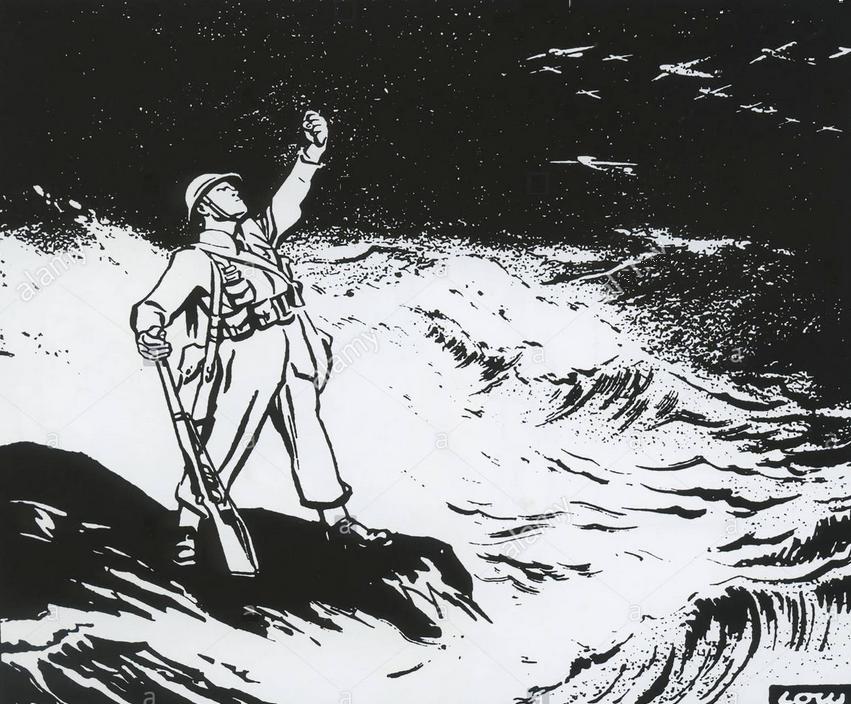 Figure 1.--The British War Cabinet with the Germans at the Channel and in the midst of the Dunkirk evacuation decided that come what may, there would be no negotiating with Hitler and to fight on (May 28, 1940). New Zeland cartoonist David Low (1891-1963) a few days later created this now iconic image capturing the spirit of the British nation--"Very well, alone"