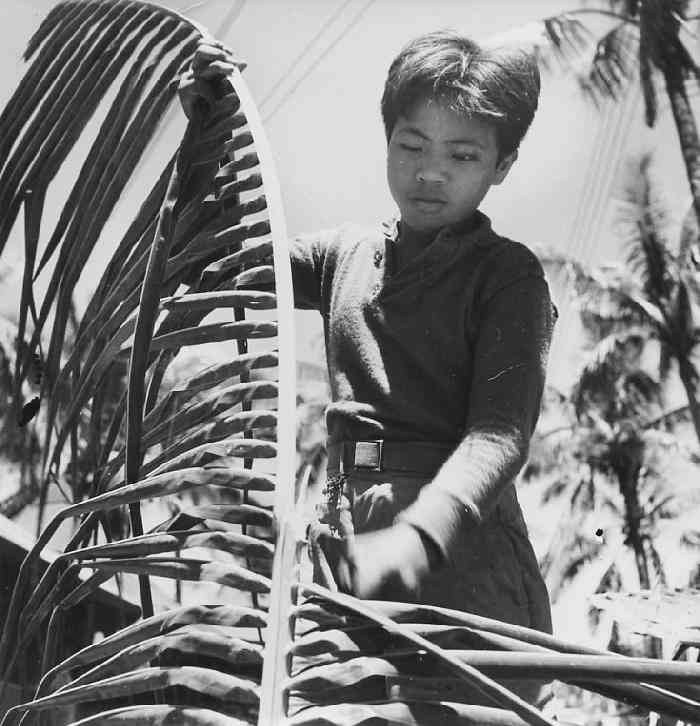
The Battle of the Atlantic was an Allied effort. The Pacific War was a largely American effort as two great naval forces gave battle over the tractless Pacific. The Philippines became the linchpin in the road to war. The war in Japanese eyes became necessary after the United States embargoed oil. The oil the Japanese needed was available in the Dutch East Indies and the Dutch could not prevent the Japanese from seizing it. The problem for the Japanese was that the American-held Phillipine Islands lay astride the sea routes between the Home Islands aqand the Resource Area of Southeast Asia tht the military leaders who goverened Japan saw a necssary for Japan to complete its conquest of China. Not only did the Philippines present a barrier to Japanese expansion, but the United States possessed
the only naval force in the Pacific capable of opposing thepowerful Imperial Navy. Of particular importance was the Dutch East Indies which had the petroleum resources that Japan lacked. Japan launched the War by a carrier attack on the Haiwaiian Islands, the base of the U.S. Pacific Fleet at Pearl Harbor. This launched the Pacific War in which America and Japan fought out naval engagements in the vast Pacific, but amphibious invasions of islands that the people of the two contrie had never even heard about before the War. Unlike the DutchEast Indies, these islands had little intrinsic value in terms of resources, only theirgeographic location made them strategically important. These islands ranged from the frigid Alutians in the North Pacific to the steemy jungle islands of the South Pacific. Ultimately the largest naval battle in history would be fought off the Philippines--the Battle of Leyte Gulf.

The Admiralty Islands off the northern coast of New Guinea were part of the westtern Bismsrck Archpelago. The two main islands are Los Negros and Manus. The Japanese landed on the islands (April 1942). The Admiralties had one of the finest anchorages in the Southwest Pacific--Seeadler Harbor. The Japanese built two air strips. After the Battle of Midway , the Japanese no longer had uncontested naval dominance. This presented them with a problem, especialy after the American counter offensive began at Guadacanal in the Solomons. There were thousands of Pacific islands. They could not defend them all. Some were obvious American targets, but many were less so. And adding to the Japanese problems, while they could cram large numbers of troops on many islands and atolls, as American naval and air power grew, supplying those widely dispersed garisons became an increasingly dufficult problem. General MacArthur targeted the Admiralties with Opetation Brewer. When MacArthur received a slender intelligence report--the Japanese were not reacting in strength to air strikes. He ordered a small force to conduct a reconisance in force, on Los Negros, a month befor a much stronger force was preparing to invade. Fortunately for the men involved. MacArthur's instincrs proved right. Support troops landed and Manus also fell (May 1943). The U.S. 1st Cavalry Division was the principal American force.The U.S. Navy turned Seeadler into one of its most important Pacific bases with facilities to repair ships. The airfield were extended. The Air Force from the air bases was able to hammer Rabaul and Japanese positions in New Guinea. They also supported the Navy's Central Pacific offensive.
The Aleutians streach out from Alaska toward Siberia. The Japanese militarists were concerned about possible American attacks from the Aleutians on northern Japan which at the time included part of Sakalin. This fear was jightened by the Doolittle Raid (April 1942). To win approval of his Operation MI (the invasion of Midway Island and final destruction of the Amrican Pacific Fleet). Admiral Yamanoto had to agree to include the invasion of Attu and Kiska inthe westetern Aleutians. Yamamoto optimistically thought it might create a diversion. In fact, it diverted Japanese carriers to cover the invasion. Carriers that could have made a huge difference at Midway. Japanese carrier aircraft from Junyō and Ryūjō bombed Dutch Harbor on Unalaska Island (June 3, 1942).
The Japanese invaded Kiska (June 6)and and Attu (June 7). Most of the native population had been evacuated before the invasion and interned in camps in the Alaska Panhandle. Logistics was key to the Aleutian campaign. The United States had only limited military resources in Alaska but rushed the Trans-Alaskan Highway to compltion to facilitate the movement of men and materials. The U.S. Navy deployed a cruiser/destroyer force to interdict Japanese supply convoys The result was the Battle of the Komandorski Islands. After which the Japanese stopped surface supply efforts and reverted to submarines. This was both inadequate and a wasteful use of the subs. The United States built an air base on Adak Island from which Kiska could be bombed (August 1942). The United Stated launched the invasion to retake Attu (May 11, 1943). It proved to be a bloody, prolonged campaign. The Japanese garrison fought to the death. An inconclusive naval engagement was fought west of Kiska--the Battle of the Pips (July 27). The Japanese abandoned Kiska (July 28).
The terrible weather conditions in the Aleutians were such that the Americans did not even notice. An American invasion force landed expecting another bitter fight (August 7). Guadacanal in the Solomons was one of the few Pacific islands that the Japanese did not defend to the death. Kiska in the Aleutians was another island abandoned by the Japanese. The Ameicans began a sustained bombing campaign against the Kuriles. The primary target was the Japanese base at Paramushiro. The principal imact was to diveet 500 Japanese aurcraft and 41,000 army troops.
Germany proclaimed a protectorate over what at the time was called the New Britain Archipelago (1884). It was subsequently renamed the Bismarck Archipelago. The two principal islsands were New Britain and New Ireland which the Germans also renamed. The Archipelao was located just to the north of the Solomon Islands. The Allies seized the islands during World War I. After Pearl Harbor, a string force of the Japanese attacked the islands, first bombing Rabaul fron Truk. Rabaul at the eastern tip of New Britain was the principal port in the Archipelago (January 1942). A substatial force of Japanese marines occupied both New Britain and New Ireland and smaller associated islands. The Allies did not have sizeable forces on the islands to resist. The Japanese converted Rabaul into their principal base in the South Pacific. Army, naval and air bases made it a formidable bastion. The Japanese used it as a base to begin the conquest of Australia. The task force assigned to seize Port Moresby along the southern coast of New Guinea sailed from Rasbaul. They were stopped by an American carrier force in the Battle of the Coral Sea (May 1942). The Japanese also moved south into the Solomons. After the American victory at Midway, some of the surviving Japanese pilots were assigned to Rabaul which along with the Zero fighter made for a powerful air arm. The loss of the four carriers at Midway, meant that the Imoperial Navy no longer had the capability to execute Operation FS abd cut off Australia from America. They decided to use air power to cut the sea lanes anf began building an air field on Guadacanal in the southern Solomons. American marines seized the airfiels in the first offensive Allied operation of the War (August 1942). This led to the bloody battle for Guadacanal and ferrocious naval and air strikes from Rabaul. Guadacanal was, however, on the outer limit of Zero operations. This aided the Marine pilots on Guadacanal operating basically obsolete aircraft. The balance of power gradually shifted as new American aircraft like the long-range Lockeed P-38 Lighting and the Gruman F-4 Hellcat arrived. Japanese naval losses and the arrival of new American ships was another major factor. The Imperial fleet was withdrawn froim the Soiuth Pacific. The Allies were thus able to move up the Solomom chain bringing Rabaul in range of intensified air strikes while the U.S. Navy made it difficult for the Japanese to resupply Rabaul. The Allies first planned to seize Rabaul, but eventually decided to simply cut it off to avoid casualties. The Allies proceeded to seize Japanese bases along the northeastern coast of New Guinea as well as islands around Rabaul--Operation Cartwheel. The final step was New Britain itself. The First Marine Division relieved from Guadacanal landed at Cape Gloucester at the western end of New Britain (December 1943). Army units landed at other locations. This and the naval blockade effectively neutralized Rabaul. The Allies bypassed New Ireland entirely. The large Japanese garrison was cut off without supplies and by the end of the War faced starvation. The Japanese abandoned Rabaul (August 1945).
Borneo is the third largest island in the world. At the time of World War II, this huge island was divivided between the British and Dutch. The Dutch controlled most of the island, the British the northeast coast. The island is located at the centre of maritime Southeast Asia and the Dutch portion of the island is today the central portion of Indonesia. Soon after the Japanese attack on Pearl Harbor, the Japanese invaded Borneo. This largely primitive island was actually a primary objective of the Japanese war effort because of the oil resources that the British and Dutch were developing. The Japanese landed first on the west coast near Miri in Sarawak (mid-December 1941). The Japanese completed the conquest when they seized Balikpapan in the Dutch portion of Borneo along the eastern coast (January 23, 1942). The Japanese did not penetrate into the jungle interior, but occupied the coastal area and the oil fields. One of the first actions they took was to intern the European officials. The missionaries working with the local people were targeted. Many families and the Japanese killed them, including the women and children. This horified the indegenous people like the Dyaks who had come to love the missionaries. The Dyaks and other tribal people were also outraged by the Japanese stealing their food and forcing themselves on their women. The Japanese decimated many local populations as well as Malay intellectuals. They eliminated the Malay Sultanate of Sambas in Kalimantan. The Japanese directly or indicrectly killed an estimated 0.1 million local people during the ocupation. The British eventually inserted a small Z Force unit to organize the tribal people so they could resist the Japanese (January 1945). Borneo had become a major source of oil for the Japanese who had virtually no domestic oil resources. After the Allied offensive reversed the Japnese onslaught, the oil instalations became a target for American bombers. The American submarine campaign also became increasingly effective (1943). Eventually it became almost impossible for the Japanese to get the oil to Japan, although oil tankers were able to make runs to Singapore. This is why by 1943 much of the Imperial Fleet was based in Singapore and not the Home Islands. An Australian force landed along the northeast coast at Tarakan (May 1945).
The Caroline Islands in the Central Pacific were one of the former German islands taken by the Japanese in World War I (1914). The League of Nations awarded the islands to Japan after the war as a trusteeship. The Japanese built a huge naval base at Truk. Japanese forces frim Truk played an important role in the Japanese offensive that carved out a huge empire after Pearl Harbor. They referred to Truk as the Gibraltar of the Pacific. It was in the first year of the war along with Rabal the principal forward operating base of the Imperial Fleet. Following the launch of the American Central Pacific campaign and the seizure of the Gilberts and Marshalls, the Japanese braced for an American assault on Truk. The Imperial Fleet withdrew most of its combat units, hoping the large garrison and substantial air contingent could defend Truk. The Americans instead odf launching a costly invasion carried out devestating carrier air attacks on Trukand its defenses. These attacks devestated Truk as an effective base. Without command of the sea, the Japanese could not resupply Truk. And without supplies Truk was rendered ineffective, unable to support efforts to defend the Marianas--the critical battle in the Central Pacific campaign. By the time the Japanese surrendered at theend of the War, the Truk garrison was near sarvation.
The Japanese referred to Southeeast Asia as the Southern Resource Area and the most precious resource they needed after the United States embargoes was oil. And oil was available in the Dutch East Indies (DEI). After the German Western offensive, the Dutch and other Europeans were no longer capable of resisting the Japanese in Asia (May-June 1940). The Dutch DEI colonial administration in Batavia recognized the Dutch government-in-exile. After the fall of Singapore (April 1942), the Japanese moved on the DEI (March 1942). The Japanese defeated decisively defeated an Allied fleet cobeled together in the Battle of the Java Sea (March 1). After this the Japanese occupied the DEI with little resistance. Japanese parchute landing seized the all-importantboil fields largely intact. The Japanese , however, benefitted little. The American submarine campaign by 1943 was making it difficult to ship raw material from the DEI and the rest of the Southern Resource Zone to the Japan Home Islands. The American destruction of the Imperial Fleet and reconquest of the Philippines (October 1944) made it virtually imposible. The nationalist DEI political leaders at the time were being suppressed by the Dutch. The Japanese attempted to win the natiionalists over, but without offering independence. The nationalists largely collaborated with the Japanese. The Japanese in the DEI committed terrible attrocities. Despite nationalist collaboration, an estimated 4 million civilians perished during the Japanese occupation.
After the initial Japanese offensice following Pearl Harbor. Fiji found itself on the front line of the Pacific War.
Fiji became one of several targets of the Japanese FS Operation designed to seize the French and British South Pacific
South Pacific islands east of Australia. This would have cut Australia and New Zealand off from America, the first step in conqueriung both Dominions. FS would have been the next Japanese Pacific offensive after they destroyed the American carriers at Midway. The ensuing Japanese Midway disaster (June 1942), however, changed the naval balance in the Pacific. America proved to have just enough naval power to prevent the Japanese from moving beyond the Solomons. In addition, the United States garisoned the island with 10,000 well-equipped Marines. A Japanese invasion would not have faced the small. poorly equipped force they found on Wake and Guam immediately after Pearl Harbor. Fiji soldiers fought with the the Allies in the Pacific campaigns that followed. Fijian soldiers acquired a reputation in the difficult American Solomon Islands campaign. The United States and other Allied countries maintained military installations in Fiji during the war, but after the Solomons campaign, Fiji became a remote rear area used for staging and logistics.
French Frigate Shoals is an open atoll located between the Hawaian Islands and Midway. It includes a large, crescent-shaped reef surrounding numerous small, sandy islets. The land area is very small (¼ square kilometer), the coral reef area is substantial. The largest island is Tern Islasnd. French Frigate Shoals was part of the U.S. Hawaiian Islands. The name resulted from two French frigate ships that almost ran aground on the reeds (1786). The atoll is both isolated and uninhabited. The Japanese learned after the invasion of Wake Island that there were no U.S. Navy facilities at French Frigate Shoals and its isolation meant that it could be used by submsarines to refuel reconisance seaplanes. Two Kawanishi H8K flying boats from Wake refuled at the French Frigate Shoals for an armed reconisance of Oahu (March 3, 1942).
After the U.S. Navy realized that the Japanese were using the area for flyingboats operations, they occupied Tern Island and built an emergency landing strip there to make sure the Japanese could no longer use the Shoals.
The Gilbert Islands in the Central Pacific (now known as Kiribati) were a British colony seized by the Japanese after the Pearl Harbor attack launching World War II. Makin in the Gilbers was the target of an American raid. The Ameirican carriers had escaped destruction at Pearl, but they were not ready to take on the Japanese. The Japanese not only had more carriers, but their pilots were better trained and had superior aircraft. Admiral Nimitz used the American carriers in hit and run raids aimed in part at giving the carrier groups more experience. This included attacks on Japanese bases in the the Gilberts. The situation had changed after the Japanese lost carriers and pilots at Midway and the Solomons and the new Essex class carriers with impoved aircraft began reaching the Pacific Fleet. The American Pacific offense began in the South Pacific. After success in the Solomons The United Strates Pacific Fleet under Admiral Nimitz launched a new front--the Central Pacific campaign. The ability to conduct two offences in the Pascific left the Japanese confused as to how to organized their defenses. The American Central Pacific campaign began with an assault on the Gilberts (November 1943). The Japanese after the Sollomons campaign had withdrawn the battered Imperial Fleet to safe bases. There was thus, unlike the Solomons, no naval opposition in the Gilberts. The Japanese hoped that a well entrenched island garison could resist an American amphibious invasion even without naval support. The American Marines at Tarawa proved they could not, but at a terrible cost. The Japanese refused to surrender and fought to the death. Losses shocked the American public, but President Roosevelt ordered that film footage of the carnage be allowed to be shown in movie news reels (the TV news of the day). Bases in the Gilberts were used to support the subsequnt American assault on the Marshalls.
The Hawaiian Islands were Americ's primary Pacific territory. By the itme of World war II, the United States had already decided to grant independence to the Philippines and plans for this were well advanced. There were, however, only limited military facilities on the Islands. This changed as the Japanese took increasingly meancing steps in the Pacific. Japan seized French Indochina (Vietnam) and joined the Axis. In response, the Roosevelt Administration tightened trade restrictions and moved the headquarters of the U.S. Pacific Fleet from San Diego to Pearl Harbor on Oahu as a signal to the Japanese (1940). The Japanese lasunched the Pacific War with a surprise carrier strike on Pearl (December 1941). Admiral Nagumo's two waves did enormous damage, incapitating the Pacific Fleet by sinking or destroying eight battleships. By mere chance, the three carriers of the Pacific fleet were not at Pearl. The Japanese attack on Pearl Harbor was a brilliantly executed military action, it was also the most disasterous operation in Japanese military history. In 2 hours, the Jaanese instantly ended the isolationist debate in America, bringing the country and its massive industrial power into World War II. Nagumo decided against a third wave, leaving the oil depots, shipysards, and submarine pens at Pearl in tact. This meant that America was left with an operational naval base around which to rebuild the Pacific fleet. Had the Japanese suceeded at Midway (and they almost did), Pearl would have inevitably come under attack. The American victory at Midway, however, left Pearl unassailable and from Pearl Harbor, Admiral Nimitz mastermined the U.S. Navy's Central Pacific campaign. Pearl Harbor and the Hawaiian Islands became the operational center of the most powerful naval force ever assembled.
Iwo Jima was an unihabited volcanic island south of Japan. Virtually no one had ever heard of the island before World War II. It suddenly became important because it was half way between Tokyo and the Marianas where the Americans were building air bases. The Japanese conceived of using the island as part of the their air defense. The Japanese thus turned the island into a massive underground forttress. This was an emense construction project that was caried out undergroujd and thus not dected by American inteligence. The Japanese plans for Iwo proved impractical because of the altitude at which the B-29s could fly and the limited capabilities of Japanese air craft. The island still proved to be of major importance because the United States needed it for its air campaign. It was too small for an important bomber base. It was, however, valuable for both a fighter/escort base and a mid-ocean refuge for bombers having engine trouble or damagd by Japanese air defenses.
The Marshall Islands were not claimed by a European power until Spain claimed them (1874). The Germans at the time were actively building an Empire, but most of Africa and Asia was already claimed by other European powers. Germany also claimed the islands. The Pope helped mediate the dispute between Spain and Germany. The Germans paid the Spanish $4.5 million and Spain in return recognized Germany's claim (1885). The Germans established a protectorate over the islands and opened trading stations on Jaluit and Ebon to develop the copra (dried coconut meat) trade. Marshallese Iroij (high chiefs) continued internal rule supervised by the German colonial administration. The Germans were not very successful. Japan seized the islands during World War I (1914). The League of Nations awarded a mandate to the Japanese after the War. The Japanese set up their administration Jaluit which had been the German administrative center. The Japanese heavily fortified the islands. The Japanese when they launched the war sought to destroy the U.S. Pacific fleet. The Imperial Fleet would then protect the expanded Empire. The elite corps of Japanese carrier pilots were lost during a series of naval engagements (Coral Sea, Midway and the Solomons campaign) during 1942. As a result the Imperial Navy did not oppose the American invasion of the Marshalls, hopeing that well entrrenched and equipped garisons could fend off amphibious invasions. The U.S. Marines and Army forces proved they could not. The Marines and Army supported by the U.S. Navy took both Kwajalein and Eniwetok Atolls in bloody invasions. The Marines landed on Kwajalein atoll (January 31, 1944). The United States quickly took control of the islands.
The Marianas were unique in that they were divided beteen the United States and Japan before World war II. The Americans obrained Guam from Spain as a result of the Spanish-merican War (1898). The Japanese seized Sipan and Tinian from Germany during World war I (1914-18). Durng the inter-War era by international agreement, the islands were jot to be fortified. The Japanese began to militaize their islands, the United States did not. Japan immedietly after Pearl Harbor seized Guam which had only a small Marine detachment with small arms (Scember 1941). Later in the War, the Marianas became a major battlefield of the War. The Navy's Central Pacific campaign was unoppsed by the Imperial Fleet. The Japanese hoped that fortified islands could resist amphibious invasions without the Fleet intervening. After the Ameicans took the Marshalls, Gilberts, and Caolines, it was clear that they could not. For the Japanese the stakes were very high. The Marianas brought the Japanese Home Islands within range of the new B-29 bombers. So when the American landings on the Marianas began, the Imperail Fleet did intervene, setting up one of the climatic battles of the Pacific War--the Battle of the Phillipine Sea (1944). As the Marine and Army troops were going ashore, the B-29 bombers were coming off the assembly line at American aircraft plants.
Midway Atol is the tiny U.S. mid-Pacific base which until the Marines arrived was unpopulated. It represented the high-water mark of Japan's offensive in the Pacific War. Midway is an atol that is in actually the eastern-most point of the Haiwaian Islnds.
It is a 2.4 square mile atoll in the North Pacific. It is about one-third of the way between Honolulu and Tokyo. The name comes from the fact that the atol was about midway between America and Asia. The atol is made up of a a ring-shaped barrier reef and several sand islets. The two significant land areas are Sand Island and Eastern Island which until the arival of the Marines primarily provided habitat for a large seabird population. The Marines built an airfield on both. The Japanese did not seize Miday after Pearl Harbor when they did seize Wake Island and Guam further east. After the Doolittle raid on Tokyo and the Battle of the Coral Sea, Admiral Yamamoto advanced the time table for completing the destruction of the U.S. Pacific Fleet. For some reason, afer Pearl the Japanese engaged in a series of tangental operatins such as a forray into the Indian Ocean to deal with the Royal Navy instead of utilizing their substantial naval advantage to complete the destruction of the American Pacific Fleet--in particular the carriers. Yamamoto finally decided that this was the priority goal. The plan was to use Miday (designated MI) to force the Americans to commit their carriers to battle. The ensuing Battle of Midway (June 4, 1942) proved to be the turning point of the Pacific War. American intelligence alerted Admiral Nimitz to the Japanese plans. Even so, the American victory was not a foreone conclusion. The experience of Admiral Nagumo and his staff, the superority of Japanese planes, and the competence of the Japanese pilots provided the Japanese the clear edge in the fighting. The decisive advantage oroved to be Midway itself.
The ensuing battle is often seen as basically a carrier battle. In fact, Midway played a crucial role in the battle. The task of destroying the air component on Midway destracted Admiral Nagumo and did the need to recover the Midway strike force and to evade air attacks from Midway. These operations combined to prevent Nagumo once the American carriers to Nagummo's surprise had been detected from laubching a strike on the American carriers that in all liklihood would have been highly successful.
The Australians seized Nauru from the Germans at the onset of World War I. The island was important because of the phosphate mining developed by the Germans. Nauru was invomved in World War II before the onset of the Pacific War.
The German auxiliary cruisers Komet and Orion sunk four supply ships close to Nauru (DEcember 6-7, 1940). The ships were targeted becausecof Nauru's phophate industry and the fact that the Royal Navy had significantly reduced its ship deployment in the Pacific. Komet approached Nauru which was largely unproitected and shelled phosphate mining facilities along the coast, oil storage depots, and the shiploading cantilever. This effectively disrupted phosphate deliveries to Australia and New Zealand. Phosphate is primarily used for fertilizer, but during war time became important foir producing munitions. The Japanese got around to occuping Nauru after their period of advance in the South Pacic had stopped (August 26, 1942). The Japanese forcibly deported 1,200 Nauruans to work as slave laborers on the Chuuk islands in the Carolines. Only about half would survive. The Japanese built the first airfield on Nauru. The Allies bombed it (March 25, 1943). This prevented the Japanese from supplying their garison. And by this time the Allied advance in the Pacific also made it impossible to supply the island by sea. The Allies decide to bypass Nauru and let the Japanese there to "wither on the vine". This was part of the Allied stategy to focus resources on defeating the Japanese and not conducting clostly invasions of every Japanese-occupied island in the Pacific. The Japanese commander, Captain Solda, surrenderedchis command (September 13, 1945). This surrender was accepted by Brigadier J. R. Stevenson, who represented Lieutenant General Sturdee, the commander of the First Australian Army, on board the HMAS Diamantina. The Australians arranged the repatriation from Chuuk of the 737 Nauruans who survived Japanese slave labor there. They were brought home om the Briutish Phosphate Commission (BPC) ship Trienza (January 1946). The newly founded United Nations designated Nauru as a trusteeship (1947). The U.N. designated Australia, New Zealand, and the United Kingdom as the trustees.
New Caledonia was one of several French terrioties in the South Pacific. Luckily for the French, they were located just outside the area the Japanese managed to seize after Pearl Harbor. And after Midway, the United states had just enough naval power to prevent the Japanese from reaching the French islands. One of the most important was the relatively large iland of New Caledonia. It was located south of Guadacanal and 680 miles northeast of Sydney. The island was not a typical South Pacific island. It had important nickel and chromium mines and much of the output was exported to Japan before the War. About 1,300 Japanese nationals worked the mines. When World War II began in Europe (1939), the Japanese increased their orders, apparently anticipating that supplies might be cut off. The island was added to the Japanese objectives, both because of the mines and the strategic location. The islands could play a very important role in severing the sea lanes between Australia and the United States. The Japanese offensive to seize the islands were part of the FS Operation and included the seisure of Fiji and the Samoa Islands. Cut off from America and with its Army in North Africa, the Japanese believed that Australia would be forced to surrender. The FS Operation, however, required Japanese naval dominance and Midway (June 1942) had significantly altered the balance of naval forces. New Caledonia played a major in the Solomons campaign. Noumea and the southerntip of the island, became the principal American base for the naval operations that were fought to protect the Marines who seized Guadacanal (August 1942). Nomea proved to have just enough facilities to keep Enteprise patched up after it became the single operational American carrier. After the Americans began moving up the Solomon Islands toward Rabaul, New Caledonia became a remote, but important rear area of the War.
Many Pacific islands that became caught up in World War II were small islands some like Iwo Jima were not even populated. This was not the case of New Zealand. The island was a huge island with a substantial, albit primitive population. It was perhaps the most isolated corner of the world, virtually unknown to the rest of the world. This change sudenly after Pearl Harbor. The Japanese lunched an offensive that swept over the South Pacific and Southeast Asia. The Allies suffered one stunning defeat after another. It was on New Zealand that the Allies first suceeded in stopping the Jpanese. This set up a 2-year struggle for the island. The Japanese Army suceeded n taking the western and northern sides of the island. The rugged Owen Stnley Mountains prevented the Japanese from striking south t seising the southern part of the island around Port Morsesby defended by a small Australian garison. Instead a naval task force was disptched to mount an amphibioys operation. This task force was stopped and tuned back by U.S. carriers in the Battle of the Coral Sea (April 1942). Futhure amphibius operations were redered impossible by the subseqent American victory at Miday (June 1942). Instead the Japanese mounted a land offensive over the Own Stanleys. They were stopped by the Australians only a few miles from Port Moresby and forced back. It was at this time that the Ameruicn mrines landed on Guadacanal (August 1942). The Japanese Army, unaware of the losseses at Midway and fully committed on New Guinea, failed to fully appreciate the importance of Guadacanal. The Allied offendise in the Solomons soon was joined by landngs along thr northeastern coast of the island and gradually moving up the coast in a series of amphibious operations. TheNewcGuinea campign was overseen by General MacArthur. The Allies suceeded in cutting off and isolating several Japanese garrisons. This was the southern prong of a dual Allied offebnsive (1943-44). The northern prong was Admiral Nimit's drive across te central pacific. Finally the Allies secured New Guinea and the two prongs converged on the Phillippines (October 1944).
The New Hebredies were islands off the northern coast of Australia. It is today known as Vanuatu. They were unique in that they were administered by a British-French "Conduminium". The largest island was Espiritu Santo. They were one of countless Pacific islands that virtually no one had ever heard of and when the War began in Europe was as far away from it as imaginable. After Pearl Harbor the islands took on importance because of importance of maintaining the sea lanes between between Ausrtralia and the United States. The 3rd Construction Battalion (Seabee unit) was sent to Efate in the New Hebrides. The island of Espiritu Santo in the New Hebrides was the closest Allied-held island to Japanese-held Guadalcanal. The Japanese were intent on severing the sealanes to Australia. After Midway, the Japanese major naval striking force was decimated. They set about building an air base on Guadcannal to support operations to sever the sealanes. Thus Espiritu Santo became critical to the Allied defense of Australia. The Seabee 3rd Construction Battalion Detachment was moved from Efate to Espiritu Santo and assigned to rapidly prepare a bomber strip. The Seabees in only 20 days carved out a 6,000 foot airstrip from virgin jungle. This enabled the United States launch air attacks disrupting the construction of the Japanese air base. The First Marine Division launched the first Allied offensive of the War by invading nearby Guadalcanal (August 1942). The New Henredies would be a major supply and staging area for the Marines on Guadacanal. Espiritu Santo 550 miles to the south was the closest source of supplies. It also meant that fighters could be flown in from Espiritu Santo.
New Zealand following the NAZI invasion of Poland was one of the first countries to join Britain after it declared war in Germany (September 1939). New Zealand played a role in the Battle of Britain. New Zealand like Australia also was an important part of the British forced that fought in North Africa. As a result, New Zealand and Australia found itself inmperiled after Japan attacked Pearl Harbor (December 1941). Only the remaining American fleet stood between the Imperial Fleet and Australia and New Zealand. The Japanese turned back after the Battle of the Coral Sea (April 1942). The immediate danger was not releaved until the American Navy devestated the Japanese carrier force at Midway (June 1942). American men and material poured into New Zealand in preparation for the Allied offensive in the South Pacific.
The invasion of Okinawa was the first American attack on Japanese territitory. Okinawa, in the Ryukyu Island chain was strategically located between Kyushu, the southernmost Japanese island and Taiwan (called Formosa by the Japanese). American strategists saw Okinawa as a necessary base from which an American invasion of the Japanese home islands could be staged. Okinawa had several air bases and the only two important harbors between Formosa and Kyushu. The American invasion was code named Operation Iceberg. The greatest naval force in histoy was assembled for the invasion. Admiral Raymond A. Spruance's 5th fleet included more than 40 aircraft carriers, 18 battleships, 200 destroyers and hundreds of support ships. Over 182,000 troops participated in the invasion. The American invasion forced was surprised when the beach landings were unopposed. Okinawa was defendened by the 32nd Japanese Army and a garrison of about 110,000 men. The Japanes had drawn back from the onvssion beaches. The Japanese strategy was to bring as many ships as possible in close to the island to support the invasion. it was then that a major Kamakazi attack was unleased on the invasion fleet. The Japanese on April 6-7 employed the first massed formations of hundreds of kamikaze aircraft. The Japanese during the Okinawan campaign flew 1,465 kamikaze flights from Kyushu. They succeeded in sinking 30 American ships and damaged 164 others. Other ships were attacked nearer Kyushu and Formosa. The Army Air Corps had rejected a request to havily bomb these air fields as it was seen as a diversion from the strategic bombing campaign. One third of the invasion force was killed or wounded. Over half of the 16,000 Americans killed were sailors on the ships attacked by the Kamakazis. Virtually the entire Japanese garison died in the Okinawa campaign. Few Japanese soldiers surendered even after defeat was certain. Large number of civilans were also killed. The Jaoanese military reserved available food and supplies for its use and in many cases forced civilians to commit suicide. The American military saw Okinawa as a dress rehersal for an invasion of the Japanese Home Islands and anticipated even fiercer resistance. The extent of the casualties was a major factor in the American decission to use the atomic bombs.
The Japanese invaded the Philippines days after the attack on Pearl Harbor. The Philippino people suffered greviously under Japanese occupation. This helped fuel an effective Resistance campaigns carried out by guerillas which had achieved control of substantial areas. The Japanese, however, controlled the population centers, especially on Leyte and Luzaon. The Navy preferred targetting Formosa (Taiwan), but MacArthur eventually prevailed with his insistence that America must retun to the Philippines. He considered his vow to return a pledge to the Philippinp people that had to be honored. Some how his vow, "I shall return." seems less approaptiate than "We shall return", but it was pure MacArthur and he convinced President Roosevelt. Reports from resistance fighters and American pilots revealed that the Japanese were not heavily defending large areas of the Islands. The inasion of Mindanao was considered unecessary and the decession was made to strike first further north at Leyte. It was in this engagement that the Kamakazis first appeared, although still in relatively small numbers. MacArthur President Sergio Osmeña waded ashore with the invasion force at Leyte Gulf (October 20, 1944). The American Army forces advanced steadily. The Japanese resisted, but could not match American fire power. The most serious Japanese resistence occurred at sea. The resulting naval engaement following on Battle of the Philippones Sea is commonly referred to as the Battle of Leyte Gulf. It was the largest sea battle ever fought and resulted in the destruction of the Japanese fleet as an effective fighting force. This opened the way for the land campaign. Further landings occurred at Ormoc (December 7, 1944).
The Samoan Islands were one of several islands groups east of Australia targeed by the Japanse as part of their FS Operation.
The Society Islands were part of French Polynesia. The best known islsand was Bora Bora, its main industry was copra production. The United States moved rapidly after Pearl Harbor to secure the sea lans to Australia. The Society Islands were beyond the combat area which extended to the Solomons. America used Bora Bora as a supply base to support South Pacific operations which were centered on Australia. Bora Bora was notable for the first deployment of U.S. Navy Seabees. The First Naval Construction Battalion left the United States (January 1942). It reached Bora Bora (February 1942). The principal assignment was to construct a fueling station. The Seabees set about constructing an oil depot, airstrip, seaplane base, and defensive fortifications. Bora Bora ws designated Bobcat, the initial Seabee designation. The American carrier task force that fought the Battle of the Coral sea were supplied by Bora Bora (May 1942).
The Solomon Islands campaign was one of the major campaigns of the Pacific War. It was in the Solomons and the waters and around the Solomons that the Japanese offensive begun at Pearl Harbor was first stopped and then reversed. The Solomons located just east of New Guinea were virtually unknown before World War II. The Germans had briefly occupied the islands north of the Solomons during their colonial outreach and naval building time. These islands since World war I had been admistered by the British and Austrlaians. The Solomons had few resources. What they did have was a strategic location. The Japanese landeds and occupied several areas in the British Solomon Islands and Bougainville, in the Territory of New Guinea (early 1942). A Japanese naval task force to take Port Moresby was turned back by American carriers in the battle of the Coral Sea off the Soplomans (May 1942). The Japanese continued, however, to occupy the Solomons and began the construction of several naval and air bases. They had three objectives. First to protect the flank of opperations in New Guinea. Second to establish a security barrier for the huge naval and air base at Rabaul on New Britain. Third to provide bases for interdicting supply lines between the United States and the principal remaining Allied outposts in Australia and New Zealand. After the devestating Japanese losses at Midway (June 1942), the Japanese Imperial Fleet no longer had the naval force to sever the sea lanes between America abd Australia. Air bases in the Solomons, however, could help with that effort. The Solomons thus became the scene of some of the most furious battles of the War. It was here that American Marines conducted the first Allied offensive in the Pacific and the Japanese Imperial Fleet and American Pacific Fleet fought a series of desperate naval battles. Unlike the subsequent naval actions in the Pacific, the Japanese Imperial Fleet still had the advantage of superial naval forces, but no longer overwealming air superiority. The Japanese at first considered the Solmons a side show to New Guinea and belatedly came to see the importance of the struggle. Despite the initial syperior firces deployed in the area, especially superior naval forces, the Japanese were unable to convert their material advantage into a victorious military campaign.
Japan acquired Taiwan (Formosa) in the First Sino-Japanese War (1895). It was their first colonial acquisition. Japan began an active program of assimilation to make the islanders to see themselves as Japanese a few years before World War II. The island would play an imporant, although not central role in the ensuibng Pacific war. Large numbers of islanders were conscripted into the Japanese Army and Navy. Taiwan provided major operational bases for the Imperial Navy.
The South Strike Group was headquared at the Taihoku Imperial University in Taiwan.
The U.S. Navy wanted to bypass the Philippines and inade Taiwan. General MacArthur argued persuasively to invade the Philippines. The United States did target military bases and industrial centers on the island in bombing raids. Carrier attacks effectively reduced Japanese air power.
The United States after liberating the Phillipines decided to bypass Taiwan and invade Okinawa which could provide air bases to cover an invasion of the Japanese Home Islands. The Japanese just before surendering attempted to add Taiwan representatives to the Diet (Parliament) so Taiwan could be claimed as an integral part of Japan rather than a colonial possession. Japan surrendered to the Allies (August 1945). The Allies at the Cairo Conference had already decided, "... all the territories Japan has stolen from China, including Manchuria, Taiwan and the Pescadores, shall be restored to the Republic of China." Yhe Japanese accepted this when Japan signed the Instrument of Surrender. Chinese troops accepted the formal surrender of Japanese military forces in Taipei (Taihoku) (October 1945). Most of the approximately 0.3 million Japanese settlers were repatriated to Japan. The 50 years of Japanese rule left a lasting imprint on Taiwan. The island had infrastructure, industry, and an educational system superior to that on the mainland. This and the introduction of the free enterprise system were in large measure why Taiwan asfter the War began one of the Asian Tigers.
The 1st Construction Battalion (Seabee unit) was sent to Bora Bora. The 2nd Construction Battalion Detachment was sent to Tongatabu in the Tonga Islands.
Wake Island is a virtually flat, small wishbone-shaped atoll in the central Pacific. Wake was located two-thirds of the way between Honolulu and Guam. There were actually three islands (Wake, Wilkes, and Peale), all uninhabited. This dot in the Pacific was strategically important, along with Guam, as they were located between thecHawaiian Islands and the Philippines. It was annexed by the United States (1889). Guam and Wake were considered important to secure supply lines to the Philippines. The island was, however, essentially a nature reserve until Pan American Airways built PAAville and a 48-room hotel on Peale Island and used it as a refueling and rest stop on their then-new China Clipper passenger and mail air route between San Francisco and Hong Kong (1935). The United States made no effort to fortify the island duriung the 1930s, but by 1941 the small Marine contingent was working on an airfield and defensive fortifications. The island was defended by 449 U.S. Marines of the 1st Defense Battalion and Marine fighter squadron VMF-211, equipped with 12 Grumman F4F-3 Wildcats, a basically obsolete fighter. There were also 1,146 American civilian construction workers of the Contractors Pacific Naval Air Bases Company. Japanese bombers from Kwajalin attacked Wake only a few hours after Pearl Harbor (December 8 ). The date difference was due to the fact that Wake was located just west of the international date line. The Marines managed to repulse the initial Jaoanese invasion force (December 11). This was the only Japanese landing that was repulsed. Over the next few days, the Marines sank two Japenese destroyers, damaged their other ships, and killed nearly 1,000 of the Japanese invasion force. The resistance at Wake sland suprised the Japanese, but after the initial assault was repulsed, a second more powerful assault force. The Japanese bombed and shelled Wakevfor 12 days before finally takig it (December 23). The Japanese almost executed the men they took. The Japanese divided the garrison. Most were trasported to China. The Japanese kept 98 men on Wake to work as a construction crew. The men sjhipped to China were shocked by five random beheadings en route. Japanese officers liked to use their swords. These men endured nearly 4 years as Japanese prisoners in dreadful conditions. Rear Admiral Shigematsu Sakaibara on Wake ordered the execution of the 98 men for using a radio. Admiral Nimitz decided to bypass Wake as part of his Central Pacific campaign. Thus Sakaibara and his 4,400 men were left to "to wither on the vine". The Navy did bomb and shell Wake repeatedly. The Navy used Wake as a combat training ground. These attacks meant and the inability of the Japanese to resupply Wake meant that only 1,200 Japanese were let alive when the garrison finally surrendered (September 4, 1945). The United States arrested Sakaibara and tried him for war crimes. He was found guilty and executed (1947). The other Japanese soldiers weew repatriated to Japan.
Navigate the Boys' Historical Clothing Web Site:
[Return to Main World War II island page ]
[Return to Main World War II country page ]
[Introduction]
[Activities]
[Biographies]
[Chronology]
[Clothing styles]
[Countries]
[Bibliographies]
[Contributions]
[FAQs]
[Glossaries]
[Images]
[Links]
[Registration]
[Tools]
[Boys' Clothing Home]