|
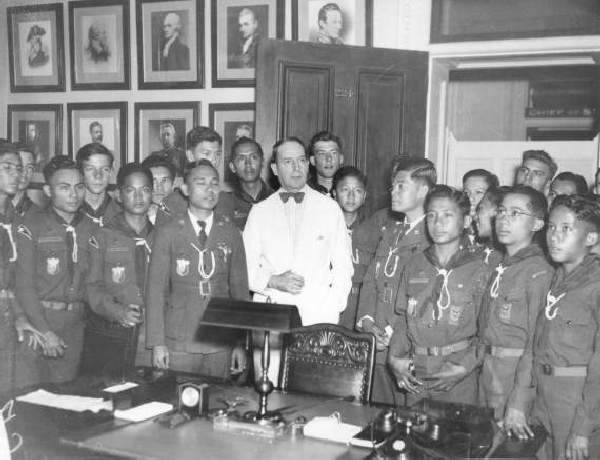
"I give to the people of the Philippines my solemn pledge that their freedom will be redeemed, and their independence established and protected. The entire resources in men and material of the United States stand behind that pledge.">
-- President Franklin D. Roosevelt, 1942
The Japanese invaded the Philippines days after the attack on Pearl Harbor. The Philippino people suffered greviously under Japanese occupation. This helped fuel an effective Resistance campaigns carried out by guerillas which had achieved control of substantial areas. The Japanese, however, controlled the population centers, especially on Leyte and Luzaon. The Navy preferred targetting Formosa (Taiwan), but MacArthur eventually prevailed with his insistence that America must retun to the Philippines. He considered his vow to return a pledge to the Philippinp people that had to be honored. Some how his vow, "I shall return." seems less approaptiate than "We shall return", but it was pure MacArthur and he convinced President Roosevelt. Reports from resistance fighters and American pilots revealed that the Japanese were not heavily defending large areas of the Islands. The inasion of Mindanao was considered unecessary and the decession was made to strike first further north at Leyte. It was in this engagement that the Kamakazis first appeared, although still in relatively small numbers. MacArthur President Sergio Osme�a waded ashore with the invasion force at Leyte Gulf (October 20, 1944). The American Army forces advanced steadily. The Japanese resisted, but could not match American fire power. The most serious Japanese resistence occurred at sea. The resulting naval engaement following on Battle of the Philippones Sea is commonly referred to as the Battle of Leyte Gulf. It was the largest sea battle ever fought and resulted in the destruction of the Japanese fleet as an effective fighting force. This opened the way for the land campaign. Further landings occurred at Ormoc (December 7, 1944).
The Philippines
The Philippines Islands are an archipelago south of Taiwan and north of Borneo. Gepgraphically it is the northeastern section of the Malayan Archipelago. There are about 7,000 different islands spread out over an emense ocean area. Only about half of the islands are permanently inhabited. Most are very small islands. The largest and most populated island is Luzon. Here the American presence was strongest. Other large islands were Leyte and Mindanao in the south. Mindanao was the least developed of the larger islands. The Philippines was largely Catholic. The Muslim or Moro presence was the strongest in the south, especially Mindanao. The Philippines in 1940 had a population of about 19 million (I have seen estimates as high as 30 million) people. Manila was the capital and largest port. Other important cities were Cebu, Davao, and Zamboanga.
Historical Background
The first European to reach the Philippines was Magellan (1521). The Philippines was conquered by Spain. The conquest began with Miguel L�pezde Legaspi (1564). The Islands were important primarily to support Spain's trade with China. As Spainish power declined in the 18th century, the importance of religious orders increased. The Philippines languished as a backwater of the Spasnish Empire. An independence movement appeared in the 19th century led by José Rizal. The Philippines was targeted by the Americans during the Spanish American War (1898). Admiral Dewey seized the Islands after the Battle of Manila Bay with an antiquated Spanish fleet and shore batteries. Spain formally ceeded the Philippines to the United States in the the Treaty of Paris (1898). Many Fiipinos expected the Americans to help set up an independent government. Filipino nationalists resisted American colonization resulting in a brutal guerilla warled by Emilio Aguinaldo. Future American president William Howard Taft was sent to the Philippines to serve as a colonial governor. After the Americans defeatted the Filipino Army, most Filipinos accepted American control. The Americans proved much more progressive than the Spanish and some economic progress was made. American began to consider independence for the Philippines. Small American military garrisons existed on the larger islands. The major military base was the naval base at Subic Bay, the principal American military base west of the Hawaiian Islands.
Rising Japanese Threat
Political developments in Japan during the 1920s and 30s brought into power in Japan a highly nationalistic government dominated by the military. Large sums were spent on the military creating powerful naval, army and airforces. Some technical support for military weapons, especilly aircraft, was obtained from Germany. Japan already had Asian colonies: Formosa (Taiean), Korea, and Chinese enclaves. The Japanese sized the Chinese province of Manchuria (1931) and then invaded China proper (1937). The Philippines located south of Taiwan was an obbvious potential target of the Japanese which was aggresively seeking to expand its colonial empire. This was especially true after President Roosevelt embargoed oil exports to Japan. The most obvious source of oil for the Japanese was the Dutch East Indies (DEI) and the Philippines was located between Japn and the DEI.
Commonwealth of the Philippines (1935)
Advocates of independence were active in both the Philippines and the United States. There had always been an opposition in America to have a colonial empire. America never had a large colonial empire like the European countries. And it decided that it did not want one. After the onset of the Deopression, agricultural interests added to this opposition to reduce the imports of agricultural production. Osme�a and Manuel Roxas, a rising star in the Nacionalista Party and Osme�a's successor as speaker of the House, were strong spokesmen for independence. They supported the the Hare-Hawes-Cutting Independence Bill. And Congress approved the bill over President Herbert Hoover's veto (January 1933). Quezon opposed the legislation because of provisions involving trade and excluding Filipino immigrants. He also objected guarantees for United States bases and powers granted a United States high commissioner which he felt compromised independence. As a result, the bill was defeated in the Philippine legislature. Quezon went to Washington and negotiated chasnges in the independence act. The result was the Tydings-McDuffie Act (March 1934). The Roosevelt Administration supported granting independences. The Commonwealth of the Philippines was established. Presidential elections were held (1935). The candidates included former president Emilio Aguinaldo who as a young man led the insurection against American rule (1898). Another candidate was the Iglesia Filipina Independiente leader Gregorio Aglipay. Manuel L. Quezon and Sergio Osme�a of the Nacionalista Party won the election. The Commonwealth Government was inaugurated (1935). Some 300,000 attended the ceremonies in Manila. The Commonwealth government launched many imitioatives, as they oprepared for economic and political independence. Initiatives included national defense (Generral MacArthue was hired to assist in the Defense effort) including conscription, expanded control over the economy, development of democratic institutions, education reforms, transport infrastructure, local capital promiotion, industrial development, and colonization of Mindanao. Full independencve wa schuledued for 1945. Nothing like this was happening anywhere else in the European colonies of Southeast Asia or Oceania. There was very little opposition to this in the United States. Granting commonwealth status was the first step toward independence. It would also prrove to be the first step in the decolonization process that would dismantlel the great European empires after World War II. The plan was for the Philippines to become independent after a 10-year transitional period. The date for independence was set for July 4, 1946.
Strategic Importance
The Philippine Islands were of imense strategic importance in the Pacific. Japanese expansion into Southeast Asia and the South Pacific was impossible without possession of the Philippines. The Japanese with their powerful navy eyed the resources of Southeast Asia. Of particular importance were the petroleum resources of the Dutch East Indies (modern Indonesia). Geography placed the Philippines squarely in the cross hairs of the Japanese. Japan was a resource-poor country that had to import raw materials for its growing industrial sector and subsantial war machine. The Philippines had some resources, but the it was the Southern Resource Zone (SRZ) further south, especially the oil of the Dutch East Indies that the Japanese wanted. But the Philippines stood stride the sea lanes between the SRZ and the Home Islands. With the Americans in the Philippines, the Japanese would have no way of transporting those resources back to Japan. Thus the principal two Axis countries developed very different strategies. Both wanted resources to support their war industries, but geography pointed them into opposities directions. The NAZIs wanted to keep America out of the War so it coud seize the resources of the Soviet Union. The Japanese on the other hand had to attack America ensconced in the Philippine Islands to get to the resources they needed. And the United States was the only country capable of effectively opposing Japan'sc expansion. The United Srates had army, navy and air bases bases in the Philippines which it was strengthening. It was also training a Fhiipono army.
Military Preparations
America in the 1930s began to prepare for Philippines Independence. Commonwealth status had been the first step. President Quezon had known MacArthur since they were both young men. MacArthur term as Chief of Staff ended (October 1935). When the Commonwealth of the Philippines achieved semi-independent status in 1935, President Quezon asked MacArthur to supervise the creation of a the new Philippine Army. MacArthur decided not to retire, but to remain on the active list as a major general. President Roosevelt allowed MacArthur to accept the Fillipino offer. The Roosevelt Administration was becoming increasingly concerned about Japan's military buildup and aggressive policies in China. The President began to worry about a possible Japanese invasion of the Philippines when America left. MacArthur thus went to the Philippines to assist in building its new army (October 1935). MacArthur retired from active duty (1937) when Quezon promoted him to Field Marshal of the Philippine Army. (MacArthur is the only American military officer ever to hold the rank of field marshal. General Marshal when the idea was raised, objected, not wanting to be call Marshal Marshall.) As relations with the Japanese deteriorated, especially the Japanese occupation of Indo-China, President Roosevelt recalled MacArthur to active duty as a major general (July 1941). He promoted him to a lieutenant general the next day. The President obtained Congressional appropriates to mobilize a substantial Pilippino Army in the U.S. Army as a major general and named him commander of United States Armed Forces in the Far East. The President also approved strengtening the Philippines air defenses with 100 of the new B-17 Flying Fortress bombers. MacArthur deployed his forces on the two largest islands (Luzon and Mindanao). He reported to Chief of Staff George C. Marshall that his force of 135,000 soldiers and 227 assorted fighters provided a formidable stronghold in the Pacific--the "key or base point" for America (October 1941). After Pearl Harbor, the President promoted him to four star general.
Pearl Harbor (December 1941)
It was the Japanese carrier attack on Pearl Harbor that brought America into the War. While Pearl Harbor was a stunning tactical victory, it was a strategic blunder by the Japanese of incaluable proportions. It was a stunningly successful military success, brilliantly executed by the Japanese. Eight battle ships, the heart of the American Pacific fleet were sunk. But the three carriers were not at Pearl. Despite the success of the attack, it was perhaps the greatest strtegic blunder in the history of warfare. The Japanese attack on the Pacific fleet at Pearl Harbor changed everything. A diverse and quareling nation, strongly pacifistic was instantly changed into a single united people with a burning desire to wage war. The issolationism that President Roosevelt had struggled against for over 7 years instantly disappeared. Even Lindburg asked for a commision to fight for the United States.
Japanese Invasion (December 1941)
A powerful Japanese carrier force attacked the U.S. Pacific Fleet at Pearl Harbor (December 7, 1941). The next day Japanese air strikes on the Philippines destroyed about half of the American planes on the Philippines. tHis rendered an effective defense of the Islands impossible. MacArthur has to be held accountable as new of the strike on Pear Harbor provided adequate time to prepare for the Japanese air attacks on Filippino air bases. The Japanese Army invaded nprthern Luzon and secured air bases. The major Japanese landings were conducted by the 14th Army at Lingayen Gulf (December 22, 1941) and raced for Manila. MacArthur with a smaller force around Manila was in danger of being cut off and decided to retire to Batan, a defensible peninsula, with the fortress of Corregidor at its pont. He was not able, however, to bring adequaute amunition and supplies. He was not aware of the extent of the destruction of Pearl or the overwealming Japanese superority in carriers. He thought that the American fleet coukd break through with supplies and reinforcements. The soldiers on Batan put up a valiant fight with meager resources. President Roosevely personally ordered MacArthur to leave Bataan and go to Australia to take command of Allied ground forces in the Pacific theater--forces which at the time were virtually non existent (February 22, 1942). General Jonathan Wainright with 11,000 American and Filippino soldiers held out hopeing for relief. The men on Batan were forced to surrender when amunitioin ran out (April 9). They were subjected to a brutal death march. Japanese officers used the slowly moving lines of prisoners as targets for their swords. After the fall of Corregedor (May 1942), the Japanese completed the occupation of the Islands.
Internment of American Civilians
America acuired the Philippines Islands from Spain in the Spanish American War (1898). It was America's primary experience with colonialism. After a bloody insurgency, the Philippines became a quiet American outpost in the Pacific. A small number of American military and civilians lived in the Philippines. The civilian included government administrators, militry dependents, business people, missionaries, and teachers. Many became very attached to the Philippinrs and Filipino people. It was very clear by 1940, especially after President Roosevelt embargoed oil exports to Japan that war with Japan was likely. It is unclear why so many American civilians stayed in the Philippines. The War Department ordered civilan dependents home. Why many stayed is unclear. Apparently some did not want to leave their husbands. There are other indications that Ameican officials in the Philippines sought to delasy or prevent dependants from returning to America. Their motivations are unclear, but some apparently believed that their presence strengthened the american commitment to the defense of the Philippines. Other civilian dependents apparently believed that America could defend the Islands, especially when President Roosevelt moved the Pacific Fleet forward to Pear Harbor. Civilians in the Philippines like many other Amerians underestimated the military potential of Japan, especially the Imperial Navy. Whatever the reasons, at the time of Pearl Harbor, there were about 6,000 Americans in the Islands. The Japanese seized four U.S. territories (Wake, Guam, two Aleutiansin islands (Attu and Kiska), and the Philippines during World War II. The Philippines at the time was a Commonwealth which the United States was preparing for independence. It had by far the largest number of American civilians interned by the Japanese. The Japanese after invading the Philippines quickly rounded up American civilians and interned them. The Japanese set up internment camps on Luzon and other islands. The largesrt and best known was Santo Tomas. Some of the military POWs were transported off the Islands for slave labor at other locations. The civilian internees were kept in the Philippines. The liberation of these camps after the American invasion beginning at Leyte (October 1944) is one of the most emotional acconts of the Philippines campaign.
Food
The Philippine Islands when acquired by the United States in the Spanish American War was a backwater of the decaying Spanish Empire and almost totally agricultural (1898). The United States oversaw a development effort. The United States built new public schools, transportation, reform system, boutiques, offices and civic buildings. There was a raid growth of the economy. Agriculture remained the heart of the economy, but tourism and industry developed. Major crops included rice, corn, hemp, tobacco, coconuts, and abaca (a species of banana). Many other crops were grown in garden plots for family consumption. Coconuts were important for oil production. Forestry was also important. The Philippines had one of the world's great strands of commercial timber. The economy grew despite difficulties with various agrarian uprisings. The robust coconut industry was a major factor in the growing economy and taxes helped fund infrastructure and other development projects. The Philipino benefitted from a developing economy. The American Commonwealth unlike many countries and colonies was not terribly affected by the Great Depression. The Japanese invasion and occuoation, however, did result in a serious recession. The Philippines before the War was laregely self sufficent in food, some foods were imported but were paid for by mostly agriculturl expots. Unlike sveral other areas of Southeast Asia/Ocenia, the Phillipines was not a major rice producer. Some rice was grown, but even before the War, rice had to be imported. And the Japanese were espcially interested in rice, it was their preferred food. The needs of the large Japanese military garison sharply increased the demand for rice. Thus the Japanese began shipping in rice was imported from other areas of the the expanded Japanese Empire (primarily southern Indo-China and Thailand). Japanese mismanagement of the economy disrupted agricultural production throughout the areas conquered, including the Philippines. Food shortages developed. People as the occupation continued has to rely increasinly on small garden polts to feed themselves. This was possible in the countryside, but not in the major cities like Manila.
Japanese Occupation (1942-45)
The Japanese internment of American civilians as well as Allied civilians in other areas is a poorly described subject. Even less well covered is the Japanese treatment of the local population in occupied countries. The Japanese announced they plan to grant independence and set up a puppet regime to work with. Japanese military occupation authorities began setting up a new government. The Japanese promised the Philippions independence. They organized a Council of State made up of selected Philipinos. The Japanese military then directed civil affairs through the Council. As the War increasingkly went against the Japanese, the declared the Philippines independent to gain more domesic support (October 1943). The Japanese-pupprt republic was headed by President Jos� P. Laurel. Much propaganda was made of this. In fact the Japanese retained total control of the Islands and no real political activity was permitted. Plans were layed to exploit Philippino resources to support the war effort. We do not yet have details on the Japanese economic exploitation. The Japanese requesitioned rice to feed the occupation forces and to ship back to Japan. Food shortages developed in Msanilaahd oher cities. Some people moved back to rural villages. Shipping food and other resources back to Japan became complicated by 1943 with the increasingly effective American submarine campaign and the growing resistance movement. The Japanese puppet regime generated little support among the Filipino people, in part because of the behavior of the occuption forces. The Filipino people suffered greviously under Japanese occupation. There were rapes and other attacks oin civiliasns. The Japanese Army press ganged large numbers of Filipinos into slave labor camps. Filipino women were forced to work in brothels operated by the Japanese military. Important members of the Philippines elite worked with the Jaapanese in occupation political institutions. This later became a political issue. Collaborators had various motives. Some though thsat collasboration helped shielded the Philipino people from Japanese opresion. Here President Quezon himself thought this might be necessary in the circumstances. Others were concerned with protecting family and personal interests. Others were influenced by Jsapsnese propsaganda promoting pan-Asian solidarity. Here it is easy for people not facing draconian Japanese repression to criticize collaborators. Of course there werecdifferent levels of collaboration. Those people who reported on theresistance is a very different matter. Others collaborated to obtain information to pass on to the resistance and the Americans.
Filipino Republic (1943-45)
Supreme Court Justice Jose P. Laurel who had been wonded in an attempted assasination became the president of the Japanese-sponsored Republic. The National Assembly voted for him (September 25, 1943). Benigno Aquino Sr. the father of Ninoy and the head of Kalibapi, was elected Speaker. The motivation of the men associated with the Japanese is unclear. Laurel seemed to believe that it was in the best interest of the Filipino people to cooperate with the occupying power. I am less sure about Aquino and Vargas. It should have been clear by 1943 that the war was no going well for the Japanese. They may have felt that had committed to the Japanese in 1942 and it was now too late to turn back. The Japanese flew the three most prominent Fhilipino leaders (Laurel, Aquino, and Jorge Vargas) to Tokyo. They were decorated by Emperor Hirohito. Premier Hideki Tojo briefed them on the plan for Philippine Independence within the Japanese Co-Propsperity Zone. Premier Tojo demanded that the Philippine Government declare war on the United States and Great Britain. Dr. Laurel with considerable courage refused to comply and explained to Tojo that few Filipinos would support this and that it would weaken his government. the Japanese-sponsored Republic was installed (October 14, 1943).
Fhilipino Resistance
The brutality of the Japanese occupation helped fuel an effective Resistance campaigns carried out by guerillas which had achieved control of substantial areas. The Japanese, however, controlled the population centers, especially on Leyte and Luzaon. The Philippines Resistance was somewhat complicated in that part of it was Communist groups hostile to the Americans. There were also a few Americans who did not surrender when Batan fell to the Japanese (April 1942). They disappeared into the dense jungle. They forged alliances with local tribes. One of the Americans developed a bond with a tribe of pygmy Negritos. [Welch] The Americans delivered some supplies to the Fhilipino guerillas by submarine as well as operatives to help coordinate the canpaign. Most Filipinos were steadfastly loyal to the United States. This was in part because even before the Japanese invasion, America was moving toward Filippino independence. More than any thing it was the stark Japanese brutality that drove the Filippino to resist the Japanese.
Battle of the Phillipes Sea (June 1944)
The Imperial Japanese Fleet after slugging it out with a battered American Pacific fleet in the South Pacific around Guadalcanal not only withdrew from the South Pacific, but the Central Pacific as well. The Japanese could not contunue to loose ships at the rate experuenced in the Souyh Pacific. They could not replace them, the Americans could not only replace, but wereadding ships at a stareling rate, The Japanese military put their faith on the heavily fortified Pacific outposts, believing that they could withstand Americn amphibious invasions. They wee wring. They bloodied the American Marines, but did not stop them. One island after another beginning at Tarawa fell to the Americans. Finally the Japanese decided to make a stand in the Marianas and commit the Imperial Fleet with brand new carriers. And the Japanese carriers would also have the support of land based aircraft on Saipan and Guam. The problem for the Japanse is that they were still using thge same aircraftvthat brought them victory in the first months of the year and they over the course of the War had lost most of the superbly trained airmen with which thy began the War. The new pilots were a very du=iffeent genrration, inadequtely trained and lacking any experience. The Battle of the Philippines Sea was the first naval battle of the Pacific War in wg=hich the Imperial Navy came into contact withbthe full force of the American indistrial juggernaught. The American Pacific fleet now had had the new Essex-class carriers and a new generation of advanced aicraft incluting the Gruman F6F Hellcat. In addition, the Americans now had well-trained and experienced aviators. The Japanese chose the Marianas to make their stand because the new B-29 bomber, another product of American industry, could reach the Home Islands from bases in the Marianas. The resulting battle was not just an American victory, but has gone down in naval history as the the Great Mrianas Turkey Shoot. The destruction of Japanese air power in the battle of the Philippines Sea opened the way for an American strike into the heart of the Japanese Empire and the liberation of the Philippines.
American Strategy
Admiral Chester Nimitz, US Pacific Commander and Admiral Ernest King, the Chief of Naval Operations, preferred targetting Formosa (Taiwan), but MacArthur eventually prevailed with his insistence that America must retun to the Philippines. He considered his vow to return a pledge to the Philippinp people that had to be honored. Some how his vow, "I shall return." sems less approaptiate than "We shall return", but it was pure MacArthur and he convinced President Roosevelt.
Mindanao
MacArthur had targeted the lightl;y populated and southern-most Philippine island of Mindanao as the first target. It was close to newly won bases along the New Guinea coast. Reports from resistance fighters and American pilots, however, revealed that the Japanese were not heavily defending large areas of Mindanao. It was thus decided to strike at the more important island of Leyte futher north. After the fighting on Leyte and Luzon, General Robert Eichelberger commanding the U.S. 8th Army landed on Mindanao (March 10). Scattered Japanese garisons offered only limited resistance. He began the liberation of the southern Philippines, including Panay, Cebu, Negros and Bohol.
Kamakazis
It was in the Philippines campaign that the Japanese Kamakazis first appeared, although still in relatively small numbers. The greatest use was at Ormoc (December 1945). The outclassed and out-gunned Japanese in desperation turned to the Kamakazis. Japanese soldiers had orders to fight to the death. On Saopan, Jpanese civilians, including women and children, were expected to join their soldiers in death. The Kamakazis were another step toward national suiside that the Japanese militarists who launched the War began preparing. Young pilots, often on their own initiative, began flying their planes into American ships, unable to stop them in any other way. The Japanese militaey eventually adopted this as an important military tactic, most priminately in the fdefense of Okinawa.
Battle of Leyte Gulf (October 1944)
The most serious Japanese resistence occurred at sea. The resulting naval engaement following on Battle of the Philippones Sea is commonly referred to as the Battle of Leyte Gulf. The Imperial Navy which had been mauled in the Philippines Sea months earlier felt compeled to resist the American invasion of the Pgilippines. The result was the largest and most complex sea battle ever fought. Admiral Soemu Toyoda, Commander in Chief of the Combined Fleet, deployed the still pperful Japanese Navy in three groups. Vice Admiral Takeo Kurita commanded the central force. Vice Admiral Jisaburo Ozawa commanded the northern force. The Japanese hoped that Ozawa's fleet of carriers but few planes would draw the poweful elements of the 3rd Fleet away from Leyte so the central and southern force could attack the American landing force at Leyte Gulf. The ruse worked. While Admiral Thomas Kinkaid's 7th Fleet destroyed the southern force, Admiral William Halsey with virtually his entire forece of 64 ships raced to engage Ozawa (October 24). Halsey took all his heavy elements with him and left the San Bernardino Strait unprotected. Kurita who had initially been turned back with heavy losses, raced through the Straits and south toward the invasion beaches where a 175,000 man invasion force and cargo ships were vulnerable. Aight force of destroyers and escort carriers (Taffy 1, 2, 1nd 3) engaged the Japanese battleships and heavy cruisers at great loss and somehow turned Kurita back in one of the most daring engagements in naval history. The outcome of the battle was the virtual destruction of the Japanese fleet as an effective fighting force. The Imperial Navy not only failed in its efforts to halt the American invasion, but was forced to withdraw from Philippine waters (October 25). This meant that the Japanese Army in the Philippines could no longer be supplied. Without the Imperial Navy, the Japanese position in the Philippines was untenable. In addition, the Japanese lost 40 ships sunk (including four carriers, three battleships, and ten cruisers) and 46 damaged as well as 405 planes destroyed.
Liberation (1944-45)
The American Liberation of the Philippine Islands began in Leyte, setting off the largest battle in the history of naval warfare. The Philippino people suffered greviously under Japanese occupation. This helped fuel an effective Resistance campaigns carried out by guerillas which had achieved control of substantial areas. The Japanese, however, controlled the population centers, especially on Leyte and Luzaon. The Navy preferred targetting Formosa (Taiwan), but MacArthur eventually prevailed with his insistence that America must retun to the Philippines. He considered his vow to return a pledge to the Philippinp people that had to be honored. Some how his vow, "I shall return" seems less approaptiate than "We shall return", but it was pure MacArthur and he convinced President Roosevelt. Reports from resistance fighters and American pilots revealed that the Japanese were not heavily defending large areas of the Islands. The inasion of Mindanao was considered unecessary and the decession was made to strike first further north at Leyte. It was in this engagement that the Kamakazis first appeared, although still in relatively small numbers. MacArthur President Sergio Osme�a waded ashore with the invasion force at Leyte Gulf (October 20, 1944). The American Army forces advanced steadily. The Japanese resisted, but could not match American fire power. The most serious Japanese resistence occurred at sea. The resulting naval engaement following on Battle of the Philippones Sea is commonly referred to as the Battle of Leyte Gulf. It was the largest sea battle ever fought and resulted in the destruction of the Japanese fleet as an effective fighting force. This opened the way for the land campaign. Further landings occurred at Ormoc (December 7, 1944). Then the fighting moved to Luzon. The Americans finally reach the main island of Luzon with landings at Lingayen Gulf (January 9, 1945). The initial American landings were unopposed. Japanese Imperial Army General Tomoyuki Yamashita had been tasked with the defense of the Philippines.
Japanese Attrocities
The Japanese committed terrible war crimes in the Philippines from the very onset of the War, most notably the Baatan Death March (March 1942). The treatment of Ameriacn POWs and Filipino soldiers as well as American civilian internees has been widely reported. The American internees were the largest number of American civilains held by any Axis power. There were reports of unbelievavle crulity and near the end of the War, the Japamese killed a group of Amerivamn POWs on Palawan by burning them to death. The primary problem was food. As the War went against the Japanese, food became a major problem both on the Home Islands and Japanese field armies. Japanese Army regulations mandated that the Imperial soldies had the first priority for available food stocks, then the local population, and finally the POWs and civilain internees. If the Japanese had managed the situation reasonably, there should have been sufficent food throughout Southeast Asia. Unfortunately they did not manage the food situation reasonably and terrible famines occurred in the Dutch East Indies (Indonesia), Vietnam, and other areas. These were food exporting areas before the War. The situation was not as bad in the Philippines, but by 1944 the POWs and internees were beginning to starve. And unlike the Germans, the Japanese did not allow Red Cross parcels through to the POWs and internees. Filipino civilians had better access to food, but were targets of the most savage attrocities imaginable. The situation escalated when President Roosevelt acceeded to General MacArthur's demand that after the Marianas, the next target would be the Philippines and not Formosa (Taiwan) (July 1944). Formosa actually made more strategic sense. The decession saved the lives of many POWs and internees hovering near death by starvation, but it put the Filipino people in a war zone and the Japanese turned very vindicative knowing that most Filipinos were strongly pro-American. The Filipinps no doubt were delighted when the Americans began landing on Leyte (October 1944), but few Filipinos or Americans for that matter understood the barbarity that the Japanese would unleash on the Filipino people. Japanese propaganda had little impact on the Filipinos. Unlike Dutch, the Amerivans were in the process of granting independence when the Jpanese invaded. And Japanese behavior during the occupation only futher alienated the Filippino people. This was especially the case of the people of Manila where the Imperial Marines and others in the Manila garison refused to surender and decided to take every civilian in their grasp with them, often after raping the women.
War Damage
Outside of China, the two countries most desimated by World war II in Asia were Burma and Philippes. This is because it was in these two countries that well-equipped Allied armies fought the Japanese in extended campiagns. There was relatively little damage as a result of the Japanese City. General MacArthur declared Manila an open city and most of the fighting was confined to the isolated Batan Peninsula. The lberation was a ver\y different matter. Much of the Pacific war was fought on lightly populated and in some case unpopulated islands. This was not the case in the Philippines. Large areas of the Philippines were devestated by the fighting. The Japanese on Luzon where their forces were concentrated retreated into the mountains of northern Luzon and held out there until Japan surendered formally (September 1945). Fortunately this was not a heavily populated area. The greatest devestation ocurred in Manila where Japanese Marine staged a fight to the death. [Aluit] In the process they murdered as many Philipino civilizns as possible. The Philippines by this time had sustained enornos physical damage. Manila in particular was virtually destroyed. There were other Japanese masacres of civilians. There is no exact acconting, but historians that 1 million Filipinos were killed. Most were killed by the Japanese in the final year of the War. The Americam liberation employed massive concentrations of naval and air firepower as well as army artillery. The damage in Msanila was particularly crippling because the city was such a major component of Philipiines social and economic life. It was the country's largest and most developed city. One assessment estimsates that the city was 80 percent destroyed. This included factories schools, hospitals, power plants, and communication facilities. It mean that the capital from which the Philippines recovery would be overseen was virtually wiped off the face of the earth.
General Yamashita
Yamashita was tried for war crimes in 1946. The trial was held before the larger Japanese War Crimes trials and were under MacArthur's control. Yamashita was blamed for Iwabuchi's attrocities in Manila. He was found guilty and hanged.
Aftermath and Recovery
The damage to the Filipino wcony ans infrastructure was extreme. Manila was the second most damaged allied city of the War. The most damaged being Warsaw. One press reports desctibes the situation in Manila. "Manila lay waste, stinking with the thousands of dead of massacre as well as battle. It had lost its piers, docks, and bridges, its electric light and power and gas plants, its telephone exchanges, radio stations, and newspaper plants, its factories and warehouses and office-buildings, its schools and universities, libraries, museums, churches, and theaters, its hotels and apartment houses, nine-tenths of its private homes, even its parks and avenues and streets. A great city, of a million inhabitants, a metropolis, three hundred years in building, was gone." There was extensive damage outside of Manila as well. And it was not just infrastruure and human nolosses. Jaoanese economic mismanahement and plunderiung caused huge damage to the economy. Manila was liberated after a brutal month-long battle (February 1945). After Manila, the major Japanese force withdrew to themontaind in northern Luzon. The Japanese surendered (September 1945). Recovery was slow. Everything was in short supply. The only source of assiastance was the United States. America had pledged to pay for the war damages. As promosed before the War, the United statesgranted independence (July 4, 1946). Although independent, the country was more dependent on Amneruca than ever before. One issue that all Axis occupied countries faced was how to deal with collaborators. President Manuel Roxas (1946-48) believed that "errors of the mind rather than the heart must be forgotten and forgiven." President Elpidio Quirino (1948-53) decided to grant clemency to collaborators and enemy soldiers despite the massacre of his family in 1945. Manila was the initial priority. The United States assiusted with clearing of debris in Manila. The United States provided surplus military equipment and a range of equipment namd matrials in that effort. .It is at this time that Manila shifted over to right-hand drive to faciltate the movement of Amerucan mikitary vehicles both during libetration and the recovery effort. The United Nations (at the time meaning the United States) provided some $11 million worth of food, clothing, medicine, and farm implements in addition to emrgeny aid privided by the U.S, military during the War. This relief effort ebnded when the Philippines became independent (1946). Essebtially the Philippines had to rebuild from scratch, especially Manila. This made the recovery difficult. One observer reports that 5 years after the War, Manilka was "in the same condition in which it had been left after the Japs and the GIs were through with it."
Independence (July 4, 1946)
The Philippines were to be a staging area for Operation Olympus, the planned invasion of the Japanese Home Islands. The Japanese had retreated to the mountains of northcentral Luzon and were isolated there. Finally after the atomic boms were dropped, the Japanese surrenderd (August 1945). They had lost nearly 0.5 million men trying to hold the Philippines in the Japanese Empire. With the end of the War, The United States could then begin to transfer soverignity to an independemt Filipino Republic which had been scheduled earlier. When the Japanese invaded, the Philippines had a democratically elected Government preparing to accept the responsibilities of independence. The president was Manuel L. Quezon. Independence had to be postponed because of the Japanese invasion (December 1941). After the War ended, the United States granted substantial sums to the new Filipino Government. The United States kept its committment made before the War. The reconstituted Philippine Congress met for the first time since its 1941 election (June 9, 1945). Any new Government faces problems. The task faced by the new Government was unprecented, because of the explotive nature of the Japanese occuipation and the savege treatment of the Filipino people. The country was devastated by the War. Manilaooked like Hiroshima. The country's economy was in ruins. There was also political division and guerrilla warfare. Not all the anti-Japanese forces were committed to restoring democracy. There was also a Communist guierilla movement, President Quezon had died durig the War (1944). Vice President Sergio Osme�a replaced him. Osme�a was a founder of Nacionalista Party. In the first election after the War, Osme�a�s leadership was immediately challenged (January 946). What emerged as the Liberal Party) broke away from the Nationalist Party and nominated Manuel Roxas who proceeded to win the election (April 1946). The Philippines became an independent country (July 4, 1946).
Personal Experiences
We are especially interested in collecting personal experiences describing the observations abd experiences of children during the War. These written accounts add to the photographic record that we havec been archiving. We have found accounts from both American and Filipino children. The children of course did not fully understand the events swirling around them and impacting their lives. They did, however, understand cruelty and barbarous behavior even though they did not understand what prompted it. Their observations are an important aspect of the War, commonly overlooked in the accounts of the dranatic events of the War.
Sources
Welch, Bob. Resolve: From the Jungles of WWII Bataan, the Epic Story of a Soldier, Flag, and a Promise Kept (2012), 448p.
CIH
Navigate the CIH World War II Pages:
[Return to Main World War II Pacific campaign page]
[Return to Main World War II country page]
[Return to Main Philippines history page]
[Biographies] [Campaigns] [Children] [Countries] [Deciding factors] [Diplomacy] [Geo-political crisis] [Economics] [Home front] [Intelligence]
[POWs] [Resistance] [Race] [Refugees] [Technology]
[Bibliographies] [Contributions] [FAQs] [Images] [Links] [Registration] [Tools]
[Return to Main World War II page]
[Return to Main war essay page]
Created: June 4, 2004
Last updated: 2:58 AM 3/31/2024