***
war and social upheaval: World War II Pacific Theater kamikazes
World War II: Pacific Theater--Kamikazes (1944-45)
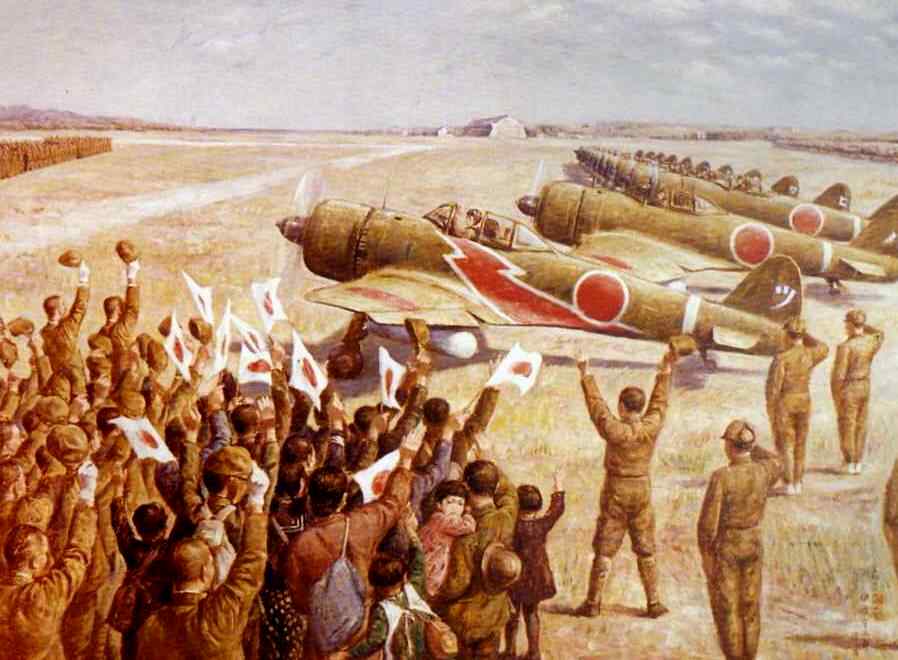
Figure 1.--The Japanese Kamikazes effort are perhaps the least understood aspect of World War II. The young pilots were not frenzied maniacs. Many but not all were volunteers. They were for the most part educated young men (or else they would not have been chosen for a pilot program) who grimly saw no option to defending their country against an ememy with superior resources in every area of warfare. Virtually all were young men in an ealy stage of pilot training and not yet well trained pilots. The idea behind the Kamikazes was to use young men with little training in an inexpensive plane to destoy an expensive warship and its large crew. They were virtually the only effective weapon left to Japan. And not often reported, the Japanese were building up in the Home Islands a massive secret air force of Kamikzes to hurl at any American invasion fleet when it utimtely appeared. The first Kamikazes flew from bases in the Philippines. This is a depiction by Japanese artist Usaburo Ihara.
Kamikaze means Divine Wind. It refers to the Mongol invasion of 1281. The Mongol Emperor of China was Kublan Kahn introduced to the West by Marco Polo. China at the time wa the most poweful country in the world Mongul armies had conquered China and then swept all opponents and pushed into the Middle East and Eastern Europe. When the Japanese Shogun refused to pay homage to the Mongol Emperor, Kubla Khan launced a massice invassion in 1281. The invasion fleet was made up of 4,200 ships and 142,000 men--larger than the D-Day invasion at Normandy. It was, however, destroyed by a typhoon which the Japanese came to call the divine wind. This became the foundation of a holy myth, buttressed in the next century by a Samari General Kusunoke who launched the hopeless battle of Minatagowi at the order of the Japanese Emperor. As a result, his obedience and sacrifice came to be lionized in Japan and a holy natianal myth was built around him. His life was seen as the basis for the Kamikaze campaign. And inded the letters, diaries, and poems of the Kamikaze pilots wre filled with references to him. Interestingly, the Kamikaze was not conceived by the Japanese General Staff. Rather it was a tactic demanded by junior officers who saw that they could not match the rising power of American air and naval power. Only reluctantly did the Generl Staff adopt the tactic. Junior naval officers wrote to the General Staff in their own bold demanding that Kamikaze units and operations be employed. Admiral Onishi, a naval aviator, was the driving force behind the Kamikaze pilot attacks. Kamikaze attacks had resulted from individual acts of Japanese pilots. After the loss of the Philippines, however, it was adopt as a major defense policy. It was central to the Japanese effort to defend Okinawa and to fend off the impending American invasion.
Historical Background
Kamikaze means Divine Wind. It refers to the Mongol invasion of 1281. The Mongol Emperor of China was Kublan Kahn introduced to the West by Marco Polo. China at the time wa the most poweful country in the world Mongul armies had conquered China and then swept all opponents and pushed into the Middle East and Eastern Europe. When the Japanese Shoigun refused to pay homage to the Mongol Emperor, Kubla Khan launced a massice invassion in 1281. The invasion fleet was made up of 4,200 ships and 142,000 men--larger than the D-Day invasion at Normandy. It was, however, destroyed by a typhoon which the Japanese came to call the divine wind. This became the foundation of a holy myth, buttressed in the next century by a Samari General Kusunoke who launched the hopeless battle of Minatagowi at the order of theJapanese Emperor. As a result, his obedience and sacrifice came to be lionized in Japan and a holy natianal myth was built around him. His life was seen as the basis for the Kamikaze campaign. And inded the letters, diaries, and poems of the Kamikaze pilots were filled with references to him.
The Marines had proven in one bloody assault after another that Japanese soldiers could not hold its Pacific Island bastions no matter how well fortified. The Battle of the Phillipine Sea showed that the Imperial Navy was also encapable of stopuing the remorless surge of American power. The fall of the Marianas was thus a tipping point in the War. The logical response for Japan would have been to seak peace. But this would have required the Japanese miklitarists who made war to have admitted that they had blundered, dragging their country into an unwinable war. It would have also mean surrender, a concept alien to the spirit of Bushido. So instead the Japanese began to work on new tactics and the major thread of the new tactics was suiside. Jaanese planners began to talk about "guerilla warfare" as well as "new ideas" and new weaopons". Suiside as a tactic had been generally rejected by militar plnners, but the increasingly desperate situation changed this.
Origins in World War II
The Japanese Kamikaze cmpaign was not conceived by the Japanese General Staff. Rather it was a tactic demanded by junior officers who by 1944 saw that they could not match the rising power of American air and naval power. Only reluctantly did the Generl Staff adopt the tactic. Junior naval officers wrote to the General Staff in their own blood demanding that Kamikaze units and operations be employed. Admiral Onishi, a naval aviator, was the driving force behind the Kamikaze pilot attacks. Kamikaze attacks had occured almost from the beginning of the War, but ere the individual acts of Japanese pilots, not an organized campaign.
Japanese Military Aviation
The Mitubishi Zero when the War began in 1941 was the finest fighter in the Pacific and Japanes aviators the best trained. Althoughtly lightly armored, the Japanese planes were fast and manuverable. As the War developed in 1942, improved American ighter began reaching the Pacific. As a result of the new American planes like the Corsair, Hell Cat, and P38 Lightings, the ballance in the air began to change. The Japanese used the navy zero and the Army Oskar throughout the war with only minor technical improvements. Not only did the technical balance shift, but the American planes were delivered in numbers that the Japanese could not hope to match. The Japanes also experienced a devestating attrituon of their trained polots. Losses at the Coral sea (April 1942), Midway (June 1942), Guadacanal (August 1942-Fenruary 1943), and the Phiippine Sea (???, 1943) substantually reduced the kadre of experienced pilots. Worse for the Japanese, they had no training program capable of rapidly replacing the lost pilots. As a result, by 1943 the Japanese which once dominated the Pacifiv has poorly trained pilots flying inferiir planes to confront the torrant of merican carriers moving aganst them.
American Proximity Fuses (1943)
One of the most difficult tasks in warfare was ti shoot down a fast moving aircraft with a gun, even anti-airctaft guns. The result was that that ships early in the War were savaged by modern aircraft. Even the modern Bismarck was undone by an obsolete biplane. The American defenses at Pearl took out onlyva habdful of Japanese plane. And two British battleships bristling with gun were sunk attempting to defend Singapore. American carriers were also ravaged by Japanese planes in the first year of the War. And Japanese AA guns were not very effectivecahainst American air attacks. And even after being desestated by American air attacks, a handful of Japanese flyers managed to put Yorktown out of action at Midway. The instalation of rapid fire Bofors guns improved the situation and bef=gan reaching the fleet for the Solomon's Campaign (1942). It was, however, only when proximity fuses reached the fleet that the anti-aircraft fire became truely effective (1943). The proximity fuse developed in secret played a major role in the Anerican victory in the Battle of the Philippines Sea (1944). The improved American aircraft and the AA shells armed with proximity fuses made it virtually susisidal for Japanese air units to attack American naval forces even if not on a Kamakaze suiside mission. A further problem was the inability to adequately train pilots because of the growing fuel sjortage resulting from the increasingly effective American submarine campaign. Thus by late 1943 few American ships were sunk by Japanese air attacks. Forvthecret of the War itcwas only Kamakaze suiside missions that succeeded in sinking American shipping.
Admiral Takashiro Ohnishi
Japanese Vice Admiral Takashiro Ohnishi concluded that the most effective way to sink American ships was to crash planes into them. Ge firmly believed that Japan should persue the war regardless of the costs. Onishi was a carrier aviation expert abd was involved in the carrier battles during the first 2 years of the War. He watched the decline in Japanese naval aviation. Ohnishi was a a flamboyant and independent officer. He was also totaly imbued wirh samari bushido code. When his plan to form Kamikaze units was rejected by the High Command, he flew to Tokyo to see the Emperor, but was stopped at the palace gates. Ohnishi appealed to the young officers who had already begun sporadic Kamakazi attacks. The idea would use young, poorly trained pilotsattacked en nasse, iberately crashed their planes into American and other Allied vessels. Some of the first attacks, however involved trained pilots.
Aircraft
The Kamikaze planes were mostly single-engiune aircraft, primarily fighters. This limited the size of the bombs which could be caWorld War II rried. They were loaded with 250kg combs. We see some referenmces to 500 lb bombs. Japanese World War II military ordinance was mostly metric. The whole history of Japnese weights and meadures is complicated, including traditional, English, and metric systerms.) The 250 kg bombs were actually slightly karger than 500 lb--about 550 pounds. The small plznes mistly used could not carry larger bombs. Japanese aircraft had less powerful engines thsn Americn aircraft. The legendary performance of the Zero, for example, was achieved by making a very light-weight plane without armor.
The major Japanese Soldier code was unyielding allegiance to Emperor and country. There was no shortage of voluteers to fly Kamkazee missions, althought not all the pilots were truly volunteers. There were three the number of volunteers as there were available planes. The Kamikazes were not experienced pilots. Experienced pilots were in very short supply. Japan began the War having gone for quality over quantity. They had a small cadre of very well trained and experienced pilots. A major concern of Admiral Yamanoto, Admiral Nagumo, and other naval commanders was preserving their corps of pilots and not expending them before the Pacific fleet was destroyed. Having failed that, after the Battle of the Philippones Sea, the Japanese wre forced to go for quantity over quality. They had neither the time or the aviation fuel to properly train pilots. The Kamakazze pilots were generally recruited from young, often idealistic students. Most were older teenagers drafted before completing their studies. Many would have pursued university educations. Many had at least some training in science and technology making them more suitanle for pilot training. Most of the Kanikaze pilots were students. Some believed that because of their sacrifice for the Emperor God, that the the Kamikaze campaign would save Japan from defeat. There were, hiwever, a wide range of feelings. Some of the pilots saw the War as lost, but felt duty compeled to then to sacrifice themselves. Others were youths anxious to be treated as adult men. They wre not as often deficted mindless fanatics. Their country through no fault of their own was enperiled and they saw resising the Americans as their duty, to both protect their country and their people.
The Philippines (October-December 1944)
It was in the Philippines campaign that the Kamakazes first appeared, although still in relatively small numbers. General Kimpai Teraoki commanded Japanese air forces in the Philippines. He rejcted Onishi's plan and refused permission to form Kamaikaze units to oppose the American invasion. He was apauled of the idea of using youth so recklessly. When the Imperal Fleet and conventional air attacks failed to halt the American landings on the Philippines, younger Japanese air commanders demanded more unconventional tactics including Kamakaze suiside attacks. HMAS Australia, the flag ship of the Royal Australian Navy, was the first Allied warship to be struck by a kamikaze pilot (October 21). A Kamikaze hit Australia again and the ship was forced to retire to the New Hebrides for repairs (October 25). On the same day a squafin of five Zeros from the 26th Air Flotila staged an unauthorize Kamikaze attack on the U.S. escort carrier St. Lo. One of the Zeros penetrated the fighter cover and hit the carrier. Fires spread to the ship's bomb magazine which exploded and sank the ship. The results elecrtified the Japanese Navy. Japanese Kamakaze pilots also hit everal other Allied ships, casuing extensive damage. Kamikaze pilots in the Philippines sank 16 American ships. After the defeat of the Imperal Fleet in the Battle of Leyte Gulf and the advance of American forces on Leyte, the Japanese intensified the Kamakaze attacks, but were limited by the dwinling Japanese air craft strength. The kamikazes appeared in substantial numbers at Ormoc (December 1944). After that, the American infantry overran the air bases on on Leyte and Luzon from which Kamikaze attacks could be launched in the Philippines. The Japanese had prepared fortified positions supported with heavy artillery. Ormoc fell (December 10). The initial Japanese successes in the Philippines resulted in an immediate expansion of the program. The increasingly desperate High Command changes its opinion. Teraoki was dismissed and replaced by Onishi.
Kamikaze Air Units
Onishi begins forming his Kamikazi units from volunteers. The trining is rigorous. The Cadets are subjected to a strict routein. Thre is no free time. The morning begins with the singingof the national anthem followed by the imperial oath. The oath included the phrase, "duty is weigter than a mountain, death is lighter than a feather". Then there was a ptriotic lecture about national heroes like Kuzanoki Masahige and the Battle of Minigawa. Before flying on their missions, the Kamikazi pilots would cut off a lock of hair for their family or loved onesto remember them. They would also clip their finger nles which could be used to produce ashes for Shinto ceremonies. They had hand bands on which they had written brave phrases. Some carried flags signed by friends. Some mothers had sent 1,000 stich belts. (They would have friends add a stitch and even seek strangers on the street toreach the 1,000 stitch total. Manu put on new uniforms to symbolize purity.
Naval Kamikazes
While the air Kamikazes were the best known. There were also naval Kamikazes. The idea was at first resisted by the High Command until junior officers began submitting demands for such attacks written in their own blood. Emperor Hirohito's naval aide, Cpt. Eiichiro Jo began advocating "special" (meaning suisidal) attacks. Naval planners began working on the Kaiten or "Heaven Shaker"--a suiside torpedo. [Thomas, p. 138.] The Japanese modified their Type 93 Long Lance torpedo so that it could be guided by a man.
The weapon had little success, however, as a specially equipped submarine had to bring it in range and by 1944 the U.S. Navy had very effective anti-sunmarine warfare capabilities. There was lso the Shinyo ("Ocean Shaker"), a suiside speedboat, and Fukuryus ("Crawling Dragons"), suiside frogmen. These were preared to fend off the American invasion. The ultimate naval Kamikaze proved to be an Imperial Navy squadron with the battleship Yamato.
The Japanese staged Kamikaze attacks during the Philippines campaign. They were, however, fairly limited, because the Japanese military had not yet embraced the Kamikaze as a major tactic. And the limited air deployment on Iwo Jima did not make Kamikaze effort possible. Okinawa was very different. The American submarine campaign in 1944 was making it very difficult for Japan to obtain food and raw materials, especially oil. After the loss of the Philippines, Japan was essentially cut off from oil and other vital supplies from the empire they had seized to the south. It was apparent to all but the most fanatical that Japan was losing the War. With the fleet destroyed and unanble to match the Americans in quantity or quality of planes, the Japanes were desperate for any weapon to resist the massive American invasion fleet descending on Okinawa. And they knew Okinawa in American hands would provide air based that would be used to cover the invasion of southern Japan. Their answer was the Kamikazes. After the loss of the Philippines, however, it was adopt as a major defense policy. It was central to the Japanese plan to defend Okinawa. The Kamikaze missions suceeded in sinking 40 American ships and damaging many more. The cost to the Japanese were hundreds of lives and planes. The Japanese on April 6-7 employed the first massed formations of hundreds of kamikaze aircraft (April 6-7). Kamikaze attacks were launched from both Okinawa and southern Japan. The Japanese during the Okinawan campaign flew 1,465 Kamikaze flights from Kyushu. The Japanese were after the carriers and other large ships. The United States by 1945 had made great strides with radar, but the range was still limited abnd it was important to detect the Kamikazes as early as possible. Thus the fleet was ringed with radar picket ships to provide early warming. The Japanese of course knew this and begun targetting the picket ships. And unlike the larger ships, the picket ships were on their own with a limited array of anti-aircraft guns and no air cover. The Kamikazes were capable of doing grevious damage, but not sinking a major ship. The small picket ships were a different matter. The carriers would dispatch planes, but the picket ships were on their own until the planes arrived. The picket ships faced some the most ferrocious air attacks faced by the U.S. Navy during the Pacific war. The Navy deployed 206 ships for picket duty. Nearly 30 percent were sunk or damaged, making it the most dangerous combat assignment of any U.S. Navy surface ships. [Reilly] Combat loss estimates vary. One American report estimates rhar the Kamikazes sunk 30 American ships and damaged 164 others. Another U.S. source estimates that the Kamikazes sunk 34 Navy ships and damaged 368 others. Japanese sources give much higher estimates, but are not reliable. Other ships were attacked nearer Kyushu and Formosa. The Army Air Corps had rejected a request to havily bomb these air fields because it was seen as a diversion from the strategic bombing campaign.
The first Kamakazis were flown from isolated Pillipines bases. The last Kamakazes flew from bases in Japan meaning Kyhshu, the southern-most of the Hime Idlands The U.S. fleet off Okinawa was in range of Kamikazes flown from bases in Kyhshu Japan. The Kamikazes were most effective when the fleet came close to shore meaning there was less time to intercept them. But as the Okinawa cmpign progressed, the Americans took or estroyed the various air bases meaning that massed assaults from Okinawa could no longer be launched and the Kamikazes were only effective if launched in mass to ovewhealm the fleet's fighter screen protecting the fleet. Some Kamikaze attacks were launched from Kyhshu against the Okinmawa invasion fleet. From these bases the Kamikaze pilots were given a stirring send off. The Government recrited virgin school girls who waved and threw cherry blosooms and other pink flowers as the pilots took off (Spring 1945). [Thomas, p. 2.] This of course signaled wher the Americans would land in any invsasion. Throughout World War II, the Americans only landed where they had air superority. (Guadalcanal was a rare exception.) And this maeant there wa sno doubt where the first blow would fall--it would be Kyhshu. So as the Americans built up forces for the Kyhshu invasion--Operation Olympic, the Japanese built up forces on Kyhshu. Among the men and material were a huge flotilla of planes. They were to be launched against the American Kyhdhu invasion fleet as was the case in Okinawa. (An even larger Kamikaze fleet was being assembled on Honshu meaning around Tokyo.) Many of the planes were hidden in caves or other sites so they were protected from American bombing and fighter sweeps. American intelligence expected Kamikaze attacks, but wsas not was not aware of the magnitude of the secret air force the Japanese were massing and the air defense that awaited them. Given the success of the Kamikazes in the Okinawa campaign, the carnage would have been massive. The large number of individuals who criticize the Ametrican bombing and maintain that Japan was a defeated natiion, simply ignore the substantial forces that Japan had assembled to oppose the American invasion. President Truman was correct with his assessment that American troops faced a series of Okinawas in the Home Islands.
The Kamikaze attcks were mostly flown from the Philippines and Okinawa. There were few Japanese civilians in the Philippines to give the pilots an emotional send off. We are not sure about Okinawa. We do not yet have information. We suspect it was not possible because of intense American air attacks on the airfields. As Kamikazee/Tokko. flights began from Japan it was different (April 1945). Kamikaze missions were prepared from airfields in Kyushu in the last months of the War. The first Kamikaze missions were to attack American naval operations off Okinawa. Men and planes were positioned in Kyhshu to attack the American invasion of the Home Islands itself. Schoolgirls were assigned to the bases with orders to care for the polots and to give them an ethusiastic sendoff--waved handkerchiefs and branches of pink cherry blossoms. We are not sure what they were told about the mission, but they seem to have unbderstood that the young men were not coming back. This transpired at air bases in southern Kyushu. One of these bases was Chiran. One of the girls at Chiran, Chino Kuwashir, recalls, "Remembering that still makes me tremble. We waved and waved until we couldn't see them anymore. Why did we have to endure such sorrow?" The girls were called Nadeshiko after a beautiful, butbfragile pink flower. Nadeshiko is also a term for the perfect Japanese woman. The girls were assigned to care for the pilots. They did the cleaning, laundry, sewing, errands, amnd other favors and finally said goodbye. The young pilots were stoic, but the gitls found that when they went to pick up the pillow cases to wash, they found they were drenched in tears. The girls became very attched to the pilots. There were some 100 girls at the base for about a month while the Okinawa campaign was fought (spring 1945). There were 439 Kamikazes launched from Chiran, many like the gurls, still teenagers. Reiko Akabane, another Nadeshiko, reported in a the video that she went up to one of the pilots before his departure, to return change from the money he had given her to mail a final letter to his parents. Instead of taking the coins, pilot Shinji Sakaguchi took out his wallet and handed it to her as a keepsake. [Kageyama and Toda]
Ohkas
The Ohka "Cherry Blossom" was a piolted rocket powered bomb. It was deadly if it could strike a big ship, but it was very hard to pilot and had to be carried into position by slow-moving bombers that were relatively easy to shoot down. The Americans naed it the Baka ("Stupid"). One Ohka struck one Navy DE, but the hull was so thin that the Ohka went right through the ship and exploded beyond it.
Assessment
The Japanese kamikaze attacks are generally seen as crazed attacks by fanatical,mindless Japnese pilots anxious to die for their Emperor. This is a misunderstanding. The young Japanese pilot may have been fanatical, but they were neither minfless of anxious to die. The volunteered out of a decdication to their county and a desire to defend it. The Japanese by 1945 had no effective weapons to use agains the American fleet. There only hope was to exact such casulties that America would tire of the War. In this regard they were effective. The Pacific fleet did sustain serious losses at a relatively light cost on the part of the Japanese. The pilots involved were not anxious to die, but thought theu were making a contribution to the defense of their country. Peer pressure among these young men was a very powerful force. [Spector]
Sources
Yuri, Kageyama and and Miki Toda. "Japanese girl's WWII job: Waving goodbye to kamikaze pilots," Seattle Times AP story (July 31, 2015).
Rielly, Robin L. Kamikazes, Corsairs, and Picket Ships: Okinawa, 1945, 460p.
Spector, Ronald H. At War at Sea: Sailors and Naval Combat in the Twentieth Century (Viking, 2001), 463p.
Thomas, Evan. Sea of Thunder: Four Commanders and the Last Great Naval Campaign, 1941-1945 (Simon & Schuster: New York, 2006), 414p.