|
"What sort of people they think we are? Is it possible they do not realize that we shall never cease to persevere against them, until they have been taught a lesson which they and the world will never forget? -- Winston Churchill. Address to Congress, December 26, 1941
The Japanese military during the 1930s gained almost complete control over the government. The depression of the 1930s hit Japan hard. The militarists decided that the solution to the economic crisis was to carve out an empire. This meant war. Japan withdrew from the League of Nations as a resulted of the criticism of her military operations in Manchuria (1933). Japan invaded China proper, launching the Second Sino-Japanese War (July 1937). The well equipped Japanese forces rapidly occupied almost the entire Chinese coast and then moved up rivers and railroad lines into the interior. The Japanese in the process committed war atrocities on an unprecedented level against the Chinese civilian population. Despite the Japanese onslaught, the Chinese government never surrendered. America funneled supplies to the Chinese through Burma. A covert operation set up the Flying Tigers to provide the Chinese a creditable air capability. Japan joined the Axis powers Germany and Italy which since 1939 had been at war with Britain. Hoping to avoid war in the Pacific, the United States and Britain responded to the Japanese actions with an oil boycott. The Japanese militarists were unwilling to change their policy. The only force standing between the Japanese and the resources of Southeast Asia was the United States Pacific Fleet and the British garrison at Singapore. A Japanese carrier task force on December 7, 1941, executed a surprise attack on the American base at Pearl Harbor. It was a brilliant tactical victory for Japan, but perhaps the greatest mistake in modern military history as it brought an instantly united America into the War. The American carrier victory at Midway dealt a severe setback to the previously invincible Imperial fleet (June 1942). American shipyards were turning out the new Essex class carriers that would engage the weakened Imperial Navy in 1944. These carriers permitted the United States to launch a Central Pacific offensive (1943) and destroyed the Imperial Fleet (1944). With new island bases wrestled from the Japanese, the United States begins the strategic bombardment of the Japanese Home Islands. The United States dropped two atomic bombs on Hiroshima and Nagasaki on August 6 and 9, 1945 and the Soviet Union entered the war against Japan on August 8. The success of the Soviet Army convinced even many hard-line military officers that defeat was inevitable. Emperor Hirohito on August 14 decided to surrender unconditionally. The formal surrender was held underneath the guns of the battleship USS Missouri in Tokyo Bay.
The Pacific Naval War
The Pacific War primarily between America and Japan was only part of Japan's participation in World War II. And it did not absorb the bulk of the Empire's resources. Japan had no way of doing this. The United States in contrast was able to do precisely this. The Imperial Army was primarily committed in China throughout the Pacific World. One might ask why Japan would take on the United States while bogged down in an interminable war in China, but this is just what the Japanese militarists did. Ironically while the Pacific War is began with a dazzling display of air power and a brilliant burst of nuclear energy, again delivered by air power. It was probably the most ill conceived military campaign in human history. Japan chose to wage a naval war which mean that its massive army could not be effectively employed to protect the country. This was of no importance as long as the Imperial Navy dominated the Pacific, but given the industrial might of the United States, it was not realistic to think this could last very long and it did not. This left the route to the Home Islands defended by only groups of small islands. And the United States had the resources not only to wage the Pacific War while pursuing an even larger campaign in Europe but to conduct a two pronged drive to the Home Islands. And this time there would be no Divine Wind this time destroying an invading armada. The Japanese faced an insolvable problem. Not only was their a huge number of islands. They could only put so many men on the small islands between the Home Islands and the Americans. Physically more were possible, but they then had to be fed and provisioned. Japan did not have the capability to do this. This mean that most of the Pacific battles were fought by only a few thousand men--much smaller in scale than the European campaigns. The Japanese soldiers fought to the death, but in every case the Americans took one island after another on the drive to Japan. And once the Marianas were in American hands, the new long range B-29 bombers were able to turn Japan's highly combustible wood and paper cities into burning infernos.
Japanese Military
The Japanese military during the 1930s gained almost complete control over the government. Civilian politicians attempting to resist the military were assassinated. Communists were persecuted. The military introduced a highly nationalistic indoctrination program in the schools. Censorship of the media was intensified. Navy and army officers occupied most of the key offices in the government, including the office of prime minister. The depression of the 1930s hit Japan hard. The militarists decided that the solution to the economic crisis was to carve out an empire in Manchuria, China, and southeast Asia. This meant war. The Japanese Kwantung Army occupied Manchuria using as a pretext a faked incident on the main railroad (1931). Japan then declared "Manchukuo" an independent state, Next would be an invasion of China itself. The Japanese proved capable of defeating Chinese armies, but at enormous cost in blood and treasure. At home the Army gradually assumed total control of the Government and with the NAZI move toward war in Europe, debited how best to take advantage of the opportunities presented. The Manchurian-Mongolian border war with the Soviets chastened the Strike-North faction. The Western powers seemed a softer target and the Dutch East Indies and British Borneo offered badly needed oil. The Army officers like Hideki Tojo had no concept of the outside world are how badly that Japan was outclassed by American industrial power. Their concept was to quickly seize a vast empire in Southeast Asia--the Southern Resource Zone. Presented with a new reality, the Japanese generals who for the most part had no knowledge of America were convinced that the United States would not have the stomach to wage the bloody military campaign needed to oust them. The Japanese decision is all the more astonishing when one realizes how poorly the Japanese Army was equipped and the lack of military competence. There were some stellar figures like General Yamashita. For the most part, however, Japanese Army commanders were unimaginative an largely incompetent. This would be nowhere better exhibited than Guadalcanal, a battle the Japanese could have won. The Imperial Navy has ships of high caliber. And the Japanese had the most effective fighter in the Pacific, but the Army's equipment was of generally poor quality. Its commanders employed unbelievably poor tactics. Even worse by launching the Pacific War, the Army which was concentrated in China, had no way of deploying in strength effectively to impede the U.S. Navy's advance across the Pacific toward the Home Islands.
China (1931-45)
Japan in the late 19th century as it began to develop a modern military, followed the precedent set by Western nations and forced China to sign economical and political treaties. The First Sino-Japanese War (1895) resulted in Japan's seizure of Taiwan. Japan's victory in the Russo-Japanese War (1904-05) strengthened Japan's influence in Manchuria. The Japanese Kwantung Army occupied Manchuria, a Chinese province, using as a pretext a faked incident on the main railroad (1931). Japan then declared "Manchukuo" an independent state, setting up Pu Yi, the last Manchu Emperor of China as puppet Emperor (1932). Anti-Japanese disturbances broke out in Shanghai. The Japanese bombed the unprotected city to quell the disturbances. This was the first of many Japanese terror bombings of civilian populations. Japan withdrew from the League of Nations as a resulted of the criticism of her military operations in Manchuria and China (1933). Japan invaded China proper in July 1937, launching the Second Sino-Japanese War. The Japanese Kwantung Army turned a small incident into a full scale war. The well equipped Japanese forces rapidly occupied almost the entire coast of China and then moved up rivers and railroad lines into the interior. The Japanese in the process committed war atrocities on an unprecedented level against the Chinese civilian population. The most savage of these explosions of barbarity was the Rape of Nanking, after the fall of the capital. Here European diplomats and missionaries witnessed the brutality of the Japanese. Despite the Japanese onslaught, the Chinese government never surrendered. America even before entering the war against Japan funneled supplies to the Chinese through Burma. A covert operation set up the Flying Tigers to provide the Chinese a creditable air capability. The Chinese achieved no real military victories, but the Japanese were never able to defeat them. They moved further inland, setting up a new capital Kuomintang. The War continued on a lower scale, but involved the continued deployment of the bulk of the Japanese Army.
Soviet Union (May-September, 1939)
Large scale clashes occurred beginning May 1939 between Japanese and Soviet forces on the Mongolian plains along the border with Japanese-held Manchuria (Manchukuo). Neither side declared war. The Japanese released photographs of captured Soviet soldiers (July 1939). The conflict was little reported in the West. An offensive planned and executed by Marshall Zukov ended in a decisive victory for the Soviets. The Japanese were forced to seek an armistice (September 1939). The clash was, however, of immense strategic significance, significantly affecting the strategic conduct of World War II. It was undoubtedly a factor encouraging Stalin to respond favorably to NAZI initiatives for a Non-Aggression Pact (August 1939) to ensure that the Soviet Union would not face a two-front war. Hitler ignored the Soviet performance in the Far East and instead saw the inept Red Army offensive in Finland as evidence that the Soviets could be easily defeated. The Japanese Army concluded that further attacks on the Soviets were unwise. This was an important factor in attacking south in 1941 at America rather than north at the Soviet Union. It was also a major factor in refusing pleas from Hitler in 1942 to attack the Soviet Union, freeing the Red Army from what may have been a disastrous two-front war.
Northern French Indo-China (June 1940)
The war in Europe opened new opportunities for the Japanese. The fall of France to the Germans rendered the French incapable of defending their colonial possessions. Hitler in the Franco-German Armistice (June 1940) allowed the new French Government in occupied Vichy to retain control of its colonies. This meant that the Japanese could move against Indochina. Indochina was important for a variety of reasons. Indochina had some resources, but it was geography that primarily attracted the Japanese interest. Possession of northern Indochina closed one of the last routes through which the Allies, primarily America, could aid China. The Sino-Vietnamese Railway from the port of Haiphong through Hanoi to Kunming in Yunnan was one of the few remaining routes through which the Nationalists could obtain supplies. The Japanese first moved against northern Indochina. Even before the French surrendered to the Germans, the Japanese French Ambassador in Tokyo with a series of demands (June 19). Tokyo demanded that France immediately cease shipment of all war materiel to China and to admit a Japanese Control Commission to regulate the border with China. Japanese troops massed on the Chinese border with Indochina and Imperial Navy ships sailed into the Gulf of Tonkin to demonstrate that these were no longer requests. The Japanese Government gave the French 48 hours to comply. Fighting lasted several days before the French authorities reached an agreement with the Japanese. The Japanese at the same time demanded that the British cease deliveries of war material to China over the Burma Road. An agreement was finally reached with the new Vichy Government which did not have the capability of resisting the Japanese (August 30). This allowed the Japanese to move military forces into the northern area of French Indochina (1940). A major goal of the Japanese was to cut off the flow of military supplies to China. The Japanese not only achieved that objective, but now could use French airfields to bomb Chinese targets. America in response to began to take economic sanctions against Japan.
Axis (September 27, 1940)
The Tripartite Pact was signed September 27, 1940. The agreement allied Germany and Italy (which were at war with Britain) and Japan (which was at war with China). Germany and Italy has since 1939-40 been at war with Britain. Japan since 1937 had been at war with China. The alliance did not require the partners to join these wars, but it did require them to come to each other's aid if attacked. The alliance became known as the Berlin-Rome-Tokyo Axis alliance, or commonly the Axis. The three Axis partners German hegemony over most of Europe; Italian hegemony in the Mediterranean, and Japanese hegemony in East Asia. After the Axis agreement was signed, several German allies joined the Axis, notably Vichy France and Fascist Spain refused to do so. Japan had no Asian allies, except or the puppet state of Manchukuo.
Economic Sanctions (July-August 1941)
The Japanese at first seized only northern Indochina. The declension to seize the south as well came with the the German invasion of the Soviet Union (June 1941). With the Soviets hard-pressed in Europe, the Japanese high command finally concluded that a 'Strike South' would solve Japan's resource problems, especially its dependence on the United States for oil. To prepare for an invasion of the oil-rich Dutch East Indies (DEI), some 140,000 Japanese troops invaded southern Indochina (July 28, 1941). Possession of southern Indochina put the Japanese within striking distance of the DEI oil fields and Malaya through which they could attack Singapore. Allied cracking of the Japanese Diplomatic Purple code provided Allied leaders access to Japanese strategic thinking, but not naval movements and planning. Still hoping to avoid or delay war in the Pacific, the United States and Britain responded to the Japanese actions with an oil boycott. The result was an oil shortage. The Japanese militarists were unwilling to change their policy of war in China and the oil embargo had the affect of convincing them that they needed to seize the oil rich DEI (Indonesia) to guarantee future supplies of oil. The DEI was virtually defenseless, but the small Dutch garrison there was loyal to the Dutch Government in exile. The only force standing between the DEI and the Japanese was the United States Pacific Fleet and the British garrison at Singapore.
Japanese Carrier Forces (1941)
Japan in 1941 had the largest, most advanced carrier force in the world. The commander of the Imperial Fleet, Admiral Yamamoto, was a proponent of naval aviation. The Imperial Navy had 13 carriers. It was not just that the Japanese had more carriers, but they had higher performance aircraft and more experienced pilots. The carriers had Mitsubishi Zero fighters which out performed any fighters available to either the U.S. Navy or the U.S. army Air Corps had. Japanese carrier pilots went through a rigorous training program. Many had combat experience from operations over China. The Japanese pilots were the most skilled naval aviators in the world. This was not understood at the time. The U.S. Navy Pacific fleet had two carriers, Lexington and Yorktown. Rising tensions in the Pacific caused the Navy to shift Enterprise to the Pacific to join them. The significance of this disparity in forces was not fully appreciated in 1941 because most naval planners still considered the battleship to be the capital ship. The Japanese carriers tend to be smaller than the American carriers, nut were slightly faster. The carriers themselves did not outclass the American carriers, but several factors made the Japanese carrier force the most powerful and potent naval force in the world. First was deck crew training. The Japanese carriers could launch a major strike in 5 minutes, something that would take the American carriers 30 minutes (based on Midway performance). Second was superior aircraft, especially the Mitsubishi A6M Zero fighter. The Japanese Nakajima B5N Kate was far superior to its American counterpart. The Americans has an excellent dive bomber, nut the Zero gave the Japanese a level of protection the Americans did not have although their combat control was weak. Third was the superbly trained and experienced Japanese pilots. None of this was understood before the War. Most Western military experts did not consider the Japanese to be capable of building high quality ships or planes or the Japanese to be effective fighters. The aircraft carrier was an offensive weapon. And the Japanese penchant for the offense and combat power was a perfect fit. The carrier force that got in the first strike was the one likely to prevail. But it also caused the Japanese to fail to give needed attention to damage control, both damage control devices and crew training.
Imperial Conference (July 2, 1941)
The Japanese decided on a "southern advance" policy with the understanding that this could lead to war with the United States. Japan had earlier acted to safeguard its northern territories by signing a neutrality pact with the Soviets (April 13, 1941). The NAZI invasion of the Soviet Union (June 22) provided further assurance that there would be no danger of interference from the Soviets if Japan moved south.
National Preconceptions
Rarely in the history of war have two great nations moved toward war with such huge erroneous preconceptions about each other. The misconceptions include both individual maters as well as industrial and scientific capabilities and for the Japanese the importance of industry and science. One very important matter to understand is the importance of race. America in the 1940s was a racist country, but not out of step with the rest of the world. It was also a country that was changing and not a country that was willing to kill on a racial basis. American racism caused the United States to underestimate the Japanese, it did not push America to war. Japan on the other hand was a virulently racist country and this racism led to brutal colonial policies like in Korea and horrific atrocities like the Rape of Nanking (1937). Racist attitudes led America to view the Japanese as a people small in stature with terrible eyesight. Japanese victories in night time naval battles during the Solomon Campaign (1942) came as a shock to the Americans as did the effectiveness of Japanese aviators during the first year of the War. The Japanese for their part viewed the Americans as soft and whose women would never allow them to fight a long war. The fundamental miscalculation was Japan's failure to understand the full potential of America's industrial an scientific might. America underestimated Japan's industrial capability, but this underestimation was small in comparison of the colossal miscalculation of the Japanese militarists who launched the War.
Japanese Strategic Concept: Barrier and Javelin
Japan by 1941 had arrived at a situation in which its military leaders managed to convince themselves that war with the United States was the only way they could ensuring the long-term security of the Empire. Repulsed in the North by the Red Army and unable to complete the long, expensive conquest of China, the Japanese militarists looked South--the Southern Resource Zone (SRZ). There they saw immense resources, everything Japan needed to complete the conquest of China and feed its industry and people in perpetuity. With these resources and possession of China, the Militarists believed that Japan could build an industrial base equal to the great powers. The British, Dutch, and French who controlled the region had only minimal forces in place to protect their colonies. The only thing that stood in their way was the Americans in the Philippines and its Pacific Fleet that President Roosevelt had moved forward to Pearl Harbor. One historian describes the strategic concept conceived by the Japanese as Barrier and Javelin. [Willmott] This meant Defense and offense. The Japanese decided to seize the SRZ even though it would mean war with the United States. (Naval planners rejected the idea of seizing the SRZ and leaving Americans untouched in the Philippine Islands.) They decided that a crushing victory over the Pacific Fleet would convince America, as it had done to the Russians (1905), to make peace. They conceived of establishing barriers that would make a counter-attack across the Pacific to costly in men and material for the pleasure seeking Americans who like the Russians before them would decide to make peace. The barrier to be constructed shifted over time. Rabaul in the New Heberdies emerged as the major bastion in the south, but the Japanese came to see Australia as their ultimate objective. Truk in the Carolines was the major barrier in he Central Pacific, but as the War progressed the Japanese began to see Midway and ultimately the Hawaiian Islands as their ultimate barrier in the Central Pacific. And the Aleutian Islands became their northern bastion.
Kantai Kessen
Kantai Kessen (decisive battle) Doctrine dominated the thinking of the upper echelons of Japanese naval thinking. This was cemented by the great victory of the fledgling Japanese Imperial Navy commanded by Admiral Tōgō Heihachirō over the Russian Fleet in the Tsushima Straits (May 1905). It was Japan's Trafalgar, but unlike the British Royal Navy, the Imperial Navy was a very recent creation with few influential traditions. But as Japan embarked on the Pacific War, Tsushima and Kantai Kessen was deeply embedded in the mind of every officer who has passed through the Imperial Japanese Naval Academy located in of all places--Etajima, Hiroshima. (It had been founded in Nagasaki.) Interesting, the U.S. Navy came up with a very similar doctrine -- War Plan Orange. The U.S. Navy had a much longer history, but had never before conducted a major fleet action against a serious enemy fleet. The similar naval plan reflects the importance of naval U.S. naval officer and historian Alfred Thayer Mahan at the time. [Mahan] Plan Orange was U.S. Navy's strategy of how to wage a war with Japan. Both Kantai Kessen and Plan Orange were based on the assumption that Japan would quickly seize the Philippine Islands and neutralize the small U.S. Asiatic Fleet. And thus the decisive battle would occur when America's primary striking force (the Pacific Fleet) would sail West and engage the Imperial Fleet just as the Russian Fleet had sailed east. There were differences as to just where this engagement would take place (Japan's mandate territories, the Philippines, or the Home Islands), but it was envisioned by both the Americans and Japanese that it would be in the western Pacific. The planning in the inter-War era did not take in account the vital importance of both air power and the submarine. Both navies were thinking primarily of battleships. Which is why the Japanese constructed two super battleships (Yamato and Musachi) and planned a third. Unfortunately for the Japanese, they were so successful at Pearl Harbor that the U.S. Pacific Fleet no longer had operational battleships (December 1941). Thus the Pacific Fleet did not have the ships needed to execute Plan Orange. Admiral Nimitz had to devise a new strategy and the tactics for the ships that were left -- most importantly the carriers. Even before Pearl Harbor the U.S. Navy had begun to revise its war plans--the new Rainbow Plans. [Spector, Eagle ..., p. 59.] The U.S. Navy had revised the assumptions and plans for Rainbow 5 in the Plan Dog memo, which concluded that the United States would adhere to a Europe-first strategy in World War II. The Japanese did not revise their Kantai Kessen doctrine even after Pearl Harbor, but by the time that the United States had built up its fleet, the Imperial Fleet had been so attritted that it had no realistic possibility of winning a major fleet action. The United States also lost vessels, but had the industrial capacity to build enormous numbers of new vessels. The Japanese did not. The Japanese Kantai Kessen doctrine was flawed because it did not take into account the enormous industrial capacity of the United States as well as the unlikely prospect that America, like the Russians in 1905, would be willing to make peace after losing a major naval battle. Pearl Harbor had just the opposite of the impact intended. The American people who had wanted to avoid war were now united with a desire to wage war.
Pearl Harbor (December 1941)
The Japanese militarists having successfully taken on China (1894-95) and Russia (1904-05) and participating in World War I believed that in possession of a powerful fleet they could now enter World War II to complete their conquest of China and expand their empire with the Southern Resource Zone. They thought that the rich, comfort loving Americans, distracted by the Germans in Europe would not have the will or capability of fighting a war in the Pacific. It was thus the stunning surprise Japanese carrier attack on Pearl Harbor that finally propelled America into World War II. On a bright Sunday morning, the six front-line carriers of the Imperial Navy launched 360 modern aircraft at Pearl Harbor, the base of the U.S. Pacific Fleet. Sleek Japanese carrier aircraft with a distinctive red circle thundered out of the sky just as the American sailors were waking up on a sleepy Sunday morning. They not only America, but the world for ever. While Pearl Harbor was a stunning tactical victory, it was a strategic blunder of incalculable proportions. It was a stunningly successful military success, brilliantly executed by the Japanese. Several hundred aircraft, most of Pearl's air defenses, were destroyed. Most on th ground. Eight battleships, the heart of the American Pacific fleet, were sunk in addition to three cruises and three destroyers. But by the slender thread of chance, the three American carriers, Yamamoto's principal objective, were not at Pearl. The Pearl Harbor attack was perhaps the greatest strategic blunder in the history of warfare. The Japanese attack on the Pacific fleet instantly changed a diverse and quarreling nation, strongly pacifistic into a single, united people with a burning desire to wage war and the vast industrial capacity with which to wage war with unprecedented intensity. The isolationism that President Roosevelt had struggled against for over 7 years instantly evaporated when the first Japanese bomb fell on Pearl Harbor. Even Lindburg asked for a commission to fight for the United States. America was finally at war.
American Carriers
The Japanese led by Admiral Yamamoto were the first to realize the full potential of naval aviation. They demonstrated this at Peal Harbor and their sweep across the Pacific in 1942. Yamamoto was correct in his assessment of the importance of the carrier. He also warned the Imperial Government that he could guarantee naval dominance only for 6 months. Japanese leaders had no concept of how quickly America could build new carries. In the end, the Pacific War was won by the carriers, but it was the American carriers. The primary target of the Japanese at Part Harbor were the three carriers of the Pacific fleet. By mere chance, none were at Pearl. Admiral Nimitz who after the strike was ordered to Pearl was given command of the Fleet. He had to develop a strategy to hold off the Japanese with those three carriers while America built a powerful new fleet. The United States began an immense effort to build a vast naval armada. Priority was given to 40 new carriers-many of which were the Essex class fast carriers. These powerful fighting ships were over 800 feet long and totaled 27,000 tons. The Essex carriers, however, would not begin to arrive until 1943. The Pacific Fleet would have to hold the line with what it had in 1942.
Japanese Offensive (December 1941-May 1942)
The Japanese with the U.S. fleet except for its carriers immobilized was able to launch a series of offensives of breath taking proportions. American Pacific outposts at Guam and Wake were taken. Hong Kong fell with little resistance. Major offensives were launched in Malaysia and the Philippines. The fall of Singapore opened a drive into the Dutch East Indies and Burma. The Japanese took both Singapore and Burma with relativity small forces. The Ditch and British were able to offer little resistance in Borneo and the Dutch East Indies. And finally they seized Rabaul (February 1942) and began building a major base and moving down the Solomons chain. Next they began preparing for the conquest of Australia by seizing Papua New Guinea. President Roosevelt ordered General MacArthur from Corregidor and put him in charge of stopping the Japanese advance and the defense of Australia. The U.S. carriers prevented the amphibious invasion of Papua in the Coral Sea (May 1942). And then, seemingly miraculously, American carriers t Midway ended Japanese naval dominance (June 1942). This ended the easy Japanese victories, but the Japanese still had a decided edge. The Japanese invasion of Papua New Guinea began at Buna (July 1942). The first Japanese offensive to be defeated occured at Milne Bay in eastern Papua where Australian infantry turned back a Japanese landing force for the first time (August-September 1942). It was a minor defeat for an enemy that in 6 months of frenetic activity had carved out an enormous empire rich in the raw materials that resource-poor Japan so coveted. American marines launched the first Allied offensive by landing on Guadalcanal in the Solomons (August 1942). This set in motion a series of major naval battle to determine who would control Guadalcanal.
Nature of the War
Most accounts of World War II find that the Pacific War was fought more savagely than the European War, especially the fighting between the Germans and Western Allies. The differences can be exaggerated. There were German atrocities in the West (Oradour-surGlane and Malmedy). Both the Germans and Allies carried out air raids on civilian populations. There are, however, reasons to conclude that the fighting in the Pacific Theater reached a level of savagery not normally experienced on the Western Front of the European War. A range of explanations have been offered to explain the savagery of the conflict. Race certainly was a factor. Woke historians pursue this narrative focusing on the United States. In fact the real racist nation was Japan committing barbaric atrocities against other Asian peoples, especially in China. The overwhelming factor, however, appears to be the Japanese martial code (Bushido) and the assumption as in the case of the NAZIs that the War was won and Japan would never have to answer for the atrocities committed. In fact Japan has a nation has never come to terms with the atrocities committed by the Imperial army in its name.
Doolittle Raid (April 1942)
The news from the Pacific was an unrelenting series of disasters. America needed a victory. The only intact offensive force in the Pacific was American carriers. Army Air Corps pilot with B-25s trained for carrier take offs. The B-25 was a medium bomber never intended for carrier use. Carrier commander Adm. "Bull" Halsey led a task force made up of Hornet and Enterprise. It was a risky operation as it committed half of the Pacific fleet's carrier force to a very dangerous operation. The B-25s took off from Hornet. It was the first blow to the Japanese home islands. The raid was led by Lt. Col. Jimmy Doolittle. The physical damage was inconsequential, but the psychological impact was immense. Most of the American aviators crash landed in China and were helped to reach safety by Chinese Nationalist guerillas. The Japanese reprisals were savage. The Japanese Army murdered an estimated 0.5-0.7 million Chinese civilians were murdered. The Japanese Navy was so embarrassed that they rushed forward Admiral Yamamoto's plan to bring the decimated American Pacific Fleet to battle at Midway Island.
Intelligence
Allied intelligence in the Pacific was largely signals intelligence. The Americans and British has no human intelligence in Japan, although the Soviets did. Breaking the Japanese codes had a substantial impact on the Pacific War. This began with breaking the diplomatic purple code (1940). Actually the attack sped up the breakthrough. Station HYPO was a very small operation. On an emergency basis it was expanded, in part because the Navy did not know what to do with the battleship naval bands. It was always known that mathematicians made for good cryptologists. The Navy found by accident that musicians were also good at it as well as learning Japanese. The increased personnel allowed HYPO to delve into the stacks of intercepted messages that had piled up. And real progress ensued. unfortunately the preliminary cracking of the Imperial Navy JN-25 code came after the Pearl Harbor attack. But when it came, it provided huge payoffs at the Coral Sea (May 1942) and even more dramatically at Midway (June 1942). As the initiative shifted to the Americans, learning Japanese intentions became less important because the Japanese had less and less capacity to conduct offensive operations meaning fewer dramatic results. The code breakers developed information that lead to an air strike which succeeded in shooting down and killing Admiral Yamamoto (1943). And the Japanese Army codes were finally cracked (1943). Cracking the Maru code provided American submariners a huge advantage. And the Pacific Fleet rapidly grew affording increasing capabilities. American shipyards launched a massive number fleet of new vessels delivered to the Pacific Fleet (1943-45). in the Central Pacific (1944). The Americans never launched a major military deception campaign in the Pacific, in sharp contrast to the operations in Europe. One historian explains that the American assessment. The Americans believed that the Japanese Empire was "... too incompetent to understand what was being told them, and stood too low in the estimation of the decision makers for it to have done much good if they had." [Holt] The Americans did carryout one important deception effort--Operation Bluebird. This was designed to convince the Japanese that southern China and Formosa (Taiwan) were to be invaded rather than Okinawa. While the Allies did not have human intelligence in Japan, there were sources in some of the occupied areas. The most important were the Coast Watchers in the Sollomans.
Asian Nationalism
The Japanese in only a few stunning months after Pearl Harbor carved out a huge empire in the Pacific and Southeast Asia. And it looked for a time that it might not only be a permanent situation, but perhaps be expanded to include Australia and India. In fact, the Japanese conquests lasted only 2-3 years. While the Japanese East Asia Co-Prosperity Sphere lasted only a few years, the impact for Asia was nothing short of momentous. The Japanese conquests has a stunning impact on Asian nationalism. Asia at the time of World War II was largely colonized or strongly influenced by European countries (Britain, France, the Netherlands, and Portugal). Nationalist movements within the European empires were, except for India, weak and poorly organized. There were no European plans to grant independence. Only in the Philippine was the United States moving toward independence. Britain was moving Ceylon and India toward domestic self rule, but not independence. Thus the Japanese conquests were seen in Asia in a very different light than the NAZI conquests in Europe. It also explains why resistance movements (except in Indochina and the Philippines) were weak and of little impact on the War. And the Japanese were able to organize local military formations (Burma, India, and Indonesia) to fight the Allies. The outcome was a notable impetus to nationalist movements throughout Asia. And within a few years after the War, the European colonial powers had granted independence to their former colonies.
Coral Sea (May 3-8, 1942)
The first important Allied effort to stop the Japanese sweep through the Pacific occurred in the Coral Sea. The Japanese planned to seize Port Morseby, completing their conquest of New Guinea. Port Moresby would have also posed a threat to Australia itself. A Japanese naval task force en route to seize Port Moresby was intercepted by an American carrier force, alerted by code breakers. It was the first carrier to carrier engagement in history. The Japanese succeeded in sinking Lexington and heavily damaging Yorktown. The Japanese lost a light carrier and another carrier was heavily damaged. Despite the American losses, the Japanese invasion force turned back, the first major Japanese reversal of the War.
Midway (June 1942)
Admiral Yamamoto was convinced that the remaining American carriers could be brought to battle and destroyed at Midway. The Japanese plans were based on achieving an element of surprise and on the fact that two American carriers had been destroyed in the Coral Sea, in fact the Yorktown, although heavily damaged had not been sunk. American code breakers had alerted the Americans to the Japanese plans. Admiral Nimitz positioned Enterprise and Hornet, along with the hastily patched up Yorktown northwest of Midway to ambush he Japanese. The American carrier victory at Midway dealt a crippling blow to the Imperial Navy. The Americans sank four first-line Japanese carriers, killing most of the well-trained crews. While the Imperial Navy still held an advantage, it was no longer an overwhelming one. Meanwhile American shipyards were turning out the new Essex class carriers that would engage the weakened Imperial Navy in 1943.
Food
While often not touched upon in military histories, a major factor in war is often food, and this was the case of the Pacific War. There were several factors at play concerning food. Most concern the Japanese and the people they occupied. First, Japan was not self-suffice in food production and was dependent on imports to feed its people. Acquiring resource-rich areas, including food producing areas was one reason Japan went to war. Second, early Japanese victories were based on seizing the supplies of the Allied armies they faced. This ended after the early victories against unprepared forces. And the result would be the starvation of Japanese forces beginning on New Guinea and Guadalcanal. Third, Japan was able to seize a vast empire, but did not have a merchant marine capable of supplying island garrisons or delivering resources including food to the Home Islands. Third, Japanese occupation policy was that every area should become self-sufficient in food. This created terrible conditions in the areas that were dependent on imports before the War. This included areas both within and outside Japanese-controlled areas. Fourth, brutal Japanese occupation policies reduced harvests through out the Japanese controlled areas. Fifth, Japanese authorities turned a blind eye to the famines they caused. Sixth, most of the Pacific islands seized by Japan were self sufficient in food. They mostly operated on a primitive agricultural subsistence farming, producing just enough to feed the small island population. it was not adequate to feed a large Japanese garrison. Seventh, the Japanese Army High Command ordered Japanese garrisons throughout the South Pacific, knowing that this was impossible. Thus at the end of the War these garrisons were starving. Eighth, as the U.S. Navy established control of the sea lanes to Japan, food imports were cut off. At first this meant sharp cuts in food rations, but the Japanese population on the Home Islands by the end of the War had begun to starve. There were two important factors affecting the war in Asia. The factors concerning the Japanese in the Pacific also affected the war in Asia. First, the Japanese seizure of large areas of agricultural land in China created a food crisis for the Nationalists. At first they managed the situation fairly well. But by 1942 a very serious food shortage began to develop leading to famine conditions in many areas. Second, the British after the Japanese seized Burma, failed to respond to the food shortage in Bengal. There were some matters affecting the Allies as well. First, Australia agreed to feed the American military stationing there to free up ocean transport for arms. Second, the Polynesian people were permanently affected by the foods introduced by the Americans. Third, after the War, America saved the Japanese people from starving. As a result the famine deaths that the Japanese imposed on others never materialized in Japan itself.
South Pacific
The fighting in the South Pacific began after the American Naval victory at Midway. It meant that America could deploy and supply supply infantry forces on Pacific islands to stop and then push back the Japanese. The 1st Marine Division began the campaign on Guadalcanal. Army divisions would join the Marines. The close-quarters fighting in the South Pacific after Guadalcanal is one of the most neglected campaign of the Pacific War. The battles for Buna, Shaggy Ridge, and the Duriniumor River were as hard fought as many better known Pacific battlefields. Other hazards included the Japanese submarines operating around New Georgia, as well as the Zeros protecting Rabaul and Wewak. [Rems] The intense fighting on Guadalcanal was accompanied with naval and air battles and at first against numerically superior, but badly led Japanese ground forces. The rest of the South Pacific campaign were different. The Japanese withdrew their fleet and new American aircraft won aerial dominance as well. The various island campaigns were fought by Allied forces which not only outnumbered the Japanese, but were better equipped and supplied. While Japanese commanders on Guadalcanal showed astonishing incompetence. Their defensively tactics on the other islands was more competently conducted. Even though casualties because of their fight to the death ethnic were much heavier than those suffered by the Allied assault forces. Normally attacking forces suffer more casualties then fighting behind prepared defenses. The Australians participated in the fighting, especially on New Guinea, but America would be largely on its own when the fighting moved north to the Central Pacific.
Burma (1943-45)
Once reaching India, the British and American commanders began to assess just what had happened and to plan how to not only defend India, but to retake Burma. For the Allies, the China, Burma, India Theater (CBI) was the most remote and lowest priority. The focus from the beginning was on defeating NAZI Germany and even in the campaign against the Japanese the CBI was of low priority. Even so, the far greater resources of the Allies meant that more resources were available to the Allied forces than to the Japanese who were hard pressed to move men and equipment forward to the front. The major British interest was taking back their colony. The Americans who attached an importance to the Chinese Nationalists with the British did not share were intent on reopening the Burma Road to Chunking China. The British planed a series of drives into Burma using mostly Indian units. They believed as a result of their experience in Burma that their own units needed training in jungle fighting. The 14th Indian Division attacked along the southern coast (January 1943), but failed to dislodge heavily entrenched Japanese troops at Akyab. Stilwell's CAI was among the most effective in the Nationalist Army. While Chaing's poorly led and supplied Army in China itself declined to attack the Japanese, the CAI was both well led and well supplied. They proved themselves a competent force. It was composed of units left in Burma after the Japanese cut the Burma Road. Stillwell was an irascible, but effective commander. He spoke Chinese and earned the respect of his Chinese soldiers. Stillwell trained the CAI along American lines. Officers were expected to train as well as men and he emphasized discipline. He also ma\de sure that commanders did not engage in corrupt practices. Thus the men were well equipped and fed. The officers as well as the men were Chinese, unlike the British Indian Army. Given the effectiveness of the units, conflict developed between Chaing and Stillwell. Field Marshal Sir Archibald Wavell decided that the British troops needed to learn to fight with the Japanese in the jungle. He gave an eccentric British officer, Orde Wingate, the opportunity to carry out a jungle warfare campaign behind Japanese lines in Burma, The force became known as the Chindits, these were the name of the stone tigers that guarded temples in Burma. The Chindits adopted classic guerrilla tactics. They attacked Japanese forces where they were unprepared and did not expect an attack. Along with the British were the Gurkhas, expert at hand to hand combat. The Chindits used deep-penetration tactic. They operated in small groups and were supplied by air. The Americans formed a comparable force. The Chindit operations seemed to have convinced the Japanese that remaining static in Burma made it vulnerable . They decided on an offensive which aimed to attack Imphal, a strategic position where the British were building up their supplies for the planned drive into Burma. The fighting around Imphal was some of the most vicious of the War, Although cut off, the British refused to surrender, In the end the attacking Japanese force was decimated. This was followed by the invasion of Burma. The British.Indian Army attacked in the south and the American/Chinese Army in the north, This eventually the Americans managed to build the Ledo Road which reached the northern part of the Burma Road and reopened overland supply deliveries to China. The British after hard fighting reached Mandalay.
The American Submarine Commerce Campaign
Japan has almost no natural resources beyond its hard working, industrious population. Yet to wage war it needed raw materials in prodigious quantities, not only strategic materialism (oil, rubber, and metals), but also rice and other food as Japan was not self sufficient in food production. Japan went to war to secure the Southern Resource Zone (Southeast Asia) which had the resources Japan lacked and desperately needed to wage war. But to be of any use to Japan, these resources had to be transported back to the Home Islands and the country's war industries. But Japan had a merchant marine (Maru fleet) that was basically adequate in war time and war requires even greater transport capabilities. The largely unescorted marus constituted a tempting target, just as the Germans had targeted the British merchant ships in the Atlantic. As a result, a day after Pearl Harbor, Washington ordered the Pacific Fleet to wage unrestricted submarine warfare against Japan. The problem with this, is that American submarine crews commanders were not trained for this. Nor were selected for their warrior spirit (like Germ an and Japanese commanders, their boats had limited range, they did not have radar to help find the marus in the vast Pacific. And to make matters worse, their torpedoes did not work. The Japanese aviators who attacked Pearl Harbor had such a low regard for submarines that the subs and their facilities were left untouched. Yet the U.S. Navy would master all of these problems and turn the submarine force into the most effective weapon in the American naval arsenal. By the end of the War they had destroyed the maru fleet and completely cut Japan off from the resources it had conquered in Southeast Asia leaving Japanese factories idled and its people near starvation.
Central Pacific (November 1943-July 1944)
Japanese Army planners estimated that the United States would not be able to amass the forces for an offensive until mid-1943. Many Japanese were convinced that America would not have the stomach for fight even then. The Japanese war plan had been premised on a German victory over the Soviet Union which would have forced the United States to use most of its limited military strength in Europe. This of course not only did not occur, but America was about to generate military power more quickly and in greater strength than Japanese planners had anticipated. The fact that a cross-channel invasion was put off until 1944 meant that considerable forces could be directed to the Pacific. Japan was shocked with the American invasion of Guadalcanal and naval forces committed to the Solomons Campaign. Here the Imperial Navy did not inform the Army of the full extent of the Midway debacle. The Imperial Army and Navy was still attempting to stop the American advances in the South Pacific when Admiral Nimitz strengthen by the new Essex Carriers and Hell Cat fighters opened a new front in the Pacific War--the Central Pacific. MacArthur had opposed this being concerned about diversion of resources. In fact, the Central Pacific campaign aided his operations. From this point of the War, the Japanese were never sure where the Americans would strike next. Thus they were never sure where to deploy their limited resources. The Central Pacific Campaign brought 20th century war to the tranquil island of the South Pacific. Americans had never heard of most of these islands. And the local people were unaware of the mas dive forces being mobilized in far away Japan and America. The Imperial Fleet was withdrawn o recover from losses in the Sollomons. They hoped that a well-armed and entrenched island garrison could repel an amphibious landing. The Marines proved at Tarawa that they could not without naval support. The Marines paid a terrible price, but learned from the experiences. Losses at Kwajelin were a fraction of those at Tarawa. Only when the U.S. attacked the Marianas did the Imperial Fleet intervene. The Marianas brought the Home Islands into the range of the new B-29 Superforts. The Imperial fleet intervened, but after the Marianas Turkey Shoot, the rest if the Imperial fleet withdrew. On Saipan the Americans encountered the first Japanese civilians. The Japanese finally decided to throw all of their remaining naval strength to defending the Philippines, leading to the greatest naval battle in history--the Battle of Leyte Gulf. The American victory at Leyte, meant that the liberation of the Philippines could proceed, a long and bloody fight.
Pacific Strategy Conference (July 1944)
The two American offensives in the Pacific came to a conclusion at the same time. The U.S. Army under Douglas MacArthur in the South Pacific had neutralized Rabaul and defeated or bypassed Japanese forces in the Solomons and northeastern New Guinea. At the same time, the U.S. Navy under Admiral Chester Nimitz after driving through the Central Pacific (the Gilberts and Marshalls) and finally seized the Marianas after the great naval victory in the Philippines Sea. But this brought to the fore the still unanswered question of 'where next?' There were two targets on the table. MacArthur was adamant about the answer--the Philippines. Since departing Corridor he had repeated his goal, 'I shall return.' His argument was largely political and moral--we owed it to the Filipino people as the Philippines at the time was American territory. Admiral Earnest King believed that Formosa (Taiwan) made more strategic sense, largely because it would more more effectively interdict the delivery of raw materials from the Southern Resource Zone to the Home Islands. A difference of such magnitude between such senior American commanders could only be resolved by President Roosevelt. The President summoned his commanders at Pearl Harbor, Hawaii to settle the issue of the direction of the advance on Japan (July 26-27). MacArthur made his and the Army's case. Nimitz made the case for the Navy. The choice would be the Philippines leading to the greatest naval battle in world history--the Battle of Leyte Gulf.
Liberating the Philippines (October 1944)
The Filipino people suffered grievously under Japanese occupation. This helped fuel an effective Resistance campaigns carried out by guerillas which had achieved control of substantial areas. The Japanese, however, controlled the population centers, especially on Leyte and Luzon. The Navy preferred targeting Formosa (Taiwan), but MacArthur eventually prevailed with his insistence that America must return to the Philippines. He considered his vow to return a pledge to the Filipino people that had to be honored. Some how his vow, "I shall return." seems less appropriate than "We shall return", but it was pure MacArthur and he convinced President Roosevelt. Reports from resistance fighters and American pilots revealed that the Japanese were not heavily defending large areas of the Islands. The invasion of Mindanao was considered unnecessary and the decision was made to strike first further north at Leyte. It was in this engagement that the Kamikazes first appeared, although still in relatively small numbers. MacArthur President Sergio Osmeña waded ashore with the invasion force at Leyte Gulf (October 20, 1944). The American Army forces advanced steadily. The Japanese resisted, but could not match American fire power. The most serious Japanese resistance occurred at sea. The resulting naval engagement following on Battle of the Philippines Sea is commonly referred to as the Battle of Leyte Gulf. It was the largest sea battle ever fought and resulted in the destruction of the Japanese fleet as an effective fighting force. This opened the way for the land campaign. Further landings occurred at Ormoc (December 7, 1944).
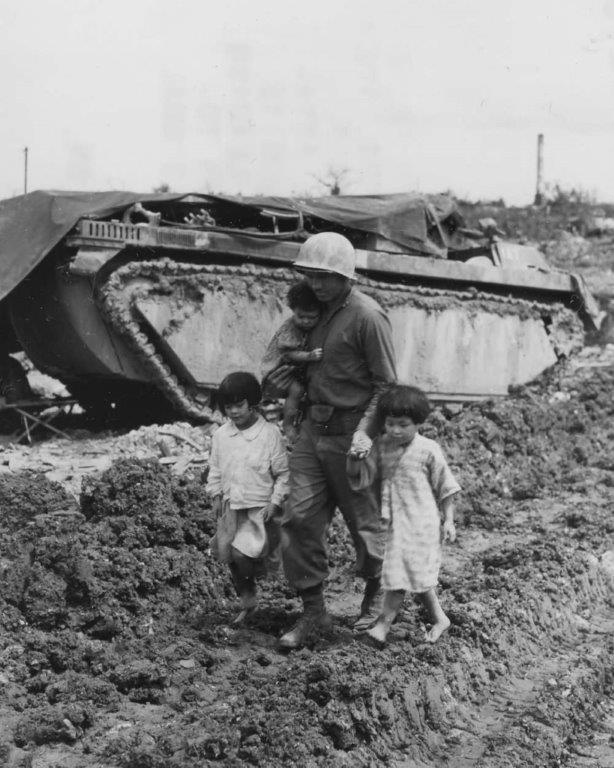
Figure 2.--Civilians suffered terribly during the Okinawa campasgn. Because of the nature of the campaign there were huge losses of civilans caught in the middle of the fighting. Then it got worse because the Japanese soldiers expected the civilians to commit suiside along with them. When they refused the Japanese soldiers woud murder them. Here an American Marine escorts Japanese children to safty beyond the war zone. Their parents are probzblky dead.Japanese Change in Tactics (October 1944)
The loss of the Marianas and Philippines transformed the Pacific War (1944). Possession of the Marianas mean that the Americans could bomb the Home Islands. Possession of the Philippines meant that the Americans had cut Japan off from the Southern Resource Zone (SRZ). This was already being done by the American submarine campaign. Possession of the Philippines meant that virtually no raw materials were s getting through to the war factories on the Home Islands. Remember, it was the American Philippines that meant that the Japanese could not just seize the British and Dutch colonies in the SRZ in 1941. They had to destroy the United States Pacific Fleet. In addition, the Battle of the Philippines Sea, part of the Marianas Campaign showed that the Japanese air capability was no longer effective. The Great Marianas Turkey Shoot shocked the Japanese. It meant that existing air and naval tactics could not stop the Americans. Japanese tactics in the Battle of Leyte Gulf were essentially a naval Kamikaze attack. Failure at Leyte meant ghat there would be no Kantai Kerssen. This lead to a radical change in Japanese tactics and strategy. It was now clear even to the the fiercely committed Japanese military that they could not win the war. The War was continued with the hope that they could avoid losing the war disastrously and most importantly prevent the occupation of Japan. Japanese strategy became very simple--kill as many Americans as possible, hoping this would dissuade the United States from pursuing the War. This led to the birth of the the Kamikazes which seemed mad to the Americans, but by 1945, the only successes achieved by the Japanese were ships sunk by Kamikazes. And naval and land tactics were not unlike the Kamikazes. Japanese defended positions like Iwo and Okinawa were designed not to hold the island, but to kill as many Americans as possible. And the final voyage of Yamato was essentially a Kamikaze attack. At the end of the War, the Japanese defense of Kyushu was to blood the Americans even more than had been the case on Okinawa.
The Home Islands (1945)
Japan began its aggression by invading Chinese Manchuria (1931). Here and fir 14 years the Japanese invaded other countries and territories. And even after they were stopped at Guadalcanal, they fought the war at locations far away from the Japanese Home Islands. The little white boxes came home to Japanese mothers and rationing became more severe, but the actual fighting was still in distant lands. This changed dramatically in 1945. It should not have been a surprise to any Japanese people reading a map. But one catastrophe after another began to unfold. The American took Iwo Jima (February 1945). Iwo was the first Japanese territory to fall to the Americans. This was followed by the first really destructive air raids (March 1945). In the ensuing months, the United States would burn the heart out of industrial Japan. Than the Americans landed on Okinawa, another actual Japanese territory. The Generals assured the Emperor that this would be the decisive battle and the Americans would be finally defeated. They had made the same prediction about other major battles. After Okinawa fell--the Emperor with Tokyo burning before his eyes lost all confidence in the military. It was clear that the Americans were next preparing to invade the Home Islands and the Military realized that the blow would begin in southern Kyushu which was within range of the newly won air bases in Okinawa. The Japanese began a massive buildup of men and material in Kyushu. Units were drawn down from China and Manchuria to prepare for the invasion. Not only were military resources deployed, but the Japanese organized civilians, including children, to stop the Americans. All of the Japanese islands are mountainous, including Kyushu. This provided like Okinawa, enumerable defensive positions to kill Americans. This was a strategy the Japanese adopted beginning with Tarawa in the Gilberts. The Japanese believed that if the killed enough Americans that the United States would tire of the War and make peace. Unfortunately for the Japanese it failed on Pacific island after another. It not only filed, but convinced the Americans that the atomic bomb had to be used to avoid the terrible bloodletting that would result from an invasion. The Americans might have used the bomb anyway, but the terrible losses on Iwo and Okinawa made the use of the bomb inevitable.
Atomic Bomb (August 1945)
The American Manhattan Program was initiated by President Roosevelt when work done by German physicists led to concern that th NAZIs might build an atomic bomb. Jewish and other refugees fleeing the NAZIs made a major contribution to the success of the Manhattan Program. The first bomb was successfully tested at Alamogordo, New Mexico on July ??, 1945. The Allies met in a Berlin suburb after the NAZI surrender to make decisions about the occupation of Germany and defeating Japan. The Allied powers 2 weeks after the bomb was tested demanded on July 27, 1945 that Japan surrender unconditionally, or warned of "prompt or utter destruction". This became known as the Potsdam Declaration. The Japanese military was prepared to fight on rather than surrender. The Japanese Government responded to the Potsdam Declaration with "utter contempt". The Japanese military continued feverish plans to repel the American invasion of the Home Islands. Many Wehrmacht generals at the end of the War were anxious to surrender to the Americans. One German General commanding forces as part of Venk's 9th Army west of Berlin after the War said, "We wondered why the Americans didn't come." This was not the attitude of the Japanese military. I know of know memoir written by an important Japanese military officer expressing similar sentiments. Truman was not anxious to use the atomic bomb. He was anxious to end the War and limit American casualties. For Truman, the American casualties on Okinawa and the Japanese response to the Potsdam Declaration made up his mind. There have been many books and articles published in both Japan and America about the atomic bomb. Japanese scholars have researched the decision making process that led to the dropping of the atomic bomb. Almost always the focus is on Truman and American military leasers. Rarely do Japanese authors address the role of Japanese political and military leaders. The United States dropped two atomic bombs on Hiroshima and Nagasaki on August 6 and 9, and the Soviet Union entered the war against Japan on August 8.
Soviet Declaration of War (August 1945)
The American Hiroshima attack caused Stalin to order the immediate declaration of war on Japan and invasion of Manchuria least Japan surrender before the Soviets attacked. The Soviet Union, 2 days after the first atomic bomb was dropped, entered the war against Japan (August 8). Stalin as promised at Yalta and Potsdam declared war on Japan. At the time the Japanese were attempting to use the Soviets to mediate an end to the War. He moved the date up after the Hiroshima bombing because he wanted to be in the War before Japan surrendered. Soviet plans included the invasion of Manchukuo (Manchuria), Mengjiang, Korea, the southern portion of Sakhalin, the Kuril Islands, and Hokkaido. All these operations except the invasion of Hokkaido were carried out. The Soviets struck in Manchuria and routed the Japanese forces there. The offensive was in sharp contrast to the campaigns the Americans conducted in the Pacific. The Soviets after declaring war immediately launched a massive invasion--the largest ground operation of the Pacific War. The Red Army rapidly swept over Manchuria. Japanese resistance crumpled. The Soviet invasion is not well covered in Western histories of the War. One question that arises is why the Soviets so quickly succeeded in Manchuria while the United States struggled in Okinawa. I think this is primarily because Okinawa was a small island where the Japanese could concentrate their forces in mountainous terrain. Manchuria was a huge area, much of it a flat plane, idea for tank warfare. The Japanese could not defend it like they were able to do on Okinawa. Perhaps readers more familiar with the Soviet invasion will be able to tell us more. Soviet plans included the invasion of Manchukuo (Manchuria), Mengjiang, Korea, the southern portion of Sakhalin, the Kuril Islands, and Hokkaido. All these operations except the invasion of Hokkaido were carried out. The Soviet invasion was code named Operation August Storm. The massive Soviet invasion swept aside Japanese resistance. The Japanese were surprised and destroyed any illusions among the military that Japan's still substantial army had the ability to resist Allied armies. Some authors believe that the success of the Soviets in Manchuria and the inability of the Japanese army to resist them, had more of an impact on the Japanese military than the two American atomic bombs. One factor that we are not yet sure about is why Japanese resistance in Manchuria collapsed so quickly and why the Japanese military commanders were willing to surrender to the Soviets, but unwilling to surrender to the Americans in Okinawa or the Philippines. The Japanese that surrendered to the Soviets spent years in the Gullag. They were used for years in construction projects in Siberia and Central Asia. [Solzhenitsyn, p. 84.] Only about half survived and ever returned to Japan.
Soviet Invasion of the Kuril Islands (August 1945)
Stalin wanted to share in the occupation of Japan of Japan in the same way that the occupation of Germany was unfolding. While he had assembled a massive force in the Far East and used it to invade Manchuria and Korea (August 8). Invading Japan, however, was a very different matter. The Soviets did not have the sea-lift capability of getting part of its Far East forces to the Japanese Home Islands. The Soviet Manchurian Strategic Offensive Operation included plans to invade Hokkaido, the northern Japanese Home Island. It soon became apparent that the limited Soviet Sea-Lift capability made this impossible. Instead they conducted a an operation to seize the much smaller Kuril Islands extenting from Japan's Hokkaido in a northerly arc to the Soviet Kamchatka Peninsula. The only battle of the Soviet campaign was the Battle of Shumshu. This was to be the beginning of a Soviet effort to seize the Kuril Islands and hopefully northern Japan. It proved to be the only major battle of the Soviet Kuril campaign and one of the last battles of the War. The United States as the war wound down in Europe pressed Stalin to enter the Pacific War against Japan. Stalin wanted to do just that, but his desire to do so. He agreed to do so only after the Germans surrendered and then with a-month lag time to transfer forces east. He also demanded Lend Lease aid for his Pacific forces. The United States complied, including transferring a dozen types of ships and aircraft to the Soviets. The United States secretly transferred 149 ships and aircraft (Spring-Summer 1945). They included vessels needed for amphibious operations. Most were escort vessels, landing craft, and minesweepers (Spring-Summer 1945). The transfer occurred at Cold Bay in Alaska and was named in Project Hula. [Russel, p. 8.] Some historians argue that President Truman because of problems dealing with the Soviets in post-War Germany was not interested in a joint American-Soviet occupation of Japan. [Hasegawa] The Soviets encountered considerable resistance, largely because of their inability to move a substantial force to Shumshu. As a result there was no fighting further south. Victory came only when the Japanese Government convinced their forces on Shumshu to cease resistance (August 23). The Soviets encountered no further resistance in its seizure of the Kuril Islands (completed by September 1). The Soviets given the level of resistance on Shumshu and their limited sea-lift capability abandoned plans to invade Hokkaido.
Surrender (August 14-September 2, 1945)
Most Americans believe that the Japanese surrendered because of the American development and use of the atomic bomb. The bomb was certainly a factor, but not the only factor. The decision to surrender is far more complex and impossible to know with any certainty. The American Pacific Island invasions, naval power, and in particular the Soviet declaration of war and startling success of the their invasion of Manchuria all played major roles. The success of the Soviet Army convinced even Imperial Army officers and the Ministry of war that defeat was inevitable. Emperor Hirohito on August 14 decided to surrender unconditionally. Even after the atomic bombs and the debacle in Manchuria, there were hardliners that were opposed to surrender. A group calling themselves the Young Tigers seized the Imperial Palace grounds and tried to prevent the Emperor's surrender broadcast. The attempted coup almost succeeded. On what has become called "Japan's Longest Day" the attempted coup, bombing raid blackout, intrigues, killings, and seppukus determined fate of millions of Japanese people. It was a complicated series of events involving both great heroism and treason by officers convinced that they were behaving honorably. The Commander of the Eastern Army, however, remained loyal to the Emperor, dooming the coup. [PWRS] The formal surrender was held underneath the guns of the battleship USS Missouri in Tokyo Bay (September 3). Not knowing just what the Japanese were planning, the American carriers were standing at sea off Japan.
Occupation and Aftermath
American troops landed in Japan immediately after the Imperial Government surrendered on September 3. The American occupation was completely unlike the Japanese occupation of the countries that it had conquered. Most Japanese were stunned by the final year of the War and the massive destruction. There was also widespread hunger. Many Japanese had been led to expect a brutal American occupation. The United States oversaw an occupation with fundamentally changed the nature of Japanese society, rooting out Japanese militarism and fomenting the development of democratic political regimes and social structures. Women were enfranchised and labor unions allowed to organize.
Liberation/Reoccupation
The situation in Asia and the Pacific was different after the Japanese surrender than after the German surrender in Europe. There was not much left of the NAZI empire (only Norway, Denmark, parts of Bohemia, and pats of Austria). Large areas of the Pacific and Southeast Asia, however, were still in Japanese hands and occupied military forces quite capable and willing to fight. The Japanese still occupied the Dutch West Indies, parts of Burma, Malaya, Singapore, and Indochina as well as Taiwan and large areas of mainland China. Moving into these areas to accept the surrender of the Japanese and reestablish civil order wee complicated by the large areas involved, the distances, and limitations of transport. The Dutch and Pacific had no substantial forces in place to do this. The problems meant that it would take some time for the Allies to move forces into these areas. A complicating factor was there were now local military forces, both resistance forces and national forces the Japanese had armed to assist them. Asia was different than Europe. Most of the territory conquered by the Japanese were colonies. Thus the local population was generally not overjoyed with the prospect of the old colonial powers (British, Dutch, and French) coming back. Only in the Philippines were the Allies (Americans) generally regarded as liberators, and even in the Philippines the resistance movement included a Communist force that was anti-American. The Allies thus in some areas used Japanese troops to keep order until they could reoccupy the areas that the Japanese had conquered. And in all of the places except Burma where the British pulled out, colonial wars resulted.
Modern Asia
The Pacific War was in many regards the birth of modern Asia. One work describes the War as the beginning of the evolution of the Asian colonies to modern independent countries. [Bayly and Harper] Almost all the Asian countries before the War were either European colonies. Much of China was occupied by Japan and its major seaports under the control of European countries. At the time war broke out in Europe, the only country scheduled for independence was the American Commonwealth of the Philippine Islands. German victories in Europe (1940) undercut the Dutch and French colonies. With Pearl Harbor the Japanese launched an offensive that brought them to the borders of India. While the Japanese were defeated and the colonial regimes restored, with only a few years, virtually every colony in Asia achieved its independence. Much of it was accomplished by negotiations, most notably the independence of India and Pakistan. In other countries there were wars for independence, most notably the French struggle in Indochina/Vietnam. The War had both stimulate nationalist feelings as well as exposed the limitations of European military power.
Sources
Bayly, Christopher and Tim Harper. Forgotten Armies: The Fall of British Asia, 1941-1945 (Belknap/Harvard, 2005).
Camp, Dick. Last Man Standing: The 1st Marine Regiment on Peleiu.
Gibert, Martin. A History of the 20th Century.
Hasegawa, Tsuyoshi. Racing the Enemy Stalin, Truman, and the Surrender of Japan (Belknap Press: 2006), 432p.
Holt, Thaddeus. The Deceivers: Allied Military Deception in the Second World War (Scribner, 2004).
Mahan, Alfred Thayer. The Influence of Sea Power Upon History: 1660–1783 (1890).
Pacific War Research Society (PWRS). Compiler Kazutoshi Hando. Japan's Longest Day.
Pellegrino, Charles. The Last Train from Hiroshima: The Survivors Look Back (Henry Holt, 2010). 367p.
Rms, Alan. South Pacific Cauldron: World War II: Great Forgotten Battlegrounds (2014), 312p.
Russell, Richard A. "Project Hula: Secret Soviet-American Cooperation in the War Against Japan" (Washington, D.C.: Naval Historical Center, 1997).
Sloan, Bill.
Brotherhood of Heroes: The Marines at Peleliu, 1944--The Bloodiest Battle of the Pacific War (Simon & Schuster, 2005). Spector, Ronald H. At War at Sea: Sailors and Naval Combat in the Twentieth Century (Viking, 2001), 463p.
Spector, Ronald H. Eagle Against the Sun (1985).
United States Strategic Bombing Survey -- Pacific (USSBS-P). Naval Analysis Division. Gordon Daniels (ed.) Campaigns of the Pacific War (GPO: Washington, D.C., 1946). The United States Strategic Bombing Survey was created in 1944 to assess the impact of strategic bombing in Europe. It was extended in 1945 to assess the strategic bombing of Japan. It includes, however, a great deal of information about the Pacific War in general.
Willmott, H.P. The Barrier and the Javelin: Japanese and Allied Strategies, February to June 1942.
CIH -- WW II
Navigate the CIH World War II Section:
[Return to Main World War II campaign page]
[Biographies] [Campaigns] [Children] [Countries] [Deciding factors] [Diplomacy] [Geo-political crisis] [Economics] [Home front] [Intelligence]
[Resistance] [Race] [Refugees] [Technology]
[Bibliographies] [Contributions] [FAQs] [Images] [Links] [Registration] [Tools]
[Return to Main World War II page]
[Return to Main war essay page]
Created: November 13, 2002
Spell checked: 6:23 PM 8/8/2022
Last updated: 5:44 AM 12/24/2023