|
Midway proved to be the turning point of the Pacific War. Admiral Yamamoto had gabled at Pearl Harbor that Japan could win a quick victory with a decisive blow. That gamble was lost at Midway. It is notable because it was the only major Allied victory in which the opposing forces were superior. Admiral Yamamoto was determined to bring the American Pacific fleet to battle before America's industrial might could redress the strategic balance. Yamamoto reasoned that Midway was an asset of such importance that Nimitz would have to commit his remaining assets to defend it. The Japanese had many advantages. Unknown to them, however, surprise was not one of the advantages. The same American code breaking operation that had learned of the Port Moresby operation also warned Admiral Nimitz that the next target was Midway. Admiral Yamamoto was convinced that the remaining American carriers could be brought to battle and destroyed at Midway. The Japanese plans were based on achieving an element of surprise and on the fact that two American carriers had been destroyed in the Coral Sea, in fact the Yorktown, although heavily damaged had not been sunk. American code breakers had alerted the Americans to the Japanese plans. Admiral Nimitz positioned Enterprise and Hornet, along with the hastily patched up Yorktown northwest of Midway to ambush he Japanese. The American carrier victory
at Midway dealt a crippling blow to the Imperial Navy. The Americans sank four first-line Japanese carriers, killing many of the well-trained crews. The weakness of the Japanese in fire safety and fire suppression was notable. While the Imperial Navy still held an advantage, it was no longer an overwhelming one. The stunning American carrier victory at Midway, significantly reduced the strike capability of the Imperial Navy and meant that the U.S. Navy would be able to slug it out with the Japanese in the Solomons (August-December 1942). Meanwhile American shipyards were turning out the new Essex-class carriers that would reach the Pacific Fleet in 1943 and permanently shift the strategic balance.
Midway was important because of its location position and even more importance its vital airbase. And as a result Midway would prove to be the turning point of the Pacific War. Admiral Yamamoto had gambled at Pearl Harbor that Japan could win a quick victory with a decisive blow. That gamble was lost at Midway. The American victory at Midway is notable because it was the only major Allied victory in which the opposing forces were superior. The importance of Midway was the airbase. It would provide a stepping stone for the conquest of the Hawaiian Islands. Yamamoto reasoned that Midway was of such strategic importance that Nimitz would be forced to commit the remaining carriers of the Pacific Fleet. And here he was correct. But Yamamoto believed that both Lexington and Yorktown were sunk in the Coral Sea. He believed that the Americans only have Enterprise and Hornet left. He thus concluded that the four operational fleet carrier would be sufficient. Of course not only did Yorktown survive, but the Midway air base essentially served as a fourth American carrier and would play a vital role.
Admiral Yamamoto for poorly understood reasons did not after Pearl Harbor press home the attack against the American carriers. Rather the Japanese engaged in an orgy of grabbing territory, which was the reason for going to wae--the Southern Resourze Zone. A more prudent approach would have been to finish off the American carriers, especially after the oil fields in the Dutch East Indies (DEI) had been secured. Rather the Japanese carriers were dispersed in a far flung series of operations, including a foray into the Indian Ocean. Part of the reasons for this was that the Japanese victories came so quickly that they were not prepared for the next step in their war effort. And there were no only disagreements between the Imoerail Army and Navy, but within the Navy. Yamamoto wanted to return to the Central Pacific and finish off the American carriers, eventually seizing Hawaii. Both the Army and Navy General Staffs opposed him. The Army because it would require a diversion of ground troops, the Navy because of the transports that would be rquired which they did not have. Rather the focus turned to Australia the last remaining major Allied Pacific output other than Pearl Harbor. The Army nixed an invasion of Australia again because of the ground trips required. So the balanceof opinion shifted to the Southwest Pacifiv where the Imperial Fleet with the First Air Fleet could sever the sealanes between America and austrilia--preventing an American build up there. This could not require a major diversion of ground forces, but would likely force Nimitz to commit his carriers and in an area far away from the powerful American land air assetts in the Central Pacific. [Parshall and Tully, pp. 34-36.] The debate was settled by the starteling Doolittle Raid launched by Hornet and Enterprise (April 1942). This embarrassment caused Yamamoto to finally get the go ahead to move forward with the Midway operation. But it was decided to first allow the already planned Coral Sea operation (May 1942) to go forward. Unfortunately for Yamamoto, two of this first-line carriers that were targeted for the Midway operation were put out of operation as a result of the battle. Zuikaku's air crews had been decimated. Shōkaku had been heavily damaged. While Lexingtion was lost in the Coral Sea, the fact that two of the Imperial Fleet's fleet carriers were unavailable would have a critical impact on the battle. Yamamoto concluded that four carriers would be adequate, but he was under the impression that the American Pacific Fleet has also lost Yorktown. The general impression in both the Naval Genral Staff in Tokyo and Yamanoto's staff at Hashirajima was that they faced a demoralized enemy with a shattered fleet.
Part of the Japanese war strategy was that the United states would be tied up in the Atlantic to support the British. Both Roosevelt and Churchill agreed to give pruority to the Eurooean fight against Hitler. But ameruican resources in early 1942 were limited. And as the Japanese calculated, naval forces had to be split between the Atlantic and Pacific. American shipyards were turn lut ataggering number if bew ships, but in 1942 the Navy had only what was at hand. Most critical was the carriers which after Pearl Harbor replaced battleships as the capital ships in the Pacific War. America and Japan had a comparable carrier force, although the Japanese piklots were better trained and had superior aircraft. The Japanese also had more exoperience in fleet operations. And unlike the americans, all their carriers were committec to the Pacific war. The American carrier force consisted of Enterprise, Lexington, Hornet, Ranger, Saratoga, Wasp, and Yorktown. Saratoga had been torpeoded by a Japanese submarine (January 1942) and had just completed repairs on the West coast. It reached the fkeet just a few days after the battle. Ranger and Wasp were bring used to ferry figher aircraft to the embattled British bastion at Malta. Given the critical poition in the Pacific, nothing could spaeks more eloquently about the Anglo-Americn alliance that two American carriers were committed to save Malta ratger thanb steamong for Pearl. Lexington was lost in the Coral sea (May 1942). This meant that Nimitz woukd have to gight the battle with only three carriers: Enterprise, Hornet, and the badly danaged Yorktown. He would have, however, the Midway air component which would play an important role as the battle unfolded.
Admiral Yamamoto knew that despite the unprecedentef victories, time was not on Japan's side. The American carriers still were a serious threat and American shipyards were building many new carriers. He thus saw the importabce of bringing the U.S. Pacific fleet to battle before America's industrial might could redress the strategic balance. Yamamoto reasoned that Midway was an asset of such importance that Nimitz would have to commit his remaining assets to defend it. The basic premise of the Japanese strategy was sound. The Imperial Navy's final plan for the battle was flawed. Yamamoto consented to detailing three carriers to the Port Moresby operation, including two fleet carriers. Battle damage meant the light carrier Shohos was lost, but more imprtantly the two fleet carriers (Zuikaku and Shōkaku) were put out of action. Zuikaku so depleted of planes and air crews and Shōkaku was so damaged that they were not available for the Midway Operation. Other carriers were detailed for a diversionary feint at the Aleutians. Thus only four carriers were committed to the Midway operation, but this seemed sufficient to Yamamoto. From the Japanese point of view, Nimitz had only two carriers left. The Japanese were convinced that the engagement in the Coral Sea proved that the American carriers were no match for the Imperial Navy's carriers. The division of force was the weakness of the Japanese plan. The idea of the battle was to concentrate their forces to deal a death blow to the American Pacific fleet. The final plan of battle, significantly divided the key carrier forces. And of course the Japanese had not asked the right question about the Coral Sea--why in the vast Pacific did the American carriers show up at just the right place and time to engage a Japanese strike force?
The lore developed around the Battle of Midway has come to portray the American victory as preordained because of the cracking of the Japanese naval code. Nothing could be further from the truth. Cracking of JN-25 provided Admiral Nimitz an opportunity. It was absolutely unclear if the American Pacific Fleet had the ability to capitalize on that opportunity. The Japanese still held many advantages. In fact Admiral Nagumo's Mobile Force (sometimes called the First Air Fleet) had most of the advantages. They had a massive
naval force, but the principal advantage was the superior carrier force. Here the Japanese superiority was staggering, in carrier numbers, aircraft types, pilot training, weaponry, and staff experience.
1) The Japanese had more carriers. Not only did the mobile force out number the two American task forces (TF16 and 17), but they had small carriers as well.
2) The Japanese aircraft were superior. This was especially the case for the fighters which were important for both combat air patrol (CAP) and escort duties. The Mitshibishi Zero outclassed the American Wildcat. The Zero was a much higher performance aircraft. In addition the American torpedo aircraft were obsolete and proved to be death traps for the brave air crews that flew them.
3) The Japanese pilots were better trained and more effective. Had Admiral Nagumo got off a major strike on the American carriers, the outcome of the battle would have been very different.
4) The Japanese torpedo planes were equipped with one of the most effective ship killing weapons of the War, the Type 91 aerial torpedo. In contrast, the America torpedo essentially did not work. The Americans had a small advantage in bombs, but it was much more difficult to sink a large ship with bombs (unless you manage to catch your opponent with decks and hangers full of armed and fueled aircraft).
5) The Japanese pilots were better trained. The American pilots were vastly improved from the beginning of the War, but they were still not up to the standards of the Japanese pilots of the Mobile Force. The American carrier pilots had gained considerable experience in the months since the Pearl Harbor attack. This had closed the gap in training and experience that had been held at the beginning of the War.
6) Another major advantage was that the Japanese carrier staff was experienced in large fleet operations such as the attack on Pearl Harbor. The Americans were not. Japanese carrier doctrine involved grouping their carriers together in a massive striking force and their officers were trained to do this. The Americans operated their carriers in task forces composed of a single carrier and escorts or at the most two. The events as they developed showed this weakness. The American strike on the the Mobile force devolved into a series of uncoordinated attacks carried out by squadrons that had become separated. Only by accident did the bombing groups from Enterprise and Yorktown find and attack the Mobile force at the same time in uncoordinated attacks. Hornet's bombing group did not even find the Mobile Force. The Americans did have some advantages.
1) The element of surprise was a factor provided by cracking JN-25. but generally lost when Nagumo's search planes found the Americans.
2) Radar was another advantage, but still had a relatively short range, but it was important in decting incoming air attack.
3) Another advantage that Nimitz had at Midway was the island itself which helped to distract Nagumo. Admiral Nagumo at the onset of the battle thought that he held the element of surprise which had proved so important at Pearl. Unknown to them, however, surprise was not one of their advantages. Fighting the battle near Midway was. It effectively added an extra carrier to the American force. Although Midway did not have effective aircraft for the battle, the B-17s and other aircraft they did have would distract Nagumo. And because he had been criticized for not launching a third strike at Pearl, he almost certainly had a mindset fixed on Midway. Thus the Americans entered the battle with a significantly inferior force, but a major advantage--Midway. Yamamoto and Nagumo were under the impression that they had deployed a superior force and in fact they had. What they did not accurately calculate was the importance of Midway and the difficulty of crippling the air element on the island.
4) Arguably themost important advantage that the Americans held was that the Japanese were not aware of how vulerable they were to air attack. The Americans had been on the receiving end of Japanese attack. Adm. Nagumo and the First Air Fleet, however, had delivere massed air attacks, but had not been on the receiving end of a succesful massed attack. But there were sinals the Japanese should have picked up on. Nagumo hinself in the Indian Ocean expeienced an attack by British bombers which penetraped the Combat Air Parol (March 1942). And the Americans in Coral Sea proved more than capable of smashing the hell out of both carriers and air groups (May 1942). Yamamoto and Nagumo ignored both lessons, largely because the First Air Fleet did not lose any of its fleet cariers. After the Coral Sea, the Japanese did not have time to adjust fleet operations. They did have time, however, to reassess the advisibility of going forward with just four carriers of the First Air Fleet. The Americans were just not considered a crditable threat. [Parshall and Tully]
The United States had an important signals intelligence
operation. It was a relatively small operation before Pearl Harbor, but then rapidly expanded. The American effort that broke the Japanese diplomtic Purple code was known as Magic. It was comparable to the British Ultra effort at Bletchley Park. The United States focused its initial effort on the the Japanese codes. The British concentrated on the German Enigma Machine. After Winston Churchill became Primeminsister, the The United States and Britain became to share secrets which came to include code breaking efforts. American code breakers cracked into the Japanese diplomatic code over a year before Pearl Harbor (September 1940). This gave the Roosevelt full knowledge of Japanese goals and plans for the Pacific. While Japanese diplomats talked about peace, Japanese Government officials as revealed in Magic Purple decrypts were clearly preparing for War. What the American code breakers had not succeeded with was JN-25, the Japanese naval codes. This effort is sometime referred to as American Ultra. As a result, American planners did not expect the attack on Pearl Harbor (December 1941). Finally the code breakers began to break into (JN-25). The first decrypts were only partial, but let to the American carriers being deployed to the Coral Sea where they disrupted the Japanese effort to seize Port Moresby (May 1942). The code breakers also managed to decrypt enough of the Japanese naval traffic to learn that they were planning a major effort to take Midway. The decrypts were not complete, but were complete enough to compile a good idea of the Japanese plans including when it would be launched. As in the Coral Sea, the code breakers had done their job. Now it was up to a Admiral Nimitz with weakened Pacific Fleet with an inferior carrier force to stop the Japanese.
Admiral Yamamoto was convinced that the remaining American carriers could be brought to battle and destroyed at Midway. The Japanese plans were based on achieving an element of surprise and on the fact that two American carriers had been destroyed in the Coral Sea, in fact the Yorktown, although heavily damaged had not been sunk. The most surprising Japanese failure seems to be the failure to ask why the American carriers had suddenly appeared in the Coral Sea to oppose the Port Moresby operation. The Americans tried to convince the Japanese that their carriers were in the southwest Pacific and this was the assessment that Nagumo had when he sailed with the Mobile Force. Yamamoto received a revised assessment, but did not advise Nagumo because of a desire to maintain radio silence. Yamamoto assumed that Nagumo received the same messages he received. In fact, Nagumo's flagship, Akagi had poor radio receiving equipment.
Admiral Nimitz positioned Enterprise and Hornet, along with the hastily patched up Yorktown northwest of Midway to ambush the Japanese. Nimitz reasoned that by the time the Japanese launched on Midway they would be discovered and that the American carriers could then get off the vital first strike on the Japanese. The key to these early battles was to get off that first strike. The Marines on Midway would catch hell, but it would provide the Americans a vital ambush opportunity. The fact that the Japanese as a result of the Corl Sea action would have only four carriers meant that they would have to use or prepare most of their planes for the Midway strike. As the battle developed, Nagumo came very close to ambushing the Americans and getting off his planes on a massive strike against the American carriers.
The Japanese deployed four of their first line heavy carriers in the Mobile Force. Aboard these carriers were the best Japanese pilots, in fact the best trained and most effective pilots in the world. The Mobile Force consisted of four of the six carriers that that had carried out the attack on Pearl Harbor. Nagumo's carriers were divided into two divisions. Division one was the Kaga and Akagi. Division 2 was the Hiryū and Sōryū. Smaller carriers were with the landing force. Midway had been planned to include all six of the Imperial Fleet's first-line carriers. Coral Sea had changed this. Two front-line carriers were not able to participate. The Americans had heavily damaged Shokaku and devastated the air crew of Zuikaku. Yamamoto decided that four carriers would be sufficient for the operation. There was also a powerful Japanese invasion force. But it was the four first-line carriers which would fight out and decide the battle.
A key factor in the battle identified by both American and Japanese assessmebts is the Japanese 'Victory Disease'. It seriouly affected both the Imperial Army and Navy. And it affected the thinking and assumption of senior Japanese commanders, including Yammoto and Nagumo. [Symonds] This thinking affected the Midway Battle in many ways. Instead of hording his carriers for the all important destruction of the american carriers, he sent them into the Coral Sea for the secondary objective of seizing Port Moresby. As a result. Nagumo t Miday only had six fleet carriers. Other mistakes flowing from the Victory Disease was a poor search effort and an inadeuate fighter cover over the crriers.
Given the long string of Japanese succeses beginning with Pearl Harbor it was not surprising. They began to assume they would be sucessful because in engagement after engagement, they had been successful. As any stock market brochure will tell you, the best indicator of future success is prior performance. this is also true with the military. The Japanese successes were due elevated military spending for two decdes, the quality of Japanese equipment (especially aircraft), rigorous training, combat experience. The Victory Disease caused Japanese cmmanders were not only permanent, but was due to their innate superiority. These advantages, however, were most effective at the beginning of the war. The U.S. Navy carrier groups were closing the gap by the time of Midway, although new cariers and adcanced urcraft were yet to arrive. What had changed was Station Hypo cracking JN-25. And while the Japanese had the advantage after Pearl Harbor, they had one huge weakness, their military system and industrial base did not have the cpability of replacing losses at the needed rate. The victoiry disease prevented them developing the best tactics meeded to destroy the U.S. Pacific Fkeet or understanding the capabilities of their adversary.
Midway would prove to be the decisive battle of the Pacific War. The Japanese if they were to win the War had to win in the first year of the War before the industrial might of the United States began to shift the strategic balance. Midway is unique in World War II battles. It is the only important battle in which an Allied force defeated a numerically superior, better equipped, and better trained Axis force. The outcome of the battle hinged on intelligence and the lack of caution by the Japanese commanders. The Japanese Midway battle plan was conceived as a trap for the remaining American carriers. It prove to be a catastrophic trap for the Japanese carriers. The Americans succeeded in part because the Japanese had not pressed the carrier war after Pearl Harbor. Instead of engaging the American carriers, the Japanese had engaged in far ranging operations including attacks on Darwin and a misguided foray into the Indian Ocean. This gave the Americans 7 months to hone their carrier force to a level that could compete with the Japanese.
Nagumo inexplicably as he approached Midway did not ensure a careful surveillance of the surrounding waters. The Japanese did send out reconnaissance scouting aircraft, but the screen was incomplete and the air crews inexplicably lax in accurately reporting what they found. A scout plane from the cruiser Tone did find the Americans. They first reported only that they spotted American aircraft. Then they reported destroyers and cruisers. Such a force was no threat to Nagumo, but an American force in that position should have caused greater concern on Nagumo's part. Only a third report from the scout plan an hour after the first report indicated "what appears to be a carrier". This was a threat. That one hour delay was all the Americans needed. The Americans with their long-range Catalinas found him before he was aware the American carriers were present. This added to the American knowledge of the Japanese plans obtained through Magic. This essentially doomed the Japanese even before the first shots had been fired. In these early carrier battles, against relatively evenly matched forces, it was the side which managed to strike first that would prevail. Had Tone's Scout reported the American carrier on its first message, the outcome of the battle almost certainly would have been different. On such slender threads hung the fate of great nations.
The battle started after the Catalinas spotted the Japanese fleet. American B-17s from Midway attacked. The Americans bombed from high altitude and had no impact on the Japanese force. Midway was in effect a fourth carrier for the Americans, but it was not equipped with effective air craft for the battle. The Marines had obsolete fighters and the Army Air Corps B-17s were unlikely to hit the Japanese carriers from high altitudes. Even so, they provided a major distraction from the American carrier force lying in ambush to the northeast. Nagumo still unaware of the presence of American carriers launched a strike on Midway, prudently holding a sizable force back in case the the American carriers appeared. Nagumo launched 108 aircraft at Midway from a range of 180 miles. The strike force was led by Lt. Joichi Tomonaga. Nagumo still had no idea that American carriers were present northeast of Midway, although he should have been cautious for several reasons. The attacking force created havoc on the Mrines on Midway and inflicted extensive damage. Often unmoted is the damage ported the Marines did to Japanese attack force. The planes actually shot down were not cripling, but large numbers of the returning force was damaged, including many damaged beyond repair. Nagumo bgan the battle with only four of his six carriers. After the Midway strike his potential effective force was further reduced. There were 11 planes shot downm 14 heavily dmaged, and 29 other aircraft damaged to some extent. [Parshall and Tully, p. 204.] Also 20 aviators were killed. Totaled up the 54 lost or damaged aircraft were almost equal to a carrier flight group. So Nagumo would now fight the battle with three carrier groups opposed to three American carrier air groups and the unsikable Midway air group with long range air craft. And note that American carriers had larger air groups than the Japanese carriers. Unlike the Pearl Hrbor attack, however, the Japanse pilots did not find American aircraft on the ground, in fact they found American fifgters already launchd to oppose them. This alone should have alerted Tomonaga and Nagumo to the fact that the Americans were forewarned. Among the Japnese pilots with badly damged planes was Tomonaga himself. It does not seem to have alerted either Nagumo at sea or the Japanese postmortem assessment of the battle. Spruance launched his attack, timed so as to catch Nagumo preparing for a second strike on Midway. The Japanese strike on Midway was effective, but because only a part of the Japanese force was used and two of the six crriers of the First Air Fleet were presenrt, they did not put the air strip out of action. As a result, a second strike was needed. This was not a suprise. Ngumo had anticupated a second strike. Nagumo at this stage was concerned primarily about the air strikes that had been launched from Midway which took his ab=nd his stff's mind off of what they thought was the unlikely presence of the American carriers. Ymaoto's and Ngumo' mind set was that the Americns were coweing at Pearl and would have to be lured out. Nagumo thus ordered preparations for the second strike.
The Japanese first strike had done considerable danmage, but had not put the Midway aur strips out of operation. Tomonaga radio Nagumo that a second attack on Midway would be needed (0700). This was not unexpected. The absence of two of the First air Fleet'six carrier mean that the strike force had been smaller than desirable and that a second strike force was not immediately available. Midway was first on Nagumo's mind and was hammared home when Midway planes began boming the First Air Fleet (0711). While the B-26s missed, aamaged plane conducted arguably the first Kamakaee attack of the War, narrowly missing the bridge of Akagiwhere Nagumo was standing. There were planes available, but as ordered by Yamamoto had been held in reserve and armed with anti-ship torpedoes and bombs in case the American carriers appeared. Thus after narrowly missing being pioned by an Americanbomber, Nagumo ordered the reserve attack group to be rearmed with bombs to attack Midway. This meant he would have to retrive Tomonaga's attack force before launching a second attack on Midway. Midway was able to mount small strikes against the Japanese carriers. None of these strikes hit the carriers, but they forced the carrier captains to take evasive action. This greatly complicated the rearming process.
Before Nagumo could launch a second strike on Midway and after setting in motion the rearming process for attacking Midway, he was confronted with a starteling devlopment. The cruiser Tone's scout reported an American surface flet, but did not specify a carrier (0740). Nagumo should have expected or at least assumed a carrier attack force, but given his fixation on Midway and basic contempt toward American aviation, dithered. It was not until a second reprt from the Tone scout that an American carrier was confirmed that he had to consider a suddenly altered combat situation. He immediately wanted to strike the American carrier. But there were complications. Tomonaga's strike force was returning from Midway and had to be retrieved and he had ordered the flight crew to remove anti-ship oprdinance from the reserve air group. And all the while. American air groups from Midway were continuing to attack the First Air Fleet forcing each carrier csptain to conduct violent manuevers at high spped. This slowed rearmanent and also the safe storage of the ordinance being removed. Nagumo decided not to order an immediate strike with what was availvle which in any case would have taken some time to oganize. Nothing was spotted on the decks. And he ordered that the reserve force be rearmed with anti-ship ordinance. He decided to retriece Tomonaga's strike force and then launch a massive attack on the Americans which at the time he was only sure of one carrier. Japanese carrier doctrine was to attack with a massive strike force armed with both toroedoes and anti-ship (armor piercing) bombs. It should be pointed out that at this point the American carrier groups were in the air. Nothing Nagump decided could have prevented being attacked. His decisions only impacted how much damage could have been exacted on the Americans.
Spruance gambled big--a dangerous gamble. He launched everything he had at Nagumo's carriers. There were no
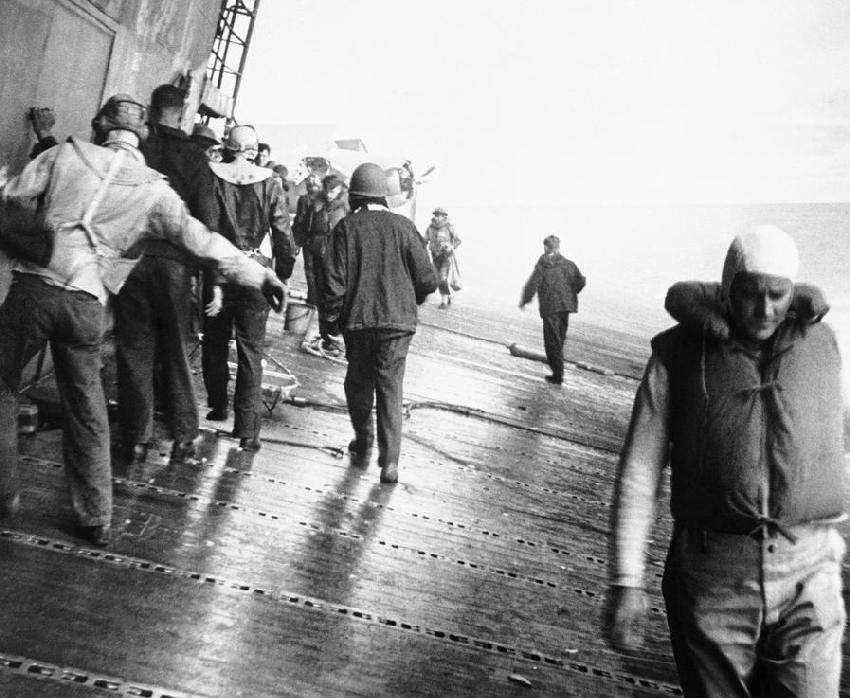
fighters left behind to provide an air umbrella over the American carriers. If Nagumo had been more careful with his surveillance and found the American carriers, the results would have been devastating. It was a calculated gamble. The realities of carrier warfare were that the side that found the opposing carriers and struck first had the greatest chance of success. The Americans planned a coordinated strike on the Japanese carriers. Coordinating attacks on a moving target from three different carriers with the communication gear available was not an easy undertaking. And the Americans had not yet perfected coordinated carrier fleet operations. The torpedo planes found the Japanese carriers first. They attacked without the dive bombers or fighter cover. Torpedo Eight attacked first 0917). Nagumo was not at first sure they were carrier groups, although the torpedoes should have yold him so. The obsolete American torpedo planes carried many dud torpedoes. [Mrazek] The Japanese zeros flying air cover attacked and devastated them. An uncoordinated attack against zeros with these planes was suicidal. The Americans even so pressed the attack, but failed to score a hit. This was not what Nagumo had expected, but the lack of success confirmed the Japanese assessment that American naval aviation was substandard. The torpedo attack groups were destroyed, but they delayed rearming aboard the Japanese cariers brcause of the violent turns and maneuvers executed. Then the American dive bombers arrived, all on the outerlimits of their range. VB-6 (McClusky) had been unable to locate the carriers and was ready to turn back. Commander McClusky saw a Japanese destroyer heading north at a high speed. That destroyer was part of the Japanese carrier escort. They had engaged the American submarine Nutilus and was attempting to rejoin the First Air Fleet. On a hunch McClusky proceeded north and ran directly into the Japanese carriers. Not only did he find the carriers, but the CAP fighter cover was engaged on pursuing VT-3 (Massey) torpedo planes attacking Hiryu. An intirely uncoordinated, VB-3 (Leslie) and VS-6 (Best) convered on the Forst Air Fleet at the same time. Thus the American dive bombers were able to attack unimpeded by the Japanese CAP. The American dibe bombers reached the First Air Fleet just as Nagumo having learned that American carriers were nearby was begining to prepare an attack on those carriers. There were bombs, torpedoes, and fuel all over the enclosed decks and the fuel lines full of hifg octane flight fuel. The result was the destruction within 5 minutes of three of Nagumo's carriers--including the one he was on. They were the potent heavy carriers--the heart of the Imperial Fleet. The loss of the irreplaceable, superbly trained air crews, howevr, is over rated. Polot losses were realtivly small as all four carriers took some time to sink. The air crews would be destroyd in dribles, largely in the Solomons. Incredibly, Yamaoto made no effortvto save it.
Nagumo who minutes before commanded the most powerful naval force in the world, was left with one carrier--
Hiryū. It had been attacked along with the other three Jpnese carriers, but by a torpedo squadron and survived. They witnessed the demise of their sister ship. The American dive bombers as luck would have it attacked the other carriers. The Hiryū launched its aircraft reduced by the earlier Midway attack against the battered Yorktown. This would be the last Japanese carrier attack at Midway. It was a pitifully small strike force compared to what the Japanese had launched at Midway. It was again launched by Tomenaga even hough his plane had been damaged over Midway. The competence of the Japanese aviators, however, left Yorktown a burring wreck. The crew valiantly tried to save her and it looked like they would succeed. The damage control teams managed to bring the fires under control. It has to be pointed out what a was. Fire fighting is a dangous undertaking at the best of times, but hese men were working on a listing, burning ship containing high octane gasoline, and hangrs and decks strwn with amunition, bombs, and torpedoes. Yorktown would be hit again by a second Hiryū strike with an even smaller force. As Yorktown was not burning at the time, the Japanese thought they had hit a second carrier. They left Yorktown buring again. But again the damage control teams put out the fires. Adm. Nimitz at Pearl was still hopeful she could be saved.
The last action at Midway was a final American strike force. As the second Japanese strike force approached Yorktown, the last Yorkrown planes were sent aloft to join a small strike force of dive bombers that had returned to Enterprise. They were ordered to seek out the last Japanese carrier, Hiryū. They found it and scored four solid hits in the fore section of the ship. Hiryū should have never been there. After theloss of three of four carriers any competent commander would have moved Hiryū to the northwest away from Midway and the suspevted location of the American carriers. From that point they Hiryū could still attacked the Americn carriets, but from a safer distance. Instead and Nagumo nd Yamguchi charged at the American carriers, ensuring that Hiryū would be hit and based on what had occured hit hard. This brought the American tally to four front-line carriers, effectively eviserating the First Air Fleet and the one great advantage Japan held in procecuting the Pacific War. In one amazing day, the balance of naval power in the Pacific had been restored. America did not yet command the Pacific, but now neither did the Japanese. And brewing to the east was the oncredible force of American industrial might which was alreading snding forward a sunami of new ships and plnes that would soon not only destroy the Imperal Nvy, but reduce Japanese cities to smoldering ash.
The Japanese submarine force was close to incompetent in its performance at Midway. A factor was the role of a commander close to the Imperial family. No only did it fail to erect a cotdon in time, but it failed to inform Yamamoto and Nagumo that it failed to do so. The I-168 did succeed in torpedoing Yorktown (June 6).
Japan began the War with finest corps of carrier pilots in the world. Their stunning success was in part due to the Zero which was the most effective fighter in the Pacific. But it was also due the their meticulous training. Yamamoto had to calculate not only how long his front-lone carriers could last, but also his pilot corps. They took several years to train nd could not be eaily replaced. The pilots on the four front line cariers lost at Midway (Akagi, Hiryū, Kaga, and Sōryū. The pilots on Shōkaku and Zuikaku were good, biut not yet as experienced as the pilots on the other carriers. (Zuikaku air component was badly depleted in the Coral Sea.) Historians commonly focus on the carriers at Midway, but equally important if not nore important were the losses of pilots and air crews, especially with the losses in the Coral Sea. While the Japanese lost the four carriers at Midway, that did not mean that they lost all the pilots on those carriets. In fact, many pilots and air crews survived. Nagumo had recovered the Midway strike force before the American dive mombers struck and was just beginning to lunch a major strike in the American carriers. The Japanese managed to save a substantial number of men from the carriers, especially Akagi and and Hiryu. Losses totaled about 2,200 men. There are different estimates of pilot losses.
It is probably fair to say that the losses were severe, but not crippling. Many pilots were saved. And there were carrier-qualified pilots not at Midway, although they were not as ell trained and experienced as the pilots at Midway. Even worse than the Midway losses was that the Japanese did with the Miday pilots saved. Rather than using them as the core of new air groups being fored for the new carriers under construction, many of these talented aciators were assigned to air groups at Rabaul and Truk and were gradually lost in the Solomons canpaign. As result, the air grouos being trained to man the new varriers would not have the benefit of the experience aviatprs with which the Japanese began the War. This was in sharp contrast to U.S. Navy policy of rotating pilots back to training facilities. The enormity of the Japanrse error would be felt in the Battle of the Philippines Sea when the new Japanese carriers salied forth to do battle with the new American carriers. (June 1944).
Aircraft carriers were floating tinderboxes. Before launch or during a battle there would be bombs, other ordinance, and highly volatile aviation fuel everywhere. Even a small hit could set off an inferno. Thus fire suppression was a very important capability. Japanese crews were very well drilled, but a strong focus was on attack operations. It is important to stress that the Japanese First Air Fleet had tremendous offensive striking force. And even at Midway the Japanese outclassed the Americans. Just look at what Hiryu did to Yorktown with a scratch force. But other critical aspects of carrier warfare were badly neglected by the Imperial Navy, including radar (available from their German ally), reconnaissance, and damage control. At Midway they paid the price for betting the ranch on offensive operations. American crews had better equipment and drilled more on fire suppression. The weakness of the Japanese in fire safety and fire suppression was notable and would make a major difference at Midway, doming Akagi which was hit with just one bomb. And unlike the Japanese carriers, the American damage control teams came very close to saving Yorktown. Only the very capable Japanese commander of Japanese submarine I-168 undid their valiant efforts.
The behavior of the four Japanese carrier captains should be noted. The Japanese carriers took a long time to sink. Some required the Emperor’s torpedoes to finally sink. Hiryu didn’t even sink for a time after being torpedoed by one of its escort destroyers. So three had plenty of time to get off the ships if they had wanted to do so. The only carrier captain not to go down with his ship at Midway was Cpt. Aoki, the commander of Akagi, the one carrier that was no so badly damaged that it could not have been saved. Aoki certainly wanted to go down with Akagi and had himself lashed to his ship. In the end he did not because Cpt. Ariga who out ranked him gave him a direct order not to commit suicide. Cpt. Okada of Kaga did not commit suicide, but almost certainly would have. Kaga was the worse hit of the Japanese carriers. Five bombs hit Kaga and 5 narrowly missed. As proven by Akagi, one well-placed bomb could have done the job. One American bomb blew out the windows of the bridge stunning Okada, he barely had time to recover his senses when another hit directly on or near the bridge killing him and many of the senior officers. The other two captains , Cpt. Kaku (along with Adm. Yamagucji) went down with Hiryu. Cpt. Yanagimoto went down with Soryu. Both by choice. Adm. Nagumo who had also led the Pearl Harbor attack was not a ship captain, but the commander of the First Air Fleet. He wanted to go down with Akagi, but was persuaded that he was needed to carry on the battle. He would finally commit harakiri, but 2 years later on Saipan (where he was commanding a non-existent fleet) as the Marines closed in on him. Adm. Yamamoto who was most responsible for the disaster at Midway (but who blamed Nagumo) was with the Main Body far removed from the carrier actions (one of the problems with his Midway plan). He did not approve of going down with the ship for the reasons Loring explains. But if anyone should have according to the Bushido code, it should have been Yamamoto.
The USS Saratoga had been damaged by a Japanese submarine (January 1942). The repairs were carried out at the Naval shipyard at Bremerton Washington. After the repairs were completed, she departed Bremeron (May 22) headed for San Diego. She arrived at the naval base there (May 25) and began retraining her air group. It is at this time that Admiral Nimitz, having been informed by the Station Hypo codebreakers of Japanese plans to attack Midway, was preparing his tactics and deploying his carrier groups. Of course Saratoga was vitally needed for the battle. Preparing Saratoga was, however, at involved process. New aircraft had to be taken aboard. The new TBF Avenger torpedo bombers as well as repaired aircraft needed to taken aboard as well as hundreds of tons of food and supplies as well as aircraft spare parts. Another problem delaying departure to join the fleet was finding the escort cruisers and destroyers comprising a carrier task force. Saratoga finally departed San Diego (June 1) and arrived at Pearl (June 6) when the final Midway actions occurred. She remained in Pearl only to refuel and departed (June 7). She reached the Midway carrier group (June 9). While the battle was over, the arrival of Saratoga was very important. The Enterprise's and Hornet's air groups were badly depleted in the battle. Enterprise and Hornet were essentilly toothless. Rear Admiral Frank Jack Fletcher (whose flagship Yorktown had been sunk) and his staff came aboard Saratoga and it became his flagship. Saratoga transferred 34 of her planes to Hornet and Enterprise (June 11). Hornet had lost all of her torpedo bombers (Torpedo Squadron 8) and Enterprise had lost most of hers. The three carriers were ordered north to the Aleutian Islands where a further Japanse attack was expected, but when this not occur they returned to Pearl (June 13). Saratoga was then used to carry more Marine Corps and Army Air Forces aircraft to Midway Island to replace the fighters shot down during the Battle (June 22-29). Saratoga delivered 18 Marine Dauntlessess (VMSB-231) and 25 Army Air Corps Curtiss P-40 Warhawks to Midway Island to replace the aircraft lost during the battle. This was a substantial upgrade over the obsolete aircraft with whch Midway had to fight the battle. While still not up to the Zero challnge, if properly used they now presented am increasinly formidable challenge. Saratoga thus significantly hardened Midway's defenses and left Nimitz with three formidable carriers in the afternath of the battle.
News of the battle immediately appeared in the American news media. The carrier losses were accurately reported, although many reports inaccurately attributed the success to Army Air Force strikes from Midway rather than to Navy carrier aviation. It seemedctonmake mnore sence that a B-17 rather than amall dive bomber would be needed to destroy a large shipnlike a carrier. The news reporting was quite different in Japan. Thr Japanese had been reporting on battles in considerable detail, although not always accurately. The Imperial Navy was deeply embarrassed by the disaster at Midway. They did their best to cover up the disaster. The Navy staff did not even inform Primeminsister Tojo until a week after the battle. The public was told the battle was a Japanese victory with the Navy losing only one carrier while the American lost two carriers. The sailors who survived the sunk carriers were kept in quarantine after reaching Japan and shipped out to the South Pacific without bring allowed to see their families. [Thomas, p. 85.] More important, the Imperial Navy did not tell the Army what had occurred. The Army was thus unaware of the substantial change in the naval balance as they planned their offensive in the South Pacific.
The American success in the Battle of Midway (June 3-6, 1942) was the turning point in the Pacific War. The New York Times reported a "crushing victory over Japanese naval units in the greatest air-sea battle fought thus far in World War II." [NYT, June 6, 1942.] The Times story, however, did nor include a great deal of specific information, although it did report that the carriers Yorktown, Enterprise and Hornet had sunk four Japanese carriers near Midway. This was followed by an account written by reporter Stanley Johnston which was published in the Chicago Tribune. [CT, June 7.] The Tribune account, however, was much more detailed than the Times story. It included the names of the Japanese carriers, information that the Navy had not yet revealed. Much worse was that the Tribune gave away the greatest secret of the Pacific War. The informed the American public that the U.S. Navy had broken the Japanese naval codes. They did not put it so clearly, but they blurted out in the headlines that the Navy had the Japanese plans. At the time, American newspapers ran banks of headlines. The headlines for the The American carrier victory at Midway dealt a crippling blow to the Imperial Navy. The four carriers were the heart
of the Imper all fleet. They were four of front-line carriers that had attacked Pearl Harbor. They were their most
powerful ships with their best planes and even more importantly the most experienced pilots. The stunning American
carrier victory at Midway, significantly reduced the strike capability of the Imperial Navy. The Americans sank four of the six front-line Japanese carriers, killing many of the well-trained crews. While the Imperial Navy still held an advantage, it was no longer an overwhelming one. The resulting standoff gave The U.S. Navy the ability to slug it out with the Japanese in the Solomons (August-December). Meanwhile American shipyards were beginning to turn out the new Essex-class carriers that would begin reaching the Pacific Fleet (1943).
The Japanese press repoted on the battle, but converted the northern diversion into the Aleutians as the main strike. The Japanese official Japan Times and Advertiser ran an imaginitive painting of Japanese aviators destroying an American carrier (June 11). The caption read 'Navy scores another epochal victory'. Reports on the actual Midway phase of the battle were reasobbly accurate as far as the American losses were concerned. Imperial Headquarters claimed sinking two American carriers and a destroyer which was an accurate description of the Imperial Navy's assessment. The article claimed that the U.S. Navy which began the War with seven carriers was now down to only two carriers. An Imperial Headquaters added an additional communiqué claiming the sinking of a cruiser and a submarine (June 15). Reporting their own cattrotrophic losses were a very different matter. The press reported in a radio broacast the loss of only two carriers (June 11). [Prange, Goldstein, and Dillon, pp. 361-62.] Not only did the press not report the true magnitude of the losses to the public, but Imperial Headquaters did not make the losses know throughout the Navy and even less so share the detals with the Army. One reason that the Army was so blinssidded at Guadacanal and failed to resoind immetaitely was that they were no aware how badly the Navy had been damaged.
The Army Air Corps flyers whothought they had scored hits on the Japanese reported first on the battle. The Navy flyers reprted to the press later. As a result, the public until after the War believes that the land based bombers from Midway had won the battle. As Admiral Nimitz was from the beginning interested in amicable relations with the Army, he did not make an issue of correcting the record. It was not until after the War and Japanese naval officers were interogated and their records became available that it became clear that it was Navy crrier aircraft that won the battle. [Prange, Goldstein, and Dillon, pp. 365-66.] Inteestingly, now it is the contribution of the Army flyers that is understated. In the movie Midway (19??) did not even mention the Army role. Much of the reason that Nagumo did not get off a strike on the American carriers was the incessent Army raids from Midway which slowed down the recivery and rearming of the Japanese aircradt.
After Midway there was a lull in naval action. This ended with the American invasion of Guadalcanal (August 1942).
Midway had a profound impact on Admiral Yamamoto. He understood more than any one that Japan's success in the first 6
months of the War had been based in large measure on the striking force of the Imperial Navy's carrier division. And now
he had lost four of Japan's six heavy carriers in addition to the two put out of action earlier in the Coral Sea. The
result was that Yamamoto became tentative. [Thomas, p. 85.] Even so, the performance of the much weakened Japanese carrier force shows just how fortunate the Americans had been at Midway. Japan still held the balance of naval power, but no longer the overwhelming balance. In the upcoming naval battles in the South Pacific Yamamoto failed to act decisively and commit the Imperial Navy as he had at Midway, least the remaining force be lost. This was a fatal mistake. Given
America's industrial power, the remainder of 1942 would be last time that Japan would have an edge or even rough parity
with the U.S. Navy. The depletion of the Japanese carrier pilot force was a major factor impeding the Japanese. Yamamoto
at first failed to understand the importance of Guadalcanal and then fed units of the Imperial Navy into the battles
piecemeal.
Holmes, W.J. Double-Edged Secrets: U.S. Naval Intelligence Operations in the Pacific During World War II (Bluejacket Books).
Isom, Dallas Woodbury. Midway Inquest: Why the Japanese Lost the Battle of Midway (Indiana University Press: Bloomington, 2007), 408p.
Johnston, Stanley. Chicago Tribune (June 7, 1942).
Mrazek, Robert J. A Dawn Like Thunder.
Parshall, Jonathan and Anthony Tully. Shattered Sword: The Untold Story of the Battle of Midway (Potomac Books: Washington, D.C., @007), 612p. First ublished in 2005. This book is very valuable because unlike most Midway histories it focuses on the Japanese side of the battle.
Prange, Gordon , Donald M. Goldstein, and Katherine V. Dillon, Miracle at Midway (McGraw Hill: New York, 1982), 469p.
Symonds, Craig L. The Battle of Midway (Oxford: 2011), 452p.
Thomas, Evan. Sea of Thunder: Four Commanders and the Last Great Naval Campaign, 1941-1945 (Simon & Schuster: New York, 2006), 414p.
Japan Times and Advertiser.
Navigate the CIH World War II Section:Impact
Japanese Press Releases
American Public Assesment
South Pacific: Guadalcanal and the Slot (1942-43)
Sources
CIH -- WW II

[Return to Main World War II naval campaign page]
[Return to Main World War II page]
[About Us]
[Aftermath]
[Biographies]
[Campaigns]
[Children]
[Countries]
[Deciding factors]
[Diplomacy]
[Geo-political crisis]
[Economics]
[Home front]
[Intelligence]
[POWs]
[Resistance]
[Race]
[Refugees]
[Technology]
[Totalitarian powers]
[Bibliographies]
[Contributions]
[FAQs]
[Images]
[Links]
[Registration]
[Tools]
[Return to Main World War II page]
[Return to Main war essay page]
[Return to CIH Home page]
Created: April 30, 2004
Spell checked: 6:02 PM 12/15/2011
Last updated: 10:28 PM 11/14/2020