
World War II Country Trends: Sierra Leone
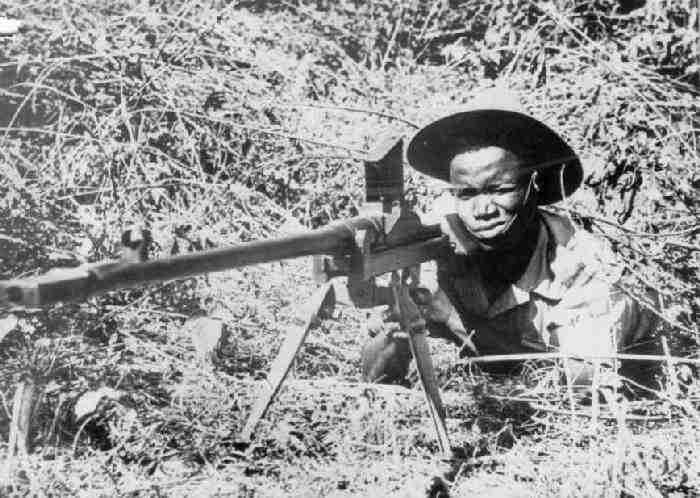
Figure 1.--Here we see a rather young Sierra Leone recruit with the British Army in Burma. I believe he photograph was taken in 1943. The captioin read, "Kipling glorifued the African native as 'fuzzy-wuzzy, a damned good fighting man'. He was good when he only had a spear to fight with. He's really something when he gets behind a modern anti-tank rifle, as Sergeant Peter Levy is here. A native of Sierra Leone, Sgt. Levy is a member of the West African Force now in India, preparing to tangle with the Japs in Burma. These West African fighting men are experts in jungle warfare, many of them helped toss the Italians out of Ethiopia." I'm not sure how old Sgt. Levy is, but he seems rather young.
|
|
Sierra Leone is not a country normally associated with World War II. It was at the time Britain declared war on Germany (September 1939) part of the Empire. Thus the colony went to war with Britain. The British after the fall of France often talk of going it alone. In fact the British were never alone and over the long run the many parts of the Empire played major role. The contribution of Sierra Leone by itself was limited, but the combined force of the Empire was a major part of Britain's war effort.
The colony did not have any critical resources. The major exports were palm oil and peanuts.
The British recruited soldiers in Sierra Leone. There was no conscription, but tribal chiefs were used to encourage enlistment. There was also recruitment during World War I, but in World War II recruits in Sierra Leone and other African colonies (except South Africa) had greater combat roles. Many of the men recruited in Sierra Leone fought with the British Army in Burma. There was some war-time propaganda to explain what life might have been like under the NAZIs. Anti-British feeling was limited, but I.T.A. Wallace Johnson, Editor of the African Standard regularly criticized British colonial rule and the War which he saw as both the result of colonialism and capitalism. The British finally convinced him. The United States had a naval observer in Freetown. Britain after the War began to give the people of Sierra Leone more responsibility in the colony's administration. The British set up District Councils and a Protectorate Assembly (1946).
Royal West African Frontier Force
The West African Frontier Force (WAFF) was a multi-battalion field force, formed by the British Colonial Office to garrison the West African colonies of Nigeria, Gold Coast, Sierra Leone and Gambia (1900). It was much less expensive to use colonial peoples to police the colonies than the British Army. Their pay was a fraction of the pay of aritish soldier. Of course arming colonials has potential dangers for the colonial power. They were of course a racist era treated very differently. Their officers were British. And we can see sharp differences in the This can be seen in the uniforming. The WAFF for example was barefoot. This was standard for all the European Africal colonial forces. Initially the African soldiers may have preferred bare feet to boots, especially as some of the colonial forces were formed in the 19th century. This was still the case during World War I unless deployed to Europe. We still see this after World War I. We suspect that it was not just money, but retained to maintain the status of the British offivers. The WAFF received royal patronage, becoming the Royal West African Frontier Force (RWAFF) (1928). A Sierra Leone member of the RWAFF, Emmanuel Cole (1908–1972), wrote a letter of protest to his commanding officer, asking that the African soldiers be given he same treated the same as the British soldiers of the same rank, including given the same footwear (1939). When his letter was ignored, he organised a strike and as a result was charged with mutiny. Despite this, changes followed and the RWAFF was issued boots. And they played a much larger role ithan in World War I. They were not deployed to Europe, but did participate in Burma as part of the CBI theater (figure 1). .
Declaration of War and the Empire
Sierra Leone is not a country normally associated with World War II. It was at the time Britain declared war on Germany (September 1939) part of the Empire. Thus the colony went to war with Britain. The British after the fall of France often talk of going it alone. In fact the British were never alone and over the long run the many parts of the Empire played major role.
Resources
The contribution of Sierra Leone by itself was limited, but the combined force of the Empire was a major part of Britain's war effort.
The colony did not have any critical resources. The major exports were palm oil and peanuts.
Recruitment
The British recruited soldiers in Sierra Leone. There was no conscription, but tribal chiefs were used to encourage enlistment. There was also recruitment during World War I, but in World War II recruits in Sierra Leone and other African colonies (except South Africa) had greater combat roles. Many of the men recruited in Sierra Leone fought with the British Army in Burma (figure 1). Some of the soldiers appear quite young. I'm not sure what the age restrictions were.
British Propaganda
The British made some effort at war-time propaganda to explain what life might have been like under the NAZIs. Anti-British feeling at the time was limited.
Opposition
I.T.A. Wallace Johnson, Editor of the African Standard regularly criticized British colonial rule and the War which he saw as both the result of colonialism and capitalism. The British finally interred him. There was certainly much to criticize in the British administration of Sierra Leone. The British did little to develop the colony and made little effort to prepare the people for self government. Johnson's criticisms, however, were both wrong headed and largely the regurgitation of Marxist doctrine. The war of course was the result of colonialism, efforts by the Fascists and Soviets to carve out empires. And the NAZI attitude toward Africans was much more sinister than that of the British. Capitalism with all its imperfections was the major force in generating wealth and industrial development. Johnson's views, however, were widely shared among the African intelligentsia. These misconceptions were to be a major factor in the failure of independent African states after the War. Economic production and living standards in most African states declined after independence.
Strategic Importance
Freetown is the site of an excellent natural harbor making it an important naval asset during World War II. For a time after the fall of France, Vichy control of West Africa colonies like Senegal and Guinea posed a potential threat to British control of the south Atlantic sea lanes. Sierra Leone's location along the West Africa coast was of some importance in the naval war in the South Atlantic, although we do not have details at this time. Freetown was a convoy staging area. A convoy from Sierra Leone to England apparently distracted German U-boats at the time of the Torch Landings (November 1942). The U-boats sank 13 ships in that convoy, but failed to intercept even one of the 340 ships involved with Torch. A number of survivors of ships sunk by the Germans were brought into Freetown. The United States had a naval observer in Freetown.
Menace (September 1940)
Evelyn Waugh's intelligence group reached Freetown (September 1940), but failed to gather much useful information. This was in preparation for Menace, the seizure of Vichy controlled Dakar. They failed to detect the Vichy reinforcement of Dakar or the fact that the authorities there were loyal to Vichy. The Free French British force reached Dakar (September 23). They tried to persuade the Vichy forces to come over to the Allies. They then attempted to take Dakar by force of arms. Efforts were made September 24-25, but without success. Dakar would remain in Vichy hands until after Torch (November 1942).
Post-war Era
Britain after the War began to give the people of Sierra Leone more responsibility in the colony's administration. The British set up District Councils and a Protectorate Assembly (1946).
Sources
Crowder, Michael. World War II and Africa: Introduction.
CIH -- WW II

Navigate the CIH World War II Section:
[Return to Main World War II S-Z country page ]
[Return to Main World War II country page ]
[Return to Main Sierra Leone history page]
[About Us]
[Aftermath]
[Biographies]
[Campaigns]
[Children]
[Countries]
[Deciding factors]
[Diplomacy]
[Geo-political crisis]
[Economics]
[Home front]
[Intelligence]
[Military forces]
[POWs]
[Resistance]
[Race]
[Refugees]
[Technology]
[Totalitarian powers]
[Bibliographies]
[Contributions]
[FAQs]
[Images]
[Links]
[Registration]
[Tools]
[Return to Main World War II page]
[Return to Main war essay page]
[Return to CIH Home page]
Created: 3:46 AM 8/7/2007
Spell checked: 12:25 AM 5/10/2017
Last updated: 6:57 AM 6/12/2017