**
war and social upheaval: World War II --Soviet Occupation of Poland: Displaced Children
Soviet Occupation of Poland: Displaced Children (1939-45)
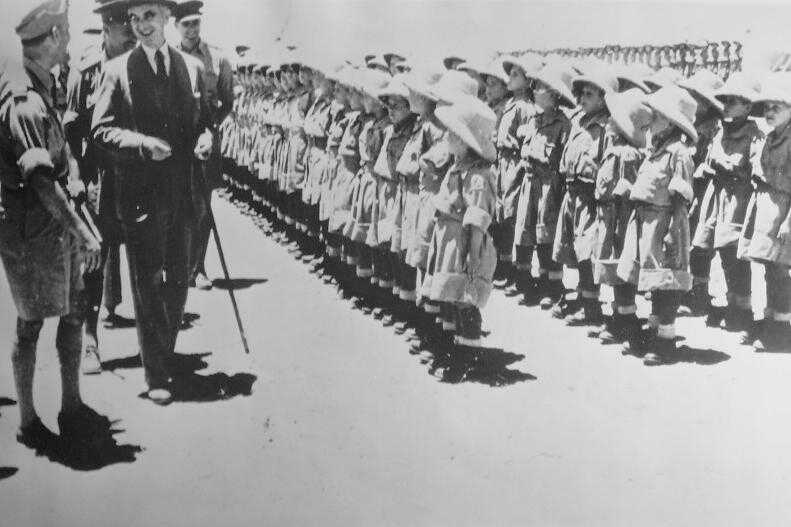
Figure 1.--This press photo of Polish children was taken in Iran during World War II (September 26, 1943). They were Polish children from the families the Soviets deported to Cental Asia. They managed to survive and reach Iran. The caption read, "'Junakas' Polish Boy Scouts in the Middle East, are reviewed by Polish leaders and Sir Harold McMichael (in civilian clothes), British High Commissioner. The Polish children who crossed the Soviet Union to get to their haven in the Middle East are cared for by the Polish Red Cross and their expenses are paid by Polish Government. Almost 250,000 Polish children are in camps from India to Mexico; most of them with no knowledge whether their parents are dead or alive." They seems to have been given British Army uniforms. Notice how the caption is written to obscure the fact that they and their parents were deported by Soviet authorities as part of a ruthless suppression of the Polish people in the areas of Poland occupied by the Red Army (1939-41).
Most World War II accounts of Poland deal with the German invasion and horific NAZI occupation. In fact, Poland was invaded by two countries in 1939, NAZI Germany and Soviet Russia. Although England and France decalred war on Germany, they wisely did not declare war on the Soviet Union. They almost did when the Sioviets next invaded Finland. For many Poles, the Soviet invasion and occupation was also disatrous because the Soviets had the same goal of wiping out Polish nationality. In fact the Soviets at this stage had more experience in repression than the NAZIs and set about repressing the Polish nation more forecfully at first than the NAZIs. [Davies] The murder on Stalin's orders by the Soviet NKVD of the Polish army officers in the Katyn forest was part of this process. The Soviets, however, did not have the added racial dimension that made the NAZI occupation so deadly, esopecially for Jews, but Chritain Poles as well. Poland was the testing ground and Generalplan Ost.
The Soviets set about deporting large numbers of Poles in an effort to Russify areas of eastern Poland. (This area had been a matter of a territorial dispute and a war between Russia and Poland following World War I.) Many children were caught up into the mass relocations as the Soviets moved whole families into Central Asia and Siberia. Because of the primitive conditions and lack of preparations, many of those transported perished. There are many tragic accounts. One Polish boy, Stefan Wassilewski, remembers being dragged from his bed in the middle of the night by a Russian soldier, herded onto a crowded refugee train along with his mother and younger brother, and transported thousands of miles across Europe to Kazakhstan. He was separated from him family and never saw them again. [Hicyilmaz] Some of the children somehow made it to Allied occupied Iran where the Polish Government in Exile with Allied assistance were able to care for them. A desparate Stalin after the NAZI invasion (June 1941) decided to give the 0.5 million surviving Polish soldiers in POW camps the choice of fighting with the Red Army or joining the fight in the West. This was part of the Polish-Soviet Agreement signed with the London-based government in exile (July 1941). The 1.5 million Polish civilans deported by the Soviets were were also released, although we have few details. The men were released to travel to Iran and eventually joined the British 8th Army in the Western Desert campaign. Children and other civilians also made their way West. This included a group of Polish Jewish children.
Dual Invasions (September 1939)
Most World War II accounts of Poland deal with the German invasion and horific NAZI occupation. In fact, Poland was invaded by two countries in 1939, NAZI Germany and Soviet Russia. The Soviets strick just as the Poles were attem,pting to establish a defensive line in the east. Although England and France decalred war on Germany, they wisely did not do so on the Soviet Union. They almost did when the Soviets next invaded Finland (November 1939).
For many Poles, the Soviet invasion and occupation was also disatrous because the Soviets had the same goal of wiping out Polish nationality. In fact the Soviets at this stage had more experience in repression than the NAZIs and set about repressing the Polish nation more forecfully at first than the NAZIs. [Davies] The murder on Stalin's orders by the Soviet NKVD of the Polish army officers in the Katyn Forest was part of this process. The Soviets, however, did not have the added racial dimension that made the NAZI occupation so deadly, especially for Jews, but Chrsitain Poles as well. The Soviet terror in Poland was every bit as terrifying as in German occupied Western Poland, although the Jews were not especially gtargeted. [Montefiore.] Soviet authorities targeted groups of people they thought might oppose Soviet rule or who might become the nucleus for Polish national resistance. The Soviets arrested and imprisoned about 0.5 million Poles (1939–41). They executed about 65,000 Poles. The remainder was sent to the Gulag. When a father was arrested and shot. This put the entire family endanger and undermined the ability of a mother to care for children. Those targeted included government officials, officers, and what might be considered the traditional 'enemies of the people' (the clergy, noblemen, and intellectuals (judges, lawyers, teachers, professors, authors, cultural icons, and many more). The Soviets in addition to outright executions set about deporting large numbers of Poles, primarily from eastern Poland in an effort to Russify the area. (This area had been a matter of a territorial dispute and a war between Russia and Poland following World War I.) The NKVD deoported some 1.5 million Poles. One report suggests that, for example, 10 percent of the population of Kresy was deported (by November 1940). Some of the deportations were conducted in the dead if winter. A source reported that 30 percent of those deported were dead by Spring 1941. [Montefiore, p. 313.]
Children Displaced in Soviet-occupied Poland (1939-41)
Many children were displaced in Soviet occupied Poland. Most of the Polish Arny was interned by the Germans or Soviets. This meant that many families no longer had a bread winner. Single mothers were hard put to care for the children. Unlike western Poland, there was very little fighting in eastern Poland. Thus few mothers were killed. Still caring for children was very difficult for single mothers.
NKVD Deportations (1940-41)
The Soviet using using the NKVD carried out four mass deportations of Polish civilians from Eastern Poland. The Soviet invasion ooccurred September 1939 and the deportations began only a few months later. They may have been delayed by the Soviet invasion of Finland as it did not go well (November 1939). Had the Germans not invaded (June 1941), there would have been more. February 1940: The NKVD forced some 250,000 Poles on to 110 trannsport trains and sent to Siberia (February 10). They were families rounded up from rural areas. They used unheated cattle cars in the middle of the winter. This was dine knowing that many of the deportees would perish in the bitter cold. April 1940: The NKVD located 300,000 Poles, mostly women and children onto 160 transports (April 13). They were deposited at unprepared communities in Kazakhstan and Altai Kraj. June/July 1940: The NKVD deported 400,000 Poles to Archangielsk and Sverdlovsk, Novosibirsk, and iother nortghern towns. June 1941: The NKVD deported som 280,000 to different locations in the Soviet Union. [Anttolak]
Children Deported by the NKVD (1940-41)
Many children were caught up into the mass relocations as the Soviets moved whole families into Central Asia and Siberia. In the process either because oparents died or the dislocations, large numbers of children were displaced. Because of the primitive conditions and lack of preparations, many of those transported perished. There are many tragic accounts. One Polish source estimates that some 90,000 of those deported were children (below the age of 16 years). [Grupińska] That may be a low estimate. One Polish boy, Stefan Wassilewski, remembers being dragged from his bed in the middle of the night by a Russian soldier, herded onto a crowded refugee train along with his mother and younger brother, and transported thousands of miles across Europe to Kazakhstan. He was separated from him family and never saw them again. [Hicyilmaz]
Soviet Orphanages
Soviet authorities also invaded Poland (September 1939). Soviet officials established orpahanages for Polish children in both occupied Poland and in various areas of the Soviet Union. We do not know much about orphanaages in occuipied Poland. There were both existing orphanages and new orphanages set up by the Soviets. We have little information about these orphanages. And these orphanages were overrun by the Germans (June 1941). There were also orphanages set up by Soviet officials in different oparts of the Soviet Union, especially the areas to which Poles had been deported.
Orphanages in Poland
We do not know much about orphanaages in Sovietv occuipied Poland. There were both existing orphanages and new orphanages set up by the Soviets. We have little information about these orphanages. We do not know to what extent the existing orphanages were allowed to continue operating. Many were supported by the Church. The Sioviets began to implementan an atheism campaign. And these orphanages were overrun by the Germans (June 1941). We have no idea what happened to them under German occupation. And to what extent the Germans allowed food to be allocated to orphan cvhildren. A major aspect of Grman policy at the time was the Hunger Plan.
Orphanages in the Soviet Union
There were also orphanages set up by Soviet officials in different parts of the Soviet Union, especially the areas to which Poles had been deported. We do not think much effort was made by Soviet authorities to assist Polish orphans in areas to which families were deported, at least we have been able to find little evidence if it. Apparently some of the exiled Poles established orohanages, but again we have almost no information on these instititions. We do note evidence of Polish orphanages after the German invasion (June 1941) and Polish-Soviet Agreement (July 1941). It is not entirely clear when these orphanages were established in may ahave been before diplomatic relations were restored, but information only became available after the resumption of diplomatic realtions. The Poles learned of the existence of quite a number of Soviet orphanages caring for Polish children. Polish officicals compiled a list of 65 Soviet orphanages caring for Polish children (August 1942). They were caring for both orphans and half orphans (generally children without fathers for which the mothers could not care). Three of the best known are ones supported by Anders Army while still in the Soviet Union: Buzułuk (Buzuluk), Guzar, and Wrewskoje. Annders Army was allowed by Soviet authorities to move to Iran (March-August 1942). Some 7,000 Polisgh children from the Polish orphanages were also allowed to leave the Soviet Union and followed Ander's Army to Iran. At this time, Soviet authorities began to disband Polish organiozations that had developed and took over Polish orphanages that were being operated by Poles and proceeded to end the Polish character of these orphanages. The next year there was a change of Soviet policy and began to allow separate orphanages for Polish children (August 1943). This appear to have resulted from requests from the Polish units that had agreed to fight with the Red Army--Związek Patriotów Polskich--ZPP) The soldiers fighting for the Red Army wanted their families to be assisted. Local Soviet authorities were ordered to allow orphanages to be set up and supported. Some 90 orphanages were set upm in the Soviet Union (Russian, Kazakh, Kirghiz, Tajik and Uzbek republics). The children were mostlyb from Poles deported by the NKVS (1939-41). They included both Christin and Jewish Poles. Soviet officials after the War, transported these children back to Poland (February-June 1946). The transports went to Gostynin and from there the Orphans were sent on to orphanages located throughout Poland. Some 6,700 Polish chiklden were repatriated to Poland (1946), a small fraction of those deported. [Grupińska]
The NAZIs and Soviets after invading Poland, paritioned Poland (September 1939). This was provided for under the terms of the NAZI-Soviet Non-Agression Pact. Both countries launched a horific occupation designed to destroy not only the country, but the very notion of Polish nationality. Polish leaders and the iunteligensia were arrested and many executed in an effort to ensure that Poland would never again become a nation. The NAZIs pursued this policy throughout the War. Soviet policy changed after the NAZI invasion (June 1941). Stalin saw the Poles as possible allies. The Germans rapidly occupied the Societ eastern zone of pre-War Poland, but the Soviets had large numbers of Poles, both POWS and civilians deported from Poland as part of the process of suppressing Polish resistance. As a result, the Soviet Government signed an agreement with the London-based Polish Government in exile which invalidated the border arrangenents negotiated with the Germans (July 30, 1941). The agreement also changed the status of the Poles detained in the Soviet Union. They were given the choice of fighting with the Red Army or joining the Polish forces fighting with the Western Allies.
Reza Shah Pahlavi's central foreign policy of playing the Soviet Union off against the British worked for a while, especially when the Soviets and Germans as a result of the NAZI-Soviet Non-Aggression Pact (August 1939) became World War II allies. This changed abruptly after the NAZIs invaded the Soviet Union (June 1941). With the Soviets and British Allies, Reza Shah's neutral regime with pro-Axis leanings was isolated. Even with huge German advances in the Soviet Union and the Afrika Korps success in the Western Desert, Iran was exposed and had no way of receiving NAZI assistance. And also because of geography, Iran became critical to the Allied war effort. Getting war supplies to the beagered Red Army became a high priority for not only the Soviets and British, but the Americans as well who passed the Lend Lease program even before entering the War. The British had only limited aud to offer the the Soviets. The United States on the otyher hand was mobilizing its vast economy for war and massive shipments were being organized. The most direct route to the Soviet Union for both th British and the Americans was the Arctic convoys, but the Germans throuh U-boats, surface ships, and Norwegian air bases made that the deadliest run in the entire war. Shipping through Iran was longer and thus required more shipping per ton of supplies delivered. It was, however, much safer. And one of Reza Shah's development projects, the new Trans-Iranian Railroad, provided the means of getting war supplies to the Soviet Union. It connected Persian Gulf ports to the Soviet border. Shipping war supplies through Iran, however, would violate Iranian neutrality and Reza Shah refused to grant permission. This proved to be his undoing. The British issued another demand that Reza Shah expel German technicians. When he refused, this time they acted. The British and Soviets launched a coordinated intervention (August 26, 1941). The Soviets invaded from the north. The British from Iraq where they had defeated a pro-Axis rebellion and by troops landed along the Persian Gulf. There was only limited Iranian resistance. The Soviets and British quickly took control of Iran's communications and coveted railroad. The Americans soon followed to make vast improvements in Iran's antiquate railroads.
Anders Army (1941-42)
Poles deported by the NKVD suffered hard labor, disease, and starvation. Soviet citizens also suffered because of the War effort, but the Poles were in a particularly bad state, having been deported under terrible circumstances. After the German Barbarossa invasion (June 1941), Stalin ordered the release of General Wladyslaw Andersfrom the Lubyanka prison in Moscow to lead a revived Polish Army. A desperate Stalin, faced with the collapse of the Red Army all along the western border of the Soviet Union, sought to mobilize a new Polish Army immediately to throw at the Germans. Stalin undr pressure from the Western Allies moved to renewd diplomatic relations with Poland, in this case the Polish Government in Exile. An agreement between Stalin, Churchill, Eden and the Polish government-in-exile in London led by General Sikorski was signed (July 30, 1941). This required the Soviets to release all Poles held to form an revived Polish Army. The Soviets announced an 'amnesty' (July 1941). The news did not reach some of the more remote camps until December. At some camps it never arrived and the Poles remained in the Soviet Union. The Polish military commander in exile, General Sikorski, named General Władysław Anders as commander of the new army. Anders was at the time being held by the NKVD in the feared Lubyanka prison in Moscow. Stalin ordered him released (August 4, 1941) with instructions to organise a reconcstituted Polish army. Many Poles had to travel from Central asia, but some came all the way from Siberia. There were various routes to the Iran. Rumours spread that Stalin was going to allow Poles to leave the Soviet Union.
Polish and Soviet officials signed a formal military agreement was signed (August 14). The subsequent Sikorski-Mayski agreement (August 17), required Stalin to declare all previous pacts with NAZI Germany to be null and void, invalidating the Soviet-NAZI partition of Poland. This mean releasing tens of thousands of Poles held in Soviet forced labour camps in what Stalin insisted on calling an 'amnesty', suggestung that 1,7 million entirely innocent Poles had commited some kind of crime. Stalin also agreed that this new military force would be under the command of the Polish government-in-exile. The news led to a desperate jouney toward Central Asia. As a result of the Polish-Soviet Agreenent, many men were released from labor camps. Women and children joined the exodus. Some were able to get on trains. Siome got on truck fior pt of the journey. Many came on foot, incredible given the dustances--in some cases thousands of miles. Polish officials set up reception camps on the borders of Iran and Afghanistan. One author describes it as an "exodus of biblical proportions in terrible conditions". Many already in a weakebned state froze to death, starved, or died of illnesses becuse they were in such a poor state. Sime managed to stay alive by selling meagre personal items. There were reports of exhausted mothers, unable to walk any further, placed their small children into the arms of strangers to save them from virtually certain death. [Antolak] This probably occurred along rail lines with mothers thrusting their children into the hands od stangers on trains. The Soviets set up army reception camps in Tashkent, Kermine, Samarkand and Ashkhabad where the men could enlist. For these men, food and provisions were available.
Polish Army Reconstituted
The first commander to begin the process which was conducted in Soviet Central Asia was General Michał Tokarzewski (August 17). The NKVD had deported hundreds of thousands of Poles to Central Asia.
Tokarzewski began in the town of Totskoye (Orenburg Region) where he awaiting Anders. Anders issued his first orders as commander (August 22, 1941). Military formations began to organize in the the Buzuluk area of Orenburg Region. Recruitment began in the NKVD forced labor camps. About 25,000 soldiers (including some 1,000 surviving officers) had been recruited and formed into three infantry divisions (the 5th, 6th and 7th). (Menachem Begin, a future Isreali Prime Minister, was among those who volunteered). Another division (the 8th) was formed ( spring 1942). The formation was moved to Tashkent. Stalin wanted to immediately throw the Poles into the fight against the Germans. Anders managed to persuade him to wait until the Poles had recovered their health and strength. After 2 years of hard labor and limited food in Soviet labor camps, the men were in no condition to fight. The Anders Army would make up the bulk of the Second Corps of the Polish Armed Forces in the West. By the time they reached the 8th Army, the Germans had been defeated in North Africa. The Poles fought under British command in Italy.
Civilian Exodus
It was not just the Polish men who wanted out of the Soviet Union. The deported women and children alo wanted out. Soviet officials made, howver, no priovision for the civilians. Only the men who enlisted in the military got food and supplies. The civilians thus camped around the military bases hoping to get food. One Polish author writes, "Instead of increasing provisions to the camps, the Soviets actually cut them." [Antolak] The Polish Army responded by enlisted as many of the civilians as they could. This included the children of both genders and ages, the only way of preventing them starving to death. "In the baking heat, dysentery, typhus, and scarlet fever became rampant. Communal graves in Uzbekistan could not keep up with the numbers who were dying. By 1942, only half of the 1.7 million Polish citizens arrested by the Soviets at the start of the war were still alive." [Antolak]
Soviets Allow Limited Exodus to Iran
Stalin, pressured by the Western allies, allowed a fraction of the Polish forces to leave the Soviet Union through Iran to join the Western allies. A small number of civilians were allowed to accompany them. We do not yet have details on this. Most had to remain behind. The evacuation was mostly by sea from Krasnovodsk to Pahlavi (Anzali). Oil tankers and coalers were used. A smaller number was evacuated overland from Ashkabad to Mashhad. There were two phases: March 24/April 5 and August 10-30. Some 115,000 Poles were evacuated. This included 37,000 civilians, about 18,000 of whom were children. We have seen larger numbers. One source climed that 300,000 Poles made it to Iran. A makeshift tent city soon spang up. The Iranian army provided over 2,000 tents. It extended for several miles on either side of the lagoon around the port. Authorities created a complex of
bathhouses, latrines, disinfection booths, laundries, sleeping quarters, bakeries and a hospital. Authorities requisitioned every unoccupied house in the city and even chairs from the movie theaters. The Iranian and British officials had not expected women and children and had no idea about the phyical state of the Polish refugees.
The Soviet badly overcrowded. Many of the people were walking skeletons wearing rags and infested with lice. The polish author writes, "Holding fiercely to their precious bundles of possessions, they disembarked in their thousands at Pahlavi and kissed the soil of Persia. Many of them sat down on the shoreline and prayed, or wept for joy. They were free at last!" [Antolak] In their weakened state, many died in Iran. Thousands of Polish men, women and children are buried in Tehran's Dulab cemetery. Almost all of the gravestones gare the same date--1942. Some 2,800 Polish refugees died within a few months of arriving and are buried in cemeteries throughout western Iran. [Faruqi] Stalin let some 115,000 Poles leave. Many of the men volunteered to join the British 8th army in the Middle East. The women and children remained in Iran for the remainder of the War.
Some 18,000 Polish children reached Iran. Many were girls. We are not sure why that was, probably many teenage boys managed to join the Army. Not all of them were orphans. Some had parents, but had become separated. The condition of the children was especially desperate. They were terribly emaciated and dangerously malnourished. Orphanages were immediately set up in Pahlavi, Tehran, and Ahvaz to deal with the children on an emergency basis.
The first major orphanage was opened in Mashhad and was operated by an order of Christian nuns (March 12 1942). The children at this orphanage were mostly those who had been transported overland by trucks. Authorities chose Isfahan as the principal center to care for the Polish children, especially the younger ines under age 7 years. The first children arrived April 10. The pleasant surroundings and healthy air of this beautiful Iranian city were seen as a kind of sanatiorium where the children could have a better chance of recovering their physical and mental health.
The British and Amerucan provided emergerncy aid supplies. The local people in a charitable spirit welcomed the children. Iranian civil authorities as well as some private individuals vacated premises to accommodate the children. Schools, hospitals and social organizations quickly appeared to cater for the needs of the children. The young Shah took an interest in the Polish children. He allowed them to use his swimming pool. He invited groups to his palace for dinner. Some of the children began studying Farsi and recited Persian poems to a delegation of Iranian officials. Authorities allocated twenty-four areas of the city to the Polish children. Isfahan became fixed in Polish émigré circles as The City of Polish Children. Most of the children were Polish Catholics. There was also a small group of Jewish children. In their case, deportation probably saved their lives.
Iran was the only available gateway out of the Soviet Union for the Poles deported by the NKVD (1939-41). Ideally they could have used the Trans-Siberian Railyway. Stalin did not permit this even though trains moving east usually had plenty of space availavle. These were people that he was not all that excited to allow out of the Soviet Union haaving deported them from Poland. They were a suspect group. The only way out was to walk and with the Germans to the west and the Arctic Ocean to the north, the only way out of the Soviet Uniomn was south through Iran. It was was only exit point and a rare outlet for the many different people deported by the NKVD. Iran was never to be a permanent haven. When thy began arriving in Iran (1942), shipping was at a premium for priority military transport. As war conditions gradually improved and American Liberty ships added to the allied merchant fleet, transport became available. Ships carrying Lend Lease supplies to the Soviet Union arrived in Irania ports full and generally left empty. As a result, the Polish refugees in Iran were gradully relocated. This included many children. D.P camps were opened in British colonies and Dominions: India, Indian Ocean Islands, New Zealand, Tanganyika (modern Tanzania), and the United Kingsom itself. Mexico took in some of the children. As a result the U.S. Coast Guard got involved in moving the children to safety. The major exit port from Iran was Ahvaz near the port of Basra in Iraq. The port had been modernized and expanded by the United states. An area of the city is still called Campolu from Camp Polonia. The last children departed Ahvaz (June 10, 1944). The last transport of orphans overland left Isfahan for Lebanon (October 12, 1945).
After the German invasion of the Soviet Union (June 1941), British and Polish relations with the Soviet Union were transformed. The British and Jews in Palestine began sending relief supplies to the Poles being held in the Soviet Union, often in terrible conditions and arrangements were made for Poles who desired to leave the Soviet Union. This only became possible after the Soviets and Britain intervened in Iran (August 1941). The Arabs in Palestine had no interest in assisting the Poles. The Jews did. This newspaper after an agreement was reached between the British and Soviet Governmebts February 1, 1942, describesthe effort in Palestgine. "The Soviet and the British governments have reached an agreement under which Palestine inhabitants will be able to send packages of food and clothing duty-free to the Polish citizens now stranded in Soviet Russia as refugees, it was learned here today. The packages will have to be transmitted through the Red Cross in Palestine and their weight is not to exceed five kilos, about twelve and a half pounds.
It was also learned here today that the Soviet authorities have permitted the first group of 600 Polish and Jewish children from the parts of Poland formerly occupied by the Soviet armies to proceed to Palestine. The children have lost their parents or were separated from them during the war and were being cared for in Soviet child-welfare institutions. They are expected to reach Palestine within the coming fortnight.
A report reaching Polish circles here today by cable from Moscow states that Mrs. Sommerstein, the wife of the leader of the Jewish fraction in the Polish, parliament, has been released from Soviet internment and is now in Bukhara. The whereabouts of her husband are still unknown. Similarly the whereabouts of the famous Bobover Rebbe who was interned by the Soviets as a Polish citizen, has not yet been ascertained." ['Soviet permits ...'] The article is notable for the obvious glossing over the fact that Poles were in the Soviet Union because Stalin invaded Poland as a NAZI ally and like the NAZIs brutally supressed the Polish people. While many Poles (mostly the women and girls) stayed in Iran for the duration.' Others were relocated in various British colonies (India, Palestine, New Zealand, and British Africa) as well as in Mexico. Many of the military age men and many boys wanted to join the fight against the Germans. This meant traveling from Iran to Egypt which was apparently done through Palestine. The first Polish refugees fromthe Soviet Union raeched Palestine (summer 1942). They were boys and some girls (aged 14 to 18 years) who were members of a scout organization formed by the Polish Army. This was in part a subterfuge so he children would qualigy for Soviet rations. The Scout transports reaching Palestine, were directed to Camp Bashit. They were divided into groups and began their education, including military training. The older boys could eventually transfer to Anders Army which became the reconstituted Polish Army. Two schools were established for them for instruction in Polih (August 1942). One school was for the younger children (aged 8 –15 years) and the other for the older children. Classes began (September 1, 1942). These Polish schools operated in Palestine until the British began to leave (1947).
Some 1,632 students attended. Other Polish schools were opened in Egypt (Tall al Kabir and Heliopolis). There were 26 schools opened for Polish refugee children in the Near East during the War.
Sources
Antolak, Ryszard. "Iran and the Polish Exodus from Russia 1942".
Davies, Norman. Book TV, C-Span 2, October 20, 2004.
Faruqi, Anwar. "Forgotten Polish Exodus to Persia" AP release (November 23, 2000), p. A45.
Grupińska, Anka. "Zapisywanie świata żydowskiego w Polsce" (recording the Jewish environment in Poland).
Montefiore, Simon Sebag. Stalin: The Court of the Red Tsar (Vintage Books:New York, 2003).
"Soviet permits children to proceed to Palestine, allows parcels to Polish Jews," (February 2, 1942). We do not know what newspaper this article appeared in, but was archived by JAT.