|
World War II left large numbers of people homeless are far removed from their homeland. Millions of homes had been destroyed. Whole populations had been removed. The Soviets transported large numbers of people from the Baltic Republics to Siberia. Poles were moved west. Chechens and other peoles were also transported. The NAZIs of course targeted the Jews for death camps. Many Poles were transported from the areas of Poland incorporated into the Reich. The Germans brought millions to the Reich for slave labor labor. Many were young people without children, but some had children which were left behind. Many parents
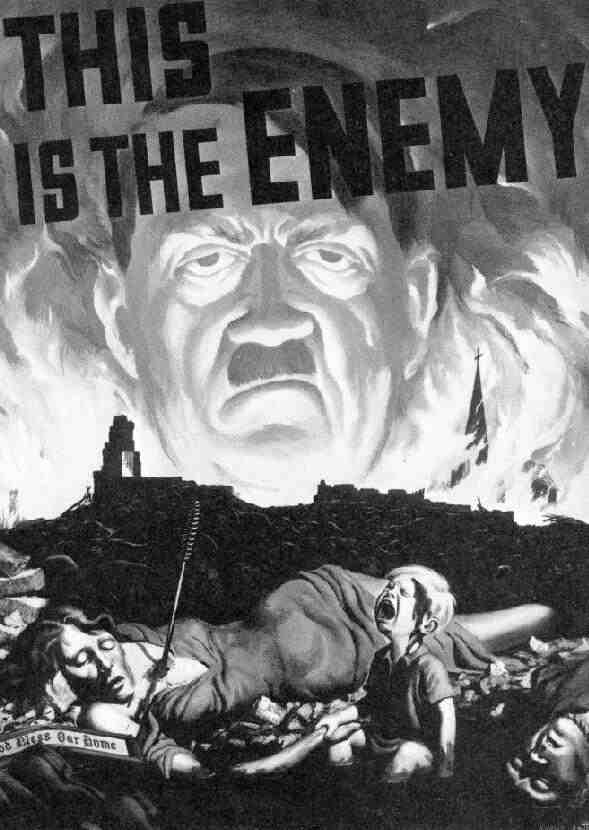
were killed in the bombing and shelling. Among the displaced were huge numbers of children. The children were of course the least likely to survive. If separated from their parents their chances were not good. Jewish children were among the first to be killed by the NAZIs because they had no economic value which could be exploited. One can not forget the images of the starving Jewish children in the Warsaw Getto whose parents had been killed and they were left alone. Even non-Jewish children were unlikely to survive without their parents. But many did survive and at the end of the war there were hundreds of thousands of displaced children. Adding to the human tragedy were millions of Germans streaming back to the Reich to avoid the Red Army. After the War German populations in Poland and other countries were forcibly transported to occupied Germany.
World War II left a sea of misery in its wake, millions of displaced people throughout Europe. The most tragic of all were the children. The numbers involved are unknown. In many areas they were on their own. The Germans were activeky unvolved in killing Jewish children. Other children were in their own. The Germans might not shoot them, but they were not about to feed them or devote resources for their care. In fact the NAZI Hunger Plan actually planned to use strbation to eliminate tens of millions of people in many ethnic groups, especially the Slavs. Thu millions of people wandered NAZI occupied areas with no one to care for them. Mny perished, epecially in the East and Balkans as well as Japanese occupied areas in Asia. The pictures of the rged and starving survivors encountered by Soviet and Allied armies are heart rending.
The experience of children during World War II dependened on where they lived and in NAZI occupied Europe, their ethnicity. For American and Canadian children, their primary problem was that they were separated from their their fathers and brothers. The experience in Europe was far different. Britain was not occupied, but large numbers of children were evacuated to the countryside and separated from their families. Even so many civilians, including children, were killed during the Blitz and later V-1 and V-2 attacks. Rationing was very strict. In NAZI occupied Europe, the situtation was far bleaker. The situation of displaced children and the situation concerning children generally varied greatly from country to country. This was primarily because of the radically different policies that the Germans persued in different countries. Race or actually a perception of race was a factor which strongly affected German attitudes. It was the Jews that the NAZIs targeted with a vengence, but large numbers of other children were also killed, especially Slavic childern in the East. After America entered the War and the strategic bombing campaign intensified, large numbers of German civilians, including children, were also killed. Massive number of displaced persons, many of them children, after the War were left in desperate circumstance.
As boundaries were altered large regions and provinces were transferred from one country to another.
Unlike regions along Germany's eastern border, when France regained control of Alsace-Loraine, there was not a whole-sale transport of Germans back to Germany. The French who were relocated by the Germans got their property back, but there was no large-scale repatriation of Germans.
The NAZI and Soviet invasion of Poland launched World War II (September 1939). Britain and France declared war on Germany (September 3). Grand Duchess Charlotte joined King Leopold III of Belgium and Queen Wilhelmina of the Netherlands in maintaining their neutrlity and urged a negotiated settlement. The Grand Duchess ordered the recruitment of an additional 125 man company of volunteer reservists. The Grand Duchy's military had no idea of resisting the Germans. The Commandant, Major Emile Speller began planning a campaign of passive defense. Speller sought to minimize any civilian casualties by evacuating border villages and to delay German units a few hours so that those wishing to flee could do so and reach Allied lines. As part of the German Western Offensive, Wehrmacht units entered Luxembourg for a second time (May 10, 1940). The NAZIs justified the attack, as they did in 1914, as a military necessitated by Allied war plans. The Germans claimed that the Allies were
planning to attack Germany through the Low Countries in cooperation with the Belgians and Dutch In the ensuing NAZI ocupation, the Jewish children were the most affected. Non-Jewish youth were also affected. Many youths were deported for forced labor. Some of the firt were the school children that had demostrated against the Germans. Other youths wee conscripted after the Grand Duchy was annexed to the Reich (1942). There was little damage and loss of done during the German invation (May 1940), but considrable damage was done after the American liberation when the Germans recooupied the Grand Duchy as part of th Battle of the Buldge (December 1944-January 1945)
Slovenia was occupied by Italy and Germany as part of the invasion of Yigoslavia (April 1941). The german sector of Slovenia was annexed to the Reich.
The Sudetenland is German term for a frontier region of German-speaking people, meaning the "southern lands" in German. The Sudetenland is the area bounded by the Sudeten Mountains on the north the Erzgebirge Mountains on the northwest and the Bohemian Forest to the west. The Sudetenland was part of the Austro-Hungarian Empire until 1919 when it was awarded to a new Czecheslovakian nation created as part of the Versailles Peace Treaty. The population before World War II largely consisted of Sudeten Germans. NAZI agitators in the 1930s brought about the Munich crisis. As a result, Britain and France at Munich acceded to awarding the Sudetenland to the Germans. Prime Minister Chamberlin returned to London and proclaimed that he had achieved "Peace in our times". Hitler if he had stopped here would have probably been regarded by Germans as one of the greatest leaders in German history. The Sudentenland was critical as it constituted a natural barrier without which, the defense of Czecheslovakia was impossible. The NAZIs proceeded to dismember the rest of Czecheslovakia in 1939 during the months leading up to World War II. The Sudentland was annexed by the Reich. The NAZIs proceeded to Germanize the population, forcibly removing Czechs. The region was restored to a revived Czecheslovakia in 1945 after World War II and the Sudeten Germans forcibly relocated to Germany. The Sudentenland is today part of the Czech Republic.
Children were a special category of displaced persons after the War. The conly more tragic aspect than the number of displaced children, was the huge number of children killed in the War. This was not just the colateral damage of the War, but Axis genocidal policies. And the NAZIs as part of its genicidal policies actually specifically targeted children. The survivors was a heart wrenching one and difficult to deal with because so many children were separated from their parents. Often the parents were killed in the War. Others were seized and transported to the Reich for slave labor. No provision were made for any dependants left behind, both children and the elderly. As part of the NAZI Hunger Plan these people were to be left to starve. The Germans did not feed slave and forced workers adequately. They had no desire to feed 'non-workers'. Jewish childrern were a special category, but very few managed to survive. Children were especially vulnerable to the Holocaust. The children were not only the most vulnerable, but actully targeted by the Germans as part of the Holocaust killing plan. Children were also caught up in German anti-partisan campaigns. Many children were affected by the loss of their parents. This could be because their parents were killed in the fighting or caught up in NAZI sweeps to secure forced labor for the war industries. Some children were kidnapped by the NAZIs as part of the SS Lebensborn porogram. Other had fathers who were soldiers and killed in the War or held as POWs after the War. In Eastern Europe there were often no organized group to assist them because of German occupation policies. As the War turned against the Axis, we begin to see displaced children in those countries as well. There were, however, the most likely children to survive because Allied war policies were not genocidal in nature and there were programs in those countries to aid children both duing and after the War.
The term mascot is most usully used to describe animals adopted by World War II soldiers. These were nostly, but not exclusively dogs. Virtually all armies had them, affected by popular attitudes toward animals in each combatant country. These mascots were different than the animals used in the war effort. Rather the animal mascots were pers to comfor the soldietrs. They were generally discouraged by commanders, but the desire of the men was so strong that this was difficult to enfoce in oractice. World War II was a massive cataclism that affected virtually every part of the world in on way or another. And because of the intensity of the War and the genocidal policies of German and other Axis nations, many more civilians than combatant were killed. While children were the most vulnerable, in mny cases it was the parents who were killed or transported for forced labor. As a result, Europe and Asia were awash with tens of thousands of orphaned children in desperate need. The soldiers who waged the war could not help but be affected by the plight of civilans. This was lss true of the Axis countries because of the racist policies of their Governments and goals of destroying whole nation states and policies of ethnic cleansings. Some of the children, always boys, attached themselves to groups of soldiers. This was discouraged by higher command, but it did occur. There were several instances of this. We know more about the U.S. Army that other armies. It was most noted in Italy, but there wew mny examples in the Pacofic. There was also some noted mascots adopted by the Germans, mostly children they believed to be ethnic Germans. There were before the War, German minoritie ctterd all over Eastern Europe. A few of these children were ctually Jews.
Perhaps the last tragic event of World war II occurred after the War. The Allies repsatriated about 1 million Soviet citizens that mannaged to make there way to Western Europe. This included men and women as well as children, often whole families. Much of this was done by the British. It was done 1-2 years after the war in 1946-47. Many believed that the British would never send them back. Some were the men Soviets who fought unfer Vlasov against the Soviet Union. There were also Krasnov Cossacks, and Moslems. Stalin ordered the aduilts committed to the Gulag where thgey perished. [Solzhenitsyn, Gulag, p. 85.] We are less sure whast happened to the children.
The needs of the World War II DPs was anticipated by the United States. American authorities were not fully warare of the enormity of the NAZI crimes in the occupied countries, but it was clear that there were large numbers of displaced persons. The United States thus helped established and fund the United Nations Relief and Rehabilitation Administration--UNRRA (1943). The purpose of the new agency was to provide services for the postwar refugees and to help repatriate them to their own countries. UNRAA was not created specifically to assist Jewish refugees, but refugees in general. Because of NAZI race policies, however, Jews were the group most affected by the War and in need of assistance. While established in 1943, UNRAA could not begin its principal work until NAZI occupied Europe was liberated. UNRRA opened camps in North Africa and began prepsrations for its work when after D-Day and Soviets offences in the East, the NAZI empire was rapidly dimantalled. UNRRA was in place when Germany surrendered in May 1945, and organized the homeward journey of most of the refugees. UNRRA set up refugee camps in old schools, military barracks, even barns. These camps were meant to be short-term transit camps, and in fact most non-Jewish refugees within a year and a half had been returned to their home countries. Jewish refugees, however, presented an especially difficult problem. [Greenfeld] In most cases they were unwilling or unable to go home. Returning people to Soviet occupied countries was another major problem.
At the end of World War II there were millions of displaced persons around the world. The problem existed both in Europe and in Asia. The problem was especially severe in Europe. There were different clsses of DPs, including POWs, slave laborers, and people targeted for genocide, but not yet killed. Because a major support for the NAZI war effort was the use of slave labor, many of the DPs were the slave labor force. The NAZIs drafted most of the phsically fit German adult male population for military service. By the end of the war teenagers and old men were being drafted. Because the NAZIs refused to use married women in war industries, the only available source of labor was POWs and slave labor from occupied countries. Some workers from neutral countries like Spain were actually paid, but most of the labor was slave labor conscripted from occupied countries. Thus there were million of foreign workers brought nto the Reich to work in factories, mines, and farms. Children were also involved because of the Holocaust and Lebensborn programs. As a result when the NAZIs surrendered (May 7, 1945) there were millions of foreign displaced persond (DPs) ers in the Reich from every country in Europe. Many were abused and mistreated and by the end of the war large number had persished because of outright murder or the apauling conditions. There were also Jewish survivors of the Holcaust. Of course only a small fractions of the Jews deported to camps survived,
The Allies set up displaced persons camps to provide emergency assistance to the DPs as to help them return to their home countries. Some of the DP camps were established in former NAZI concentration camps. One of the most notable was the Jewish Camp set up in the former NAZI Bergen Belsen conentration camp.
Laura Pringleton has prepared an excellent overview of the World War II from a children's perspecrive. She explains, "My rationale for choosing this subject is found in the aim of the course itself. World War II, although enduring only four years for Americans, has played a sizable
part in the history of American Children�s Literature, both in itself and in its preparation and wake. There have been many books written about the war that pertain to the people who were children at the time of siege and about their coping and survival. I myself was a child during the war years and remember quite keenly that at the time my reading habits were being formed and becoming fixed. I thought that there was very little literature then about the war and that most, if not all of it , had been written immediately after and beyond the war itself. However, Jean Wood Garrison�s survey shows that over 300 books with war-related themes were published for children during World Wars I and II in England and over 400 in the United States. She categorizes her plots as follows: (a) home front, (b) home front in other countries, (c) evacuation, (d) flying, (e) sea action, (f) spies, (g) land fighting, (h) animals, (i) sabotage, (j) girls in action, (k) training and (l) miscellaneous or
undetermined. Garrison found that there is no significant difference in the English and American books. She found very few books of quality and only a few that are now still in print. [Garrison, 1981] "
The heart rending human drama involved with the Hollacaust and displaced people has been the subject of many films. Often these films deal with children and in some cases the film centers on the child. "Watch on the Rhine" is set in the period leading up to the War. A film about the German invasion of France is "The Pied Piper (1942)". One particularly notable film in the U.S. film The Search (1948) about a boy from an unidentified country who an American G.I. helps unite with his mother who survived the War. Anothger important film is "Europa, Europa" (1990). Films concerning the Pacific theater include: "Empire of the Sun" (1987) and "Three Came Home".
Children were a special category of displaced persons after the War, a heart wrenching one and difficult to deal with because so many children were sparanted from their parents. Often the parents were killed in the War. Others were seized and transported to the Reich for slave labor. No provision were made for any dependants left behind, both children and the elderly. As part of the NAZI Hunger Plan these people were to be left to starve. The Germans did not feed slave and forced workers adequately. They had no desire to feed 'non-workers'. Jewish childrern were a special category, but very few managed to survive. Children were especially vulnerable to the Holocaust. Children were also caught up in German anti-partisan campaigns. Many children were affected by the loss of their parents. This could be because their parents were killed in the fighting or caught up in NAZI sweeps to secure forced labor for the war industries. Some children were kidnapped by the NAZIs as part of the SS Lebensborn porogram. Other had fathers who were soldiers and killed in the War or held as POWs after the War. In Eastern Europe there were often no organized group to assist them. As the War turned against the Axis, we begin to see displaced children in those countries as well. Thry were, however, the most likely children to survive because Allied war policies were not genocidal in nature and there were programs in those countries to aid children both duing and after the War. American aid as in World War I played a key role in saving countless lives. Some mothers or other family members were unable or unwilling to care for them. Even if mothers did care for them, they often lacked the supervision and support supplied by a father. Schools all over Europe were destroyed. This was a major problem in Germany whose cities were reduced to piles of rubble. And there were also the war orphans, children who lost both parents nd did not have reltives willing are able to adopt them. Orphanages and groip homes were opened in belligerant countries. The nature and extent f these institutions varied from country to country. Some fortunte children were adopted by people in fireign countries, primarily America.
HBC has archived several accounts about individual boys in various sections of the site. They cover both the European and Pacific theater. Not all come to mind at the momment, but we will begin to list them here. Jim Ballard was the British boy in "Empire of the Sun" (1987), the film version of his book. Stephen Brooks was a Burmese-British boy caught in Burma during the Japanese invasion. Tsvi Nussbaum was the Polish boy with his arms raised in the famous photograph from the Warsaw Getto. Solomon (Solly) Perel, was the boy whose War-time experiences was the basis for "Europa, Europa" (1990). There are many accounts from the evacuations of British, but relatively few about German children. There are many accounts from the Hollocaust.
Garrison, Jean Wood. "A Comparison of Selected Factors in Children�s Realistic Fiction Having War-Related Plots Published in England and the United States during World Wars I and II." Ed.D. dissertation, Temple University, 1981, 193 pp., DA 42:1930A.
Greenfeld, Howard. After the Holocaust (Greenwillow Books/HarperCollins Publishers, 2001).
Rhodes, Richard. Masters of Death (Knopf, 2002).
Solzhenitsyn, Aleksandr I. The Gulag Archipelago (Harper & Row, 1974), 660p.
Stueck, Rudi. E-mail message, April 22, 2003.

Navigate the CIH World War II Section:
[Return to the Main Children in World War II page]
[Biographies]
[Campaigns]
[Children]
[Countries]
[Deciding factors]
[Diplomacy]
[Geo-political crisis]
[Economics]
[Home front]
[Intelligence]
[Resistance]
[Race]
[Refugees]
[Technology]
[Bibliographies]
[Contributions]
[FAQs]
[Images]
[Links]
[Registration]
[Tools]
[Return to the Main World War II page]