War and Social Upheaval and Children: Country Trends (1939-45)


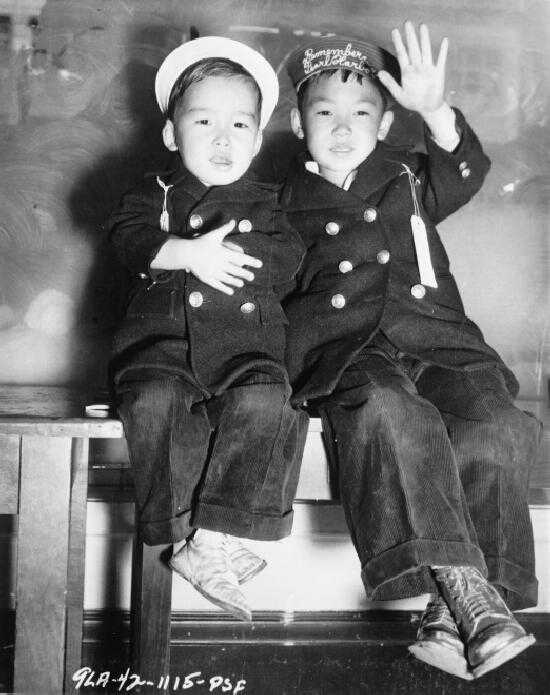
Figure 1.--It was not just European and Asian children that were impacted by World War II. Although not separated from their patents, Japanese-Americans in Pacific coast states were interned in concentration or relocation camps as they were called. Italian and German families wre also interned, but only those who parents have been involved in subversive activites. These two San Francisco boys, one with strip "Remember Pearl Harbor" on his hat, wave good-bye while awaiting the bus. Notice how the older boy is holding on to his little brother.

The experience of children during World War II dependened on where they lived and in NAZI occupied Europe, their ethnicity. For American and Canadian children, their primary problem was that they were separated from their their fathers and brothers. The experience in Europe was far different. Britain was not occupied, but large numbers of children were evacuated to the countryside and separated from their families. Even so many civilians, including children, were killed during the Blitz and later V-1 and V-2 attacks. Rationing was very strict. In NAZI occupied Europe, the situtation was far bleaker. The situation of displaced children and the situation concerning children generally varied greatly from country to country. This was primarily because of the radically different policies that the Germans persued in different countries. Race or actually a perception of race was a factor which strongly affected German attitudes. It was the Jews that the NAZIs targeted with a vengence, but large numbers of other children were also killed, especially Slavic childern in the East. After America entered the War and the strategic bombing campaign intensified, large numbers of German civilians, including children, were also killed. Massive number of displaced persons, many of them children, after the War were left in desperate circumstance.

America

American children were not affected by World War II like children in Europe and Asia. The Atlantic and Pacicfic Oceans acted as an effective barrier to the Germans and Japanese. Many American children lost their fathers, but unlike European children were not orphaned or displaced. American children, however, did particiapte in a variety of war-time activities to support the war effort. Children studied current events. Air raid drills and alerts were common. Both children and their families were involved with conservation and recycling of goods. The Scouts and other youth groups were actively involved in may home-front activities. Children often worked in sponsored rallies, parades and cultural events (such as dances) to raise money to buy war stamps and bonds to finance the war. Some children were more adversely affected by the war. Although not separated from their patents, Japanese Americans in Pacific coast states were interned in concentration or relocation camps as they were called. Italian and German families wre also interned, but only those who parents have been involved in subversive activites.

Australia

We do not know much about Australian children during World War II. A few Australian children along with English, American, and Dutch children were interned by the Japanese in concentration camps. The death rates in these camps through mistreatment, starvation diets, and disease were apauling--especially among the children. Children were kept with their mothers until about 12-13 years of age when they were moved in with their fathers or ther men. The movie "Three Came Home" (1950) was I believe based on the experiences of an Australian family. Had the Japanese not been forced to surender in September 1945 very few of the surviving internees and POWs would have lived. Japanese operations against Australia itself were limited to a few incidents such as the bombing of Darwin. This could have been different had a small American carrier task force not turned the Japanese back at Coral Sea (April 1942). (At the time Australia was virtually defenseless. Most of the Australian Army was in North Africa fighting Rommel.) As a consequence of Coral Sea and the later American victory at Midway (June 1942), Australia became a rear area of the War where an influx of American soldiers equipped with a tidal wave of supplies prepared for the offensive against the Japanese. Australian children were involved in a variety of home front activities.

Belgium

The Belgium war orphans were a major issue in World War I. The Germans invaded Belgium in an attempt to outflank the French Army. It almost succeeded, but the gallant resistance of King Albert I and the Belgian Army slowed the Germans down just enough that the French stopped them at the Marne. As a result, much of the war in the West was fought in Belgium, creating a humnaitarian dissaster. World War II was different. The Germans invaded on May 10, 1940 and succeeded in taking the suposedly impregniable Eban Emal fortress on the Albert Canal. As a result, King Leopold III was forced to surrender the Belgian Army on May 28, 1940 as the British were preparing to evacuate at Dunkirk. After the British evacuation of Dunkirk, there was little fighting in Belgium until the after D-Day when the Allied forces moved north in an effort to liberate Belgium and the Netherlands. The last German offensive of the War was launched through the Arndennes into Belgium, in an effort to retake the key Belgian port of Antwerp. We do not yet have details on the plight of displaced children in Belgium during World War II, but hopefully our Belgian readers will provide details.

Canada

The Canadian mainland like America was untouched by the War. The Canadian war experience was a little different than the American experience. This was primarily because Canada went to war with Britain in 1939. War was automatic in 1914 when Britain went to war against Germany. Constitutional changes after the War gave the Dominions the right to decide. Canada and the other dominions loyally followed Britain to war with Germany in 1939. Canada like America had been adversely affected by the Depression, but with the increase in military spending even before te War began, there was a return to propsperity. The draft of men for the military meant a shortage of labor, quite a shift from the Depression years. In America many women and teenagers entered the workforce. We have no details about Canada, but assume the same took place there as well. At this time we have no detailed information about Canadian children during the War. The principal adverse impact to children was the absence of their fathers who were stationed abroad and for some the loss of teie fathers. Canadian soldiers were mostly stationed in England and them after D-Day in France and the Low Countries before entering Germany in 1945. There were plans to evacuate British children to Canada and the other Dominions, but after ships with evacuee children were torpeoded, these plans were cancelled.

Czechoslovakia


England

Another factor that has to be considered in assessing World War II is the number of displaced children and children who lost one or both parents. A variety of factors are involved here. Many London and other city children were sent to live with family and strangers in rural areas that the Germans did not target during the Blitz and subsequent bombing. Some were sent to America and Canada, but this was stopped after some of the ships were torpedoed by U-boats and after the Battle of Britain it was clear that German invasion was not emmenent. Another factor were the civilian casualties. The horrendous casulties in World War I were virtually all male combatents. Substantial numbers of civilians were killed in the Blitz and later V-1 and V-2 attacks and huge numbers of homes destroyed. This was quite different than World War I because of the bombing of English cities resulted in substantial civilian casulties. One Londoner tells that after a V-2 hit a crowded London Wollsworth in 1944 that the neighbor children came by to say that "mummy hasn't come home yet". Many of these children were taken care of my surviving parents or families, but many had to be institutionalized. We have not yet assessed the impact of the World War II displacement on clothing.

France

A substantial number of French parents in Paris and other big cities during World War II and the immediate post-war (baby-boom era) sent children to live with family or family friends in the country. Only a few children were cared for in orphanages. This topic has not been adequately analized. The children were often raised by relative and sometimes did not return to their families for several years. They were thus sometimes raised differently than had they stayed in their parent's home. It often meant that the clothes and education were those of their grandparents or uncles and aunts. Many children left for only some months other were away for years. Some never returned home. For a child, even a short period seemed like a major part of his life. Some children were anxious to return home. Other children were not happy to come home at all. Sometimes the relatives did not want for the children to return home. Those children who lost their Parents were called "Les pupilles de la nation" (pupils of the nation) and were looked after as much as possible after the War. The French Government granted many adventages for their current life and career. Despite all the assistance, those children were traumatized. A classic movie telling one of these cases "Les jeux interdits". Virtually every French person has seen this film and the music is known through the world. A French reader tells HBC that it is not possible to see this picture without some emotion.

Germany

German children through the Hitler Youth played an active part in World War II. The Hitler Youth movement was in fact a major support for the German war effort, both on the home front, supporting the anti-aircraft defense against the Allied bombing campaign, and actual combat roles with the Weheremacht and Volkstrum. After the war, however, there were large numbers od displaced children in Germany as well as the countries that the Grmans had occupied. The displaced children were te porphans resulting from battlefield deaths of partents as well as deaths from the Allied bombing campaign and the fighting in the final months in Germany. Many more oprphans were created in the caotic poupulation transfers from the German populations that had lived in East Prusia, Silesia, the Sedetenlands, and other areas in the east. Many Germans relaized that because of the NAZI atrocities, Germans could no longer live in Poland, Czecheslovakia, and other easter European countries. Many who did not understand this lost their lives in bloody reprisals or were forcibly transported after the War. There was also the problem of the foreign children brought to Germany under the Lebensborn program.

Greece

The Germans incaded Greece in April 1941 to assist the faltering Italians and secure their southern before invaing the Soviet Union. The Germans consiscated large quantities of food in Greece for shipment back to the Reich. The winter of 1942 was especially difficult. There was mass hunger in Greece. Children were the most vulnerable and thousands died of starvation in Athens along in the winter of 1942. Greeks organized one of the most effective resistance movements of all the occupied countries. The largest and most effective of the several Greek resistance groups was the National Liberation Front (EAM). The military arm was the National Popular Liberation Army (ELAS). The NAZIs answered guerilla actions, especially when German soldiers were killed, with the execution of civilian hostages. The hostages were usually men, but included women and youth, but usually not children. I am not sure if there were actual regulations here or if the NAZIs simply went by how old a child looked when selcted hostages. These actions, however, did create orphans or families left with only one parent, usually a mother. There were also some cases in which enired villages were burned to the ground and the peopled killed. In similar incidents in other countries (such as Lidice in Czecheslovakia), young children were often exempted, in some cases being used in the Lebensborn program. I am not sure if this was the case in Greece as the Germans were interested in acquiring light complexioned children. The Germans began to withdraw from Greece in September 1944 so as not to be cut off from Germany by the advancing Red Army. British forces landed in October. This did not mean the end of fighting. The British found EAM had gained control of much of Greece. Figting brok out between Greek factions. The British fought ELAS until early in 1945, when ELAS agreed to disband.

Italy

The Allied invasion of Italy (September 3-8, 1943) comenced a military campaign which began at the tip of the Italian border and continued north to the Po Vally until the Germans surrenderedc (May 1945). The fighting destated villages and cities all along the way. Large numbers of children were displaced as well as many orphaned. We have very few details on the dimensions of the problem are the measures taken by Italian authorities to deal with it at this time. We do known that an Irish priest, influenced by Father Flanigan's Boys' Town, organized Boys' Republic in 1945.

Lithuania

1 Lithuania declared independence from Russia in 1918 as a result of the disorders association with the end of World war I and the Russian Revolution. Fighting occurred ith both the Russians and Poles, but the country by 1920 had established its independence. The Ples, however, occupied Vilnius and Kaunas was used for the capital. Although largely Catholic, Lithuania broke relations with the Vatican after Rome recognized Polish possesion of Vilnius. Lithuania became one of the eatly victims of the NAZIs. There was a dispute between Germany and Lithuania over Klaipeda, a coastal city on the Baltic. Before World War I, Klaipeda had been part of German East Prussia. Without foreign support, Lithuania was forced to turn over Klaipeda to the NAZI in March 1939. Hitler traveled to Klaipeda on March 22 to celebrate another victory. Hitler and Stalin in a secret protocol to the NAZI-Soviet Non-Aggression Pact (August 1939). Lithuania and the other Baltic Republics fell into the Soviet sphere. Stalin finalized the seizure of the country in 1940 and ordered mass deportations to Siberia in an effort Russify the population. The Soviets ho had previously invaded Poland in 1939, transferred Vilnius back to Lithuania. The NAZIs occupied Lithuania in the opening days of Opperation Barbarossa--the NAZI invasion of the SovietUnion (June 1941). The NAZIs killed most of Lithuania’s 240,000 Jews. The tied of battle i Russia turned after the Soviet victory at Stalingrad (January 1943). The oviets retook Lithuania in 1944. Over 500,000 Lithuanians were deported, forced into exile, jailed or shot. Many had collaborated with the Germans.

Luxemburg

NAZI Germany's invasion of Poland launched World War II (September 1, 1939). Britain and France declared war (September 3). Grand Duchess Charlotte joined King Leopold III of Belgium and Queen Wilhelmina of the Netherlands maintained their neutrlity and urged a negotiated settlement. The Grand Duchess ordered the recruitment of an additional 125 man company of volunteer reservists. The Grand Duchy's military had no idea of resisting the Germans. The Commandant, Major Emile Speller began planning a campaign of passive defense. Speller sought to minimize any civilian casualties by evacuating border villages and to delay German units a few hours so that those wishing to flee could reach allied lines. As part of the German Western Offensive, Wehrmacht units entered Luxembourg for a second time (May 10, 1940). The NAZIs justified the attack, as they did in 1914, as a military necessitated by Allied war plans. The Germans claimed that the Allies were planning to attack Germany through the Low Countries in cooperation with the Belgians and Dutch In the ensuing NAZI ocupation, the Jewish children were the most affected. Many youths were deported for forced labor. Some of the first were the school children that had demostrated against the Germans. Other youths were conscripted fir service in the Wehrmacht after the Grand Duchy was annexed to the Reich (1942). There was little damage and loss of done during the German invation (May 1940), but considrable damage was done after the American liberation when the Germans reoccupied the Grand Duchy as part of the Battle of the Buldge (December 1944-January 1945)

(The) Netherlands

The Dutch for racial reasons were not one of the occupied countries targeted by the NAZIs for destruction. Children were still affected. Dutch Jews were arrested as were Dutch politicans that were anti-NAZI as well as Ressiastance members. Jewish children were the least likely to survive. Many children had fathers or brothers interned as POWs. Some parents and relatives were drafted for slave labor in Germany. Many Dutch government and cultural institutions, however, were allowed to function as long as they did not interfere with occupation policies. Unlike countries in the east, the schools, for example, were allowed to continue opoerating. A Dutch reader who was a schoolboy at the time tells us that during the occupation, "We were not bothered by their propaganda at school, but the teachers learned to keep their mouths shut in regards to the occupying forces. The general atmosphere was very anti-German and more anti-Nazi, but the Germans did not try to 'educate' Dutch children like they did in their own country." Of course if the War had gone differently, the NAZIs would have made major changes in Dutch schools along the lines of their own education ststem. I was a boy during the German occupation of the Netherlands (1940-45). Despite the German attiyudes toward the Dutch racially, the Netherlands abd Dutch children still suffered terribly during the War. A Dutch reader who was a boy during the War writes, "We suffered terribly and nearly died of starvation. I could write a book about it. We did not live far from a village, Putten, where the entire population was killed as a reprisal for the murder of some high ranking Germans in that area. As far as I know Putten was the only place in Holland where women and children were shot. But nearly every occupied country had its "Putten", Ouradour in France, Lidice in Czechoslovakia come to mind." [Stueck] Dutch children were primarily affected at the end of the War where the civilian population east of the Rhine was close to statvation by the times the Allies liberated them in 1945. A reader reports, "We in occupied Holland were certainly happy to see the Canadian liberators. We were starving to death."

Norway

The Germans occupied Norway early in the War (April 1940). Norway ptoved useful to the NAZIs as naval and air bases made it difficult for the Royal Navy to bottle up the U-boats in the North Sea. Norway was also an important source of raw materials. Later after the invasion of the Soviet Union, the Germans were able to launch devestating raids on Allied convoys delivering war materials to Murmansk and Archangel. The NAZIs much admired Norway as a rich source of Nordic Aryan breeding stock. We do not yet have details on the extent to which the Lebensborn program may have operated in Norway. There does not seem go have been any organized kidnapping program as was the case in the East. The Resistance was active in Norway and numerous Norwegians were arrested and executed by the occupation authorities. We do not have details on their children. Most seem to have been taken in by family. The Germans maintained a substantial army of occupation. Later in the War, the Allies tried to convince the Germans that they were planning an invasion, to discouraging the Germans from drawing down the occupation force to strengthen the Atlantic wall in northern France. Thus over th 5 year occupation of Norways, there were many liasons between German soldiers and Norwegian women. After the War, these women were shunned. Over 10,000 children were born with German fathers. These children were also shunned and harassed. They were bullied at school and descriminated against when they began working. The Norwegian parliment finally offered a small cash payment as retribution (March 2005).

Poland

The NAZI occupation of Czecheslovakia had been brutal. The ocupation of Poland was savage. The NAZIs were determined to destroy every vestage of Polish national culture in an effort to wipe out the very idea of Poland. Their plan was to destroy the entire Polish intelegencia and reduce Poland to a kind of ignorant labor pool of mannual laborers for German industry and agriculture. The NAZIs began the process even while figting was still going on. Some children were actually shot, but many more died in the mass expulssions of Poles and Jews living in the areas of Poland annexed to the Reich. Polish children were also a principal target of the NAZI Lebensborn program.

Soviet Union

The NAZI-Soviet Non Agression Pact made World War II possible (August 1939). Hitler and Stalin were in effct allis for the first two years of World War II. After both counties invded Poland, he Soviets went on to invade Finland, Estonia, Latvia, Lithuania, and Romania (1939-40). The Soviets also fought a substantial engagement with the Japanese along the Chinese border. This of course changed when Hitler invaded the Soviet Union (June 1941). The resulting conflict was the most massive and most brutal in modern history. No one knows but perhaps 20 million Soviet citizens died in the struggle with the Germans. Hitler saw it as a war of anialation. Part of the purpose was to depolulate lage areas which could be colonized by Germans. The rmaining Serbs were to be used as a slave labor class. Himmler and other NAZI were especially concerned that as much as much Aryan blood be retrieved from the East as poosible. After the Stalingrad debacle in January 1943, Himmler ordered that trasit camps be set up for children and youths of suspects rounded up in anti-partisan operations.

Yugoslavia

All of Yugoslavs neighbors bit Greece by 1941 were under NAZI domination or influence. Prince Paul to avoid bloodshed felt obliged to sign a formal pact with Germany and Italy. Shortly afterwards, however, on March, 27 1941, he was unseated in a coup and the young King Peter II was declared of age. Within a week, Germany, Bulgaria, Romania, Hungary, and Italy invaded Yugoslavia as part of an offensive against Greece. The Yigoslav Government was forced to surrender. While a military disaster for the Yugoslavs, the Germans action forced them to delay the planned invasion of Russia. The precious weeks of delay was a critical element in the German failure to smash the Red Army before the onset of winter in 1941. King Peter II, with the Yugoslav Government, made his way via Athens, Jerusalem and Cairo to London where he joined numerous other governments in exile from NAZI occupied Europe. The NAZIs partioned Yugoslvia among allies and local clients. The northernmost part (Slovenia) was split. Part was annexed into German Reich. The other part of Slovenia and the Adriatic coastline of Croatia was goven to Fascist Italy. Macedonia in the south was given to Bulgaria. What remained of Yugoslavia was divided up between two NAZI puppet-states. Croatia which was compensated for the losses along the coast by being granted all of Bosnia. ) A NAZI controlled Government in Serbia was estblished headed by former royal Yugoslav army general Milan Nedich. Yugoslavia with the pent up natioanlist feelings before the War fueled by NAZI geocidal occupation policies became perhaps the greatest killing field of World War II. Perhaps no other European nation except Poland suffered more and tragically it was the Yugoslavs themselves more than the Germans that did much of the killing.

Sources

Rhodes, Richard. Masters of Death (Knopf, 2002).

Stueck, Rudi. E-mail message, Aoril 22, 2003.


HBC


Navigate the Boys' Historical Clothing Web Site:
[Return to Main displaced children page] [Return to Main World War II page]
[Introduction] [Activities] [Biographies] [Chronology] [Clothing styles] [Countries]
[Bibliographies] [Contributions] [FAQs] [Glossaries] [Images] [Links] [Registration] [Tools]
[Boys' Clothing Home]


Created: February 7, 2002
Last updated: 3:50 AM 8/6/2007