|
Japan did not sign the Geneva Convention. The Japanese martial code did not permit surrender and thus the Government saw no need to acceed to the Ruropean standards of warfare relected in the Geneva Convention. The Japanese treatment of POWs in World War II was barbaric. The most severe treatment was directed at the Chinese who were killed in large numbers by a variety of brutal means. American, Australian, and British POWs were starved, brutalized, and used for forced labor. The construction of the Burma-Thai railroad was a particularly horendous project in which malnourished British and Australian POWs were forced to do hard labor undervthe most extrene conditions. POWs were used as slave laborers, working in brutl conditiins, in many others areas such as Manchurian coal mines. Some were even used for medical experiments, including live vivisections and assessments of biological weapons. Some POWs were shot at the end of the War in an effort to prevent accounts of their mistreatment to become public. We are unsure how extensive such incidents were. We know of one such incident in the Dutch East Indies. The Japanese shot about 100 American contract workers on Wake Island.
Japan did not sign the Geneva Convention governing the treatment of POWs (1929). We are not sure why they refused. The Militarists by 1929 were becoming increasonly influential. Presumably as the Japanese martial code (Bushido) did not permit surender, they saw no need for adhering to the European standards of warfare reflected in the Convention. What we do not fully understand is that during the Russo-Japanese War (1904-05) and World War I (1914-18), Japan also took Western POWs. These POWs were not subjected to the horrendous treatment accorded to World War II POWs. The Japanese announced after the War began that they would adhere to some provisions of the Geneva Convention (1942). I do not have details on this decession. One would assume that it was a propaganda statement as Japanese treatment of POWs throughout the war was barbaric.
he Japanese military code was based on Bushido--unwavering allegiance to Feudal masters converted to Emperor and country. Bushido originated as the ethical code of Japan's medieval Samurai warriors. The central theme was unquestioning loyalty to their Feudal Daimyo (大名) or Feudal master -- an unquestioning obedience in all matters. Bushido has been likened to European chivalry --the ethical code of medieval knights. And there was a great deal of similarity. We note some objections to this with authors maintaining differences. First of all we have to understand that despite the legends that both Samurai and Knights in reality were more like armed thugs brutally treating the common people and defeated opponents. The major difference we see in moderating force of Western Christianity. Of course this also can be overstated. The Christian knights that fought the Crusades committed terrible atrocities. But this was a brutal age and Muslim forces were hardly the soul of the code of tolerance. justice, and mercy. But over time, Christianity moderated and channeled overall Western society in a more humane direction. This did not occur in Japan. Some Japanese authors contend that classic Bushido placed an emphasis on compassion, benevolence, and other non-martial qualities. his of course is how Western chivalry came to be viewed. There appear to be eight principal qualities emphasized by Bushido. they include: 1) Justice, 2) Courage, 3) Mercy, 4) Politeness, 5) Honesty, 6) Honor, 7) Loyalty, and 8) Self Control. Bushido was based on a belief in an absolute, universal moral code. Now we can question how close this came to the behavior of actual Samurai warriors came during the medieval and modern era. We believe that Western society developed in a more positive direction than Japanese society. This can be debated, but what can not be questioned is the fact that the Japanese military in the Meiji Era seized upon Bushido and its code. Among other matters, the Bushido code prohibuted soldiers from surrendering. It was seen as a loss of honor which the Japanese took very seriously. And they applied that concept to the unfiortunate soldiers that surrendered to them. According to one military historian, "those who had surrendered to the Japanese -- regsrless of how courageously or hionorably they had fought -- merited nothing but contempt, they had fofeited all honor abnd all rights to be treated with dignity or respct." 【Borch】 And eventually the miklitary fashioned Bushido it in its own image, not only as a code for the military itself, but after sizing control of the nation (1930s), imposed Bushido on the population nation as whole. The military retained many aspects of Bushido (Courage, Honor, and Loyalty), but displaced or reduced many other features (Justice, Mercy, Politeness, Honesty, and Self Control). Especially lacking was any degree of Mercy. What is observable is the difference between the behavior if the Japanese Army in previous wars. There were in the Russo-Japanese War (1905) and World War I (1914-18) none of the atrocities reported during World War II.
The Marines on Guadalcanal who began as raw recruitys with no bttlefield experience were shocked by Japanese brutality and the refusal to surrender. The Allies did take prisoners, but the fact that Japanese soldiers pretending to surrendr often tried to take out those around then with a grenade did not incourage the Mrines to accept soldiers trying to surrender. Even wounded Jaoanese would do this. Many of the Japnese who did survive were those too badly wounded to offer any resistance. The whole process brutalized the Marines far beyond the GIs in Europe. And they ended up returing savagrry with savagery of their own. The Marine never stooped to beheading prisoners and theur officers did not carry swords. It was a rare Banzai charge that was not led by a Japanese officer brandishinbg a sword. But quite a few Japanese were beheaded. The Solomon Islanders and New Guinea natives had a history of intra-tribal feuding. The Australian offivcials and missionaries had nearly ended the practice, but quite a few of the natives saw the defeted and starving Japanesde as fair game. Most hated the Japanese because they stole food and women. As a result quite a few Jaoanese heads could be found decorating homes and lodges after the War.
Kllling is of course central to the bussines of war. This is understood by all nations, but ovr time rules of war developed among nations, especially Western nations. And one of those most commonly recognized was that after a soldier surrendered, than the victorious nation was responsible for his care and wellbeing which was monitored to an extent by the Red Cross. The care of POWs was first codifded in the Hague Regulations (1899) and after World War I updated with the Geneva Convention (1928). Japan did not ratify the Geneva Convention, but that does not mean that they can not be held responsibk in the Court of Public Opinion for their barbarity. Killing enemy soldiers in battle is one thing. Killing soldiers after they surendered in murder pure and simple. There are tragically many well doumented incidents of the Japanese mudering POWs after they had surrendred and were disarmed. This included such incidents whereever the Japanese military went. But the Japanese were especially brutal in China, lerac=ving a bloody trail of millions of vivtims in their wake. It was a policy not only tolerted, bu ordered by the higerst levrl of commasnd. It was China where the War in Asia began. After seizing Manchuria (1931),the Japanese invaded China proper (1937). The Japanese claimed to be waging war to protect Asians and the drive the Europeans out of Asia. But even before actually launching the War (1937), but they they had been invading independent coubntries in Asi (China and Korea). And their treatment of Asians was unbelievably barbaric, much more brutal than their treatrment of Westerners. It is not entirely clear why thatbwas. This was espcially true of the Chinese, both civilians and military personnel. The treatment of Chinese military personnel was incomprehensible horific. Of course Americans and the other Western Allies know most about their own soldiers. Modt Americans know about the Bataan Death Msrch dufring which the Jopnese were especially brutal toward the Filipinos. The Japanese brutalized and killed many Allied POWs, both overtly and indirectly thriufgh midtreatment sbd stavation. but their actions against Westerners, were a tiny proprtion of what they did in China. Most but not all of the victims were Chinese. 【Kowner】 And for the most part they did not hold Chinese POWs long eniough to starve. They killed them in masny horrible wats, shooting, behading, bayonetting, drowning, burning, bearing alive, and other heinous methods. As a result, after the Japanese surrender (Seoptember 1945) when POWs were exchanged, despite ober 8 years of war and taking millions of POWs, the Japanese had virtually no Chinese POWs to repatriate in exchasnge for the lasrge nunbers of Japanese the Chinese had. The Japanese may have killed 30 million Chinese--the exact number will never be known. How many were soldiers and how many were civilians we do not know.
Japan after more than a decade of War had a serious manpower crisis. Men had to be conscripted from the work force to fight the Empire's wars. This began in Manchuria (1931), but in much larger numbers after Japan invaded China proper (1937). This only increased with the onset of the Pacific War (1941). The drafting of so many Japanese men for military service created a serious labor shortages.They were simply ran out of men to power the factories and mines essential to the war economy. The Japanese used Allied POWs for forced labor projects throughout the Japanese Empire. This was mostly in Southeast Asia where many of the Allied POWs were captured early in the War. This included the Americans captured in the Philippines. Many of the Americans were shipped North to help alleviate the labor shortages on the Home Islands and in Manchurian mines. The Geneva Convention prohibited using POWs in war industries or the construction of military fortifications and other facilities, but they could be used in other areas such as agriculture. The POWs in Southeast Asia and the South Pacific. Those prisoners shipped back to the Home Islands were commonly forced to work in mines and war-related factories under terrible conditions. Some of these men were shipped on to Manchuria. But in addition to these basic violations of the Geneva Convention was the brutality of the Japanese toward the POWs. This was part of a larger issue, the Japanese use of civilians in conquered areas for forced labor. This issue has clouded relations with Japan in the post war era. It is part of the reason that Koreans find it so difficult to normalize relations with Japan. The Allied POWs were routinely beaten, starved, denied medical care, and abused in countless ways, commonly for no real reason except to torment the prisoners. The fate of Chinese POWs was even worse, they were for the most part simply murdered in one of the most murderous racist atrocities of the War. The Japanese held men who surrendered in low regard. The prevailing code of Bushido did not permit the Japanese to surrender. And throughout the Pacific War the Japanese honor code prevented men from surrendering. On island after island the Japanese fought to the death. Many of the small number actually taken prisoner were men injured to the extent that they could not resist. Some 27,000 Americans were captured by the Japanese, a horrifying 40 percent died in Japanese captivity. Other Allied POWs fared even worse. The construction of the Burma-Thai railroad is the best known Japanese construction project and the fate of the POWs and Burmese civilians used to build it was particularly horrendous . Malnourished British and Australian POWs were forced to do hard labor while being fed starvation wages under the most extreme conditions. POWs were used as slave laborers, working in brutal conditions, in many others areas such as Japanese coal and copper mines and limestone quarries. Conditions were especially bad in Manchurian coal mines. There were Allied (mostly American) prisoners who were held at a forced labor camp near Hiroshima. Most survived the atomic bomb attack because they were deep underground in coal mines. A side issue here is that if you try to reserch this issue on the internet, much of what comes up is the American internment of Japanese-Americans. While this was unjust, the internees were not abused and starved or required to do forced labor. And did not die in the internment camps. This is one of countless examples as to how Google algorithms are purposefully designed to portray America in negative ways while obscuring positive aspects of American history and society.
Despite the hard labor they were put to, the POWs were fed very poorly. Often it was rotten or magot-infested rice. As a result they contracted scurvy and diseases associated with vitimin defincies like pellagra and beriberi. POWs had to supplement their rations with what ever they could find, including scorpions, snakes, and rats. Sanitation conditions were also poor leading to cholera, dengue fever, diptheria, and dysentary. The Japanese set up many different POW camps throughout Southeast Asia, the Home Islands, Manchuko, and Korea. Considerable information has been collected on these camps.
Thousands of Australian and British POWs suffered and died at the infamous Sandakan camp established in the in the Borneo jungle. The Japanese forced the small number who survived on a tortuous 160-mile march. Any one who dropped out along the way was summarily shot. In the end only six escapees survived to report what the Japanese had done. 【Tanaka】
Notice that there are no POW caps listed in China. This is because the Japanese simply killed all the Chinese POWs they captured except for those who agreed to fight for Japanese puppet leaders. The numbers of Chinese soldiers the Japanese killed, but must total several mullions. the
The Japanese also forcibly deported more than 1,000 indigenous inhabitants as labor to other occupied islands. They also exterminated the island's leper colony. They forced the island's 39 lepers on a derelict boat, the Japanese led them far out to sea and out of sight. Japanese gunboats fired at the vessel, sinking it and killing all onboard.
Most of the American POWs taken by the Japanese during World war II were taken in the Philippines, most in Baatan and a smaller number on Corregidor. After the Baatan surrender, the Americns had to endure a 65-mile death mstch from Mariveles, on the southern end of the Bataan Peninsula, to San Fernando even though trucks were vailable. the starving, disease-weakened Americans were forced on a ??-mile death march to Camp O'Donnel. Stranglers and those who collapsed along the way were kliiled, many bayoneted. 【Groom】 The Japanese soldiers conducting the march randomly beat the POWs. They were denied food and water for several days. The lack of water in the tropical heat was especially harrowing. Food tht was provided was inadequate. The POWs were allowed a few hours tgo sleep, but under conditions that made real rest difficult. Finally the POWs were cramed into suffocating box cars. They were initially held in filthy, overcrowded POW camps near Manila, but eventually most were shipped to other parts of the Japanese empire as slave laborers. The Japanese opened several camps, mostly using existing facilities. Most of them were eventually deported to work camps on Hell Ships. The conditions in these camps and on the Hell Ships were incredibly bad, primarily because of the decesion by Imperial Army commanders that most of the men should die and because of brutality of camp commanbders and guards. The Japanese camps in the Philippines included: (Los) Baños, Bilibid Prison, Cabanatuan, Davao Prison and Penal Farm, (Camp) Holmes Internment Camp, (Camp) John Hay, (Camp Manganese--Guindulman Bohol, (Camp) Malolos--Bulcan, (Camp) O'Donnell, Palawan, Puerto Princesa Prison Camp, Santo Tomas Internment Camp. The larger camps like Los Baños and Cabanatuan are well known. As a result of the conditions in the Japanese camps, some 40 percent of the American POWs died, but many died after neing transported from the Philippines. Many were actually mirdered, most died from abuse, inadequate food, unsanitary conditions, and lack of medical care.
Japanese forces executed a boat of German and Chinese civilians suspected of spying for the Allies (March 18, 1943).
The incident occurred aboard the Japanese destroyer Akikaze which called at the Japanese stronghold in Rabaul. hey picked up, German missionaries and Chinese civilians that had been living in the South Pacific islands of Kairuru and Manu. At sea the captain received orders to execute the entire group. This was conducted by quietly leading their victims one-by-one to the stern of the ship where a makeshift gallows had been erected. The victims' wrists were bound and attached to a pulley. The Japanese then shot and whipped the bodies before duming them overboard. The sounds of the ship, wind, and waves meat that the victims from learning what was happening until the last moment. It took 3 hours to kill all 60 civilans. Two children were simply trown overboard alive.
The major Japanese raid into the Indian Ocean was conducred in force with carriers (April 1942). After Midway, such major forays were no longer possible. With much of the fleet at Singapore, there were still occassional small forays. The last such
mission by surface ships occured (March 1944). Durin this raid, the Japanese heavy cruiser Tone sank the British merchant vessel Behar. They took on 108 survivors. Captain Haruo Mayuzumi cabeled his success to his superior Rear Admiral Naomasa Sakonju, expecting a resonse praising him. Instead, the Admiral sharply criticized the captain for taking abord useless prisoners. He ordered the captain to execute them immedately. Cpt. Mayuzumi appealed to the Admiral several times to spare the survivors. The Admiral would not hear of it. Mayuzumi finally carried out his orders. He divided the survivors into two groups composed of 36 and 72 men. The first contained the Behar's captain and other ranking personnel. Cpt. Mayuzumi transferred them to a second ship which freed them. The second group was murdered. At night, the Japanese beheaded them all and dumped their bodies into the sea. After the War, Sakonju was convicted of war crimes and hanged. Mayuzumi was given a 7-year prison tern for his role.
Japan had a substatial submarine force. Some of these subs were involved in war crimes. The I-8 ws responsible for two hideous actions (March 26 and July 2, 1944). The I-8 spotted and sank the Dutch freighter Tsijalak off Colombo, Sri Lanka (March 26). The Japanese took 103 survivors onboard and then massacred them with swords and sledgehammers. They then bound those still alive and left them on deck as the submarine dove below. Only five people survived the barbaric ordeal. Three months later they snk the U.S. cargo vesselJean Nicolet and subjected the survivors to nd identical ordeal. The Japanese sailors tortured and killed their prisoners by setting up a gauntlet of swords and bayonets and making them run through. The bodies were then tossed overboard. The Japanese finally dove after spotting an Allied aircraft with 30 prisoners on the deck. Only two dozen of the 100-plus people onbpord somehow survived.
The POWs were also subjected to savage treatment by the camp guards. Beatings with sticks and wire were common place. Guards devised a range of fiendish tortures. Lighted cigaretts butts were pressed to flesh and stick into noses and ears. There were crucifictions. Men were made to hold buckets filled with sand or water in the sun for hours on end. Men were forced to swollow gallons of water and then the guards kicked or jumped on their stomachs. There were also executions, including shootings and beheadings. One survivor describes his experiences as to how the Japanese guards disciplined POWs, "Their method was to strip you down, and then they'd put two buy behind you. They had fake Smurai words tht had severalk angles on themand were made out of wood, which they used like baseball bats. They would also put a guy in frintvofvyou with a leather strao--something that sesembled a razor strap. When they were ready they'd tell you how many times they were going to hit you. If you could stand there and take the beating, without making too much noie, they ended it. They'd give you the required number of swats and stop. If you fell down or if you yelled and screamed too loud, they started over." 【Smith】
Escape from German POW camps have become a matter of Hollywood legend. Escape grom a Japanese POW camp is a topic virtually uncovered by both Hollywood and historians, in part because it was so rare and almost suicidal. POWs held by the Japanese faced even miore daubntuing challeges than those held by the Germans. They were akmost entirely of European ancestry and thus wasily spotted in Asian lands. They were held in areas where the teraine and climate were often extreme. Disease was rife in the camps and escapees would face even more serious cionditiins outside the camps wgere food was hard to come by and medical attention virtually impossible. Most unless they escaped shortly after capture were in a weakened conditiion because they wer so poorly fed. Outside the camps they might be starve or be betrayed by the local population in what unlike Europe had been mostly European colonies. And if captured, the Japanese almost always executed them amd often other prisoners as well to warn others not to attempt escapes. There were, however, despite the dangers escape attempts. There are reports from China (Hiong Jong and other palces), the Dutch East Indies (Borneo), the Phillipines, and Thailand. Many come from the Philippines where the local population tended to be sympathetuic to the Amerians. One historian describes an incident in the Philippines. "Once McCoy's party was out of view of the main gate they ducked into a nearby coconut griove and began to crawl towards a place where they had hidden their escape equipment in the jungle. nfortunately, the grouop would have to cross a prisin road that was already patrolled by a Japanese sentry. 'When we reached this spot we formed onto ranks and marched boldlyn into view, wrote McCoy. 'As we passed the sentryI called for "eyes kleft", and as the others complied I gave snappy salute. This we never didexceopt for an occasional guardwho was a little less severe than the others; in payment for his kindness we thus attemopted ti hive him "face" with his suoperiors.' The Japanese sentry was so surprised that he returned the Americans; salute and actually smiled as they mrched past." 【Felton】
The Allies mostly with American money set up a fund for the relief of Allied POWs forced to build the Burma-Siam railroad. The governments of the United States, Britain and Sweden (representing the occupied Netherlands) secretly agreed on a plan in which money from each country would fund a Swiss bank account. This money was to be transferred to the International Red Cross for the Allied POWs most urgently requuiring relief, namely the men laboring on the Burmese-Siam railway. The United States contributed 2.8 million Swiss francs to the account and Britain and the Netherlands added additional funds (August 1944). 【Holmes, pp. 98-112.】 Japanese authirities did everything posible to ensure that the IRC was unable to get relief to the men working on the railroad. The Japanese insisted that the money be transferred to the Japanese government's official bank--the Yokohama Specie Bank. The IRC did this. The Allies eventually transferred 98.5 million Swiss francs. Very little of this money ever reched the POWs. The Japanese tried to use some of the funds to purchase artillery from the Swiss. The order was not filled and it is unclear just how the Japanese planned to get artillery through the Allied naval blockade. Some of the funds diappeared. Most remained in the Yokohama Specie Bank gathering interest. Eventually the funds wre returned tonthe IRC. Much of it was destributed as compensation to surviving POWs.
Among the POWs taken by the Japanese were Military nurses. The Japanese captured U.S. Army and Navy nurses on Bataan Corregidor (April-May 1942). They had become known as the Angels of Bataan or in some quarters the Battling Belles of Bataan. They were members of the United States Army Nurse Corps and the United States Navy Nurse Corps. One reasons Gen. Wainwright surrendered Corregidor was the Japanese threat to kill all who ciontuinyued to resist, including the nurses and wounded. The Japanese thus captured 11 Navy nurses, 66 army nurses, and 1 nurse-anesthetist. As far as we know, they were treated correctly by the Japnese and interned in camps set up in and around Manila. They continued to serve as a nursing unit in the various camps. A group of 65 Australian nurses and British soldiers were notv so fortunate. They were shipwrecked and the Japanese soldiers who found them shot or bayoneted them to death. The Japanese captured another group of 32 nurses on another island and sent them to Sumatra. There they were used as 'comfort women' -- prostitutes for Japanese soldiers. 【Tanaka】
Some Allied POWs were even used for medical experiments, including live vivisections and assessments of biological weapons. The research was part of the Japanese effort to develop wapons of mass destruction. The Japanese developed biological weapons at Unit 731, a sprawling research favility at Harbin in Manchuko--Japanese occupied Mnchuria. The work included experimentation on live subjects. The numbers killed are not known with any precision, but may have totaled as many as 0.2 million civilians and military POWs. Most of the individuals used for the experiments wrre Chinese and Korean nationals, primarily because they were the people most accessable. People selected for these experiments included children. Some Pacific Islanders as well as Allied POWs were also used for the experiments.
British signals sergeant Jack Edwards survived Japanese POW camps. After liberation he joined British and American war crimes investigating teams. They searched the remains of the Kinkaseki copper mine--POW Branch Camp No. 1, Formosa (Taiwan) (1946). The detailed records of German industrialists were captured by rapidly moving Allied invasion forces after they crossed the Rhine. The Japanese industrialists had more time to destroy or hide their incriminating records. 【Holmes, pp 129, 135-36.】 Among the burnt debris in the camp offices, Edwards found 15 handwritten transcriptions of broadcast orders dated April 1942 - August 20, 1945 from command headquarters in Tokyo. 【Holmes】 One of those documents was orders from the Japanese vice-minister of war to all POW camp commanders in the occupied territories and home islands (August 1, 1944). The orders were apparently in response to queries from the head of the POW administration on Formosa. At the time Formosa was believed to be a possible target for an American invasion force. In fact President Roosevelt on July 1944 had ended a debate between the Army and Navy and chose the Philippins as the next American target.] The Taiwan commander asked for clarification as to circumstances under which he should act on his own, anticipating an American invasion and a breakdiwn of communicatiins with heafquarter in Tokyo. The Vice-minister authorized camp commanders to kill all the POWs they held if "an uprising of large numbers cannot be suppressed without the use of firearms" or "when escapees from the camp may turn into a hostile fighting force" and "not to allow the escape of a single one, to annihilate them all, and not to leave any traces." 【Holmes, pp. 115-116.】 This order is of course prepostrous. The POWs by this time were emaciated and in poor health. Some were starving. The idea that these unarmed men could pose any kind of threat is absurd and both the officers who issued it and those who received it understood this fully. What this order was to kill the POWs before they were liberted so they could not testify against the Imperial Army and specific individuals, in essence a bloody cover up. An entry in the journal of the Japanese headquarters at Taihoku on Formosa (February 26, 1945) ordered 'extreme measures' to be taken against POWs in "urgent situations: Whether they are destroyed individually or in groups, or however it is done, with mass bombing, poisonous smoke, poisons, drowning, decapitation, or what, dispose of the prisoners as the situation dictates. In any case it is the aim not to allow the escape of a single one, to annihilate them all, and not to leave any traces." 【Daws, pp. 324-325.】 An official copy of the murder order was later found in the files of the Japanese Governor General of Formosa, Richiki Ando. 【Holmes, p. 121.】 Not only have these murder orders been found, but there are several instances in which they were actually carried out.
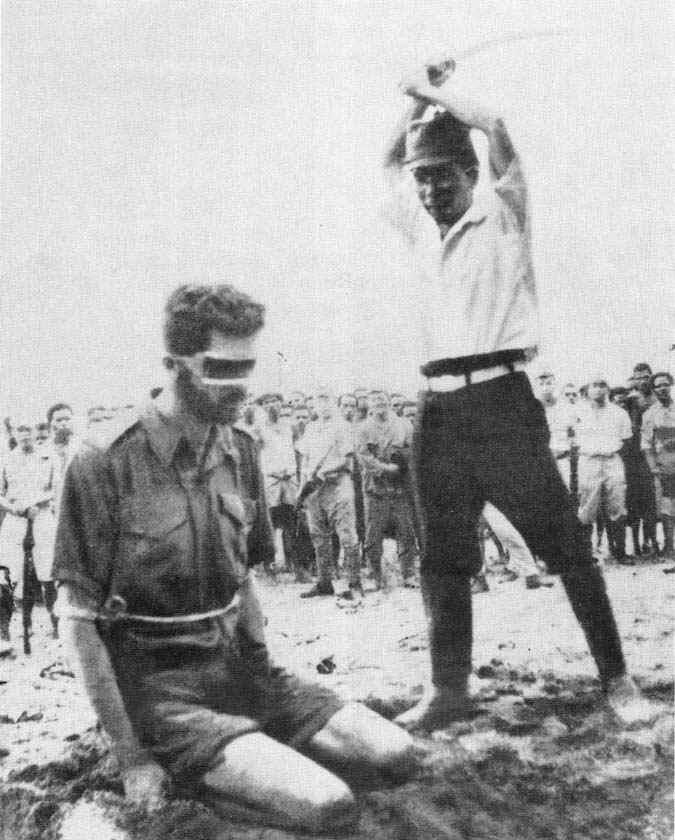
The Japanese murdered most of the POWs they captured. As horfific as the the GermAn and Soviet treatment of POWs were, they at least took POWS. Most of the POWs taken by the Japanese were simply murdered. Most of the POWs taken by the Japanese were Chinese soldiers. Virtually all were killed at the time of capture or soon after. The death toll was in the millions. The Japanese did not maintain POW camos for the Chinese. They simply murdered them after they surrendered and in unbelebly horific ways: bayoneting, burrying them alive, medical experiments, and other inhuman actions. The Japanese also murdered Allied POWs, but in much smaller numbers. Here there were two types of killing. Ome was murder en masse like the killing of Chinese POWs. The other was murder in the camps done individually, usually as a form of punishment, but not infrequently for no reason at all--simply for the pleaure of it. There are many documented reports. This began almost immediated after the Japanese launched the Pacific War. Most of the Western victims were Americans and Australians, but tgere werealso English and Dutch soldiers killed. Indians fighting with the Brirish were also killed. Most of the Allied fatalities were more from neglect, denying the POWs food and medical care. There were, however, numerous actual incidents of flagrant murder. Reports indicated that the Japanese upon seizing the Dutch East Indies forced some Australian prisoners in basket and them took them out to sea and throwing them overboard (1942). There were murders during the Bataan Death March in which about 1,000 Americans perished (April 1942). The deaths included Japanese officers wielding their swords, in some cases trying to cut off heads from moving automobiles (1942). The American survivors on Wake Island were murdered (October 1943). Most of the murders came later in the War. Some but not all camp commanders for various reasons executed orders recived from Tokyo to kill surviving POWs. As instructed, they murdered all or almost all the POWs in their hands. 【Holmes, p. 116-17.】 In almost all instances this occurred in circumstances that there was no danger of attack. One of the best documented murder incident was on Palawan, a narrow island in the eastern Philippines. The Japanese 14th Area Army Commander was General Tomoyuki Yamashita. His men to prevent the rescue of the POWs on Palawan herded the remaining 150 prisoners of war at Puerto Princesa into three covered trenches (December 14, 1944). The trenches had been dug earlier as air raid shelters. One man who after noting there were no approaching planes refused to go into the trenches. A Japanese officer cleaved his head in two with his sword. The Japanese then poured aviation fuel into the trenches and set them a fire. The POWs who tried to escape the inferno were shot. Others attempted to escape by climbing over a cliff that abutted one side of the trenches. They were also hunted down and killed. Only 11 men escaped the masacre. 【Wilbanks】 A POWs survived and made it back to Allied lines. He recounted the details to Army Inteligence. This and other reports is why the Americans were so concerned about what the Japanese would do with the POWs and civilians at the main camps on Luzon. Japanese Army officeres murdered Australian POWs on Borneo (June 1945).
Interestingly, most camp commanders hesitated to carry out the murder orders. In some cases rescue raids may have prevented additiinal murder. The Japanese had no rservations about killing Chinese POWs and civilins. There seem to have been some reservations about killing Allied POWs and civilians. We are not entirely sure why some camp commanders held back from carrying out the murder orders. We suspect that the major reason was that the Japanese by 1944 were clearly losing the War. And not all Japanese commanders were that excited about dieing. Many wanted to survive the War and understood that there would be repercussions. This seems to have been especially true at the larger, well documented camps. These camps commanders would not be able to hide the fact that they were in command if POWs and internees were murdered. We have not yet noted a scholarly discussions of why some Japanese commanders ignored the murder orders from Tokyo. Perhaps some readrs will have insights.
Most of the Western Pows were taken taken in early 1942 and thus spent about 3 years in Japanese custody. As a result of the horrendous conditions and atrocities, 27 percent of the POWS perished. This compared with 4 percent of Germans in Allied POW camps. (The small number of Japanese POWs in American care do not provide a valid comparison.) Fully one-third of the deaths occurred among the POWs put to building the Thailand-Burma railroad that the Japanese constructed to support their invasion of India. After 3 years in Japanese camps, the surviving POWs were reduced to skeletons and in apauling condition. If the War had not ended when it did, the survival rate would have been much lower than the already horendous rate. While the srvival rate of Americans and Commonwealth troops was shocking. the survival rate of Chinese POWs was essentilly zero. The Japanese killed almost all Chinese POWs.
Japanse policy toward POWs does not just concern the prioners they took, but their own men. The Japanese soldier was no allowed to surrender -- under any circumstances. Even badly wounded soldiers were not allowed to surrender. It was seen as shammeful and not only dishonored the inividual, but his family as well. It was totally contrary to Japanese military doctrine and the doctrine imposed on the nation by th emilitary. Nationalists and militarists, usually one and the sane, sought inspiration in the past. They reached back to ancient myths about the nation and emperor. The Japanese came to see themselves and their empeor as being directly descended from the Sun Goddess, Amaterasu Omikami. The militarists demanded that the Japanese restore a past racial and spiritual purity that because of contmination by the West had been lost. Children were indoctrinated from an early age to worship the Emperor as a living deity. War was presented as a legitimate act which woild purify the self and the the nation. As part of this national ethos the supreme sacrifice of life was regarded as not only a small matter, but the purest of accomplishments. Soldiers wre told, "Do not live in shame as a prisoner. Die, and leave no ignominious crime behind you." This was all part of Japan's ancient samurai heritage. The revered samurai code of ethics was known as 'bushido'. It served as as the basic code for Japan's military during World War II. The main classic of Bushido is 'Hagakure'. It was begins with the words, 'Bushido is a way of dying' (early-18th century. Its central thesis is that only a samurai prepared to die at any moment can devote himself fully to his feudal lord. And the Japabese military did a very good job of inclcating this spirtit throughout Japan. it was not only the professional soldiers that came to believe this. The military managed to convince the millions of civilians drafted that surrender was not an option. The soldierswere told that the Americans were monsters and would torture them. Perhaps even more important was the idea of honor. surrender was seen as dishonorable. As aesult, nany of the Japanese soldiers captured were wounded and no longer capable of resistance. (Many attemoted suiside when they had recivered a little. Even Japanese soldiers cut off in isolated Pacific garrisons nd srarving were not allowed to surrender. And there are instances of Japanese soldiers holding out in the Pacific for years after the war. Lieutenant Hiroo Onoda continued fighting on the Philippine island of Lubang nearly 29 years after the end of the war (1974). The Japanese military even convinced civilians on Saipan and Okinawa to do the same. Not only were there virtually no survivors from the 30,000 strong Saipan garrison on Saipan, but 40 percent of the 22,000 civilians perished.
Few young Japanese are aware of thes and other atrocities committed in Japan's name. Much of their concept of World War II centers on the Atmic boms dropped on Hiroshima and Nagasaki and the view as Japan as a victim of the war.
Borch, Fred L. "Asia for the Asians: Bushido, and Japanese War Crimes in the Netherlands East Indies, 1942 to 1946," in Military Trials of War Criminals in the Netherlands East Indies, 1946-1949 (2017).
Daws, Gavin. Prisoners of the Japanese: POWs of World War II in the Pacific (New York: Morrow, 1994).
Felton, Mark. Never Surrender: Dramatic Escapes from Japanese Prisin Camps (2013), 208p.
Holmes, Linda Goetz. Unjust Enrichment: How Japan's Companies Built Postwar Fortunes Using American POWs (Mechanicsburg, Pennsslvania: Stackpole Books, 2001).
Kowner, Rotem. "Imperial Japan and Its POWs: The Dilemma of Humaneness and National Identity," in Guy Podoler, ed. War and Militarism in Modern Japan: Issues of History and Identity, (Folkestone: Global Oriental, 2009), 88f.
MacArthur, Brian. Surviving the Sword: Prisionors of the Japanese in the Fat East, 1942-45 (Random House, 2005), 458p.
Smith, Craig B. Counting the Days: POWs, Internees, and Straglers of World War II in the Pacific (2012), 288p.
Tanaka, Yuki. Hidden Horrors: Japanese War Crimes In World War II (Transitions: Asia and Asian America).
U.S. Deprtment of Veterrans Affairs.
Wilbanks, Bob. Last Man Out: Glenn McDole, USMC, Survivor of the Palawan Massacre in World War II.

Navigate the CIH World War II Section:
[Return to Main World War II POW page]
[Return to Main Japanese World War II crimes and attrocities page]
[Biographies]
[Campaigns]
[Children]
[Countries]
[Deciding factors]
[Diplomacy]
[Geo-political crisis]
[Economics]
[Home front]
[Intelligence]
[POWs]
[Resistance]
[Race]
[Refugees]
[Technology]
[Bibliographies]
[Contributions]
[FAQs]
[Images]
[Links]
[Registration]
[Tools]
[Return to Main World War II page]
[Return to Main war essay page]