|
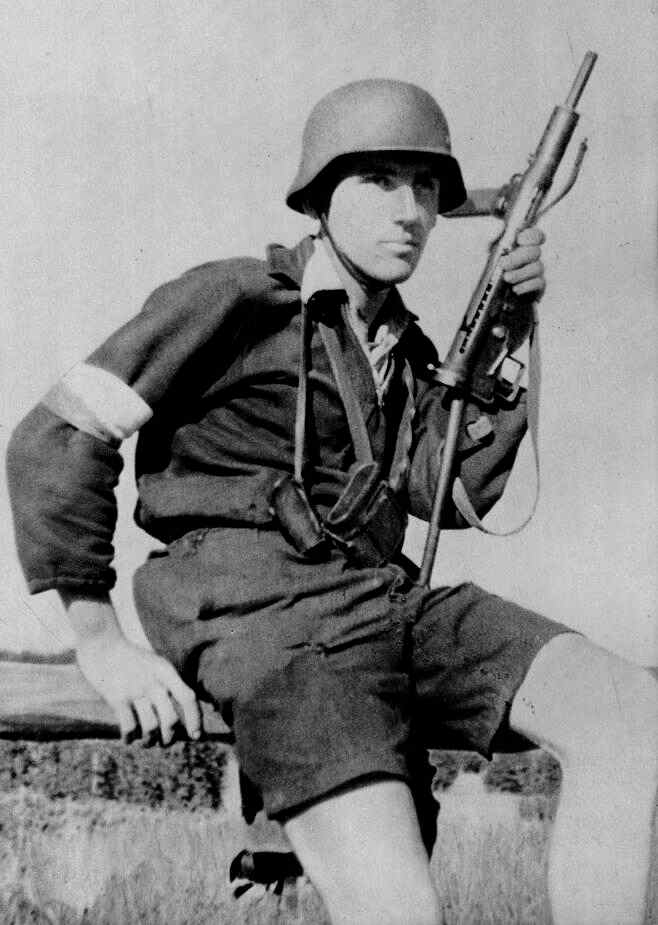
The Polish underground resistance to the NAZI occupation began almost immediately after the NAZI and Soviet occupations began. As far as we know if was
largely fovcused ahainst the NAZIs. The resistance effort continued throughout the War. The resistance was carried out primarily by the Home Army (Armia
Krajowa) which was loyal and under the control of the London-based government-in-exile. The Polish resistance was active, but impaired by Soviet actions against non-Communist Polish POWs and resistance groups. The Polish resistance played a role in soome of the major efforts of the War. Perhaps its most important role was at the very beginning of the War. The Poles played a role in the British cracking of the German Enigma code machines. The Polish resistance managed to obtain information on the German missile program and get it to London. The most notable action by the resistance was the Home Army's uprising in Warsaw.
The Polish underground resistance to the NAZI occupation began almost immediately after the NAZI and Soviet occupations began. As far as we know if was largely fovcused ahainst the NAZIs. Of course, the NAZIs occupied the rest of poland when they invaded the Sovirt Union (June 1941). The resistance effort continued throughout the War. The Polish resistance played a role in soome of the major efforts of the War.
The cracking of the German Enigma code was one of the most important achievements of World War II. Credit is usually given to British cryptologists. Less well known is that the Poles played a major role. After the German introduced the Enigma code machines four Polish ELINT stations (Warsaw, Starogard near Danzig), Poznan and, Krzeslawice near Cracow) began noticing the signals (1928). Initial efforts to crack the codes failed and the Poles realized that the Germans had a very effective code system. The Ciphers Office (BS) of the Polish Army's General Staff decided that academic assistance and a major effort would be requited.. They BS approached the Dean of the Department of Mathematics, Professor Zdzislaw Krygowski at the University of Poznan. He provided them a list of his most promising graduating students that would be available to work at the BS. The BS put them through a cryptology course and they began working on the project. Some of the leaders were: Marian Rejewski, Jerzy Rozycki and Henryk Zygalski. They at first worked at Poznan and later moved to Warsaw. The German Enigma was based on a commercial machine developed for the German railroad. The Poles one of the commercial machines and thus knew what the Germans were doing. The military Enigma macjine was, however, more complicated and the Polish cryptology group made little progressing in cracking the code. As a result of Poland's alliance with France, Polish Intelligence worked with French intelligence (Deuxieme Bureau). They developed an agent in the Reichswehr Cipher's Office (1931). Rejewski was thus able to obtain a description of the military Enigma and some of the old key tables. This helped Rejewski, create the internal connections and essebntially build a working Enigma machinr (December 1932). Within a month, the Poles were reading German military and Foreign Ministry messages (January 1933). This was of course the same month the NAZIs seized power in Germany. The BS established a special site for the German branch (BS-4) in the Kabaty Forest near Warsaw (1934). The Poles managed to dechiper over 100,000 German messages. The Poles thus were able to read German messages during some of the major pre-War operations of NAZI Germany (the remilitarization of the Rheinland, the Anschluss, and occupation of the Sudetenland after Munich. The Polish codebreaking operation was done in the upmost secrecy. . After Rejewski constructed a worable machine, the Poles built about 70 copes which they operated at BS-4. The Germans began changing how they used the Enigma machines and made mechanical changes further complicating the messages (September-December 1938). The Poles could still read the messages, but decphiering was made much more complicated, drastically reducing the number of messages that could be read. Rejewski developed a prototype computer (bomba kryptologiczna) to help with the effort (October 1938). The French assisted the Poles, but the Polish Enigma machine stayed exclusively in Polish hands until a few months before the WAr (July 1939).
As Hitler began increasing the presure on Poland, Chief-of-Staff Lt.-Gen. Waclaw Stachiewicz, ordered BS-4 to share their knowledge of Enigma with British and French intelligence. The Poles gave the British and French Polish clones of the Enigma machine (July 24-26 July, 1939. Polish officers delivered an Enigma clone to General Stewart Menzies at Victoria Station (August 16, 1939). Thus by mid-August the British were reading some German messages. NAZI Germany invaded Poland launching World War II (September 1, 1939). BS and ELINT surveillance stations were evacuated to Romania. As the Germans approached Warsaw and the Soviets invaded from the east (September 17), Polish authorities ordered BS-4 to destroy all documentation and equipment. The Germans never learned that the Poles had cracked their Enigma machine. Given the number of people working on the oproject, this is quite astounding. Rejewski, Zygalski, and Rozycki managed to get to France (late-September 1939). [Bury]
There are many heros of the Polish resistance. For every know hero there are probably many more who commited heroic acts whose identity is unknown. One of these is an unknown boy who lived along the Polish-Hungarian border. Many Poles after the German invasion (September 1939) wanted to get to France to join Polish units being formed in France. One Pole managed to get forged travel documents that allowed him to get to Krakow. The border at the time was another 50 miles and it was heavily patrolled by Germans. He began walking south and was soon joined by others. As they neared the border, a local youth approached them and offered to show them how to avoid the German patrols. He asked for nothing in return. The youth helped Polish soldiers and others espcape to Hungary for several months. He was eventually shot by the Germans. [Nagorski]
Some members of the Polish government and the military forces were able to escape Poland the German and Soviet military forces had fully fefeated the Polish Army and suceeded in closing the borders. The refugee Polish troops mostly headed for Frane which was still at war with the Germans. Thery numbered about 100,000 men and were regrouped into combat units. A government-in-exile, led by General Władystaw Sikorski, was also organized in France. With the German invasion and fall of France (June 1940), the Polish government relocated to London.
Poles operating at considerable personal danger formed many resistance groups in Poland after the NAZI invasion. Most were loyal to the Government-in-exile. The major exception was the Communists. They organized a network constituting an underground Polish state. The principal military force of the underground Polish state was the Polish Home Army (Armia Krajowa--AK) was the underground army fighting the Nazi German occupation of Poland during World War II. The AK evolved from the Service for the Victory of Poland (Sluzba Zwyciestwa Polski--SZP) (September 27, 1939). SZP was a political-military organization which was created the military organization Union for the Armed Struggle (Zwiazek Walki Zbrojnej--ZWZ. The ZWZ was the fondation for the AK. The AK was an integral part of the Polish Armed Forcesand under the command of the Polish Armed Forces in London. The best known commander of the Polish Army was General Sikorski. The activities of the AK were intelligence, sabotage, suppression, diversion, and finally uprising. The Polish resistance was active, but impaired by infighting among the vsarious resistance groups. The primary split in the reesistance was between he groups loyal to the London Government in Exile and the Communists loyal to the Soviets. .
There were several different resistance groups operating in Poland, not all of which were under the control of the AK. While the AK probably had the support of the majority of ethnic Poles, there were several other resistance groups. The principal group were the Communists. Of course they supported the Soviets who invaded eastern Poland (September 1939) and thus were not a resistance group until the German invasion of the Soviet Union (June 1941). The Communists attracted considerable support in eastern Poland because the AK was hesitant to begin an active campaign. Here the AK hesitated both because of the Germsan military superiority and the massive reprisals tht would result. In addition to the AK and Communists were a variety of small bands operated by the Peasant Party, Jews who has escaped NAZI roundups and massacres. There were also Soviet partisan groups as well s units formed by the right-wing NZS.
The Germans invaded Poland on September 1, 1939, which beause of defense treaties with Britain and France, launched World War II. The Polish Army was defeated in a 6-week blitzkrieg. When it was clear that Poland was defeated, the Red Army invaded from the east, partioning Poland. The German split western Poland into two areas and annexed both. The rest of the NAZI occupied area was created a Government General--a World War I term. Rgis basically central Poland. The Soviets occupied eastern Poland. Regulations varied greatly in these areas, but the goal of destroying Polish national ecsistence was the same. The Germans outlawed Scouting. They Germans did not organize any pro-NAZI youth groups for Polish boys as was the case with many occupied countries in Western Europe. The NAZIs considered the Poles and unter-mench, suitable only for death or slave labor to support the Reich as part of Generalplan Ost. The Scouts and Guides did not disappear. They organized underground. It became dangerous to wear Scout and Guide uniforms. They becasme part of the underground state. They rebranded as the Gray Ranks (Szare Szeregi). Led by Scoutmaster Florian Marciniak, the older youth became a paramilitary group, working independently but in cooperation with the resistance.The Soviets in their zone of eastern Poland began organizing Young Pioneer groups. We assume they immeditalely outlawed Scouting. This of course changed in June 1941 when the Germans invaded the Soviet Union. The Germans proceed to put the same draconian occupation regulations into force in the rest of Poland. While Scouting was outlawed, the NAZIs were unable to destroy the movement. Scouts continued to operate underground. In fact, it played an important role in the Polish ressistance in opposing the brutal occupation of their country. NAZI actions during the occupation are There wre many examples of heroic acts against the NAZIs. Younger Scouts for example delivered the mail and messages during the Warsaw uprising in (August-October 1944). Tragically, most of the boys involved were killed. Olfer Scouts actually engaged in combat, like the Grey Wolves.
The Communists formmed the National Council of the Homeland as an alternative to the Lomdon-based Government-in-Exile. The anti-Communist parties countered with the Civic Anti-Comminist Committee.
Peenemünde is a small village on the Baltic island of Usedom at the mouth of the Peene river. The Germans located their Heeresversuchsanstalt research facility there (1937). The island/peninsula facilitated security measures. It was a top secret facility that worked on cruise missles, rockets, and missles. Both research facilities and test ranges were located there. The research team headed by Wernher von Braun and Walter Dornberger began work at Kummersdorf, south of Berlin. The Kummersdorf facility proved inadequate, especially for testing. Peenemünde proved a perfect site as the weapons could be launched out over the Baltic in relative secrecy. The island/peninsula location also allowed the Germans to easily restrict access. The researcher teams at Peenemünde developed many of the most advanced weapons used in World War II, including the Vergeltungswaffe Weapons.
The best known werew the V-1 Buzz Bombs which were the first cruise missles and and the V-2 which was the first balistic missle. he Home Army intelligence oranzation began receiving reports from field units regarding some kind of secret tests being carried out by the Germans on the island of Usedom, a Baltic Sea island close to the pre-War German-Polish border in Pomerania (summer of 1941). The Home Army had previously established intelligence group "Lombard" to conduct espionage inside the Reich and the Polish areas annexed after the 1939 German invasion. There were sympathetic Poles in the Reich of German natinsality. After the German invassion the SS began expelling Poles from the areas annexed, but this proved so disruptive that in the run-up to Barbarossa the explusions were curtailed. Thus large Polish populations remained in the annexed areas. The Home Army formed a special Bureau to investigate the reports of secret weapons. Antoni Kocjan, an engineer an aeronautical enthusiast was assigned to provide technical support. The AK Bureau was able to recruiting an Austrian Anti-Nazi, Wehrmacht NCO Roman Traeger, who was stationed on Usedom. Trager provided the AK with more detailed information regarding what were sescribed as "flying torpedoes". He also identified Peenemünde as he location of the German research effort. Test firing of the V-1 project began in early 1942 and the V-2 (called the A-4) project on October 3, 1942. The data obtained was written up by Jerzy Chmielewski, code named Rafal. He was the AK intelligence officer processing economic data obtained by the Lombard group. His report was the first AK report on the German research effort forwarded to London.
The development of Polish armed resistance was promyed by clashes with Ukranian nationalists. The population of eastern Poland and the western Ukraine was mixed. This included Galacia which has until World War I been part of the Austro-Hungarian Empire. The NAZIs has conducted barbaric ethnuc cleansing operations in the area between Vilnius and Lviv. The situation worsened when when fighting broke out between Poles and Ukranians. After the Wehrmacht experienced major defeats and the Soviets increasingly organized resistance efforts, Soviet partisans appeared in the area (1942). Ukranian nationalists wanted to prevent the peasants from supporting the partisans. After German defeats, Ukranian police that had been working with the Germans began defecting and organizing resisance bands in the forests. The Ukranian nationalist OUN-B began organizing a Ukranian Insurgent Army (UPA). They had Germnan arms and began attacking Polish civilians. And Poles in Galacia where they were a majority turned on the Ukranians. Polish refugees from the Ukranian ethnic-cleasing campsaigns joined partisan groups in large numbers as the AK had been unable to defend them. Fighting also spread north into eastern pre-Wqar northeastern Poland where Poles were a minority.
The overwealming NAZI military superiority and the cooperarion of the Soviets in the supression of Poland made any kind of armed resistance virtually impossible. As a result the initial operations were aimed at organizing and intelligence. The AK assisted the British in learning about the NAZI V-weapons program. As the NAZI military situation weakened, overt military actions became feasible. The Government-in-eile and the AK adopted a new strategy of defeating the Germans and thus having a liberated Poland when the Red Army arrived (late-1943).
This was code named Tempest ( Burza ). The AK escalated armed actions. AK Units fighting against the Germans and representatives of the underground government were ordered to contact the advancing Red Army and identify themselves as representative of the Polish Republic. They were to act as "hosts". The Poles were still hoping for a universal Uprising and a collsapse of German foirces. This strategy was deeply flawded, although there were few alternatives available to the Poles. This did not, however, prove possible. The Germans in 1943 and even 1944 were too strong for the AK who also had the Ukranisans to contend with. Even in the eastern cities with large Polish populations (Lublin, Lviv, and Vilnius) the AK strategy was unobtainable. And even the idea that the Soviets would accept Polish claims. As the Red Army moved toward the Vistula and Warsaw, the AK had to make a momentous decesion. They had husbaned their resources for 5 years. The Germanswee still too strong to take on, yet if they did not the whole point og the resistance would prove futile. And actions taken ny the Sovierts asgainst AK units was a powerful argument to make soime effort before the Soiviets arrived. The most dramatic resistance effort by the Polish Home Army was the uprising against the NAZIs in Warsaw when the Soviets neared the Vistula (July 1944).
The Polish Committee of National Liberation (Polski Komitet Wyzwolenia Narodowego--PKWN), sometimes referred to as the Lublin Committee, was a provisional Polish government established by the Soviet Union as the Red Army reached pre-War polish territory in its drive east (July 21, 1944). A State National Council (Krajowa Rada Narodowa--KRN) was formed as the first step in the formation of a Soviet-controlled Communist government for Poland. This meant a break with the London-based Polish Government-in-exile. The Lublin Government issued the Manifesto of the Polish Committee of National Liberation (July 22, 1944). It proclaimed radical social, political and economical reform and a continuation of the struggle against NAZI Germany. The Manifesto also endorsed the nationalisation of industry and a "decent" border in the West along the
Oder-Neisse line. It was silent about Poland's eastern border. The PKWN Lublin govenment was designated as "the only legitimate Polish government". Soon afterwards, the Soviets began a pretense of transfering power in the Soviet-controlled areas of Poland to the Lublin Government. Actual control remained firmly in the hands of the NKVD and the Red Army. The PKWN set up its headquartered in Lublin as Warsaw was still occupied by the Germans (August 1, 1944). Lublin was the largest Polish city east of the Vistula.
Nikolai Alexandrovich Bulganin was the Soviet representative in Poland. The Soviets chose various communist and leftist politicans compliant to Soviet wishes for the PKWM. The Chairmen was Edward Osóbka-Morawski, amember of Poland's pre-War Socislist Party.
The most dramatic resistance effort by the Polish Home Army was the uprising against the NAZIs in Warsaw when the Soviets neared the Vistula (July 1944). After Operation Bagration (June-July 1944), Warsaw on the Vistula was the principle barrier standing between thev Red Army and Berlin. The Poles did not greet the Red Army in the same way that populations in the West cheered the Americans and British. They had no illusions about what would follow in the wake of the Red Army, a Stalinist dictatorship. The Home Army (loyal to thev London goverment-in-exile) decided on a desperate gambit at the Red army apprpached the Vistula. They would stage an insurrection and free Warsaw. The Home Army rebelled (August 1) anticipating the support of the Red army. Instead Stalin ordered the Soviet troops to stop on the far side if the Vistula. The German reaction was savage. On one day alone the SS rounded up and shot 25,000 Polish men women and children. The Americans offered to drop supplies, but Stalin refused permission for the flights to use needed Soviet air bases to refuel for the return trip. Thev Poles fought valiantly on, finally capitulating (October 2). The Germans at Hitler's orders virtualy razed the city. The Soviets finally took Warsaw with little resistance from the Germans (January 1945).
Local Red Army commanders etering Poland initially treated AK units as allies fighting the Germans. This soon changed. The Soiviets ordered the AK to be disarmed in Lithuania, west B\relorussia, and the Wesern Ukraine (July 14, 1944). This of course included areas of pre-War eastern Poland. NKVD Red Army units unis began arresting Polish officers. And by this time what the Soviet NKVD had done with Polish officers at Katyn was widely known.
The AK was severly weakened in the Warsaw uprising when the Red Army failed to support them. The Sovies subsequently compleed the liberation/occupation of Poland. The President of Poland (in London), Gen. Okulicki ordered the AK to disband (January 19, 1945). The Soviets invited the Chief Delegate Jan Stanisław Jankowski, chairman of the Council of National Unity Kazimierz Puzak and Gen. Okulicki were invited to a meeting with Soviet authorities in Warsaw (March 26, 1945). This was a ruse and they were arrested by the NKVD. They were transported to Moscow where they were tried with a group of 16 other Polish resistance leaders.
The director of Internal Affairs in the Delegatura, Stefan Korbonski (Labor Party representative) took over the function of Chief Delegate. The Council of National Unity ordered the Delegatura to disband (July 1, 1945). This was the end of the Polish Underground State.
Bury, Jan. "The Greatest Secret of World War II - The Enigma Code Breach".
Nagorski, Zygmunt. "A brave boy at the border," Washington Post May 28, p. W11.

Navigate the HBC World War II Section:
[Return to Main World War country resistance page]
[Return to Main Polish World War II country page]
[About Us]
[Biographies]
[Campaigns]
[Children]
[Countries]
[Deciding factors]
[Diplomacy]
[Geo-political crisis]
[Economics]
[Home front]
[Intelligence]
[Resistance]
[Race]
[Refugees]
[Technology]
[Bibliographies]
[Contributions]
[FAQs]
[Images]
[Links]
[Registration]
[Tools]
[Return to the Main World War II page]