**
World War II -- technology land campaigns weapons motor vehicles motorcycles
World War II Motor Vehicles: Wheeled Vehicles--Motorcycles
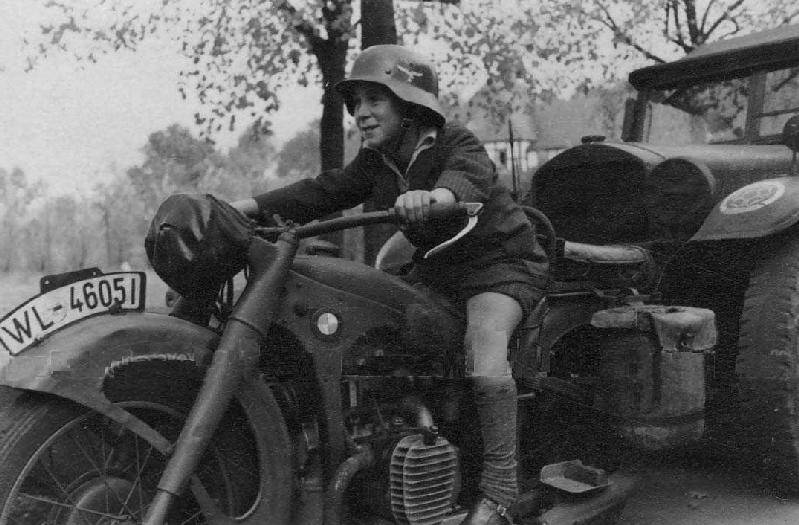
Figure 1.--The Germans during World War II made a greater use of motocycles than any other countries, eving adopting them for combast assault purposes. BMW made some of the best. One reason that the Wehrmscht made a greater use of the motorcycle was that German industry could not produce needed quantities of the light four-wheeled jeep-like VW Kübelsitzwagen. The WL on the front means Wehrmacht Luftwaffe, note that the boy also has a Luftwaffe helmet. We do not yet know know what units it was assigned to based on the number. This ppears to be BMW model which wasoften mated with a sude car, some what aopproach the value of the Kübelsitzwagen.
The motorcycle was important during World War I, but less so during World War II. They served for dispatch riders and scouts and wuth a side car to transport inddividuals and particularly valuable supplies. Most of the combatant countries prepared to use the motorcycle as they had in World War I. The French were knocked out of the War after the German victory in the West (1940). This left the British with active infantry operations only in the Western Desert. The Germand did use the motorcycle widely in its offensive campaigns, including the massive Barbarossa campaign. For the Wehrmascht, the motorcycle had the advantage that it was easier to build and required a smaller motor than cars and jeep-like vehicles. The United States planned to use motorcycles and some were deployed in North Africa. American commanders soon decided that the jeep was a much more useful light vehiche and American industry had the capacity to buld them in large numbers. The Americans did use some, particularly the military police, but they were not widely used. It found its greatest with the Germans, in part because they lacked the industrial capacity to build utilitarian four-wheeled vehicles as the United States did.
Purpose
It relates to the purpose of a motor cycle. A cycle has a very small carrying capacity. It was not meant to move men and equipment. It was meant to replace mounted couriers that had been a factor on the battlefield since the horse first appeared on the battlefield in ancient times. It was the way battlefield commanders communicated beyond the line of sight. This only changed in World War I when the motor cycle first became available.
The motorcycle was important during World War I, They served for dispatch riders and scouts and wuth a side car to transport individuals and particularly valuable supplies. But the primary use was communications. One of the greatest problems World War I commannders faced was how to communicate with units on the move, especailly advamcing units. By the time of World War I, the telegraph and telephine had improved military communicatiins. But they primarily required fixed land lines. Which advancing units did not have. Until these linges were established, advancing units wsere out of touch. Thus they had to fall back on the mounted messenger -- in this case mounted on motor cycles. And they were also important with commuications withbstatuinary units when documents and maps had to be delivered. There were wireless communication, but they required bulky semding and reciving statiins beyond the means of advancing units. The U.S. Army began using motorcycles even before the War broke out in Europe. General John J. Pershing was ordered to arrest Pancho Villa who staged attacks across the border (1913). As part of that operation, American firces used Harley-Davidson motorcycles. One third of the company's production was sols to the military (1917). European armies also begun using the fast and agile motorcycles as reconnaissance, communication, and transport vehicles as well as ambulances. The European armies began the war with horse calvalry and transport, but this rapidly changed as the War progressed. Sidecars were developed which could be fitted on the cycles. These could carry individuals and could be used for weapons like machine guns. Thus when the United States finally entered the War (1917). the motorcycle was being widely used by the major combatant countries. The U.S. Army used an estimated 20,000 motorcycles during the War. The first American to enter Germany after the armistice is believed to have been motorcycle dispatch rider Cpl. Roy Holtz.
Inter-War Era
Huge advances were made in wireless communication in the inter-war era. No one had a radio even at the end of World War I. But the advances in electronics during the ar spawned a whole new industry. Suddenly the radio and gramaphone (record player) became items that everyone aspired to have. The radio in particular is what everyone wanted. Radio sets (the early ones were built as large piecesof equioment). And they were at first very expensive. Only in America, however, was the average person able to afford either. Electronics became a major industry. nd by far the largest electrinics industry was in America. The same forceswere at play when Henry Ford bought the autmobile within the price range of the average person. Radio was important in Europe as well, but many people could not aford one. Which meant that European electronics industries like the automotive were much smaller than the huge, American indutry.
Country Trends
Motorcycles were contrary to expectations used less in World War II. Most of the combatant countries prepared to use the motorcycle as they had in World War I. The French were prepared to use them extensively for communucations. French tanks, unlike the German tanks, were not equipped with radios. France for this and other reasons were knocked out of the War after the German victory in the West (1940). This left the British with active infantry operations only in the Western Desert. The Germand did use the motorcycle widely in its offensive campaigns, including the massive Barbarossa campaign. For the Wehrmascht, the motorcycle had the advantage that it was easier to build and required a smaller motor than cars and jeep-like vehicles. The United States planned to use motorcycles and some were deployed in North Africa. American commanders soon decided that the jeep was a much more useful light vehiche and American industry had the capacity to buld them in large numbers. The Americans did use some, particularly the military police, but they were not widely used. It found its greatest with the Germans, in part because they lacked the industrial capacity to build utilitarian four-wheeled vehicles as the United States did.
America
The United States planned to again use motorcycles extensively in World War II as it had in World War I. Advances in electronics and radio, however, mean that the ceentral role the nmotoircycle played in miliytary comminications during World War I was not the case in World War II. Harley Davidson produced a motorcycle to withstand the harsh African deserts where American forces were first deployed in the European theater (November 1942). and some were deployed in North Africa. American commanders soon decided that the jeep was a much more useful light vehiche and American industry had the capacity to buld them in large numbers. The Americans did use motorcycles. Harley Davidson was the main supplier and produced some 88,000 WLA models during the War. It had nearly 15 horsepower. They bwere supplied to the U.S. Armed Forces and its Allies (mostly Britain, Canada, and the Svoviet Union). The U.S. military used the bikes primarily for messengers and military police duties.
Britain
The German victory in the West left the British with active army operations only in the Western Desert. We are unsure to what extent the British used bikes. Based on the photographic recird they do not seem to have used them to any great extent.
France
The French Army was prepared to use motircycles extensively for communucations as they bhad in World WarI. Within the Maginot Line they had modern comminications linmes, primarily telephones. Their mobile units and infantry, however, ioerated much as they did in World War I. French tanks, unlike the German tanks, were not equipped with radios. The French could not adjut to the German Blitzkrieg tactics. France for this and other reasons were knocked out of the War after the Germans struck in the West (May-June (1940).
The motorcycle found its greatest use with the Germans, in part because they lacked the industrial capacity to build utilitarian four-wheeled vehicles as the United States did. But primarily because they did not have an electronics industry that could fully equip units with advanced communications gear. The Germans did use the motorcycle widely in their early offensive campaigns, including the massive Barbarossa campaign. For the Wehrmacht, the motorcycle had the advantage that it was easier to build and required a smaller motor than cars and jeep-like vehicles. This issue was partially solved by the BMW R75, a motorcycle and sidecar combination. Bikes were built by both BMW and Zündap, both companies that did not priduce motorcycles during World War I. The BMW R75 and the competing Zündapp KS 750 were both widely used by the Wehrmacht in North Africa and the Sovuet Union. Heer analysts eventually comluded. concluded that the Zündapp had superior characteristics. The Heer for logiatical reasins wanted one single model mwith interchangeable parts. Zündapp and BMW agreed upon standardization of parts for both bikes (August 1942). The goal was create a Zündapp-BMW hybrid to be designated the BW 43. A BMW 286/1 side-car would be grafted onto a Zündapp KS 750 motorcycle. By this time the motorcycle was declining as a vehicle priority. German commanders continued to use the motorcycle as they had in World War I, meaning primarily a messenger fumction.. The Germans also used the motorcycle for tactical assault, at least in the early campaigns beginning in Poland and thriough Barbarossa (1939-41). We are unsure about the tactical value. Their use of motorcycles began to change as the War advanced. This mission declined as the tide of battle turned and the Germans were forced to adopt a defensive posture.
Soviet Union
One of the many weaknesses of the massive Red Army at the onset of the war was communications. This was largely because of the samall size of the electronics industry. The average Soviet citizen did not have a radio. News was in part spread by newspapers loudspeakers set up at numerous siyes in cities. The United States had a huge electronics industry, capable of profucing communicatiins gear in massive numbers. And Amerivan industry as part of Lend Lease provided communicatiins gear to its own forces as well as it Allies, inckuding the Soviet Union. One of many factors that changed the Ostkeieg. We have no information in Soviet usage of motorcycles. Based on the photographic record it was not extensively, but this may be receptive. As part of the NAZI-Soviet Pcy (August 1939), there were exchanges. Primarily this involved the Soviet Union shipping vast quntities of oil abd oher citical mzterils to Germzny. The Germns were susposed to provide mmchined tools bnd oyher msnufuctured goods. Hitler already planning to invade the Soviet Union, prdered to slow actual deliveries as much as possible. TYhere were some deliveries. One was BMW R71 motorcycle engines. BMW ha alreadsy developed the new R75 engines. Stalin took a personal interest. He orddred the etablishment of the IMZ-Ural facyory (1941). The factory built the BMW R75 for Red Army motorcycles. The Red Army designtion was the Soviet Ural M72, basically the sanme as the German BMW R71. Some 10,000 of the M72s, fabricated in the Siberian factory were built dutring the War. After the War the Soviets occupsation forces packed up the BMW tooling and engineering designs and shipped them bck to the Siviet Union, part of reparations exacted from their occuption zome. This included the R75 motorcycle OHV engine and dual-wheel drive system technology. They were used to ce=reate the advanced Russian 'Ural' and 'Dnepr' models. After the Comminist seizure of China (1948). The Sovits trnsferred the technology to China and the Chinese begn producung them.
Utility
Sources
Garson, G. Paul. "Military vehicles: German motorcycles in WWII," WarfareHistory Network (November 18, 2015).