|
We do not have many ads and catalog pages from the 1880s, but we have a few items. B. Altman offered a wide selection of clothing. HBC has some early Altman pages. As we can not date them, we have at this time loaded them in the mail order catalog garment section. Sears Roebuck launched their mail order business in 1886 and became along with Wards the two principal American mail order companies. These catalogs thus become an invaluable source of information. Other companies advertized in magazines. American boys in the 1880s begin to commonly wear kneepants, although older boys still mostly wear long pants. Te Fauuntleroy suit become as important styles in 1885. Boys commonly wore kneepants suits with long stockings. Only the very youngest boys wear short socks. Thus we begin to see garments to hold up the stockings. We notice an L. Stein ad for stocking supporters (1885). We also notice the Double Ve Waist (1886). We note various styles of high-top shoes. The catalog and magazine ads had illustrations, but the lithographic techonology at the time meant that they were rather primitive.
We have found several items we believe dating to the 1880s, but we do not know the year. B. Altman offered a wide selection of clothing. HBC has some early Altman pages. As we can not date them, we have at this time loaded them in the mail order catalog garment section. We have also found an historically interesting advertisement for hose supporters--one of the earliest on record and important because it uses a technology for the clasp that apparently didn't survive the test of
time or popularity. We notice an ad for a Warner's corset waist. Whilit is undated, the illustration quality sduggests the 1880s.
These supporters (apparently used for all members of the family) were made by the Phoenix Suspender Company of Milwaukee, Wisconsin, a manufacturer of men's suspenders. We believe it dates to the 1880s.
We have archived several items from 1880 issues of The Delineator. We will eventually add them to a 1880 page that we plan to create. In the interim you can view them on The Delineator 1880s chronology page. These entries are very important because The Delineator provided a very detailed discussion of the garment patterns they offered.
The 1880s: An American Department store (Lord & Taylor) indicated
in 1881 that:
Childrens' stockings are usually ribbed and are as fanciful as possible. The foot in fine stripe of gay color is separated by the plainer top by bands of gold-color, blue, or dull red. Black stockings are liked for children with bright Madras stripes of blue, red, or yellow, or strewn with small polka dots. Half hose or socks are preferred during the warm weather for little ones under five. They are in liske-thread, in the color, and often in open-work patterns.
Types
White socks: Lord & Tayor in 1881 offered white socks
for children in sizes 4 in to 6 1/2 - 7 in, both f ull length and 3/4
hose.
Plain color socks: Lord & Tayor in 1881 offered plain colored socks
for children in sizes 4 in to 7 in, both full length and 3/4
hose.
Striped socks: Lord & Tayor in 1881 offered striped
and fancy striped socks
for children in sizes 4 in to 6 1/2 - 7 in, both full length and 3/4
hose.
Silk hose: Lord & Tayor in 1881 offered 1/2 and 3/4 silk
hose in both sandal-lace and plain colors
for children in sizes 4 in to 6 in.
We note a corset waist offered by the Warner Brothers corset company in 1982-83. This would more accurately be called an underwaist.
We note a complicated design for a child's underwaist (both boys and girls) submitted for a patent in 1883. The designer was a woman, Mary E. Higgins, who presumably lived in
Michigan. The patent number recorded is MI 288,803, and the patent was registered November 20, 1883. I believe this is the earliest underwaist we have recorded on HBC.
We have acquired pages from the 1884 Strawberry and Clothier (S&C) catalog. This wa Philadelphia department store which had kaunched a catalog business. The number of avaialble 1880s catalogs is limited, esapecially catalogs that illustrate many of their offerings. Lithography was still a problem in the 1880s. Which is why many of the catalogs have lists of items, but few illustrations. We have always wondered why mothers would order an item with just a few sentences and no images. S&C offered fewer itemns than many catalogs, but more were illustrated. This it is a very important addition to our HBC catalog section. There were four pages with boys' clothing. The organization is a little strange. The items for boys are on seprte pages, but the ages and garmernts are all mixed up. We see some nteresting trends. We see how popular kilt suits for younger boys were. We see sailor suits, but mot the iconic three-stripe detailing tht would beconme so recognisable. nee pants were commonon for chool ge boys, but only youngr school age boys. Older boys wore long pants. The pricing is also intresting. In relative terms, clothing was much more expensive than is the case in modern times.
The year 1885 was a major turning point in Amerivan boys' fashion. It was the year Mrs. Burnett published her book, Little Lord Fauntleroy. The outfits do not begin to show up in the catalogs, however, until the following year. The shift to knee pants is becoming increasingly apparent in both the phorographic record and catalog offerings. American boys in the 1880s begin to commonly wear knee pants, although older boys still mostly wear long pants. The N.J. Schloss & Co catalo shows a range of knee pants and long pants outfits. Sailor suits seem popular. . Boys commonly wore kneepants suits with long stockings. Only the very youngest boys wear short socks. Thus we begin to see garments to hold up the stockings. We notice an L. Stein ad for stocking supporters (1885). Strawbridge and Clothier (a Philadelphia department store) published a quarterly magazine, the "Strawbridge and Clothier Quarterly" which was essentially a catalogue of clothing with emphasis on women's and children's wear. One example of their advertising is an illustration of two types of early stocking supporters for girls and boys (they would later be called garter waists) for children from 3-12 years old. Strawbridge and Clothiers Quarterly (Winter issue, 1885-86), p. 419.
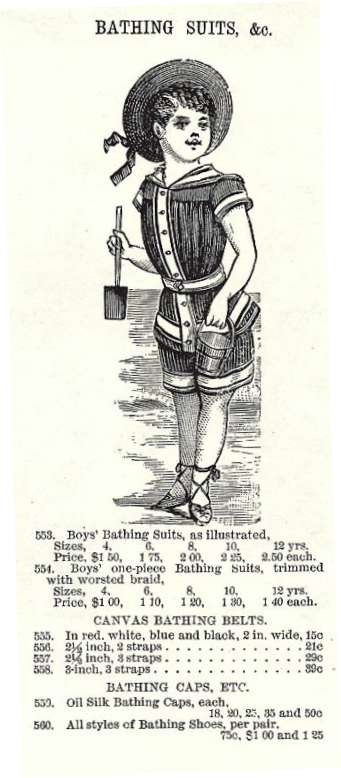
Sears Roebuck launched their mail order business in 1886 and became along with Wards the two principal American mail order companies. These catalohgs thus become an invaluable source of information. There were also catalogs issued by individual stores, both clothin stores and department stores. Here we see a boy's bathing suit offered by Bllomingdales in 1886 (figure 1). We notice the Double Ve Waist to help hold up long stockings.
We have found a few items for 1887. We note an early version of the Sampson Suspender Waist for boys. The newspaper ad appeared in the Middletown Daily Argus, Middletown, New York (July 13th, 1897). We notice pages from a J.B. Lewis Boot and Shoe Company catalog for 1987-88. The catalog described the company's product line and prices. All the styles we note were high-top footwear.
We have found a few items from 1889. Fauntleroy suits had become an important style by the 1880s. We note a Fauntleroy suit from an unidentified publication with some information on materials used. This was a collar buttoning suit with a crocheted collar and an elaborate sash. Most children wore long stockings. We note a Ferris corset waist in a Good Housekeeping magazine. We think they were primarily for girls, although they are made in "child" sizes.

Navigate the Boys' Historical Clothing catalog/magazine pages:
[Return to the Main American mail order 19th century chronology page]
[Return to the Main American mail order chronology page]
[Main photo/publishing page]
[Store catalogs]
[Fashion magazines]
Navigate the Boys' Historical Clothing Web Site:
[Introduction]
[Activities]
[Biographies]
[Chronology]
[Cloth and textiles]
[Clothing styles]
[Countries]
[Topics]
[Bibliographies]
[Contributions]
[FAQs]
[Glossaries]
[Images]
[Registration]
[Tools]
[Boys' Clothing Home]
Navigate the Boys' Historical Clothing Web Site:
[Sailor hats]
[Sailor suits]
[Dresses]
[Kilts]
[Buster Brown suits]
[Eton suits]
[Rompers]
[Tunics]
[Smocks]
[Pinafores]
[Coats]
[Long stockings]
[Underwear]