
American Mail Order Catalogs with Boys Clothings: Chronology
|
American mail order catalogs offer a very useful time line on changing fashion trends. We believe the importnt mail order business began in the 1870s with Montgomery Ward. There may, however, beeb some small earlier companies. Several comapnies, inclusing Sears Roebuck entered the industry in the 1880s. Large numbers of Americans in the late 19th century still loved in rural areas and small towns without access to stores carry a large selection of merchandise. Thus the clothing and other products offered in these catalogs were in effect a window to the wider world.
Early Catalogs
Catalogs appeared soon after the printing press was perfected (15th century). This of course was before America even existed. The first known catalog appeared in Venince (1495). These early catalogs were not well illustrted because lithography was so primitive. The earliest catalogs for bookss--rathrr the samne way Amazon began.. Other early catalogs were for seeds. At the time agriulture dominated econommies. An English gardener published the first known seed catalog (1667).
The 18th Century
It was in America that the mail order concept was invented and by none other than Benjamin Frankline was created the Post Office (1744). He published "A Catalogue of Choice and Valuable Books, Consisting of Near 600 Volumes, in most Faculties and Sciences". On the first page, the terms of sale for the books he offered, are described. Franklin writes, "To be sold for ready money". Freanklin's Post Office played an important role in the Revolutiion. But even before that, Frabklin's Post Office was making it possible for Americans throuout the Colonies to purchase books without visiting his shop in Philadelphia. He tells people, "hose Persons that live remote, by sending their Orders and Money to said B. Franklin, may depend on the same Justice as if present."
The 19th Century
The 19th century is when modern consumerism was born and the mail order catalog was a big oart of it. Marrxist prodessors would tell you that the century was one of grinding poverty and explotatiion of weorking peopole. Now there was cerainlky some of tghat, but what occurred iverall was the creation of vast wealth as a result of the Industrail Revilution. Never before in World history had so much wealth been put into the hands of ordinary people. And despite the narative Marxist professors want to paint, ordinaruy poopl bebefitted nd nnfitted nig. And gthis was not judst the upper and middle-class, but wirkers. And where did workers had, theyu headed yo meicn in the millillions because wages were highest in mneric, Abd wages were the highst because American adopted capitlism more energetically than any other country. Department stores appear in all big American cities. Thus workers from all over Europe came to America. They used thse wages to buy condumer goods at unprescedented levels. Most Americans still lived in rural areas, so the mail order catalog was especially important. This enabbled rural America to but the same merchandise available in big city stoires, including fashionabler clothing. In a short period the railoroads and the Wells Fargo Wagon had become an Amrrican institution brining mail order goods to every nook and cranny of America. Mongomery War began its catalog (1872) followed by Sears (1886). Nail lorder clothing wa not possible much earlier, bcause ir required ready-made clothing, items that could be offeredsnd delivered in large quantities. This was not possible until the Indudtrial Revolution, especially the sewing machine. Steam-powered sewing machines and other devices appered in factory work-rooms (early- 1850s). This was just in time for the Civil War (128612-65). After the Civil War ready-made clothing raodly expnded and filled the many catalogs. There were many other important catalogs besides Wards and Sears. And as lithograpy developed we get better and better images of their offerings.
The 20th Century
The 1900s
Mail order catalogs and clothing advertisements show major changes in American boys clothes during the 1900s. Several important fashion trends are notable. Tunic suits like Buster Brown suits were all the rage for little boys. Sailor suits were still popular. Kneepants were still dominate in the 1900s, but knickers began to be worn by older boys. Short pants were intoduced for the Boy Scouts, but the boys insisted on wearing knickers. Kneesocks were still little worn. Most boys wore long stockings, Usage baried, but many boys even in highschool wore kneepants. usually black ones. Children at the turn of the 20th century, both boys and girls, almost universally wore underwaists or stocking supporters to hold up outer clothing and long stockings.
The 1910s
Several important fashion trends are notable during the 1910s. We notice a basic trend toward simplier less formal clothing. This trend was especually pronounced in children's clothing. Another notable trend is the increasing gender specific styles for younger children. Earlier both girls and boys wore dresses and it was often difficult to identify gender. We still see boy dresses advertized in the 1910s, but such offerings became increasingly rare as the decade progressed. The Oliver Twist suit was much simplier than the fancy suits that younger children had previously worn. HBC notices another catalog, Stuarts in the 1910s. Boys continued to wear tunics. A new style called an Oliver Twist suit appeared for todlers in the 1910s. The straight-leg knee pants common in the 1900s were replaced by knickers in the 1910s. Long stockings were still the dominant hosiery, although young children often wore three-quarter socks during the summer.
The 1920s
Mail order catalogs show major changes in American boys clothes during the 1920s. Kneepants were still worn in the early 1920s, but were completely replaced by short pants and knickers by the mid 1920s. American boys fashions for the first time exhibted major differences from Europe. For the most part only younger boys wore short pants, although knickers were much more commonly worn than in Europe. Gradually styles changed from the above the knee to the below the knee stylw. Kneesocks increased in popularitym but many younger boys still wore long stockings.
The 1930s
There were no major fashion changes in the 1930s. Boys at the beginning of the decade were wearing clothes that many will see as dated today, but by the end of the decade many more modern styles had emerged. Flat caps were still commonly worn at the beginning of the decade, but had largely disapperared by the end of the decade. Younger boys often wore short pants. American boys still mostly wore knickers, although older boys increasingly wore long pants. Most knickers by the 30s were the below the knee style. Long stockings were still commin at the beginning of the decade, but had begubn to be replaced by kneesocks. Ankle socks became increasingly popular as the decade progrrssed. Major changes occurred in the underwear boys wore.
The 1940s
Mail order catalogs show major changes in American boys clothes during the 1940s. Boys still commonly wore knickers in the late 1930s, but they rapidly disappeared during the early 1940s. Some boys wore short pants instead of knickers, but most wore long poants. Jeansm often called dungarees, increaed in popularity, especially during the late 1940s. Kneesocks declined in popularitym but some boys still wore them. A few boys even wore long stockings.
The 1950s
Catalogs and periodical advertising provide a great deal of information about popular styles during the 1950s. nd we also have useful school portraits to provide a complete picture of popular styles. The trens we have noticed toward informality in dress continued into the 1950s. Baseball caps became increasingly popular, perhaps ecause of Little League in the suburbs. In the middle of the decade coon skin caps appeared thanks to Walt Disney and Davy Crocket. Praked caps wre worn by younger boys when dressing up. The standard wear for most American dress was T-shirts and dungarees (jeans). Jeans came long so the cuffs could be turned up. In the middle of the decade coon skin caps appeared thanks to Walt Disney and Davy Crocket. Teenagers wete often not allowed to dress like this in high school, but was their standaard casual dress. Boys also wore colorful collared shirts. Western style shits were popular because of TV and the movies. Some boys wore short pants. Long pants were much more common for school-age boys. Shorts were becoming basically casual, summer wear, but even in the summer most boys wore long pants. Here there were regional and social-class differences differences. Suits were still wirn when dressing up, but not for school except some private schools. Boys were wearing mostly slacks and jeans. A few boys still wore knicker suits in the very early-1950s, but they disappeared from clothing catalogs. We see mostly long pants suits. Younger boys might wear short oants suit. Here there weresocial-class differences. Suspenders seem common for younger boys. WCasual jackets were common. Boys mostly wire ankle socks. Knee socks wereseen ncreasingly as girls wear. Boys commonly wore low-cut leather shoes. Sneakers were poular, but viewed as casual after school wear.
The 1960s
Major trends occurred in boys' fashions during the 1960s, mostly in the secomd half of the century. Fashions were still conservative in the early 1960s. Gradually we begin to see new styles like turtle necks and large hairy sewaters becoming popular. Camp shorts appeared in the 1960s and short pants increasingly began to be seen as casual clothes. Fashion magazines often showed boys wearing dressy short pabnts outfits. A HBC reader has provided us some information from a 1960s Spigel catalog. The general trend, however, was the emergence of short pants as a popular cassual garment for summer wear. We begin to see much more colorful clothing in the second half of the decade. We begin to see Hippy-influenced psychedelic clothing. The Hippies and flower chikdren defied the conservatuve conformity of the 1950s. Tight jeans were fashionable and bell-bottoms that flared wide at the knee became a fashion hit. ' Ethnic clothing makes an appearance, especially leather jackets. Along with the new Mod fashions, preppy fashions for more conservative youth remained popular, including Madras plaids. Synthetic fibers mostly used as blends with cotton and wool had a major impact on 1960s fashions leading to an even more important role in the 1970s.
The 1970s
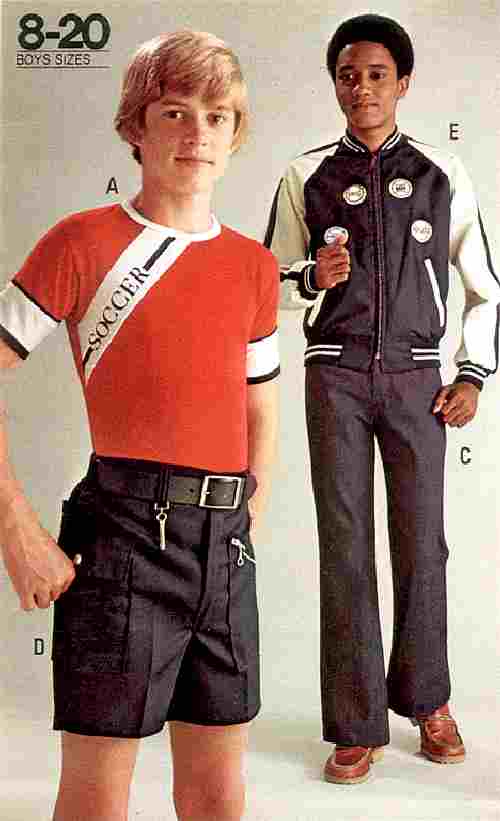
American boys no longer wore short pants suits, although younger boys wore Eton suits. There was a major shidt in the 1970s. Many American boys never wore short pants except when they were very young. In the 1970s in became very common for boys to wear short pants during the 1970s, often with tube socks. Bellbottom trousrs became all the rage.
The 1980s
Casual styles were dominant in the 1980s. They were widely worn to school as well as for casual wear. Boys tended to see wearing a collared shirt as dressing up. Garments like "T"-shorts, sweatshirts, and jeans were very popular. Designer jeans were all the rage. "T"-shirts wih logos were in fashion. Denim was the dominant fabric. Short pants for casual wear continued to be popular in the 1980s. Short cut styles were fashionsable. Cord shorts were popular iun the early-80s. Tube socks were still popular in the early 80s. Both boys and girls wanted to wear fashionable sneakers rather than leather shoes.
The 1990s
We have very little information on 1990s catalogs and advertisements at this time. Hopefully readers will help us develop this section.
The 21st Century
The 2000s
A HBC reader writes, "I picked up the Spring 2004 JCPenney catalog the other day, and was struck by a change from how boyswear was offered 20 years ago. In the 1984 catalog, there was a separate section for clothing for little boys sizes 4-7, with the main section of boyswear covering sizes 8-20, and another section for teens called "Prep Stop" with sizes 14 and up. The little boys' section was largely similar to the regular boys' section, but included more "cute" items such as overalls. The teens' section had things that were either a little more mature in style or more fashionable. In the 2004 catalog, there is no such age gradation. Just about everything is offered from size 4 to size 20. About the only concession made to little boys is the sentence "Preschool sizes have elastic backwaist" in the descriptions of many pants and shorts. There are no "cute" items offered for little boys. The largest overalls (offered on their website and not in the paper catalog) are sized for boys of 24 months."
The 2010s
Sources
Pugh, David.
HBC

Navigate the Boys' Historical Clothing catalog/magazine pages:
[Return to the Main American mail order page]
[Main photo/publishing page]
[Store catalogs]
[Fashion magazines]
Navigate the Boys' Historical Clothing Web Site:
[Introduction]
[Activities]
[Biographies]
[Chronology]
[Clothing styles]
[Countries]
[Bibliographies]
[Contributions]
[FAQs]
[Glossaries]
[Images]
[Links]
[Registration]
[Tools]
[Boys' Clothing Home]
Navigate the Boys' Historical Clothing Web Site:
[Sailor suits]
[Sailor hats]
[Buster Brown suits]
[Eton suits]
[Rompers]
[Tunics]
[Smocks]
[Pinafores]
Created: May 20, 2000
Last updated: 8:18 PM 4/19/2015