|
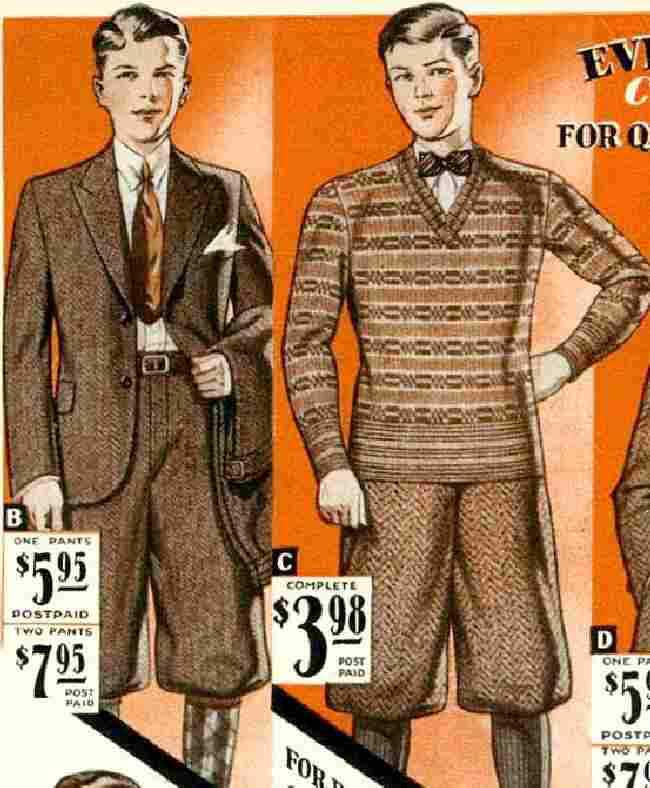
American mail order catalogs offer a very useful time line on changing fashion trends. There were no major new fashions introduced in the 1930s, but several long-running trends were observeable. They were well documented in the catalogs. Knickers were still worn, but by younger boys and were declining in popularity. Long pants were becoming increasingly common. Younger boys still wore short pants, especially in the summer. Kneesocks were commonly worn, usually with Argyle or other patterns. Ankle socks were less common, but increasing in popularity. Some boys wore long tockings, but increasingly younger boys. The Butlers Brothers wholesale company in its 1930-31 catalog offered a range of boys' suits, both knickers and long pants suits. Sears catalogs also offered many knickers both as individual pants and as suits. The suits were sized by age--from 7 to 17 years. Some boys wore long trousers earlier than 17, but by 18 nearly all boys had switched to longies. There were no short pants suits shown. I'm not sure if this was bdeacuse it was winter or because they were less popular. We also note new styles of underwearin keeping with the new juvenile styles like short pants. One example is the Minneapolis Knitting Works. The overiding event in 1930 was the beginning of the Depression.
Boys commobly wore both blouses and shirts in the early-20th century. Blouses were still worn in 1930, but were becoming less common. The primary blouse was still worn were those worn as part pf shorts sets which included both tops and bottoms. Most of the blouses/shirts for boys 10 years of age and under were made in the button-on style. We also notice dress blouses for younger boys, often with Eton or Peter Pan collars.
On the page with the short pants were two types of button waists. Note that the term "waists" used in these advertisements refers not to underwear waists but to boy's shirts--especially those with waist buttons to button on to short pants. Underwear waists also had buttons, however, for the purpose of attaching outer clothing such as short pants as well as pin tubes to allow for the fastening of hose supporters. The use of the term "waist" for both boys' outer shirts and for underwear with waist buttons is a bit confusing for modern readers. Waists were very similar to modern shirts, but were not called waists because there were no shirt tails. Tails were not needed as the waists securely buttoned on to under-wear waists or the pants directly. They were presumably included on the page with short pants because they were most commonly worn with shorts pants. They were, however, not exclusively worn with shorts.
We have limited information on coats and other cold weather at this time. The U.S. populationr clothing was still very important. Boys had caots and many were stillrather formal. Sears offered a range of rather dressy looking double breasted overcoats for younger boys. We also notice Robert, Peet coats.
The Sears Sears Fall and Winter catalog, 1930, p. 416. The top row shows a variety of boys' winter overcoats with caps. All of the coats were double breasted. One was a sailor reefer style. Most of the ohers had a muted plaid pzattern. The various styles were for boys 2/4-9 years of age.
Rogers, Peet was a toney men's and boys' clothier in New York city since 1874. Their clothing had aestinctive British look, which appealed to many well-tp-do Americans at the time. An advertisement shows some of their offerings. A library has dated it 1930, but this may be more of an estimate than a definitive date. They often depicte British-styled short pants suits in their advertising, although knickers were nore common in America.
We notice snow suits for younger boys. They allow boys and girls to play out on the csnow without getting a chill. One company came out with a Polar Patrol play suit, presumably trying to cash in on the Byrd expedition to the Arctic. The manufacturer calimed it was designed like an aviator's flying suit. It was a kind of snow suit for boys who might not ordinarily wear one.
We noticed quite a range of suits for boys in the 1939s, including short pants, knicketrs, and long p[ants suits. The Butlers Brothers wholesale company in its 1930-31 catalog offered a range of boys' suits, both knickers and long pants suits. There were no short pants suits shown. I'm not sure if this was beacuse it was winter or because they were less popular. Sears catalogs also offered many knickers both as individual pants and as suits. The suits were sized by age--from 7 to 17 years. Some boys wore long trousers earlier than 17, but by 18 nearly all boys had switched to longies. There were also short pants suits for younger boys. A reader writes, I was interested in your statement about the boys' short pants suits -- that there were so few shown in the 1930 Spring/Summer catalog--also in your
theory that the short pants suits would have been more popular with upper-class boys whose parents wouldn't be buying at Sears. I hopeyou are other readers will develop these thoughts as HBC expands."
Knickers were still worn, but by younger boys and were declining in popularity. Long pants were becoming increasingly common. Younger boys still wore short pants, especially in the summer. Pants are sold with both jackets and suits and separately. Sears calls some of its shorts "English shorts. Shorts are mostly for boys 10 years of age and younger.
The same page with the short pants suits were short pants that could be purchased
separately. These included both dress and play shorts. The play shorts were called wash shorts as they were made of cotton and could be easily washed. Short pants in 1930 were still seen as an English style and were called English shorts. By this I do not believe that a prticular cut of shorts was meant, but rather short pants cut above the knee were seen as an Englush styl. The term "short pants" in America was used variously during the early 20th century. Kneepants werecommonly referred to as short pants. Like wise in Britain terminology was often inprecise with knickers sometimes bring used for short trousers.
Here we have an ad for boys' school clothes--timed appropriately in September--from Good Housekeeping Magazine (September, 1930, p. 266). This advertisement illustrates a new kind of shirt and short pants that are fastened to each other not by buttons but by a special elastic band that keeps the shirt looking as though it is always tucked in. This new feature substitutes for the older-style button-on shorts that attach to the boys' waist buttons. Some boys apparently didn't like this "buttoned-on" aspect of their shorts.
We notice that shorts sets were very popular for younger boys. They were also referred to as was or laundered suits. Here the term 'suit' refers to the tops matching the bottoms, not to dress wear. These were a variety of outfits in which the shirt and shorts matched or were coordinated with each other in some way, including both style and color. Thus they really are outfits that should be linked to both our blouse/short and pants sections as they include both. In the 1930s these shorts sets were commonly button-on outfits, often with self belts hiding the buttons. I'm not sure when these first appear. I believe in the mid-1920s. This reflects the trend for boys below the age of 10 years to wear casual clothing rather than the more formal suits as was much more common before World War I. They may have originated with the one-piece little boy suits we see yonger boys wearing in the 1920s. The topps were styled like shorts and were increasingly referred to as such. The fact that there wa no shirt tail, however, suggests that they more correctly shoukld be referred to as blouses. These blouses and shorts were almost always purchased as sets, other wise the buttons on the blouse might not fit into the button holes in the shorts. These sets were not always done with short pants, but shorts were by far the mot common.
We notice stores offering both long stockings and kneesocks. We note entire catalog pages devoted to both long stockings and kneesocks. The prominance of the ads suggest that both were widely worn. Kneesocks were commonly worn, often with Argyle or other patterns. Boys might wear suits with solid colored socks, but even suits were sometimes worn with patterened kneesocks. Some boys wore solid color hosiery which often is difficult to discern if they are wearing kneesocks or long stockings. Ankle socks seem to have been much less common. Some boys in the summer would wear knickers with ankle socks, but this does not seem to have been very common in 1930. We also note continued advertising for stocking supporters.
We also note new styles of underwearin keeping with the new juvenile styles like short pants and shorter-length skirts. Underwear came in a wide range of styles and lengths. The undergarments to be worn with short pants were called French styles. The length of short pants was highly variable and e notice underwear in several lengths. Also not all underwear came with the bttins and tapes common with waists.
The Minneapolis Kinitting Works after World War I developed new styles of underwear for children. An ad in Parents' Magazine read, "Minneapolis "M" garments are universally accepted as the correct underdressing in juvenile styles. The fashionable French Type (short trunk) garments illustrated above are made for both boys and girls in all popular fabrics." The advertisement appeared in Parents Magazine during September, 1930, p. 45. This Minneapolis Knitting Works advertisement, timed obviously for mothers who were shopping for their school children at the beginning of the school year, advertises principally waists suits. The ad shows a wide range of underwear garments.
Here is an underwear ad showing two kinds of boys' underwear offered for sale by Hanes, the famous underwear manufacturer. It appeared in the Saturday Evening Post in October, 1930, just when the chillier weather was beginning to set in and boys were changing from summer underwear to winter longies or, if they wore short pants, changing into long stockings.
We note in the inter-war era the appearance of several new fabrics. Some were fabrics made of well known natural fibers. These fabrics included synthetic fisbers and blends of syntheticcand natural fibers. Some of the fabrics are well known to us today and still used. Others appeared only briefly.
This ad for a new fabric, Durene, used in socks and underwear,
appeared in Good Housekeeping for October, 1930, p. 241. It was a knit cotton fabric (sometimes mixed with wool), used in a variety of clothing for both children and adults. This ad stresses its use in boy's cotton union suits. The little boy wears a trunk-length sleeveless union suit of smooth durene. The older boy's suit is also sleeveless but has knee-length legs and is mesh
durene.
The overiding event in 1930 was the beginning of the Depression. The Depression is normally dated from the stock market crash in late 1929. Very rapidly the ecomomy began spiraling down. Thus 1930 was the first full year of the Depression. It was not yet clear just how severe the economic decline was going to be or that it would last most of the decade. Most Americans began to feel the impact of the Depression in 1930. We are not yet sure just how the Depression affected clothing. Certainly in the years to come children would wear threir clothes longer than before and hand-me-downs became very important.

Navigate the Boys' Historical Clothing catalog/magazine pages:
[Return to the Main American mail order 1930s page]
[Main photo/publishing page]
[Store catalogs]
[Fashion magazines]
Navigate the Boys' Historical Clothing Web Site:
[Introduction]
[Activities]
[Biographies]
[Chronology]
[Clothing styles]
[Countries]
[Bibliographies]
[Contributions]
[FAQs]
[Glossary]
[Images]
[Links]
[Registration]
[Tools]
[Boys' Clothing Home]
Navigate the Boys' Historical Clothing Web Site:
[Sailor suits]
[Sailor hats]
[Button-on clothes]
[Short pants]
[Rompers]
[Tunics]
[Smocks]
[Knickers]
[Kneesocks]
[Long stockings]