|
Orphanages were established througout the United States in the late-19th centutry. They were establidhed by state and local government as well as charitable organizations, mostly relgious. Teligious orgnizations got involved because children in governmnt run organiztioms tended to lose their religious identity. We have collected some information about specific American orphanages in various parts of the country. Here we have some details, but in other instances have little more than an image. After World War II, attitudes toward child care began to change. Orphnges were closed and other approsches such as adoptiomn, group homes, and foster care replaced them.
Thanks to the sign displayed on the cabinet card here we know who these boys are. They are boys being cared for at the Boys Institute Seashore Home. We have been unable to find much information about the Home, but believe it was an orphanage. The term Home commonly meant orphanage. The Home was established (1873). The late-19th century is when many orphanages were founded in the United States. Pen note on the back states Kennebunkport Maine, but one source insists that it was actually Beachmont, Massachusetts (Revere Beach). The boys are picured in full military uniforms posed in front of the Home. The Home is on stilts and a read sign stated Ocean Ave. The portrait is undated, but the uniforms and mount style suggest the early-1900s. The image is just under 4 ¾” x 8” on a much larger mount. The boys range in age from young to older teens. This was not usual for orohanages which normally had a wider age range. It is of course possible that these are just the older boys. It is the normal range for military schools. Military schools, however were fee paying institutions for boys from affluent families. Native American schools were run on a quasi-military system. But American orophanages usually were not.
The Vista del Mar Homr began as the Jewish Orphan’s Home of Southern California (1906). It was founded as home in Los Angeles for Jewish orphans as a project of B’nai B’rith Lodge #487 (1906), The project was incorporated under the name of The Jewish Orphan's Home of Southern California. They secured a fine old residence to house the children. They began with 17 children. A newspaper report read, “With impressive ceremonies, the Jewish Orphans’ Home of Southern California was dedicated yesterday afternoon. The building is on Macy Street, and at present has about seventeen inmates. There are accommodations for fifty children.” A 1909 report revealed, "“The local lodge of IOBB has generated some splendid ideas but far and away the most splendid that it has ever fathered is the establishment of an orphan asylum for Jewish children in Los Angeles." The Home was destroyed by fire (July 1909). There were no injuries to the children or staff. A temporary Home was found in Boyle Heights. Harris Newmark stepped up and donated 16 acres in the Montebello/Huntington Park area for a new home along with a generous $10,000 endowment, a substantil amount of money at the time. The next location was in the city at 137 West Adams at the site of the former Paige Military Academy. The Jewish Orphan’s Home moved West again, this time to a former ranch in West Los Angeles called Vista del Mar. A foster Care program was started (1921). Vista del Mar became the official name of the organization (1923). More and more services were added as the years went by, including care for asthmatic children, aid for World War II refugee children, an adoption department and much more. Vista del Mar is known as the Vista del Mar Child and Family Services and is located at 3200 Motor Avenue, Los Angeles.
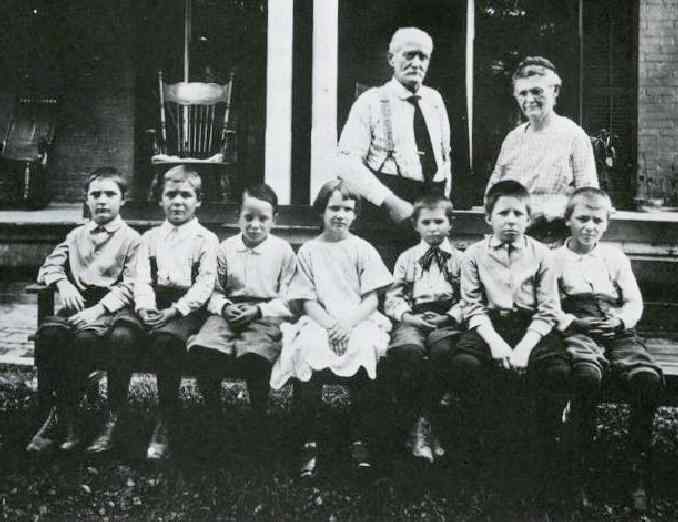
Here is an image of Indiana Orphans taken outside the Gibson County state Orphanage about 1918--six boys and a girl (figure 1). The children look about 8-10 years old. At an earlier period, orphans who became wards of the state had been apprenticed to work on farms. Now they lived in a state run institution supported by local taxes. The children were cared for by the couple you can see standing behind them. The boys are nicely dressed for their official photograph, wearing white shirts, above-the-knee knickers, and long black stockings. One boy wears a floppy bow tie. They all wear hightop shoes.
This is the St. Vincent de Paul School, an orphanage/boarding school in Manchester, New Hampshire.
Sisters of Providence of Montréal, Quebec founded a Hospicevfor which they are best known (1892). It was the 83rd institution founded by the Sisters, whose initials at that time were FCSP for Filles de la Charité, Soeurs de la Providence. The sisters have since shortened their name to Sisters of Providence (SP) with their motherhouse located in Montréal. The school in Manchester was originally an orphanage. It was established at the request of the Rev. J. A. Chevalier, founding pastor of St-Augustine parish, in commemoration of his 25th anniversary as a priest. Srs Marie Hermas, superior, Marie of Jesus, Marie Christine, Legault, Barrette and Gallant took possession of the house and opened their doors to 12 orphans (7 boys and 5 girls) (1895).
The original house was soon too small so Father Chevalier erected a larger building (1893). Between December 1892 and July 1895, the Sisters cared for 291 orphans.The Sisters also visited the poor and the sick in their homes and cared for some elderly boarders. The school was going strong in 1941 when it celebrated its 50th anniversary. The school closed (1958). We have a photo showing a girl of about 9 years old in the school or orphange uniform. It is a rther old fashion-looking dress with a kind of caoe and large white collar. A message also on the photo says that the girls ordinarily wore brown or tan long stockings for ordinary days but that on feast days they were required to change to white long stockings. Notice the pig tails and white collar and cuffs.
The Orphans' Home to be known as the Mennonite Children's Home was founded as a private act of charity by David Garber and S. K. Plank on their farm near Weilersville, close to Orrville, Ohio (1896).
The Home became an official Mennonite charity when the Mennonite Board of Charitable Homes was established (1896). The Board operate the Orphan's Home and the Old People's Home at Rittman, Ohio.
With more financial support, the children to better facilities in West Liberty, Ohio (1900). The new Home was formally opened a year later (1901). Abram Metzler (1854-1918) was the first and long-time superintendent of the West Liberty Orphans' Home. The Board was merged into the Mennonite Board of Missions and Charities (1906). The Mennonite Orphan Home was operated as a standard orphanage for several decades. We are not sure about the children. We do not know if they were all Menniite children or if other needy children were taken in at the Home. As attitudes toward orphan care changed, the emphasis became orphan placement in private homes. It was closed as an orphnage, but reppened as the Adriel School for mentally handicapped children (1957).
We know little about the Evagelical United Brothern Orphanage and Home (UBO) except that it was locted in Quincy, Pennsylvania. Quincy is a very small town located in southeastern, Pennsylvania, a rural areaclose toAmish counry.
Some times the Evalgelical a left off the name of the orphange as was 'and Home. Like many early orphanages, they organized a band for the boys, reminding one of the Broadway show 'Music Man'. Thy were well uniformed. The band photograph that we have looks like it was taken in the 1910s. And we know the UBO was active in the 1930s and 4os because a grl cared for there mentions it. We only see boys in th band, but at least in the 1930s it cared for girls as well. We also notice the orphanage mentione in the 1950s. The sponsiring church ppars to be the the Church of the United Brethren in Christ which was an evangelical Christian denomination based in Huntington, Indiana. It is a Protestant denomination of episcopal structure, Arminian theology, with roots in the Mennonite and German Reformed communities of colonial Pennsylvania. Thee were also close ties to Methodism. The local churches held a conference at the Otterbein Church in Baltimore, Maryland (1789). The Church was was formally organized by Martin Boehm and Philip William Otterbein (1800). It was the first American denomination that was not transplanted from Europe. Until 1800, the United Brethren churches did not have any central orgnization. And not all of which joined the church when it firsr formally organized.
A HBC reader tells us,I was raised in an abusive Catholic orphanage. The story of which I am now writing. I was born in 1933. As a younger boy in the 1930's and 40's we wore short pants with long wool stockings. The stockings were always dark and held up with garters or with garter vests. I wore short pants and the stockings until around age 11. After that, believe it or not, we graduated into knickers which was worn up to the 6th grade. Knickers had rather much gone out of fashion, but we continued wearing them anyway. Long pants came in when we were in 7th and 8th grades, by which time, I actually missed wearing short pants. The problem with wearing short pants is that we got teased by the older boys who were in long pants. I think shorts for males didn't really come into fashion until the early 50s, and then the army started the troops in shorts during the summer around 1955. If I recall, this was shortlived. As a very young boy, I wet the bed frequently, and the nuns made me wear a dress as punishment, and to cure me of bedwetting, which, incidentally, it never did. I have since discovered that the Sears catologs of the 1920's actually showed dresses for boys up to age 5, or so. This probably explains why I was forced into a dress, but of course it was no longer common to outfit boys in dresses by the 1930s and especailly the 40s. While I was embarrassed at this age, I actually began to wonder why, around age 8, why boys didn't wear dresses just as the girls did. There was no good answer given."
I was cared for at the Mt. Loretto orphanage/chilren's home in the late 1940s and early 1950s. Mt. Loretto cared for children from 4-18 years of age. We were sent their by family courts or local churches. We wore knickers, If I rember correctly without knee socks. When the knickers were phased out we wore cordoroys. I remember that we souned like a hor of locusts in our new cords when we marched to school and to the cafeteria.
We have been unable to find any information on the Passaiant Memorial Home, but we believe it was an orphanage operating in Rochester, Pennsylvania during the 1910s. We have found a postcard-nack portrait of an unidentified girl in 1915. The plain bangs hair style would have been very common at orphanages. An inscription on the back reads, "Taken Jan. 27 - 1915, 9 yrs., Passaiant Memorial Home, Rochester, PA". We assume this means an orphanage, but we have been unable to confirm this. The imange is also interesting because it was a rare NOKO postcard. The photographer was the Wilson Photo Studio, Harrisburg, Pennsylvania.
We know very little sbout the Tressler Orphan Home. We know it was located in Loysville, Pennsylvania. It was sometimes called the Pa Tressler Orphans Home. It was founded at the end of the Civil War in a former school. David L. Tressler built a three=story brick building for a college (1855-56). When the Civil Broke out, Tressler accepted a capitancy and the male students volunteered toi serve under him (1862). After the War, the school was converted into one of the fitst orphanages for the children od soldiuers killed in the War. (1865). The State of Pennsylvania appropristed funds for the care of children orphaned by the War. The orphanage thus received state finding. One reports suggest the orphanage closed in 1892, but this may be when state finding ended. We note the orphange was operaring as late as 1938. Like many orphanages, there was a boys' band. Local churches also supported the orphanage with food and other donations.
Here we see the children at the Vine Street Orphanage in Chattanooga, Tennessee probably during the 1930s. The photograph is undated, but we would guess was taken in the 1930s or early 40s. The children all have their Easter baskets. I am guessing that they are about to have an Easter egg hunt. We know nothing about the orphanage at this time. Interestingly the children are all dressed quite differently. Orphanges like schools in Tennessee and other southern states were racially segregated.
A second grader recalls how the clothes were issued every morning and how the other children at school would tease the orphans about their ragged or ill-fitting clohing. Based on Roger Dean Kiser, Sr.'s heart rending book, Orphan.

Navigate the Historic Boys' Clothing orphanage pages:
[Return to the Main U.S. orphanage page]
[Return to the Main orphanage page]
[French]
[Polish]
[Russian]
Navigate the Historic Boys' Clothing Web Site:
[Introduction]
[Activities]
[Biographies]
[Chronology]
[Cloth and textiles]
[Clothing styles]
[Countries]
[Topics]
[Bibliographies]
[Contributions]
[FAQs]
[Glossaries]
[Images]
[Links]
[Registration]
[Tools]
[Boys' Clothing Home]