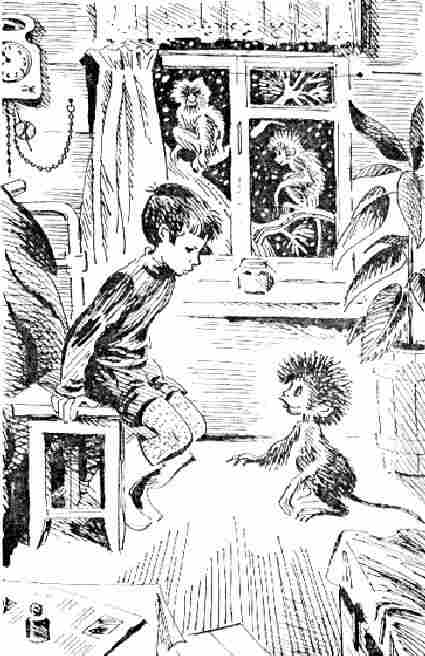
Figure 1.-- One reader remembers Krapivin's book The Tales of the Old Arbat. Like many of Krapivin's books, the story includes children an fastasy creatures. Arbat is best known street in Moscow, the principal commercial street of the city where clothes and toys are purchased. Like some of Krapivin's books, it was illustrated by Evgeniy Medvedev. The illustrations show the short pants and long stockings worn by Soviet bows during the 1950s. They also show the " valenki " -- the kind of felt boots typically worn during the cold Russian winters, even inside the home.
We have limited information on Soviet authors of children's books. Soviet children's books wre not distributed in the West and, as a result, HBC has little information on them. Some authors we have noted include Krapivin, Marshak, Neverov, and Politschuk. There were many others. A HBC reader tells us that Vladislav Krapivin was the most famous modern Russian author of the books for children during the late Soviet period. Krapivin had a close association with Evgeniy Medvedev who illustrated many of his books. We have little information on these authors and their work. Hopefully our Russian readers will provide more information on these authors.
Viktor Dragunsky was a Soviet children writer. He was born in United States, in New York in 1913 in the family of Russian immigrants, but his parents soon returned to Russia. He worked as a theater/movie actor, as a clown in circus and as a screenplay writer. But he became famous after in 1959 he started to publish small novels about everyday life of a small Russian schoolboy Denis Korablev. After Dragunsky�s death in 1972 all those novels were composed into one big book �Denis�s Stories�. His most beloved novels among Russian children are:
�He�s alive and shines�
�A mistery letter�
�A girl on the globe�
�What I love�
�Smell of the sky and tobacco�
�25 kilograms exactly�
�Phantomas�
�20 years long under the bed� and so on
Based on various Dragunsky�s novels about Denis Korablev there were taken several children movies in Sovien Union:
�Funny Stories� (1962)
�Where can it be seen, where can it be heard� (1973)
�Captain� (1973)
�A spyglass� (1973)
�A fire in a house meaning rescue under the ice� (1974)
�Wonderful adventures of Denis Korablev� (1979)
In all stories Dennis is pictured as a cheerful and active first-grader who lives in Moscow with his mom and dad.
A HBC reader tells us that Vladislav Krapivin was the most famous modern
Russian author of the books for children during the late Soviet period. Krapivin had a close association with Evgeniy Medvedev who illustrated many of his books. Some books were about realistic childhood experiences such a children away fom home in summer camps. One reader remembers Krapivin's book The Tales of the Old Arbat. Some of Krapivin's books included children an fastasy creatures. Arbat is best known street in Moscow, the principal commercial street of the city where clothes and toys are purchased. Like many of Krapivin's books, it was illustrated by Medvedev. The illustrations show the short pants and warm-looking long stockings worn by Soviet bows during the 1950s. They also show the " valenki " -- the kind of felt boots typically worn during the cold Russian winters, even inside the home.
Alexander Ivanovich Vvedensky is today known as a poet and dramatist in Russia, but in Soviet times was known orimary as an author of children's literature. Alexander was born in St. Petersburg before the Revolution (1904). We know very littler about his childhood. We know rhat took an interest in poetry at a very young age. It should be understood os a much more popular henre in Russia than America. And not within august literary circles, but with the rading public. It was poetry that captured Vvedensky's immagination. He admired thework of Velemir Khlebnikov. Hev attemoed to gain apprenticeships with writers connected to Russian Futurism. Russia in the early years after the Revolution considerable diversity of thought in non-political venues. Vvedensky tudied with well-known avant-garde artists with Futurist mindsets, including Matiushin, Tufanov, and Terentiev at the new GInHuK state arts school headed by Kazimir Malevich. Vvedenskywas part of the OBERIU group of non-conformist authors. He was seen seen as the most radical poet of the OBERIU group which sattracted NKVD attention. As Stalin gaind control of the Soviet state the space for literary experimentation narrowed. Vvedensky was unable to get his poetry published. Ti earn a living he began to write childrrn's books. This is how he was knowen to the general public. Vvedensky was able to retrn to Leningrad. He contunued to write children's books. One of his books was illustrated by Konstantin Vasilyevich Kuznetsov (1886-1943), a prolific illustrtor of early Soviet children's books. We note children's story oublished by Vvedensky (1935). Thr images follow the standard Soviet guidelines of a simple life for children. His work in children's literature is much admired. He wrote short pieces for children's magazines, translated children's books, and wrote his own several children's books. Interestingly bcause children's literatures often deals with fantasy, authors were able to short around the oppressive censorship more successfully than other literary genres.
The NKVD was arrested Vvedensky (1931). He was charged with belonging to a faction of anti-Soviet children's writers. His intrrogators accused him of encoding anti-Soviet messages in 'zaum' or sound poetry. The NKVD exiled him to Kursk for a time. In the Soiviet Union as the Purges unfolded resulting in summary execution or years of slave lanor in the Gulag o a massive scaled, this was a slap on the wrist. We are unsure why the NKVD was so lenient.
He was arrested for a short while in 1931–1932 on charges of belonging to a faction of anti-Soviet children's writers.
After the short exile in Kursk, he returned to Leningrad. He moved to Kharko (mid-1930s). This was where he was when the Germans invaded (June 1941). Hhe was unable get on the crowded evacuation trains and was separated grom his family. He was arrested by the NKVD for 'counter-revolutionary agitation' (September 1941). He was evacuated in prisoner ttransports in boxcars to Kazan on Centarl Asians. The conditions on these prisinr transporyts were deplofrable. He dies of pleuritis before reaching Kazan. The bodies of those who died were probaly just tossed incerimonously from the train. Vvedensky's adult works, ncludung his novel (Murderers, You Are Fools) has been lost. Thus was not only because of the chaos of the NAZI invasion, but because if fear of the NKVD. People did not wab=nt to be caught with manuscripts associated with authors in trouble with the NKVD--it could be used as incriminating evidence. Most of what survived was in the private archive of fellow poet Daniil Kharms in Leningrad. Yakov Druskin palyed a vital role--a couragerous step. Lenningrad was cut off by advancing German armies (September 1941). The population faced a terriuble winter without food and fuel. The NKVD arrested Kharms. Druskin was a close friend of Vvedensky and Kharms. Druskin in the middle of the deadly winter and NKVD investigations broke into Kharms apartment which had been sealed off by the NKVD and removed Vvedensky manuscripts. He secretly preserved therm for years. Vvedensky's poetry was largely unknown outside of a small circle not only during his lifetime but thriughout the Soviet era. A two-volume collected works was finally published in America. The first poujblication occurred iun Moscow as the Soviet Union was imploding (1991). He is now a recoignized poet od some importance.
Lubov Voronkova was active in the 1960s. We do not know a great deal about the author at this time. We notice his book Masha-rastyeryasha (Masha-loose-all-things). The book was published in the mid-1960s. Thwre were some nicely done illustrations by Henrich Valk. One illustration shows a child putting her stockings on in the morning. Here you can note that instead of garter waists or other support garmenrs, stockings were
supported with special buttons on panties before tights replaced stockings. The child in the illustration is a girl on the pic, but in the period illustrated, girls and boys wore similiar underwear and hosiery.
Vladimir Suteev was a prolific illustrator and creator of cartoons. Some people called him the "Russian Disney" for his incredible cartoons about animals. He was also an author and Usually illustrated his own stories. Here's an illustration for the tale "January" which is about fir trees.