|
The ambrotype was a less expensive alternative to the daguerreotype. By the 1850s
it had become the dominant form of photographic portraiture. Frederick Scott Archer improved the calotype and invented the "wet collodin" negative. A glass plate was cleaned and iodized collodin was poured onto it, then it
was immersed in a silver-nitrate bath. This was put into the camera while still wet, and the development had to be performed before it dried. A variation of the "wet collodin" was the ambrotype. The ambrotype is an underexposed wet-collodin negative on glass. Ambrotypes were mounted against black backing appearing like a positive, but did not have the tonal range of a Daguerreotype and could not be duplicated. The tintype was a variant of the ambrotype (Ferrotype or Melaninotype). It produced positive images usually on a thin sheet of iron. This process was easier, cheaper, and unbreakable compared to the ambrotype, but lacked the tonal range. Ambrotypes, tintypes made the Daguerreotype a dead art. These forms eventually became dead arts also with the development of the dry plate process and negatives.
Early photograohic processes produced positives. The first commercially viable process was the Daguerreotype. There were other types of photographs that were positive processes. This was fairly expensive process because of the cost of the metal plate. Two alernatives appeared at about the same time--the ambrotype and the tintype. Daguerreoyypes were expensive disappeared rapidly after the appearance of the CDV albumen print in the 1861. So did the ambrotype which while less expensive than the Daguerreotyoe, but more expensive than albumen prints. The tintype was a positive process that persisted into the 20th century because it was such an inexpensive process.
Daguerre continued Ni�pce's experiment. He accidentally discovered that exposed photographic plates were developed by Mercury vapors. This greatly reduced the exposure time from 8 hours down to 1/2 an hour. Daguerre announced his discovery in 1839 and named it the Daguerreotype. [Note the link is to a costume board, you have to scroll down to select the Daguerrrotype Society.] It was a sensation and an instant popular success. The announcement that the Daguerreotype "requires no knowledge of drawing...." and that "anyone may succeed ... and perform as well as the author of the invention" was greeted with enormous interest, and
"Daguerreomania" became a craze overnight. The process could produce strikingly beautiful images. They provide us rhe first true photogaphs of the 19th century.The Daguerreotype process, though good, was expensive. In addition, it produced a positive image which could not be duplicated.
The tintype was a variant of the ambrotype (Ferrotype or Melaninotype). It produced positive images usually on a thin sheet of iron. This process was easier, cheaper, and unbreakable compared to the ambrotype, but lacked the tonal range.Tintypes became enormously popular in the United States during the Civil War and the 75 or so years following, they were used to depict every aspect of American life. The most typical 19th century tintype was of course still the studio portrait. Tintypes were easier to make than Daguerreotypes or Ambrotypes, and the customer did not have to return for prints as with negative/positive processes. It was not the first instant process, but it was certainly the one more people could afford. Being easier to make and less expensive opened the door for a new type of photographer.
Frederick Scott Archer improved the calotype and invented the "wet collodin" negative.
He worked with Peter Fry. Their work on negatives eventually led to the ambrotype positive. It was the first wet-plate collodion process. Archer had developed a workable commercial process (1851). It was the first commercial challenge to the Daguerreotype. James Ambrose Cutting introduced the ambrotype to the United States (1854). This was soon followed by the invention of the tintype, another wet plate process.
A variation of the "wet collodin" was the ambrotype. The ambrotype is an underexposed wet-collodin negative on glass. Ambrotypes were mounted against black backing appearing like a positive, but did not have the tonal range of a Daguerreotype and could not be duplicated. Ambrotypes, tintypes made the Daguerreotype a dead art. Reaerachers working on negatives found that if an extremely thin, under-exposed negative is placed in front of a dark background, the image gives the illusion of a positive. This was because the silver reflected light, The areas without silver appeared black. This was the principle behind the Ambrotype process, the pictures being more correctly known as collodion positives. Photographers cleaned a glass plate and carefully poured iodized collodin on it. The next step was immerse in a silver-nitrate bath. Finally it was put into the camera while still wet. After exposure, it had to be performed before it dried. Ambrotypes were, like Daguerreotype direct positives, made by under-exposing collodion on glass negative, bleaching it, and then placing a black background--usually black velvet, less commonly varnish--behind it. Ambrotypes somewhat resembled Daguerreotypes. They were also often finished in leather cases often with velvet backing, also giving the impression of a Daguerreotypes. The process for preparing an Ambrotype, however, as described above was quite different. They were also much cheaper to produce, giving the process a substantial advantage.
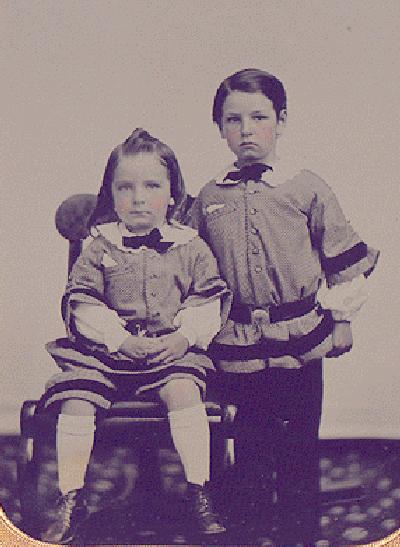
Most Ambrotypes have a low contrast, grayish white appearance. A skilled ambrotypist cold produce a high-quality image, but contrast was an inherent problem. We note some attempt at colorization of the these Ambrogypes. Although most Ambrotypes were not colorized, we note several images that were coloized to varting degrees. Especially common was adding blush to the cheeks. Here the photographer has added some rosy touches to the cheeks of these children (figure 1).
A ambrotype was normlly done with clear, colorless glass to create the negative. The back was normally painted black. Other options were to use a black cloth or other blackened objects like carbord to place in the frame behind the negative.
Some Ambrotypists offered colored class Ambros. The most popular was red tinted glass. These were called ruby Ambros. With ruby Ambros, the black background or paint was not required as the red tint made the glass naturally darker.
Some Amrotypists also offered dark green glass, but this was much less common. We do not note the term emerald Ambrotype being used, but authors sometimes refer to emerald-tinted glass. The ruby Ambros gave a warmer appeaeance and also hinted at flesh tones. This makes ruby Ambros especially popular among modern collectors. The ruby Ambros can often not be identified with any surity unless you take the Ambro plate out of its protective case. Holding it up to a light allows you to look through the glass instead of viewing reflected light.
Frederick Scott Archer in in 1851 announced that he had developed a new type of photography. It was less expensive than a Daguerreotype and thus soon began to replace the Daguerreotype process. I am not sure just how quickly Archer succeeded in introducing his new process. Several sources refer to Ambrotypes as beginning about 1855. I think this may rfer to when the Ambrotype began to appear in large numbers. Apparently by the mid-1850s the Ambrotype had become the dominant form of photographic portraiture in the United States. Ambrotypes were made from the 1850s through the early 1860s. The were, however, by the mid-1860s, increasingly replaced by negative photography--especially the cartes-de-visite (CDV). The fact that the Ambrotype was such a popular process from the mid-50s to the early 60s is useful to know in attempting to date these images. Ambrotypes were probably made after the very early 1860s, however, we believe that there were not many made in comparison to the number of CDVs. One example is portraits of David Platt. of While cheaper than a Daguerreotype, the Ambrotype were still more expensive than CDVs and less desirable because the image was of a lower quality and not easily stored in albums for display. Thus there were strong inducements for photographers to rapidly make the tranhsition. It can thus be assumed that most ambrotypes were made in the mid- and late-1850s or very early 60s (1860-62).
Better quality Anbros had a cover-glasses inside the case. This allowed the glass negative plae to be placed emulsion-side up. This not only offered further protectin, but had the advantage of correcting the lateral inversion which occurred when the image is viewed emulsion side down.
The Ambrotype was a less expensive alternative to the Daguerreotype. Glass was a lot cheaper than a polished metal plate used for an Ambro. There were, however, other advantages to the Ambrotype process. Images could be created with a shorter exposure. This an important advatnage because the long exposure times needed for Daguerreotype often ruined many settings as well as making the process of sitting for a portrait a tedious trial. The production process was not only cheaper, but also quicker because no printing was required. The Ambrotype "negative" could be flipped and mounted in a lateral reverse format through simplly putting the collodion side down over the backing material. Thus there was no lateral reversal, as was the case in most Daguerreotypes. Also unlike Daguerreotypes, Ambrotypes were easy to look at because they could be viewed from any desired angle. The Ambrotype was very quickly adopted for use in photographic studios and had largely dispalced Daguerreotype process by 1860. The Daguerreotype as the first popular photographic process had so completely captured the public imagination that the term "Daguerrean" was applied to any studio photographer long after the Daguerreotype process had largely disappered in the commercial trade. The major disadvntage of an Ambro is the vuknerabilty of glass and the possibilitty of breaking. Which is one reason they were caried in cases.
Early photographs were very expensive and fragile. This meant that because of the cost, storage was not a very serious problem. The cost meant that there were not very many photographs. The fragility, however, meant that they had to be well protected. Thus the initial system of little cases worked well. Daguerreotypes and ambrotypes came in these cases. Some cases were highly decorated. The mounting varied from country to country s was the popularity of the vaious formats. A German reader tells us that these cased portraits were much less common in Germany that they were in America. The common practice in the United States was tp mount the Daguerreotype in small hinged cases. The finished Daguerreotype image was sealed in glass to protect the plate from both atmospheric and physical damage. The cases were normally made of wood with artistically crafted leather or paper coverings. We also find tin-types in these cases, although inexpensive mounts that looked liked these cases were developed for tin-types because people came to think that was how photographs should be presented. Our interest in these cases is that they can be useful in dating the portraits. This is particularly important because so few dags and ambros are dated. There are several elements of the case which can be used in dating the cases, including the case, the decorative plate, and the covering over the actual plate.
Portraiture before the mid 19th century, because of the cost, was only an option available to the super rich of the day. Thus most portraits are of monarchy, nobility, political leaders (mostly monarchs and nobels before the 19th century), and wealthy merchants. The Daguerreotype changed this, giving the affluent but no rich classes the opportunity to sit for a portait. The Amrotype by further reducing the cost of a portrait brought portrature within the range of the middle class by the mid-1850s. This is of emense historical significance because beginning in the mid-1860s we begin to get larger number of images showing how people looked and dressed. No longer was the history of an era being illuninated by how the nobility and a small number of wealthy merchants dressed.
The Ambrotype was a major step toward modern photography. The lower cost a shorter exposure lengths meant that photographers could move outdoors. We see outdoors portrits. Most Ambros were studio portraits, but we see some outdoor portraits. This opened up enormous possibilities. You begin see enterprising photograsphers taking photographs of major events. The first war to be photograsphed was the Crimean War (1854-56). And we have large mumbers of photographs of the American Civil War (1861-65). These images were made in glass plates. This is not to say that photography outside the studio was easy, but it was possible and thus beginning in the 1850s we begin to have photographs of major historical events.
The Ambrotype was especially popular in America. The great percentage of the Anbros we have archived are American. We are not sure at this time why it was more popular in America than Europe. Presumanly it was the same reasons that Daguerreotypes were more common. First, the vibrant American economy and high wages gave individuals purchaing power beyond that of Europe. Second, parent law was not as vigiorusly enforced as in Europe. Perhaps readers will have other insights. For whatever reason we see vastly more American Ambros than European Ambros. The Ambrotype process was also referred to as "Melainotype" in Europe. We are not sure just why these different terms were used. One indicator of popularity is the internet. Almost all the Ambrotypes we see advertized on eBay are American. Very rarely do we see European ambrotypes. Cased images in general seem less common in Europe than in America. And because they were g;ass, Ambros for themost part had to be cased to protect them. A German reader tells us, "Yes, Dags and Ambros came in cases but I have never seen a German tintype in a case before. Actually here in Germany I see very few cased photos at all. On ebay.com there are much more cased photos offered compared to ebay.de." Our German reader has found an Ambro of an unidentified German family, probably dating to about 1860. It came in a frame rather than a case.
The early forms of photographhy (Daguerreotype, Ambrotype, and tintype) eventually became dead arts with the development of the dry plate process and negatives. English inventor William Henry Fox Talbot in 1835 discovered that an image could be made permanent by immersing it in salt. Ordinary salt disolved the unexposed silver cloride leaving only the darkened silver image. The process is called "fixation". Modern chemical-based photography is still based on this process. While the initial images were not as sharp as Daguerreotypes, the process proved much less expensive and multiple prints could be made from the resulting negative. The process was called calotype. Talbot by 1840 had made some significant improvements and his process gradually replaced Daguerreotypes. Prices for Daguerreotypes varied, but in general would cost about a guinea (�1.05), which would be the weekly wage for many workers. The collodion process, however, was much cheaper; prints could be made for as little as one shilling (5p). The two most important types of negative portraits made in 19th century studios were cartes-de-visite and cabinent cards. The cartes-de-visite, a photographic visiting card, was the size of a business card with a portrait or scene mounted to a cardboard backing made by using a wet plate negative allowing unlimited copies to be made. The cartes-de-visite appeared in the 1850s, about the same time as the Ambro. It did not, however, become popular until the early-1860s then and very raidly replaced the Ambrotype provess that was so popular in the 1850s.
Many of the ambrotypes we have archived are unidentified. This is in part, because unlike CDVs and cabinent cards, there is no back that owners can easily writes names, dates, and locations. Wjile unidentified, the narrow chronological range of this process means that they provide a useful window in the 1850s and early 60s. The images that we have found are mostly American images. Unfortunately many are not high-quality images.

Navigate the Boys' Historical Clothing Web Site:
[Return to the Main photography process page]
[Return to:Main photography page]
[About Us]
[Introduction]
[Activities]
[Biographies]
[Chronology]
[Clothing styles]
[Countries]
[Girls]
[Theatricals]
[Bibliographies]
[Contributions]
[FAQs]
[Glossaries]
[Images]
[Index]
[Links]
[Registration]
[Search]
[Tools]
[Main HBC Topic page]
[Boys' Historical Clothing Home]
Navigate the Boys' Historical Clothing Web Site:
[Sailor suits]
[Sailor hats]
[Buster Brown suits]
[Eton suits]
[Rompers]
[Tunics]
[Smocks]
[Pinafores]