
Ambrotypes: Collodion Positives
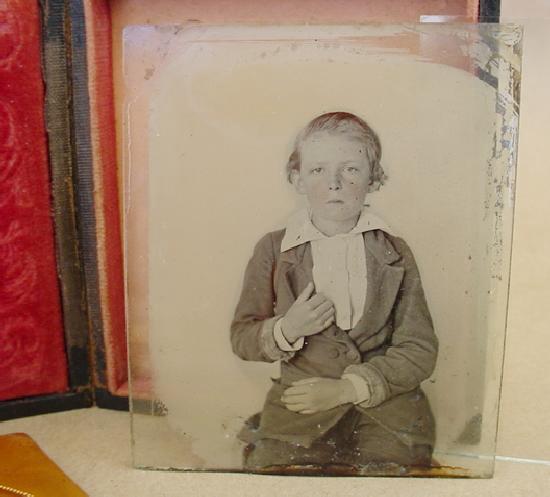
Figure 1.--This boy probably had his portrait taken in the late 1850s. We know nothing about him exceot that he was American. Notice hiw the jacket sleeve cuffs have been turned up. You can see here the glass plate used for ambrotypes. Put your cursor on the image to see the various pieces that go into making a cased ambrotype. Notice how the boy's hands are held. The photographer must have instructed him to do that so that they are kept still.
|
|
A variation of the "wet collodin" was the ambrotype. The ambrotype is an underexposed wet-collodin negative on glass. Ambrotypes were mounted against black backing appearing like a positive, but did not have the tonal range of a Daguerreotype and could not be duplicated. Ambrotypes, tintypes made the Daguerreotype a dead art. Reaerachers working on negatives found that if an extremely thin, under-exposed negative is placed in front of a dark background, the image gives the illusion of a positive. This was because the silver reflected light, The areas without silver appeared black. This was the principle behind the Ambrotype process, the pictures being more correctly known as collodion positives. Photographers cleaned a glass plate and carefully poured iodized collodin on it. The next step was immerse in a silver-nitrate bath. Finally it was put into the camera while still wet. After exposure, it had to be performed before it dried. Ambrotypes were, like Daguerreotype direct positives, made by under-exposing collodion on glass negative, bleaching it, and then placing a black background--usually black velvet, less commonly varnish--behind it. Ambrotypes somewhat resembled Daguerreotypes. They were also often finished in leather cases often with velvet backing, also giving the impression of a Daguerreotypes. The process for preparing an Ambrotype, however, as described above was quite different. They were also much cheaper to produce, giving the process a substantial advantage.
A variation of the "wet collodin" was the ambrotype. The ambrotype is an underexposed wet-collodin negative on glass. The glass could be different sizes, but most were done on small class plted which were carried in cases like Daguerreotypes. Photographers cleaned a glass plate and carefully poured iodized collodin on it. The next step was immerse in a silver-nitrate bath. Finally it was put into the camera while still wet. After exposure, it had to be performed before it dried. Ambrotypes were, like Daguerreotype direct positives, made by under-exposing collodion on glass negative, and bleaching it.
Ambrotypes were normally mounted against black backing appearing like a positive. Ambrotypes and tintypes made the Daguerreotype a dead art. Reaerachers working on negatives found that if an extremely thin, under-exposed negative is placed in front of a dark background, the image gives the illusion of a positive. This was because the silver reflected light, The areas without silver appeared black. This was the principle behind the Ambrotype process, the pictures being more correctly known as collodion positives. The dark background was commonly black velvet. Less commonly black varnish behind the glass plate was used. A dark colored backing could add the appearance of color. This aooears to have been done with the Ambro here (figure 1).
Advantges and Disadvantages
There were advantahes and disadvantages to the Ambrotype. The advantages far outwighed the disadvantages. The principal advantage was the cost. They were much cheaper to produce, giving the process a substantial advantage over Dags. Glass was much less expensive than the the polished metal plate needed for a Daguerreotype. Dags used a highly polished metal plate. The plate was more expensive than glass and polishing that plate was an even more expensive undertaking. Another important advantage was the shorter exposure time required. This was far preferable to the clientelle. It also avoided the problem of changing light sources.
Production costs were also lower because the process involved fewer steps. And the glass plate could be reverse mounted by putting the emulsion side of the glass plate on top of a dark backing material. This eliminating lateral reversal that could not be corrected with Dags. The Ambrotype could also be viewed from any angle. A Dag had the disadvantaged that the mirrored surface could only be seen to best advatages from an angle.
The principal disadvantge was that the images were produced were not as high a quality as Dag images. Ambros did not have the tonal range of a Daguerreotype. And the glass plate was much more fragile than the Dag metal plates. Like Dags they could not be duplicated.
Cases
Ambrotypes somewhat resembled Daguerreotypes. They were also often finished in leather cases often with velvet backing, also giving the impression of a Daguerreotypes. The protective cases were necessary because the glass plates were so fragile and the becessary dark backing could easily be placed in the case.
HBC

Navigate the Boys' Historical Clothing Web Site:
[Return to:Main ambrotype page]
[Introduction]
[Activities]
[Biographies]
[Chronology]
[Clothing styles]
[Countries]
[Bibliographies]
[Contributions]
[FAQs]
[Glossaries]
[Images]
[Links]
[Registration]
[Tools]
[Boys' Clothing Home]
Navigate the Boys' Historical Clothing Web Site:
[Hair styles]
[Shirts]
[Suits]
[Tunics]
Created: 9:54 PM 1/26/2008
Last updated: 3:49 AM 5/4/2010