|
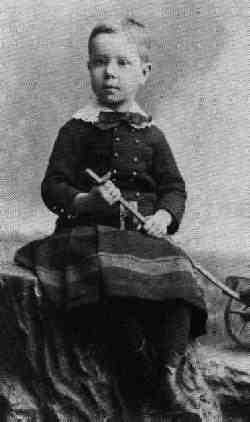
The first important specialized child's garment was the boys' skeleton suit. Note that at first their was no specialized girls' styles. Girls and small boys continued to wear dresses styled just like their mothers' dressess--only in small sizes. But the skeleton suit was developed a suitable for children, it was not at first a style worn by men. Ot would take several decades before men, at least gentlemen began wearing long trousers. The boys' suit has since those first sleleton suits undergone many changes in style and wearing conventions. Many different types of jackets have been worn. Many different types of rousers have been developed for a boys' suit. It should also be remembered thatin the late 19th century, many boys wore their suits with a skirted gament, someyimes called a kilt, instead of the more familiar trousers. Many suits once also included a third--element, the vest.
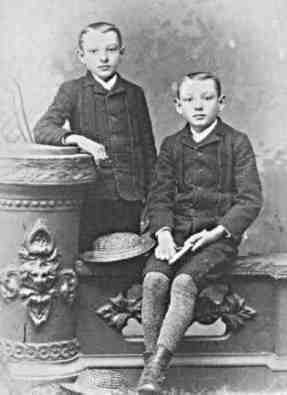
The first suits specifically by boys was the skeleton suit. More modern looking suits began to appear in the mid-19th century. We note that suits for younger boys were often heavily detailed, often with embroidery, much more so than adult suits. Younger boys commonly wore kneepants or bloomer knickers as well as kilt suits. Until the 1870s long pants were still common, especially for school age boys. About this time the heavily emroidered suits became less common. Boys by the turn of the 20th century commonly wore kneepants or knickers suits--even older boys. Here social class and regional trend patterns were significant. Eton suits became very popular in the late 19th century. We notice both modern looking suits with lapels as well as suit jackets that buttoned all the way up at the collar. Norfolk styling became quite popular at the turn of the 20th century. Both single and double vreasted jackets were worn, but gradually after World War I single breasted suits became increasingly popular. Blazers also became popular for boys, an influence from English schools.
Men in the 19th century urban society wore suits. This was not the case in ural areas, although even there suits wee worn for special occassions. Working-class men did not wear suits at work, but they sid when dressing up for church or other occassions. Appearing in public wihout a suit jacket was considered inappropriate. Thisconventin grew in strngth as the century progressed. Varios factors were at play. The Industrial Revolution brought with it immense wealth. Millions of people moved to the growing industrial cities and entered the middle-class for the first time. An this meant dressing more formaly, meaning wearing suits. And this mean dressing the childrn more formally. We are not entirely sure how boys dressed in the early-19th centuryWe know the skeleton suit was popular as well as tunics. We do not know, however, how prevalent these styles were. Thanks to photography, we know a good deal about mid-century, at lest in America. We note a lot of boys at mid century wearing shirt-like garments worn rather like tunics. And hen suddenly by the 1860s wenote most boys wearing either suit jackets or one-piece outfits. Gradually as the century progressed, suit jackets necame increasingly common. Even youngr boys once breeched wore jackets. There was some exception for boys during the summer. We see some boys just wearing blouses and shirts during the summer even when dressing up. The term in America appeared, 'shirt-tail youngers'
Suit typs are a littke complicated, largely because mpst of the styling of a suit is on the jacket and the the names of the major suit types are largely derived by the styling on the jacket. Thus you can find a discussion of the various suit typoes by clicking on "Garments" below abn then going to "Jackets". To a lesser extent, boy's suits are also classified based on the tyoe of pants/trousers. Again you can find a discussion of the varius pabts types by clicking on "Grments" below and then going to "Pants and Trousers".
|
There are three primary elements to a suit. The jacket and trousers are requited. The vest is optional. Suit jackets for boys first appeared with the skeleton suits in the late 19th century. Since then a great diversity of styles have been worn. Some have been quite plain, some very fancy--hardly seen as suitable for a rough and tumble boy in our modern casual era. Some suit jackets have been quite destinct from the suits worn by a boy's father while others have been quite similar. The conventions for wearing suits has changed considerably. Boys have also worn pants and trousers of different length. [Note: the authors have generally chosen the American word pants. In British English the proper word would be trousers, pants in Britain refer to underwear.] Long trousers were common in the first decade of the 19th Century. Boys wore long pants with their skeleton suits. At mid-century knee-length pants had appeared for boys, but it was not uncommon to see even younger boys wearing long pants., but had generally been replaced by knee-length pants and long stockings by the 1860s boys under 12 years of age, but some older boys were also wearing them. The vest or waistcoat was a common part of many 19th century suits, especially in themid and late 19th century. (The British use waistcoat as a vest there means an undershirt.) Most fashionable suits had them. There were even common with boys wearing kiltsuit. We have noted them both made in the same material as the suit or in contradting material and colors. The three piece suit as it was called continued to be worn in the 20th century, but by the 1930s it began to be seen as a particularly formal style and was optional. There are also a number of accessories worn with suits, including caps, ties, belts, socks, and shoes. The accessories and styles have varried over time and from country to country.
|
Suits are normally worn with trousers. American boys in the late 19th centurty, however, commonly wore their first real suit with skirt kilts. The Scottish kilt was never extensively worn by American boys, despite the sizeable number of Scottish Americans. A related garment, however, the kilt suit, was very commonly worn by two generations of American boys. I believe that the style was also widely worn in England and to a lesser extent in France. Its popularity in Germany and other continental countries, however, appears more limited, although admittedly I have little
information on these countries.
Boys in the late 19th and early 20th century commonly wore suits with the jacket and pants matching. This was the srtandard until after World War I (1914-18) when two alternatives appeared. The first was the blazer, a garment which appsdared in late 19th century England as a kind of sports garment. By the 1920s many English schools began intrducing brightly colored blazers worn with grey trousers. Gradually boys vegan swearing blazers there were not part of a school uniform. This was especially popular in America. The other alternative was the sports jacket. The sports jacket had much varied styling and was worn with more varied trousers. Both were worn, however, as alternatives to suits, as part of the evolving casual life style in Europe and America. Unlike suits, blazers and sports jackets are not always worn with ties.
The most popular suiting material for boys were woolen worsted fabrics. A range of bldnded fabrics have been used. Velvet was populsr for younger boys. Corduroy was an inexpensive cotton fabric that was extensively used for boys' suits.
We notice a range of patterns in the 19th century. Some were quite muted while others were loud. A good example is an American boy, Dan Brown, with a rather loud check suit in the 1870s. We see another American boy, Clifton Harrison, with a more muted check pattern in 1866. We note an unidentified American boy. wearing aloud checked knickers suit in the 1910s.
The colors of suits varied over time. We see some bright colors in the 18th century, but but by the 19th century more subduded colors were preferred by men and boys. Black became popular during the Victorian era. We see mostly black, blue, brown, and grey suits. We also een green and white suits. White suits were a seasonal color for summerwear and commonly done in a light frabic. A good example is American boy Ben Davies in the 1920s. It was also worn for special occasions like First Communions. Unfortunately the black and white photograohy of the day makes color assessments impossible, although we can usually discern black and white suit. Many suits had patterns using multi-colored thread with mixed material. Popularity of coloes varied over time and among countries. A British reader remembers his grey short trouser suit that he wore for Sunday best. There was a pinstripe through the material. He also had green Harris Tweed and one in brown of the same material. American boys might have black or navy blue suits which were not so common in Britain. Grey was also common in America. We are less sure about popular colors in other countries.
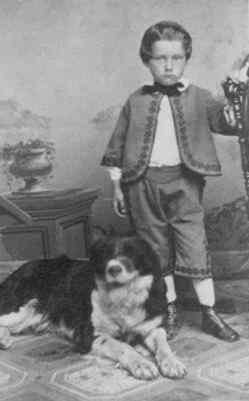
We notice a range of decorations on suits and blazers. This is something we do not think of much today as boy suits tend to be plain, done without patterns, let alone decorative elements. This was not the case in the 19th century. We notice a range of decorative elements, including buttons, embrodiery, frogging, and piping. Button are a utilitarian item, but often used for decorative purposes as well. This was mostly for suits worn by younger boys. Embroidery was popular in the suits for younger boys. It often does show clearly as we notice it was often done in the same color as the suit. We see embroidery used extensively on suits for younger boys like Fauntleroy a Zouave suits. Embridery wase especially common on cut-away jackets, including Funtleroy suits. Sometimes the decorations were continued on the pants. Frogging was also a decorative element. Frogging was ornamental braid or coat fastenings consisting of spindle-shaped buttons and loops. It was most common on dress military uniforms, but we see it on boys' wear as well. It was used on some Fauntleroy suits. Piping was also a decorative element. This we see mostly in the 19th century. An exceotion herewas English school blazers we see in the 20th century. Ribbons and braid were used, often for piping. A good example of piping is an unidentified Canadian boy wearing a velvet cut-away jacket suit in the 1860s. These decorative elements were primarily ysed on the jacket, but we also see decoratibe elemebt on the pants
Some suits had more than one decorative elements.
Most coats neatly fit into some of the basic categories detailes on the HBC suit insex page. We have, however, noted a number of garmenrts that we are less sure about. Many of these garments date from the early 19th century on which HBC has developed less information. We would be very interested in reader insights into these garments.
We do not yet have a complete account on the history of the ready-made suit. We do know that they were first marketed in America by Brooks' Brothers (1845). I think this was before ready-\made clothing appeared in Europe, but am not yet positive. This came just after the Jacksonian Era in the United States in which the trend was toward democratization. Ready-to-wear clothing was a major democratizing factor in 19th century America. [Zakim] Ready-made methods lowered the cost of clothing. It meant that fashionable clothing beegan to come into the price range of the average man. The manufacturers and retail establishments that participated in the ready-to-wear industry were at the cutting edge of both capitalism and democracy--the core of the developing American Republic. The clothing industry was one of the most important American industries at the time, much more important than in the 20th century. This also the beginning of America's consumer culture.
Ready made clothing made a modest beginning, but the Civil War changed that. Ready-made uniforms were needed in huge quantities. Than after the Civil War the mail order catalog appeared and these stores offered only ready-made clothes which required standardized sizing. This meant tht no matter where a person lived, he could easily get a fashionable suit at a modest price.
Suit styles were primarly established in Europe. Here Britain was especially important. France was very important for women's abnd girl's fashions, but Britain was more importsnt for male clothing. There were quite diverse styles in the 19th century. Often it was possible to identifyb the countries involved. Suit styles became mor standardized in the 20th century. There were still variations in jackets, vests, and pants ajmong major countries. HBC has many country suit pages. We have just begun, however, to link these pages to our country suit page. This will take a littke time to complete.
Zakim, Michael. Ready-Made Democracy: A History of Men's Dress in the American Republic, 1760�1860 (Chicago: University of Chicago Press, 2003). 296p.

Navigate the Historic Boys' Clothing Web Site:
[Return to the Main garment page]
[Introduction]
[Activities]
[Biographies]
[Chronology]
[Clothing styles]
[Countries]
[Bibliographies]
[Contributions]
[FAQs]
[Glossaries]
[Images]
[Links]
[Registration]
[Tools]
[Boys' Clothing Home]
Navigate the Historic Boys' Clothing Web chronological pages:
[Early 19th century]
[Mid-19th century]
[The 1860s]
[The 1870s]
[The 1880s]
[The 1890s]
[The 1900s]
[The 1910s]
[The 1920s]
[The 1930s]
[The 1940s]
[The 1950s]
[The 1960s]
[The 1970s]
[The 1980s]
Navigate the Historic Boys' Clothing Web style pages:
[Skeleton suits]
[Eton suits]
[Norfolk jackets]
[Kilts]
[Knicker suits]
[Blazers]
[Short pants suits]
[Long pants suits]