|
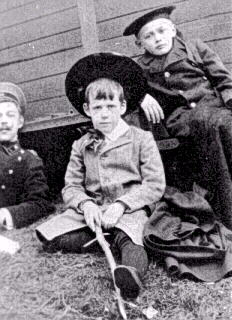
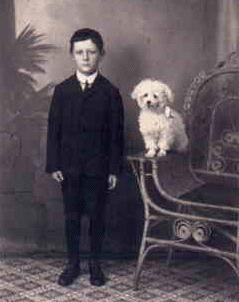
Boys fashions at the beginning of the decade were little changed from the turn of the century. Formal dress was still common, although the fresh air and sunshine movement as well as the Boy Scours had some impact. We see some less formal styles for children, especially boys, but adults still tended to dress very formally. Boys commonly wore knee pants, although in America, knickers suddenly became sandard for boys. World War I proved to be a major dividing point not only in world history, but fashion as well. It is unclear just how the War had this impact, but it is not hard to envision. Women working in defense plants dressed practilly amnd this experience must hve affected future fashion choices. And the idea of fancy dress for little boys not only seemed absurd after the war, but many women did not want to devote their time to such absurdities. Many major changes occurred during the War and affected life style and fashion after the War. It certainly had the impact of destroying all the old certanties of pre-War Europe. And during the war, industry including the clothing industry was directed toward the War effort rather han fashion. The impact was to permnntly alter fashion trends. The 1910s were a major dividing point between the formal styles of the late 19th century and the more clearly recognizable as modern styles of the 1920s. Certainly World War I (1914-18) must have been the major factor forging the new fashions. Similar significant changes ocurred after World War II. W are not entirely sure about the sociological forces at play. Perhaps it was the loss of innocence brought about by the War. Perhaps it no longer made sence dressing children in the innocent, child-like fashions commonly worn before the War. As a result, by the 1920s boys were dressing very differently than at the turn of the century.
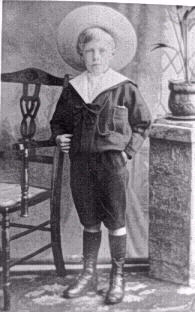
Major changes in fashion and garments occurred during the 1910s. The decade began with a great deal of formality in dress, even for children, although thst hd begun to change. Many of the boy's styles from the 19th century had largely disappeared like Fauntleroy suits and kilts suits. These chnges occurred before comparable changes ocuurrred in adult fashions. Comfortable casual styles for boys became increasingly popular. he sailor suit fashion continued popular in the 1910s. Maby styles at the beginning of the decade were little changed than at the turn of the century, except that shorts and knickers largely replaced knee pants. By the end of the decade sailor suits were being worn by increasingly younger boys in Britain and America, although older boys continued to wear them in Germany and other European countries. Most American boys wore knickers, often including high school age boys. The real changes occurred in the second half of the decade as Europe and America was rocked by horrendous tragedy of World War I (1914-18). It is unclear just how the War had this impact, but it is not hard to envision. Women working in defense plants dressed practilly amnd this experience must hve affected future fashion choices. And the idea of fancy dress for little boys not only seemed absurd after the war, but many women did not want to devote their time to such absurdities. Many major changes occurred during the War and affected life style and fashion after the War. It certainly had the impact of destroying all the old certanties of pre-War Europe. And during the war, industry including the clothing industry was directed toward the War effort rather han fashion. The impact was to permnntly alter fashion trends. The 1910s were a major dividing point between the formal styles of the late 19th century and the more clearly recognizable as modern styles of the 1920s. Certainly World War I (1914-18) must have been the major factor forging the new fashions.
|
Natural fibers (linen, cotton, wool, and silk) used, with rayon (artificial silk) a new invention in 1910. Rayon invented in 1910 as the first artificial fiber. It was introduced to common fashion in the late teens, but used by Chanel as early as 1915. Medium to heavyweight fabrics like serge and gabardine seen for everyday wear. Jersey and denim?? were popular fabrics for pay clothes.
Although bow, lace, and ruffles were commonly used for boys clothes in the late 19th century, many boys did not wear these styles. There were always some who quetioined this fashion. These voices by the 1910s, especilly after World War I, were becoming the dominate voice. One such voice was De Pinna Company. The 1917 De Pinna Co. catalog wa issued in hard over. De Pinna was an important New York retailer. It was located on 5th
Avenue with other exclusive retailers and was the New York branch of an English boys clothing store that was founded in London, 1880, so I presume that the text was written by them.) The catalog advises, "The manly appearance of an English lad is always noticeable. Over there, the dressing of boys and young men has been standardized for years. There is lacking in their dress that suggestion of feminine intervention which has crept at times into the dress of American boys. There is no reason why any good healthy American boy should be decked in ribbons, frills, and laces. There is every reason why he should wear--according to his station in life--clothing and accessories that closely resemble those of men ..." The text runs on another few pages to tout the importance of "manly" attire... It is interesting that this word is no longer used in children's fashion ads It
certainly was used a lot around the early 1900s! One wonders why the term fell out of favor. Sometimes the changing rhetoric of fashion is just as mysterious as fashion trends themselves. Also note the phrase "good, healthy". There is a psychological implication here. Did men innately regard a boy who is ill or a invalid as more the property of his mother than a "good, healthy" boy? One factor that needs to be considered is that De Pinna was a menswear retailer. Boys were likly to be brought there by their fathers and thus frilly clothes would not normally offered there. Fancier outfits were more likely to be found at dress shops which commonly offered clothes for young boys nad department stores. In both these, it would be more likely that boy would be likely to be bought by their mothers.
We have begun to collect some infoemation about hair styles for boys in the 1910s. The elaborte long hair styles, both ringlet curls and straight hair continued to declinein popularity, but had not yet disappeared. Those boys still wearing curls were more likely to have shorter curls. Also it became increasingly rare to find school age boys in curls. One veru popular style for boys were bangs. This was the case in many countries. Mostr school age boys wore short haor cut around the ears. This was worn both with bangs and with side parts. Mosy but not all boys had left parts.
|
We have begun to collect some unformation on boys' clothing trends in other countries during the 1910s. By the turn-of-the 20t century the family sbap dshot pprared and e ythis have a huge photiograohic record to work ewith. This was especially true in America, but also the major European countries as well. There were still destinct national differences in the 1910s, but a variety of common styles like sailor suits. Some iof thecreally fabcy stlyleslike the Funtleroy suit begn to decline, but dresses remained rther formal. he decade begin with the ebthusiasm of a prosperous America and Europe. There was great technological strides and increaing affuence. That affluence was was reflected in fashion and increasingly well-dessed children. There was still considerable formality in dress. For some reason Ameican and European boys' fashion began to diverge. European boys begn wearing short pnts nd American boys began wearing knickers. Germany launched World War I by invaing Belgium. The War dominated most of the rest of the decade. World War I began in 1914 and impacts from the War can be seen in combatant countries. This ushered in an era of frugality and praticality in dress. This would start a trend that would continue throughout the 20th century. Europe was desrastated by the War, both by the destruction and blood letting and also by the massive expenditures needed to fight the War. Anmerica was lease affected and recorved quickly but Europe suffered long term economic damage.
We are compiling some information about individuals in the 1910s. In some cases we have some information about their lives. In other cases we have just the name or an especially interesting photograph.
1911: Raymond Bykes: America--messenger boy
1916: Harold Walker: America--agricultural laborer
While HBC focuses on boys clothing, we have collectd considerable information on girls' clothinng as well. Here you can view some of the clothes worn by girls during the 1900s. There are large numbers of images of girls outfits, almost all
dressess, archieved on HBC, both in America and Europe.
White dresses were popular. Often girls wore their dresses
with pinafores. Girls also commonly wore smocks. Weare less
sure to what extent girls wore tunics and rompers. Hair bows
were especially popular--sone remarkably large.
German doctors found the cause of tuberculosis and developed the closed institution or sanatoriia approach to treating the disease (1880s). And a central focus was exposing the suferers with a healthful environment including fresh air and sushine. This was a major shift as until the 1880s the general approach was to wrap up children from head to toe. A factor here was modesty, but protecting children from both fresh air and sunshine was also a factor. Slowly we begin to see attitudes toward fresh air and sunnshine changing and those attitudes beginning to affect fashions. This was notable in the 1890s. We note, for example, more boys wearing knee pants, cut shorter, and to an older age. And in Europe, fewer boys wearing long stockings with knee pants. Swimsuits begin to become more sensible. This varied from country to country. The impact on fashion in the 1890s was still limited, but we begin to see the beginning of important fashion shifts. Other related dsevelopments can also be seen such as the summer camp movement in America which was an effort to get kids out of the polluted cities abd into the fresh air and sunshine of thge countryside. These trends were even more pronounced by tge 1900s even though there was still a pronounced foirmality in dress. The Scouts appeared in the 1900s were an effort to get youth involved in outdoor activities. We also see the appearance of barefoot sandals. Tghe trends were ecven more notably in the 1910s as they merged with the new casual styles introduced during World War I.

Navigate the Boys' Historical Clothing Web Site:
[Introduction]
[Activities]
[Biographies]
[Chronology]
[Clothing styles]
[Countries]
[Bibliographies]
[Contributions]
[FAQs]
[Glossaries]
[Images]
[Links]
[Registration]
[Boys' Clothing Home]
Navigate the Historic Boys' Clothing Web chronological pages:
[Return to the Main 20th century chronology page]
[Return to the Main chronology page]
[The 1800s]
[The 1840s]
[The 1870s]
[The 1880s]
[The 1890s]
[The 1900s]
[]
[The 1920s]
[The 1930s]
[The 1940s]
[The 1950s]
[The 1960s]
[The 1970s]
[The 1980s]