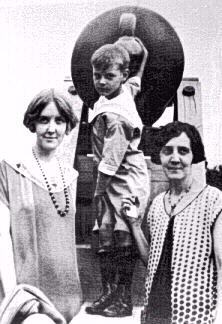
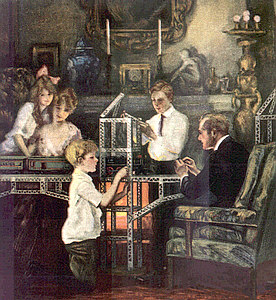
The 1920s was a major turning point for fashionsandthis included boys' fashions. Modest channges were observable earlier in the decadetwith modest concessions to the the formality of the late-Victoriuan era when men and boys wore suits, even very young boys. But it was after World War I in the 1920s that we see essentially a fashion revolution. Just why did fashion change so markedly in the 1920s? An entire book could be written on this topic. Surely the disaster of the World War I caused people to covet change. Many fear change and hold on to old traditions. This was especially true in the more static socities before the development of mass media. The War invalidated many of the exiting taboos and social standards. It undermined the existing social order. At the same time the new mass media was beginning to coalese around movies which appeared in the 1900s and radio which appeared in the 1920s. Never before had so much information about the wider world been available to so many people. People wanted to experiment and try something new. They proceeded to do so, in many cases with abandon.Short pants in Europe and knickers in America worn with knee length socks rapidly replaced knee length pants and long stockings. The growing popularity of the Boy Scout uniform played an important role in popularizing shorts. The trend was particularly rapid in England and Continental Europe. Quite old boys were soon wearing short pants suits and sporting bare knees.
|
The 1920s was not just any decade. Even those without any interest or
knowledge of history have heard of the "Roaring 20s". It may have been the brashest, the loudest, and brighest decade at all. The images are numerous and often starteling: bath-tub gin, gangsters, fast cars,
prosperity, short skirts, bobbed hair, modern art, the Charleston, and many more. In many ways our
modern era was born in the 1920s. The catastrophe of the Great War
gave it birth and a calamity of the Great Depression ended it. Within
the brief 10 years many in Europe and America changed how they looked
on themselves and the world. Fashions was only one of the many changes--
but in many ways the most observable.
The 1920s were notorious for its scandalous changes in fashion and custom. It was not just boys fashions which changed. Girls and women bobbed their hair at the same time long curls for boys also passed from
the fashion scene. Just as shorter pants became common for boys (at least in Europe), women also began showing your knees as hemlines rose--the costume glamorized by the flapper.
The heorine of the 1920s was the flapper. Her revolutionary short hair and a short skirt, with turned-down hose and powdered
knees--scandalized the older generation. The flapper must have seemed to her mother (symbolized by the gentle, but elegant Gibson girl of an
earlier generation) like a Hell-bent rebel. No longer confined to home
and tradition, the typical flapper was a young women who was often
thought of as fast and brazen. Mostly, the flapper offended the
older generation because she defied conventions of acceptable
feminine behavior. The flapper was "modern." Traditionally,
women's hair had always been worn long. The flapper wore it
short, or bobbed. She used make-up (which she might well
apply in public). And the flapper wore baggy dresses which often exposed her arms as well as her legs
from the knees down.
Some authors believe that fashion trends during the 1920�s displayed
the superficiality and rebellion of the
era. Outward appearance rather than personality was found to be most
appealing and fashion helped create that feeling. Fashion was evident in
the dancing and movies of the decade and was made popular by the
flappers. Many writers such as H.L. Mencken and F. Scott Fitzgerald
showed the importance of fashion and how it contributed to society and
fashion was a major part of the atmosphere of the time period.
While it was the flapper that caught the public eye, boys' fashions
were quietly makin a revolution of their own. In fact, a major
cross current occurred in the 1920s. Boys' clothes became less
girlish. Little boys no longer wore dresses nor Fauntleroy suits with
lace collars--although boys from affluent families might still wear a
kess fancy velvet suit. At the same time, girls' clothes became more
boyish. The
short dresses were complemented with long necklaces and short and sometimes
bobbed hair. The "boyish" look was the trend of the period and short hair
was considered attractive. This was not just a cute histiorical footnote.
Clothes have from time immemorial symboloized social status and power.
Men's clothes symbolized power and authority. Feminine clothes
symbolized attractive, but submissive social status. Girls in the 19th
Century never wore men's clothes. Even the bloomers interoduced by
Emelia Bloomer had scandalized Victorian society. The fact that girl's clothes were becoming more
boyish was in fact a reflection of the changing status of women.
Just why did fashion change so markedly in the 1920s? An entire book
could be written on this topic. Surely the disaster of the World
War I caused people to covet change. Many
fear change and hold on to old traditions. This was especially true
in the more static socities before the development of mass media. The
War invalidated many of the exiting taboos and social standards. It
undermined the existing social order. At the same time the new mass
media was
beginning to coalese around movies which appeared in the 1900s and
radio which appeared in the 1920s. Never before had so much information
about the
wider world been available to so many people. People wanted to experiment
and try something new. They proceeded to do so, in many cases with
abandon.
Natural fibers (linen, cotton, and wool, silk). Fancy fabrics, acetate, and rayon (artificial silk) became less commonly used, even for dress clothes. Inovations during the decade incuded development of bias-cutting fabric by Madeleine Vionnet. Also acetate fabric was invented in 1924.
|
We have quite a bit of information on the 920s, including trends in several different countries. It was still possible to identiufy where children wee from by how they were drtessed. This was the case in many European countries, but American boys were especially easy to identify from how they were dressed. This difference had become apparent in the 1910s when knickers became stadard for American boys. The short pasnts common in Europe were less popular in America. Canadian fashions were similar to America. There were diffences among European countries, but the variation in European and American fashions were particularly striking.
|
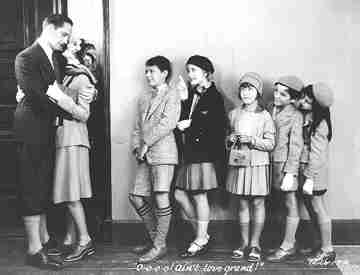
Mocies are a great source of information on 1920s fashions. Most of the films made in the 1920s were low-budget silent films. The period films are especially interesting because a lot of the children were not costumed, but wore their own clothes. The main charsacters might be costumed, but the childen with small roles or the extras, probably just wore their own clothes. Unfortunateky, we do not know a lot about silent films. Deveral contries (America, Britain, Germasny, and France) had important movie industries.

Navigate the Historic Boys' Clothing Web Site:
[About Us]
[Introduction]
[Activities]
[Biographies]
[Chronology]
[Cloth and textiles]
[Garments]
[Countries]
[Topics]
[Bibliographies]
[Contributions]
[FAQs]
[Glossaries]
[Images]
[Links]
[Registration]
[Tools]
[Boys' Clothing Home]
Navigate the Historic Boys' Clothing Web chronological pages:
[Return to the Main 20th century page]
[Return to the Main modern chronology page]
[The 1840s]
[The 1870s]
[The 1880s]
[The 1890s]
[The 1900s]
[The 1910s]
[]
[The 1930s]
[The 1940s]
[The 1950s]
[The 1960s]
[The 1970s]
[The 1980s]