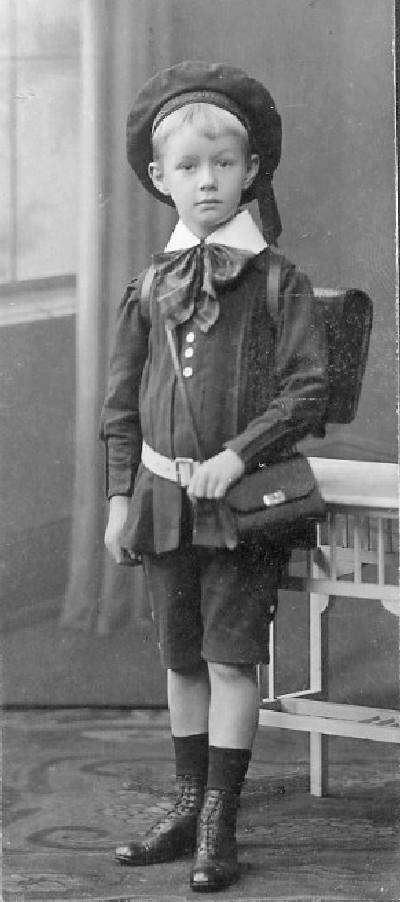
Figure 1.--Here we see a Berlin school boy wearing a sailor cap and tunic fo school. The portrait is undated, but we would guess was taken aboit 1905. Note the floppy bow. |
|
German boys have worn a wide range of garments to school over time. This of course varied chrnologically. German boys did not normally wear school uniforms, except for boys attnding military schools. Thus there are no school uniform garments in the same sence as in England. Thus the garments worn to school are a good reflection of popular contemporary dress patterns. While there were no uniforms, there were certain garments that were commonly worn by boys for school. Perhaps the most popular garment was the sailor suit. Sailor and army-styled caps were also popular. We see many boys wearing suits of various styles to school, but this became less common during the inter-War era and was gradually went out of style asfter the War. Lederhosen were commonly worn in in Bavaria, but less so in other parts of Germany.
Sailor hats were commonly worn by younger school boys in the early 20th century. We have noted both broad-brimmed hats and the floppy soft caps. We although many boys also wore an army-style peaked cap, although these were sometimes worn with sailor suits as well. I'm not sure what older boys wore. One study explains that school caps showed through colour the school type the pupil belonged to (today Gymansium, Realschule etc). They also showed grade he was in, and even his progress, by different coloured ribbons around their caps. The colours of a Gymansium at Jena (to which the brother of the author went to) were also mentioned. [Ossowski and Rösler] We have noted boys in the 1940s and 50s wearing a kind of ski cap. It was the winter uniform cap worn for the Hitler Youth. Unlike other Hitler Youth uniform items, it continued to be popular after the War.
German boys did not normally wear smocks to school. We have noted a few examples, but they are not very common. We believe that smocks were consideredc a French school style. Interestingly though we do note boys wearing berets.
We do not notice German boys wearing pinafores to primary school. We do see a few Kindergarten children wearing pinarores. We do not know if this was just in their classrooms. We note both boys and girls wearing pinafores. They seem to be the same style for both boys and girls. We do not know how common this was. We note Swiss children commonly wearing pinafores to school, but this seems more common with French than German speking Swiss communities. We also do not know if wearing pinafores in Germany was regional. such as close to Switzerland. The pinafores seem to be very simple, practical ones. They also look colorful. We are not sure about the chronology here. Tne image was dated to the 1920s. They do not seem to have been required. Perhaps the teachers encouraged the mothers to purchase them.
We commonly notice German children dressing up for school in the 19th century. We see many children wearing suits to school. Of course they would have worn some kind of shirt garment underneath. Just what kind of shirt they were wearing is difficult to determine from the photographic record. We suspect that dress was more casual in rural village schools. After World War I school wear became increasingly casual. We see more and more children wearing shirts and sweaters rather than suits. Here social class was a factor. Middle and upper-clss Germans continued to dress more formally than working-class Germans. The general trend was, however, toward more casual schoolwear. This essentially reflect overall dress srandards and not school rules.
Casual shirts and sweaters had become nmore common by the 1940s as German boys began to dress more casually for school. These casual garments became standard in the 1950s. The sweater became a standard garment in both cool and cold weather.
Large numbers of British boys of all social classes wore Eton collar to school in the late 19th and early 20th centuries. We note far fewer German boys wearing Eton collars to school. We do not note large numbers of German boys wearing Eton collars, although we have few 19th century images at this time. I am not sure why the Eton collar was not very popular in Germany, probanly it was perceived as an English style.
We do not hve a great deal of informtion about German tunics worn to school yet. We believe, however, that the tunic was a common school garment in the early- and mid-19th century, although we cannot yet confirm this and it may be difficult because of the limited number of photograohic images. We think the popularity of tunics may have declined in the late-19th century. During this period there is a wealth of photographs, although our archive is still limited. We have acquired many more 20th century images. We are not sure what age boys wore tunics in the 19th century. As far as we can tell, the tunic was a boys' garment. We do bot see girls wearing them.And we do see boys wearing tunics in the early-20th century. The ones we have found are rather short cut tunics, more jacket length than the knee-length tunics we see American boys wearing at the same time. Many of the photographs are undated, but we think this was more common in the 1900s than the 1910s and we no longer see tunics being worn after World War I (1914-18). By the 1900s the tunic was only being worn by younger primary childten. Thdey were commonly worn with matching knee pants. We still see some boys wearing tunics to school in the early 20s, but they were not very common by the end of the decade.
HBC has little information on schoolwear in Germany during the 19th century, at least by the 1890s. We are not sure, however, just when German boys began wearing sailor suits. Kaiser Wilhelm II himself in the 1860s, because of his English mother, may have been one of the first German boys to wear sailor suits. We believe that sailor suits were probably common in the late 19th century as Kaiser Wilhelm after dismissing Chancellor Bismarck, began to build a fleet of highseas battleships--a development of enormous national pride and a pet project of the Kaisser. We note that many younger school boys in the early 20th century wore sailor suits to school. Sailor suits declined in popularity during the NAZI era (1933-45). I see no indication that boys after the War wore sailor suits to school any more.
Winters can be quite cold in Germany, not as cold as in Svadanavia and Russia, but colder than in England and France and especially southern Europe. Germany can get quite a bit of snow. Thus children needed a variety of jackets and coats to keep warm in the winter. Light jackets and sweaters might be enough in the Spring and Fall, but children needed a heavy coat to go to school in the winter. We notice many different styles. Some might be worn by both boys and girls hile otghers were gender specic garments. A lot of jackets had navy styling and seemed to have been done in dark blue. Navy pea jackets seem to have been a popular style. Colors were geneally muted unil after World War II when we begin to see more brightly colored coats.
German boys commonly wore suits during the early 20th century. WE notreall kinds of different styles. The suits worn by
younger boys were especially varied. Sailor suits were just one of the many styles popular for the younger boys. While older boys were confined primarily to single- or double-breasted suits, we see much more varied suitsn by the younger boys. And we think older boys wore suits every day nd not just on special days. Not all boys wore suits. Here age, social class and demographics were all factors. We note many boys wearing suits. It was most common with the older ahe groups, boys from affluent families, and boys living in urban areas. Suits were commonly worn through the 1940s. They seemed to have declined in the 1950s. We suspect World war II was a factor. As a resiult of the shortages and sharp dross of family income, many families could not afford suits. But this trend is observable in other countries as well and seems to be associuated with a general trend toward casual dress. While outfits in primary schools were varied, most secondary school boys wore suits until the 1950s. Suits by the 1950s were much less common and unusual by the 1960s. An exception here seems to have been younger boys, at least in their first day portraits, a German famioly tradition. We see quite few photigraphs of youngr boys in suits. This may have been first day portraits and not what they normally wore.
The types of pants worn to school varied over time. We see boys commonly wearing long trousers in the 19th century. By the late 19th century knee pants were becoming increasingly common. We also see boys wearing bloomer knickers. At the turn of the 20th century, knee pants were very common. Gradually after World War I, short pants became more and more common. Older boys wore long pants to school. The age at which boys shifted from shrt to long pants varied over time. The school did not play a role here. This was essentially a family decession. We note that in the 1920s and 30s boys often began to shift to long pants a school a a about age 15. Some boys began wearing longs earlier, others later.
In some cases boys wore knickers in between the transition from short to long pants. By the 1930s seasonality began to become an issue with some mothers allowing boys to wear long pants in cild weather, Until the 1950s, however, shorts were more common. Some German readers tells us that even if parents allowed boys to wear long trousers to school at age 14 or 15, they often wanted the boys to wear short trousers at home and to church until at least 16. Again this varied substantially from family to family.
Many German boys beginning in the 1920s seem to have worn lederhosen to school, but this from available images appears to have usually been a minority of the boys in most classes. We have noted lederhosen being worn earlier, but we do not begin to see a lot of boys in school photographs wearing lederhosen until the 1920s. Often a few boys in many primary schools are wearing lederhosen by the 1920s. I'm not sure why lederhosen became more common for schoolwear at this time, but surely it had something to do with the war. Almost always boys wearing lederhosen to school wear them with the decorative halters. Wearing lederhosen varied regionally in Germany, being most common in Bavaria. Lederhosen continued to be worn to school through the 1960s, but are now not very common.
Hitler Youth uniforms were sometimes worn to school. I am not sure if there was a specific day for this, as was common for Scouts in many American schools through the 1950s. I do not yet have full details, but boys appear to have worn their Hitler Youth uniforms on special days, but not regularly on a weekly Scout day as in America.
German boys have wore a range of hosiery to school and this changed over time. We note a variety of hosiery worn by German Swiss school children. Swiss children commonly wore both short socks and kneesocks as well as long stockings. We do not yet have much information on the 19th century. We note mostly three-quarter socks and long stockings in the early 20th century. Knee socks gradually became very common, Younger boys wearing shorts in the winter might wear them with long over-the-knee stockings. The popularity of the various types of hosiery varied over time. There were also some gender differences. After World War II short socks became common during the warmer months and gradually became more important. We see fewer children wearing long stockings in the 1950s and more children wearing long pants. In the 1960s long stockings were replaced with tights. Also we do not see knee socks very commonly by the 1960s, they seem to have been gradually replaced with ankle socks. Seasonality was another factor. Tights began to be worn in the 1960s, but we do not notice them at school, although because boys began wearing long pants, this is a little difficvult to follow.
German boys wore a range of fifferent footwear to school. The popularity of the different types varied over time. We see German boys in the early 20th century going to school in heavy boot-like shooes. These shoes were very popular for younger boys. Okder voys were more likely to wear oxford low-cut shoes. We also see boys wearing strap shoes and sandals. The hoigh-top shoes were still worn after World War II in the 1940s, but were rarely worn by the 1950s. In the 1970s sneakers also began to be worn.
Many Germans boys sent off for their first day of school were equipped with a book satchel or bag, a lunch satchel, and a pencil case. This was very common into the 1930s. Boys before Workd War I often had slates as well. These items were very standard and the satchels continued to be seen into the 1950s. German parents loved to have a portrait made of the new scholar all done up for school. As the century progressed we begin to see more family snap shots rther than formal portits. These images leave us a wonderful record as to the school items German children were equipped with in the late 19th and early 20th centuries.
Germany like France had highly academic schools. Extra-curicular activities were limited. There were gym classes and some limited sports. We know virtually nothing about the 19th century. We have some insight into the 20tyh century and images from the phoographic record. I am not sure just how attention was devoited to gym/physical education in Germn schools. I assume most gymnassiums (secondary schools) of any size had gyms for physical educations classes. Before World war II, most German secondary schools were single gender schools. I am not sure if there was aiufference in the gym rogram at these schools. One might think thst the boys' gymnasims gave more attention to gym than the girls' schools, but we have no asctual dat on this. Nor do we hsave much informnastion on the actual program. We tink activitives like gymnastics were given more attention than sports. Children really interested in sports like football would join sports clubs. Girls commonly wore middy blouses and bloomer with long stockings in the early 20th century. Biys wore knee pasnts and long stockings. After Wirkd War I we see the chikldren gradually wearing less restrictive gasments.
Ekkehard Ossowski and Winfried Rösler. Ed., Kindheit: Interdisziplinäre Perspektiven zu einem Forschungsgegenstand.

Related Chronolgy Pages in the Boys' Historical Web Site
[Main Chronology Page]
[The 1880s]
[The 1930s]
[The 1940s]
[The 1950s]
[The 1960s]
[The 1970s]
[The 1980s]
Related Style Pages in the Boys' Historical Web Site
[Main school uniform page]
[Main country page]
[Long pants suits]
[Short pants suits]
[Socks]
[Eton suits]
[Jacket and trousers]
[Blazer
[School sandals]
Navigate the Boys' Historical Clothing School Uniform Pages
[Main German School Uniform Garment Page]
[Main German School Uniform Page]
[Australia]
[England]
[France]
[Italy]
[Japan]
[New Zealand]
[Scotland]
[United States]
Navigate the Boys' Historical Clothing Web Page
[Introduction]
[Activities]
[Biographies]
[Chronology]
[Clothing styles]
[Countries]
[Bibliographies]
[Contributions]
[FAQs]
[Glossaries]
[Images]
[Links]
[Registration]
[Tools]
[Boys' Clothing Home]