
Boys' Clothing: Age Grading
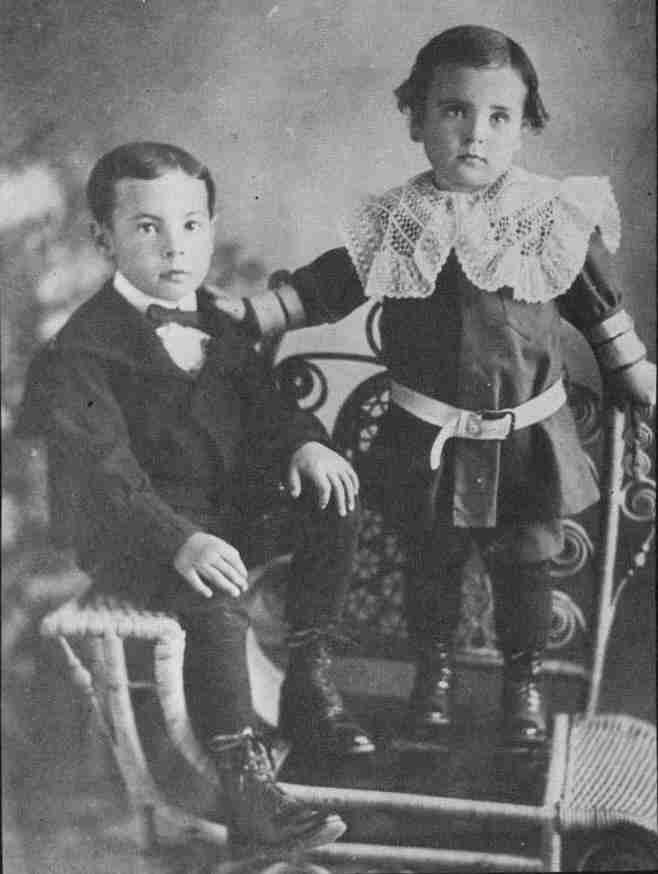
Figure 1.--Age grading can take different forms. Sometimes if the children are close in age, the age grading is subtle. If the children are further apart or if there are set age shits, the differences can be substantial. Age grading was also used in hair styling. Here we have two brothers that are not that different in age (perhaps 5 and 7 years old), but dressed very differently. The brothers are American, but otherwise unidentified. It is interesting how differently they are dressed. The older boy wears a knee-pants version of an adult male suit with matching dark jacket and pants except that the jacket has a boy-styled collar, which looks similar in design to a sailor-suit collar without the usual striping. He wears a stiff white collar and bow tie. The younger boy wears a tunic suit with an elaborate lace collar and a white belt. Both wear knee pants with long black stockings. Notice the boots and the hair styles. We do not know, but suspect that in a year or two the boys would be dressed almost identically.
|
|
One convention that can be seen in many family portaits is age grading. This is actually related to the convention of dressing children in identical or coordinated outfits. Age grading was also used when the children were dressed in differehnt types, but not necesarily identical outfits. This is of course adopted with children that are close in age. In the 19th and early 20th century, families were commonly larger than they are today. Thus it was not appropriate to dress all the children alike. In large families there mighgt be two or three levels of age grading. There were also refinements of age grading. Children might, for example, wear the same suit, but with alterations such as different collars and neck wear ot trouser types. There are many examples of age grading on HBC. We will start to link some of the here as examples. A good example of a family whichpracticed this approach is the Rockefellers. We note an Louisiana family (1924). Age grading is a convention that virtually disappeared in the late 20th century. We are not sure why age grading when out of style.
Age gradied clothng was a very common convention in the 19th and early-20th centuries but it was largely unknown before the late-17th century. Destinctive styles of clothing for children, once they were breached, is a relatively recent historical phenomenon. Dressing children as children only began in the late-18th century. Up until at least the late-18th or early-19th century, most children wore exactly the same styles as their fathers, often their parents old clothing cut down to fit a smaller size. Rank or status, of course, influenced children's clothing, but rarely age until the late 18th century. It is only fairly recently, with Romanticism and the related development of child psychology, that children were thought of as anything other than miniature adults. In the 16th century, for instance, boys as young as 9 or 10 years of age could be hanged for stealing. The law took no cognizance of their tender age as having any bearing on the punishment. (This continues to be the case under Islamic Shsria Law.) The same principle that applied to legal punishments applied also to styles of dress. Once childhood be widely recognized as a important developmental stage, we befin to see clothing styles for children and the phenomenon pf age grading. Age grading became very common in the 19th and early 20th centuries. Inumerable portraits demonstrate just how wide spread this practice was. Age grading is a convention that virtually disappeared in the late-20th century. We are not sure why age grading went out of style. Our reader also raises an interesting question. "I don't understand why that has now become so unfashionable. Boyswear today tries to make no concession to differences in age other than to make clothing in different sizes. Perhaps it has something to do with the spirit of equality that began with the Civil Rights Movement, and then extended to the Women's Rights Movement. The ideas of rank and privilege became unfashionable, and so not only did it seem right that children should dress as adults, but it also became possible for adults to dress as children without loss of status. Now clothing is used only to indicate how much money you have, not how old you are. But how can you make a t-shirt look expensive? The answer is to print the brand name boldly across the front and back of the t-shirt. Certain brands are famous for being expensive, even though they are usually no more better-made than an unbranded t-shirt."
One convention that can be seen in many family portaits is age grading. HBC has begun to develop family pages in the various country sections. We have considerable information fpr some countries, but have not yet created family sections for many other countries.
Generations of mothers dressed their children, in some cases both sons and daughters, identically or in similar outfits--convinced this was a charming fashion. This was a simple matter in the 18th and much of the 19th Century. As
little boys wore dresses just like their sisters, it was easy to ooutfit the boys and girls in identical. At the time it was considered in appropriate to outfit girls in boys clothes. As distinctive dress styles for little boys developed in the late 19th Century and the fashion of dressing little boys in dresses disappeared after World War I (1914-19), this became more difficult. Many nothers, however, still wanted to dress their children similarly. Thus styles outfits with girls dresses and coordinate boys outfits were developed. This is actually related to the convention of dressing children in identical or coordinated outfits. Age grading was also used when the children were dressed in differehnt types, but not necesarily identical outfits. This is of course adopted with children that are close in age. There were also refinements of age grading. Children might, for example, wear the same suit, but with alterations such as different collars and neck wear ot trouser types.
Hair Styling
Levels
In the 19th and early 20th century, families were commonly larger than they are today. Thus it was not appropriate to dress all the children alike. In large families there might be two or three levels of age grading.
Set Ages
Some mothers made these clothing and hair style on an ad hoc basis. The decession could be affected by a range of factors such as the practice in the parents family when they were growing up, fashion trends, neighbors and family approaches, the child's personality, social class, and other matters. In other families there were set ages for some of these changes which may or may not have taken place at or after birthdays. The American brothers here in 1904 are dressed very differently even though they look very close in age (Figure 1). This suggests to us that there was a set age at which the boys began wearing more mature suits. Some families may have even made a bit of an occassion out of major transitions. These transitions are, however, a matter on whuvch we still have relatively limited information.
Approaches
Age grading could take different forms. One form was to dress children of different ages within large familes in identical or cooirdinated outgfits. Another approach was to make a variety of minor or incremental changes as a boy got older. Brothrs might, for example, have similar suits, but wear different neckwear, collars, pants, or other age-graded items. One example of age-grading as well as coordinated boys' is a portrait of two Pittsburg brothers (1906). The two brothers wear almost identical suits except for the difference in their trousers. The older boy wears below-the-knee knickers whereas the younger boy wears an Eton collar, above-the-knee knickers (or perhaps short-cut knee pants), and long black stockings. The older boy is about 14 or 15. The younger boy seems to be about 11 or 12. There is only approximately a 3-year difference in their ages.
Age grading was a common practive throughout Europe and North America, but it was not limited to those countries. It is common practic throughout history in a wide range of civilizations and coutries. The styles and fashions have changed. What is particularly notable is that it was especially pronoumced in Europe (primarily Western Europe) and North America as the Industrial Revolution progressed, more and more individuals benefitting from the wealth created were ever to indulge thir fashion sence and display their increasing affluence. Thus we see some of the most pronounced examples of age grading during the late-19th and early-20th century Victorian and Edwardian Eras in the countries a rpidly industrializing. We note age grading in both America and Europe. This is notable because if you read many American history books you get the impression that America was aand of tenaments and poverty. Actually while this certainly existed, indistrilization broufht decent standrd of living to the average personnfor the first time. Many of our examples are America, but this is in part because our American archive is so extensive. We do not yet have enough information to note any destincive country trends. We do have an American age gradeing page. There are many examples of age grading archived on HBC. We will start to link some of the here as examples. A good example of a family which practiced this approach is the Rockefellers. Another American image is two Pittsburg brothers (1906). We note an Louisiana family (1924). An example in England is three brothers in London's West End. An example in France is the Delesseps family. We see many other examples from Belgium, Germany, Italy, and many other countries.
HBC

Navigate the Boys' Historical Clothing Web Site:
[Return to the Main clothing style page]
[Introduction]
[Activities]
[Biographies]
[Chronology]
[Cloth and textiles]
[Countries]
[Families]
[Topics]
[Bibliographies]
[Contributions]
[FAQs]
[Glossaries]
[Images]
[Links]
[Registration]
[Tools]
[Boys' Clothing Home]
Created: June 9, 2004
Last updated: 8:10 PM 4/15/2013