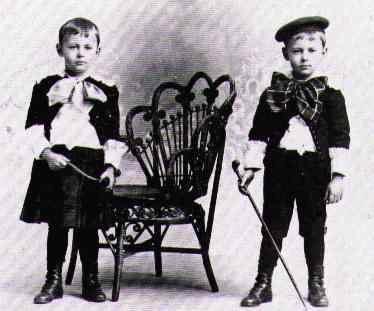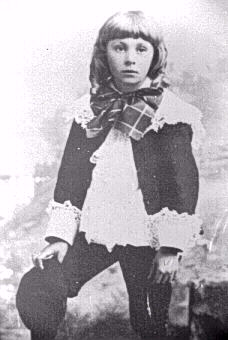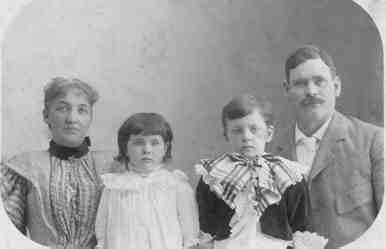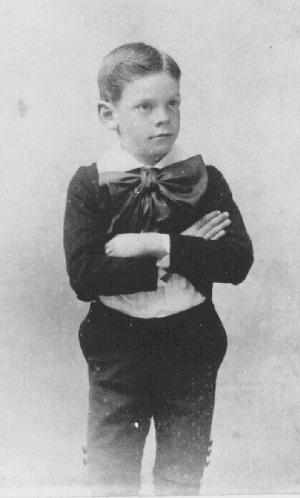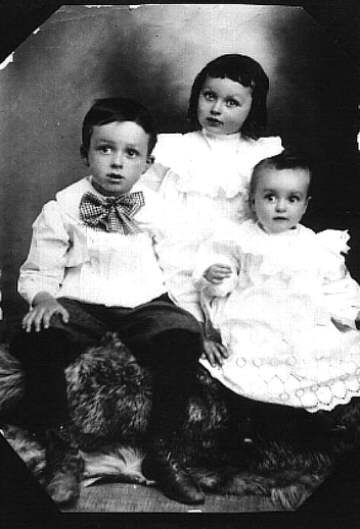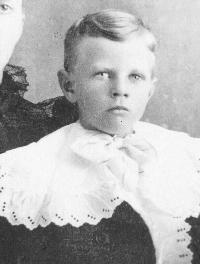
Figure 1.--This boy wears an elegant Fauntleroy blouse with a large collar made of eyelet lace. He also has a white bow to complement his elegant outfit. Note the small size of the bow. |

|
Francis Hobson Bennetts's book Little Lord Fauntleroy was published in 1885. The book and susequent draatizations caused a sensation in boy's fashions. Boys had wotn velvet suits and lace collars before the book was published, but the book popularized the style and doting mothers proceeded to inflict it upon a generation of unsuspecting boys. Some of the collars worn with Fauntleroy suits were worn without bows. Others used a bow as a major fashion accesory. The bows came in many sizes and patterns, This was a major fashion shift because until the 1880s, boys generally wore only small bow ties or bows. The growing sizes of the bows was in part due to the large size of the lace collars worn with the increasingly popular Fauntleroy suits. Apparently many mothers felt that a small stringy bow would look out of place with a large lace collar. Many boys' outfits had collars which could be worn with or without bows. The bow not being an integral element of the outfit. Often it was up to the mother's disgression. Other styles required large floppy bows. As the century progressed open collars disappeared and collars were increasingly worn with bows--in some cases very large floppy bows. Some smaller bows were also worn, but many mothers chose the larger size. The bows were usually made of satin or silk. Many Fauntleroy blouses had very large collars, sometimes covering the entire shoulder area of the velvet jackets. Most were made with
eyelet lace or
ruffles which could be used to greatly enlarge the size of the collar. Not all the collars were elaborate lace or ruffled. Some were quite plain. The more fashionable Fautleroy suits, however, did have elaborate lace or latter ruffles.
Francis Hobson Burnett is the author if some of the most important children's 19th century classics, although at the time thaey were not seen as spedcifically children's books. She originally conceived of the Little Lord Fauntleroy story as a way of entertaining her children. She published the story serialy (1885) amd in book form (1886). The book and susequent draatizations caused a sensation in boy's fashions. Boys had wotn velvet suits and lace collars before the book was published, but the book popularized the style and doting mothers proceeded to inflict it upon a generation of unsuspecting boys.
References to clothing are limied in the book. Probably more important were the original illustratios.
She also published several other books, the text and illustratins to which include interesting discritions/illustrations of boys' clothes during the late-19th century and early-20th Century. She has two other very famous books. One was The Secret Garden, in which the rich boy, Colin, is often depicted in a Fauntleroy suit. It has also been produced in film and TV productions as well as a Broadway musical. Another of her books was The Little Princess, made into a notable 1930s movie staring Shirley Temple.
|
We do not yet have details on how floppy bows were worn over time. We are just beginning to develop details as to how the bows on Fauntleroy suits varied overtime. We have few details on the early-19th century. We do not see floppy bows at mis century. We see some small ows in the 1870s, but they were not very common. We have aood bit of information specifically on Fauntleroy blouses because of the great wealth of available photographic images. Unfortunately many of thecportraitscare cundated, although we can roughly date them. It is not until the 1880s, primarily the mid-1880s that we begin to see boys commonly wearing floppy bows and Fauntleroy suits. They were most common in the 1890s. A hood example is American boy Freddiec Deveraux in 1892. We also commonly see them in 1900s, but they began to decline in popularity after about 1905. One question we can not yet answer very well is how color or pattern differences varied over time. Certainly they did. Many available images, however, are undated. Thus it is difficult to assess changing preferences overtime.
|
Mothers had differing ideas about collars and bows. Some mothers wre particularly enchanted by a beautiful lace collar. Thet elected not to add a bow to an elegant lace collar so as not to distract from it. Other mothers much preferred to add a large decorative bow. Most American boys in the classical period did wear their lace collars with bows. I am not sure about the trends in Europe, but most American boys wearing lace Fautleroy collars worn them with bows. This was generally up to the mother's discresion rather than the design of the blouse.
We don't have very much information about the material of these bows. The betters ones were presumaby made in silk or sation, but presumably the bows were made in other fabrics as well.
|
The bows worn by boys with lace collars during the classic Fauntleroy era could be quite large. In some cases they cobered almost the etire front of the boy's collar. Compared to the bow-tids the modern boy might wear, the large bows worn with Auntleroy duits almost seem to engulf the boy.
Unfortunateky I do not know enough about knots to be able to describe the knots used for these bows. Presumably there were no clip on bows and
the mothers had to tie the bows each time. The large size of many of these bows must have made this a bit tricky.
Some bows were tied as bow ties. These were mostly the small bows. I'm not sure how to date this style.
More commonly the bows were tied with two large wimgs, but little are no trailing tails falling below the wings.
|
Solid colored bows seemed to have been the most common. The black and white photography of the day make it difficult to assess the color of the bows. Colors appear to have varied, but were usually black or white. The black bows
contrasted nicely with the emaculate white lace collars, matching the black velvet suit. They appear to be the most common, but details on color is not readuly available as so much of the information comes from black and white photographs. Many Fautleroy suits were made in other dark colored velvet, such as blue, green, and
burgandy. I'm not sure what colored bows were worn with these colored suits. Some mothers, however, preferred the elegant white-on-white look of white bows on white collars. The boys might wear a red sash with there Fauntleroy suit, but never a red bow.
|
Some mothers chose a patterened bow. Bows were available in a wide variety of patterns. Scotch plaid was one of the most popular patterns. Many other patterns including non-Scotch checkered patterns or polka-dot patterns were employed.
Some mothers preferred bows with polka dots. I believe that the plka dot bows were less common then the solid colored or patterened bows, but I still do not have enough information to fully establish this. I am not sure what colors these polka dot bows were made in.
One of the most common patterns were tartan or plaid patterns or patterns with crossing horizontal lines similar to tartans.
Some bows had vertical pr horizonatal stripes.
Some bows had a variety of checkered patterns.
Large floppy nbows are most associated with American boys wearing Fauntlerooy suits. Although worn in England, France, and other countries, they were not nearly as common or in most cases as large. We have archived hundred \s of images showng American boys wearing these large bows. Boys in Europe might wear their bows more informally and were less comminly tied in the perfect perky bows worn so commonly in America. We have begun to create country pages about these bows. At this time the only one we have is on American boys.

Navigate the Boys' Historical Clothing Web Site:
[Return to the Main bow page]
[Introduction]
[Activities]
[Biographies]
[Chronology]
[Cloth and textiles]
[Garments]
[Countries]
[Topics]
[Bibliographies]
[Contributions]
[FAQs]
[Glossaries]
[Images]
[Links]
[Registration]
[Tools]
[Boys' Clothing Home]