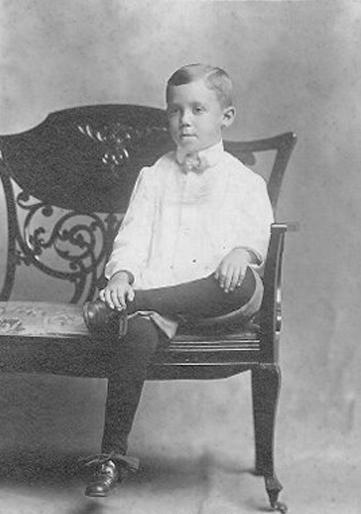
Figure 1.--This studio portrait was taken in Massilion, Ohio, probably about 1910. the boy seems to be wearing above-the-knee knickers and black stockings. He looks to be about 10 years old. Notice the shoe bows. |

|
Mothers in the late 19th and early 19th centuries loved bows. They tied them on every where. Of course girls were the most common recipients, but many hapless boys also wore them around their collars, in their hair, on their pants, and even their shoes. Somewhat more common than pants bows was tieing bows on boys' shoes. This rather emulated a common 17th Century style. Louis XIV and other stylish pesonages of the era were so pictured. This was particularly
common for boys still in dresses or wearing fancy Fauntleroy suits, but boys in run of the mill sailor suits might also have shoe bows. This
was a particularly popular style in France. These bows were most commonly worn worn with strap shoes or patent leather shoes. Frequently the boys wearing these bows had long, often curled hair, but not always.
Mothers in the late 19th and early 19th centuries loved bows. They simply couldn't ger enough of them. ngegious mothers figured out how to put boys innvirtually any boy and any garment. Their bows were every where. They tied them on every where. Of course girls were the most common recipients, but many hapless boys also wore them around their collars, in their hair, on their pants, and even their shoes. Somewhat more common than pants bows was tieing bows on boys' shoes. This rather emulated a common 17th Century style. Louis XIV and other stylish pesonages of the era were so pictured. But the style had declined in the 18th century and was not seen with any frequency in the early 19th century. Oy appears to have reappeared in the late 19th. Interestingly, they were not commonly worn with Fauntleroy suits--at least not until the turn of the 20th century. Shoe bows appear to have been most common from about 1900-1920.
When we first saw examples of boys with bows on their shoes, we though that it was simply a fauning mother who decided to add a liyyle style to her sons's clothing. We have since noted quite a number of these images and now see that it was a popular style at the time and not just a few over zealous mothers. In fact we have also noted that shoes came with the bows already afixed, showing that it was a popular style. We are not sure when this was first done, but we note it being done in American 1910 catalogs.
Boys wearing bows on their shoes appear have include tose up to about 10 years of age. A good example cis 8-year old American boy, Carl Peirce.
These bows were most commonly worn worn with strap shoes or patent leather shoes. But they were not limited to these styles. The shoes appear to have been both black and white shoes. Strap shoes appear to have been most commonly worn with bows.
Boys wearing bows on their shoes seems to have been a particularly popular style in France. Available images show that it was also not unknown in America and Canada. We see quite a fe examples in the Amerucan photographic record. Most boys, however, wore high-top shoes rather thn the low-cut shoes thst had bows.
HBC has not information on what kind of bows were afixed to boys' shoes. Probably it was just normal ribbon tied on for special occassions.
As the available images are black and white photographs, HBC has no information on the color of the shoe bows. We think that they were mostly black or white, but there may have been colored bows as well. White bows appear to have been worn with white shoes and black or dark-colored bnows with black shoes. On some occassions white bows were worn on black shoes.
We have archived quite a number of boys who had their portraits taken with bows like this on their shoes. Unfortunately we have not yet been able to link all of them here. A good example is A. Balfour, a Canadian boy in 1898. Anotherexample is an American boy, Roy Chapman Hodgson, in the 1890s.

Navigate the Boys' Historical Clothing Web Site:
[Return to the Main bow page]
[Introduction]
[Activities]
[Biographies]
[Chronology]
[Cloth and textiles]
[Clothing styles]
[Countries]
[Topics]
[Bibliographies]
[Contributions]
[FAQs]
[Glossaries]
[Images]
[Images]
[Links]
[Registration]
[Tools]
[Boys' Clothing Home]