
French Boys' Hair Styles: Parts
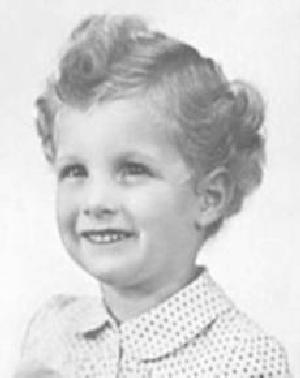
Figure 1.--A HBC reader has provided us his photograph taken in 1947. This haoir style was called a "choupette". It was common for boys from affluent families after World War II. Notice that the part is indestinct. Here a factor was also the boy's curly hair. Sharp parts were more difficult with curly hair.
|
|
HBC is just beginning to research the part (raie dans les cheveux) in French hair styles. One French reader tells us that with the short hair that was common for boys in the 20th century, especilly after World War I, that the boys in France usually parted their hair on the left and the girls on the right. There were no definitive rule on this and boys could be seen with both left and right oarts. The left part for boys, however, was much more common. This convention not as strictly observed for the boys from affluent family and with especially attentive mother. One could thus see boys with part on both the left or right. Today this old convention has not changed. The girl always parts her hair on the right
and the boys normaly on the left although one can find some boys with part in right and this is regardless of social class.
Terminology
Some of the French words associated with hair parts may be useful to English-speaking readers:
Hair: cheveux
Part: Raie dans les cheveux
Part right: Raie à droite
Part left: Raie à gauche
Alternatives
French boys had the same standard part alternatives as we see in other countries. Namely we see side parts (left or right, center parts, and no vissible parts. The side parts were the most common. We note both left and right parts, bu somewhat more right pats than we note in America. A variable here is how far down the side of the head the part was made. Here there was considerable variation. The center part was most common for girls. This is often a good gender indicator in 19th century photograohy. Center parts at times have been fashionable for boys. The center part was never the dominsnt part, but was at times very trendy. There were also boys' styles in which the part is not apparent, at least in the photographic record because so many portraits are frontal shots. The most common here are bangs which were widely used for younger boys. Men before World War II often did not have a part in their hair. They combed their hair straight back from the forehead. This was not very common for boys, but some teen agers did comb their hair like this. Since World War II and it has continued today, most French wear their hair with a part as do children. This is the case in many other countries, including America.
The sharpness of a boy's part varied. Some parts are razor sharp as done with a ruler. This was primarily popular when the hsir was slickened down a bit. Also the type of hair affected how straight the hair could be. Really sharp parts required straight hair. Natuarally curly hair is difficult to part as easily as straight hsir. The kmore curly the more difficult. Another factir was who was doing the parting. Most boys did not give huge attention go combing the their hair. This varied by age. As they got older they began to give more attention go it. But even here boys varied. Some were more inteested un their zppearance than others. And of course sometimes mothers got involved. Generally some one else doing the part coukld do it straighter than the boy himself. And the occassion was another factor. Both boy znd mom would giove more attention to a straight part for special occassions. Of course this was especially true for mother who wanted her son to shine for those special occassions. The more special, the sharper the part.
Hair styles as well as other fashions changed in France after World War II. After World War I, short hair became increasingly common for boys, even younger boys. Working class families did generally follow the left for boys and right side for girls convention. The affluent class was less likely to follow this convention. One French reader tells us that with the short hair that was common for boys in the 20th century, especilly after World War II, that the boys in France usually parted their hair on the left and the girls on the right. There were no definitive rule on this and boys could be seen with both left and right parts. Today this old convention has not changed. The girl always parts her hair on the right
and the boys normaly on the left although one can find some boys with part in right and this is regardless of social class.
Social Class
The gender convention described above was not as strictly observed for the boys from affluent family and with especially attentive mother. One could thus see boys with part on both the left or right. This was in part because younger boys from affluet families might have their hair cut longer and the styles involved often did not have the definitive part in the shorter hair styles worn by boys from working class families.
A French reader tells us of his hair styles as a younger boy, "I usually had my hair parted on the right. But for some styles it was parted on the left. My hair was not natural curly, so the maid at night put 2 or 3 curlers "bigoudis" in my hair. In my time they were
made in wood or bakelit; today they are plastic. (Bigoudi pronunciation = bee goo dee.) Then the next morning it was easy to do a "choupette" hair style which lasted 2 or 3 days. {Choupette pronunciation = shoo pet.) The "bigoudis" were not particularly pleasant to keep or tomsleep in. So it could be replaced by some "barrettes". I suppose that probably the American boys in the 19th century to maintain the hair styles shown on HBC had the same treament for their ringlet curls ! We certainly looked attractive, but we sufferd a bit to get it."
Styles
In middle 1950s a style of cup-hair was in vogue and was called " cheveux à la brosse " (very short hair and combed straight alike a brush). The hair part with this style was not prominent if it existed at all.
HBC

Navigate the Boys' Historical Clothing hair style pages:
[Return to the Main French hair style page]
[Return to the Main National Boys Hair Style page]
[Long hair page]
[Bangs]
[Ringlet curls]
[Hair bows]
[Curls]
[Caps]
[Collar bows]
[Dutch hair styles]
[German hair styles]
Navigate the Boys' Historical Clothing Web Site:
[Main French page]
[Introduction]
[Activities]
[Biographies]
[Chronology]
[Clothing styles]
[Countries]
[Bibliographies]
[Contributions]
[FAQs]
[French Glossary]
[Images]
[Links]
[Registration]
[Tools]
[Boys' Clothing Home]
Created: January 24, 2002
Last edited: 6:07 PM 10/7/2011