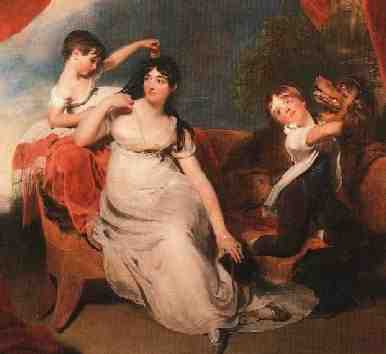
Figure 1.--Sir Thomas Lawrence painted Mrs. Henry Bartig and children in 1817. Her son appears to be wearing a black velvet skeleton suit. I'm not sure what he is wearing over it, perhaps a white tunic or perhaps a front buttoning pinafore. |

|
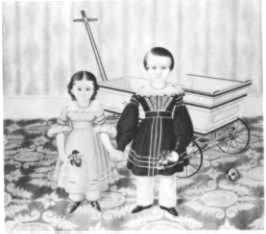
Tunics were one of the more enduring 19th Century styles for boys. As the 19th Century progressed, another garment was added to the small boy's wardrobe--a smock-like tunic. The tunic suit was a form of jacket, close-fitting to the waist, with a gathered or pleated skirt below the waist. It was often the first boyish garment purchased for a boy after he was breeched and allowed to stop wearing dresses. Some tunics look like simple dresses or even smocks. At first gance it is sometimes difficult to distinguish tunics from dresses and smocks. The tunic is very plain, often the same cloth--in many cases of a dark or muted color. Tunics are generally styled very simply. Some did have dress liked puffed sleeves. The major distinguishing feature is that tunics in the late 19th Century were worn with knicker-type pants just as they had been worn with pantaletts earlier in the decade. Girls who wore dresses would never wear them with knickers. Boys' tunics were one of the most enduring styles for boys. They were often the first boyish garment worn after breeching. They appeared before the turn of the 19th Century and were commonly worn through the first 2 decades of the 20th Century. No other fashion endured for such a long time. The styles of the tunics, the neckline and collar, and the pants worn under the tunic changed significantly over time.
People in the Middle Ages tended to wear long gowns, even the men. In the late middle ages this began to change. It should be understood that in the middle ages fashion did not change at the same rate as modern fashions. Whole centurries passed with little change in fashion. Obly in the late middle ages did the pace of fashion chaznge quicken. You can see it in Renaissance painting. Boys and young adults began to dress differently than older men. The fashionable outfit was a tunic worn with coloful hose that extended all the way up the leg. The effect was rather like modern tights. Less fashionably attired country boys would more likely go barefoot. The length of the tunics varied. The tunic was not a boyish style, although boys wore them. They were also worn by young adults. Some were very short. This also was not a particularly boyizh style. Rather the short tunics were an afectation of fashionable youths and young adults. The particularly short tunics casused some church men to comment unfavorably on the fashion. Paintings and illustrations suggest that the tunics were done in bright colors. We suspect that this may have been the case with fashionable urban families, but in the country less colorful tunics were worn.
We continue to see fashionable young men and boys wearing short jackets and tunics with long hose in the 16th century. A goof example is King Henry VIII's son Edward VI. There are several portraits of him and he is depicted wearing jacket or tunic-like garmens. There was no paticular boy syle. Very young boys wore dresses like their sisters. Older men wore long gowns.
Modern dress began to develop in the 17th century. Trousers began to become more prpnounced and developing as knee britches by the end of the century. We do not note tunics being worn, but our information is very limited.
We are not sure to what extent tunics were worn in the 18th Century, but will try to collect information on this period. We do not yet have any protraits suggesting that tunics were being worn during this period. This was the period in which dedicated children's clothing developed, most notably the skeleton suit at the end of the century. As e first noyice tunics in the early-19th century. We suspect that they were worn in the late-19th century.
|
We have first noted tunics on boys in the early-19th Century. We believe that they were quite common for boys until the teen years. We have noted these tunics in early fashion magazines, but so far have few portraits to substantiate this. Photography had of course not yet been developed. They were mostly worn with open neck styles. Square openings were popular. the middle. Some of the tunics buttoned from neck to hem, but others only opened partly. The early 19th Century tunics suits were widely worn from the 1820s (some authors give a later date), but became less common after mid-Century. The open collar style was popular for early 19th Century tunics. The puffed sleeves that were also worn by men and women began to appear in boy's tunics during the 1820s. We notice white tunics being worn as a kind of school uniform at the New Lanark school in Scotland, a kind of educational experiment at the time (1820s). We have little information about mid-19th Century tunics. I believe that after the 1850s they became less popular until reappearing in the 1890s. However, my knowledge on tunics during this period is very limited. They were worn during the middle 19th Century. I have noted them both in America and England and believe they were worn throughhout Europe, although I have few European images from this period. Boys wore tunics to school during this period as images exist with boys carrying book bags. Double breasted styling was introduced on many children's garments during the mid-19th Century. This included double breasted styling on boys' tunics. We also noted American boysearing single-style tunics woth belts over them. The development of pohotography in the mid-19th century created a much better look at these tunic outfits than possible during the early 19th century. As the century progresed, tunics for boys got progressively shorter. One of the most popular styles were Russian box-pleated tunics with matching bloomers and/or knickers. In the early decades of the 19th Century boys wore long trousers under their tunics which could be quite long. Neither boys or girls exposed their bare legs. Some younger boys might wear lace trimed pantalettes under their tunics instead of long trousers. As the Century progressed boys knee length garments for boys appeared. For the most part boys in knee length garments wore long stockings, but some younger boys began to appear with bare knees, a fashion to be developed in the 20th Century. Boys still in tunics by the end of the 19th Century commonly wore knee-length bloomers and, unlike his early 19th Century predecesor, rather than long trousers.
|
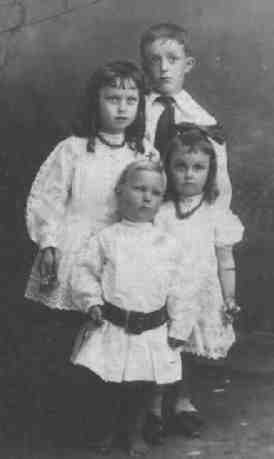
Tunics were commonly worn by little boys during the first two decades of the 20th Century. They were particularly popular in the early 1900s. They came in several different styles, sailor and Russian blouse styling were particularly popular, and colors, but white was particularly popular. Many were very plain, but some mothers preferred tunics heavely decorated with lace and ruffles. Tunics rapifly declined in popularity after World War I. Some wealthy European children, however, continued to be dressed in tunic-like smocks at home into the 1920s. We note that some of the later tunics were shorter and the boys more clearly wear knickers rather than bloomer knickers that are mostly covered by the tunics. We note a few American boys wearing tynics in the very early 1920s as well as some tunic-influenced garments.

Navigate the Historic Boys' Clothing Tunic pages:
[Return to the Main tunic page]
[]
[Stylistic features]
[Tunic styles]
[Tunic accesories]
[ Pantalettes]
[ Stockings]
Navigate the Historic Boys' Clothing Web Site:
[Introduction]
[Activities]
[Biographies]
[Chronology]
[Clothing styles]
[Countries]
[Bibliographies]
[Contributions]
[Essays]
[FAQs]
[Glossaries]
[Glossary]
[Images]
[Links]
[Registration]
[Tools]
[Boys' Clothing Home]