|
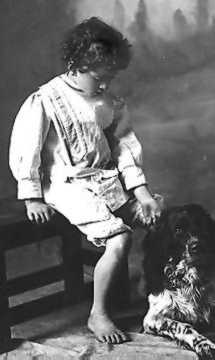
Tunics were one of the more enduring 19th century styles for boys. As the 19th Century progressed, another garment was added to the small boy's wardrobe--a smock-like tunic. The tunic suit was a form of jacket, close-fitting to the waist, with a gathered or pleated skirt below the waist. It was often the first boyish garment purchased for a boy after he was breehed and allowed to stop wearing dresses. Some tunics look like simple dresses. At first gance it is sometimes difficult to distinguish tunics from dresses. The tunic is very plain, often the same cloth--in many cases of a dark or muted color. Tunics are generally styled very simply. Some did have dress liked puffed sleeves. The major distinguishing feature is that tunics in the late 19th Century were worn with knicker-type pants just as they has been worn with pantallets earlier in the decade. Girls who wore dresses would never wear them with knickers.
There was no cap or hat made especially for different styles of tunic suits, but there were styles commonly worn with them. This has varied over time. Tunics were worn over an extended period. We note them throughout the 19th century and during the early-20th century. Thus a wide range of headwear both caps and hats were worn with tunics. With the appearance of photography we have a much better idea of the headwear worn with tunics. We note boys wearing peaked military caps in the mid-19th century. A good example is an unidentified American boy. The most common headgear for boys wearing tunic suits were wide-brimmed sailor hats. While the styles of the hats were rather basic, they varied a good deal in the width of the brim. The combination of sailor hats and tunic suits appears to have been essentially a coincidence. The most popular headwear for small boys at the turn of the century when tunic suits became popular was the wide-brimmed and other styles of sailor hats and caps. Thus they became the most common style of headwar worn with tunics.
We are not entirely sure what kind of shirt-like garments were worn under tunics. We have little information about the early-19th century. We note tunics being worn with very small collars of different types during the mid-19th century. A good example is unidentified American boy, we believe in the 1840s. We see collars, many different styles of collars. But that is all, nothing more of the shirt like garmnents underneath. And many of the collars we see are detachable, meaning that they werr not part of a shirt or blouse--suggestiung a shirtwaist. But some tinics mah have had trim suggesting a collar sewed atiund the neck openung. Tunics weremotly button at the collar garments. There was an exception--the sailor tunic. But usually what we see in the V-coolar is a diuckie covering ober what ever shirt garment they made be wearing undeneath. Tunics became popular again at the turn-of-the 20th century. We have not yet worked out the types of shirts/blouses worn with these tunics.
|
The most important accompanying garment with for tunics was the pants that were worn with them. Tunics were worn with different pants, of varying styles. We see pantalettes, long pants, knee pnts, asnd bloomer knickers. All legs whether of boy or girl in the early 19th century were covered to the ankles by trousers, pantaloons (which were those shirred at the ankles), and pantallets. Tunics at the beginning of the 19th century were worn with either fancy or plain pantalettes (younger boys) or long trousers (older boys). We see tunic suits in the early-19th century with long pants. But without photogrphy, there re only a few painted portraits. Many of the tunic outfits were actally suits as the pants that were worn with them usually made in the same color and in the same material as the tunic itself. We have little information on the pants worn with these tunics in the early and mid-19th century. After mid-century it became less common for the boys to wear long pants with tunics and instead they began wearing them with bloomer knickers. We see a lot of American boys wearing what look like long shirts, almost always with long pants. We begin to see what looksd like tunic suits with the CDVs of the 1860s. Why they are rare earlier we are not do sure. We think it may relte to the rarity of early photography in Europe (Dags abd Ambros) compared to America. We believe that younger boys by the 1860s wore pantalettes with tunics. We are not sure about earlier. When the boys were a little older they began wearing long pants. Tunics in the mid-19th century often did not have matching pants and the tunics looked more like shirts, but by the turn-of-the-20th-century were often sols as suits with matching pants. After mid-century boys began wearing bloomer knickers. We have much more information about these outfits at the turn of the 20th century, but more on the tunics than the pants. Some of these outfits like Buster Brown suits were actually called suits. The pants were usually knicker length which bloused at the knee. Some were more like straight-leg knee pants. Some were worn above the knee, but they were also worn below the knee as well. Some contemprary fashion writers referred to the pants worn with tunic suits as bloomers. The destinguishing feature og these pants is that usually bloused at the leg with elastic gathering rather than having buttons or buckles like proper knickers. Some of the tunics may have been worn with knee pants, but the bloucing effect was much more common. The pants were very plain, almost never with any notable detailing. There were several different types of tunics (Buster Brown, Russian, sailor, and others), but there were no special type of pants assocaited with these different styles. I am not sure if these had pockets or other features.
|
Early tunics were worn with long pants or pantalettes. As a result, long stockings were unecessary. Most were work with short stockings. As hem lines rose and pantaleetes became shorter and knickers appeared with tunics, long stockings appeared. Young children after mid-Century might wear tunics with short socks, but older children wore long stockings and by the 1870s even younger children generally wore long stockings. By the turn of the Century younger boys began wearing tunics with knbickers, but with out shoes and socks during the summer.
As with dresses, mothers varied greatly as to the hair style of boys in
tunics. Some mothers refused to have their boys' hair cut upon breeching.
Thus some boys continued to wear long hair with breeches, even ringlet
curls.

Navigate the Historic Boys' Clothing Tunic pages:
[Return to the
Main tunic page]
[Historical trends]
[National trends]
[Stylistic features]
[Tunic styles]
[]
[
Pantalettes]
Navigate the Historic Boys' Clothing Web Site:
[Introduction]
[Activities]
[Biographies]
[Chronology]
[Cloth and textiles]
[Clothing styles]
[Countries]
[Topics]
[Bibliographies]
[Contributions]
[FAQs]
[Glossaries]
[Images]
[Glossary]
[Images]
[Links]
[Registration]
[Tools]
[Boys' Clothing Home]