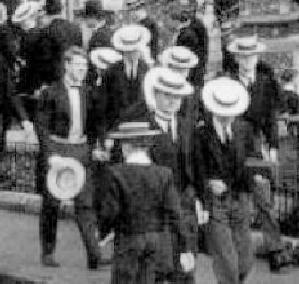
Figure 1.--Boys at Harrow are seen here attending a memorial service for Old Harrovian Winston Churchill in 1965. |
|
We have obtained some information on Harrow. A Harrow school uniform can be seen on the social class page. Some Harrovians wore light-coloured waistcoat, which were permitted to wear with their Eton suits on special occasions. Eton boys were restricted to buttonholes. The Eton suit continued as the dress for juniors at Harrow into the 1960s. A photograph shows boys attending a memorial service for Old Harrovian Winston Churchill in 1965. A HBC reader has provided us some information on the Harrow uniform during the 1970s-80s.
Harrow is one of the best know Engklish public schools. It is one of the original nine English public schools as defined by the Public Schools Act 1868. The School was founded in 1572 by John Lyon of Preston, under a Royal Charter issued by Queen Elizabeth I. Lyon was a member of the gentry and Harrow at the time was a more rural setting, albeit ner London. Lyon wanted a school for local boys. He was particularly adament about educating boys and Harrow is still to this day a single gender school.
Harrow begin to take its current shape in the Victorian era. It was at this time the school rolls was significantly expnded. Britaon needed administrators for its new-found empire. Existing public schools expanded and new schools were founded.
Most of Harrow's boarding houses were built at this time. Harrow by the 19th century was no longer a school for local boys, but one of the most prestigious public schools in Britain, attended by well-to-do boys from all over the country, royalty, and boys from leading families around the Empire. The Harrow governers founded John Lyon School in the 1870s which focused on the education of local boys.
The School was founded in a rural setting near London. Since the 16th century, however, Londin has grown and spread out. Thus the school is now located is located at Harrow on the Hill in northwestern London.
The academic program at Harrow and the classics was for the first three centuries based largely on the classics. Like all the public schools, the academic program steadily became more rigorous during the 19th century. It is now a demanding program. The program added a greater emphasic on science in the 20th century. Almost all boys entering Harrow at age 13 years come from private preparatory schools and are thus 1-2 yhears ahead of boys their age in the state system. New boys study English, French, Mathematics, Biology, Chemistry, Physics, History, Geography, Latin or Classical Civilization or Mandarin Chinese, Religious Studies, Art, Music, Design Technology and Information Technology. Boys who demostrate a facility for foreigbn language can optionally take Greek, German, or Spanish. While there is now a strong science program, Harrow continues to emphasize the classics (Latin and Ancient Greek). Boys during their second and third years begin to work preparing for their GCSE examinations. Theboys when finishing their third year will have completed required classes in English Language, English Literature, French, Mathematics, Religious Studies and a Science. There are a range of optional subjects availabke, including: History, Geography, Latin, Classical Civilisation, Greek, German, Spanish, Italian, Biology, Chemistry, Physics, Music, Art and Design Technology. Senior boys in the Sixth Forms pursue a more specialized program. They are expected to take AS-level in at least four main subjects, going on to A-level in at least three. There are many to choose from, including English Literature, French, German, Spanish, Italian, Latin, Greek, History, Geography, Economics, Business Studies, Ancient History, Classical Civilization, Political Studies, Religious Studies, Mathematics, Biology, Chemistry, Physics, Design Technology, Physical Education, Music, Music Technology, Art, History of Art, Theatre Studies, Statistics, and Photography.
Harrow like other public schools developed an important sports program before sports were as important as they are in our modern world. In large measure this was because as a boarding school, somethinghad to be found to occupy the boys outside of class. Sport came to become a major part of the program. Academics in the late-19th century began to develop more strongly. Although sports continue to be an important part of the program as it as other public schools. It is seen to provide important lessons in mastering challenges and team work that cannot be offered in the classroom. Harrow offers a very high standard of coaching and competition for the talented sportsman. But there are also opportunities for the less talented to enjoy sports. Boys can play sport every day if they so desure, but unlike presvious times there is more choice involved. The School has programs in major sports which compete with other schools. There are less intense opportunities for the less gifted sportsmen more interested in friendly diversions. There are house competitions and interamural programs. Likevother public schools, there are extensive sports facilities at Harrow, including playing fields which include all-weather pitches which are suitable for rugby, soccer, and hockey. The modern Sports Centre has an 8-metre high indoor climbing wall, and weights room. There is also a
25-meter swimming pool. We are not sure when swimming was added to the sports program at Harrow, but it was certainly functioning by the 19th century. Boys used to swim nude in their outdoor and indoor pools which apparently was common at British schools. At Harrow this continued into the 1980s. At that time some housemaster’s wife complained that the housemaster’s wives and daughters were prohibited from using the pools. The sports hall with indoor cricket nets for winter practice. There are courts for tennis, rackets, squash and Fives and the School has its own nine-hole golf course. The athletics facilities were re-built in 2005.
Britain's public schools developed as boarding institutions. About 800 boys now attend Harrow, all of whom board. Harrow is one of acdeclining number of British schools which continue to focus on providing a high quality boarding school experience. The boys y are organized into twelve boarding houses. All the boys continue to board full time. There are non of the variables forms of boarding which have developed in recent years. .
Harrow is noted for its illustruious old boys. Eight primeministers attended Harrow. The most famous old boy at Harrow was Primeminister Winston Churchill. He was not happy there. As a younger student he was very hurt that his parents rarely visited him while at the school. He did poorly academically, but was brillint in the subjects tghat appealed to him. Indian primeminisdter Jawaharlal Nehru attended the school. Another famous old boy was Henry John Temple, 3rd Viscount Palmerston.
The Harrow uniform took its tradition form in the 19th century. The formal Harrow school uniform can be seen on the social class page. Some Harrovians wore light-coloured waistcoat, which were permitted to wear with their Eton suits on special occasions. Eton boys were restricted to buttonholes. We note boys wearing both top hats and boaters. The Eton suit continued as the dress for juniors at Harrow into the 1960s. The photograph shows boys attending a memorial service for Old Harrovian Winston Churchill in 1965 (figure 1). In addition to the formal uniform we note caps and blazers worn for games.
A Harrow graduate tells us about the uniform he wore, "I attended Harrow School between the ages of 13 and 18, from the late-1970s to the early -80s. It was - and is - a school steeped in tradition which pervades every aspect of school life, including the uniform and the way in which it is worn."
The uniform worn from Monday to Saturday consists of a solid blue blazer - known as a “bluer” - dark blue sweater, white shirt, black tie, grey trousers and black shoes. The bluer has no emblem of any kind on the breast pocket, even though the school crest and motto (“stet fortuna domus”) are ancient and well respected, and has a rough texture. The tie is pure black in mourning for Queen Victoria, a tradition that is unlikely to change! All of this is topped off by a straw Harrow Hat with a blue band. This is not a boater, this crown is much shallower, the crown is 2inches high and the brim (wider than that of a boater) is 3inches wide. Harrow School is spread out over a wide area (the whole of the town of Harrow on the Hill), with major public roads running right though it, and walking to lessons wearing that hat is no joke, believe me. Of course, when 700 other boys are doing the same thing, nobody really notices or worries too much about it.
On Sundays the school attends chapel, and the students wear morning dress, consisting of a cut-away tailcoat (similar to those worn in the mid 19th Century) black waistcoat, black tie, white shirt, and striped formal trousers held up by braces - plus the ubiquitous hat. Boys under 5ft have to wear a ‘Harrow Short-coat’ (a tailcoat without tails. Simaler to an Eaton-jacket but cut straight at the back) but otherwise the outfit is the same. The entire school did not attend Chapel in tails on Sundays. Pupils of religious denominations other than Church of England (COE) were not compelled to attend chapel on Sundays. They could worship at a church / institution nearby, ie Catholic in their Bluer to avoid embarrassment. [Hanna]
Some uniform traditions are so old that nobody remembers why they exist, or pretends that there is a logical reason to them, but they are enforced and obeyed just the same. For example, the blazer - bluer - cannot be buttoned up by anyone who has been at the school less than three years (a “three-yearer”), and an umbrella, when carried, must be unfurled at all times by everyone except school monitors (prefects). There were personalised waistcoats that could be worn on Speech day and the numerous other House Clours/Ties/Fez’s.
[Hanna]
Uniform privileges are bestowed by virtue of age, rank, or sporting proficiency. A three-yearer can wear a white cravat-type scarf inside their shirt instead of a tie in the afternoons, and many sports allow those representing the school to wear special ties, as do some of the more exclusive clubs. Additionally, the main school sports - rugby, cricket, and Harrow Football (a unique game which I will not explain here) - allow those in the school first team to wear special blazers, not unlike those worn by rowing enthusiasts at the Henley Regatta.
School monitors are a class apart and have the school crest on the ribbon around the rim of their boaters and on their ties. Furthermore, on Sundays they wear top hats and carry black canes, looking for all the world like they’ve stepped though a time warp from the mid 19th century. The ‘Phil Athletic Club’ (a club for the schools foremost sportsmen) may wear a black bow-tie and ‘The Guild’ (a club for the schools most scholarly boys) may wear a maroon tie with the school crest on it and a maroon waistcoat on Sundays. ‘Bloods’ (Boys who are in the schools top team for a major sport) may wear grey waistcoats on Sundays. ‘Triple-Bloods’ (a boy in the school foremost team for three sports) may wear a red bow-tie. The Head-Boy has all the aforementioned privileges and on special occasions wears a white bow-tie, black trousers, white waistcoat, evening-tails (the same as the rest of the school) and, of course, a top-hat and cane.
Although the uniform as described above has not changed much - and probably will not change much more - with passing time, society in general has become less formal over the years and this is reflected in the wearing of casual clothes inside boarding houses and at certain special events - such as dances and parties - involving other young people from outside the school. Overall, however, Harrow is a place which thrives on tradition and encourages a respect for it in many ways, not least of which is the wearing of proper uniform.
Hanna, Matthew, Harrow pupil 1975-79, E-mail message, December 23, 2004.

Navigate the Boys' Historical Clothing Eton pages:
[Return to the Main individual school page]
[Return to the Main Eton suit school uniform page]
[Return to the Main public school page]
[Classic Eton suits]
[Eton collar]
[Eton kilts]
[Eton choir costumes]
[American Eton suits]
Navigate the Boys' Historical Clothing Web Site:
[Introduction]
[Activities]
[Biographies]
[Chronology]
[Clothing styles]
[Countries]
[Bibliographies]
[Contributions]
[Essays]
[FAQs]
[Glossaries]
[Images]
[Links]
[Registration]
[Tools]
[Boys' Clothing Home]
