|
British statesman and author, considered by most historians to be the greatest of all primeministers for his role in warning about the dangers of Germany' military buildup in the 1930s, and after being ignored, leading the seemingly hopeless resistance to the NAZIs during the darkest days of World War II when Britain stood alone. He was born at Blenheim Palace, Oxfordshire and had a trurbulent childhood. He was born into one of te most elustrious families in England, a descendent of the Duke of Marlborough. His father was a brilliant parlimentarian who considered his son slow and a disappointment. His mother was the beautiful American heiris, loving but tied up in the social swirl of the time. He was educated at Harrow and Sandhurst, the Royal Military Academy.
Sir Winston Leonard Spencer Churchill, a direct descendant of John Churchill 1st Duke of Marlborough. His father was one of the most bvrilliant British politicans of the late-19th century. Many believed he would be primeminister. He was, however, not a very good parents. Winston for him was a disappointment and made it very clear to his son. Sometimes forgotten is that Sir Winston was half American. His mother was the beautiful Jennie Jerome. As he was later to tell the U.S. Congress after World War II, "If my father had been American and my mother British, I might have gotten her on my own." She was more sensitive than her husband, but was not a very engaged parent. As Winston would later explain, "I loved her dearly--but at a distance." While his father was focused on his political career, his mother was largely concerned with social life to support her husbans rising political career.
Winston's father was the brilliant, but mercurial Lord Randolph Churchill (1849-95) 3rd son of the 7th Duke of Marlborough. He was an importanht 19th century British statesman. Winston grew up in fear and awe of his father.
Lord Randolph was a leader in the Conservative Party and many, including Lord Randolph himself, believed he would one day rise to be primeminister. He was an excellent debater and Winston would listen to him un the Commons. Lord Randolph showed little affection for Winston. Not only was he preoccupied with his political career, but Winston was not the son he expected. Lord Randolph was disappointed at his poor performance in school. He essebntially thought Winston a stupid boy. His letters show no real affection and a modern reader would judge them as cruel. That of course is affected about our modern attitudes toward child rearing, but they certainly pained Winston greatly. And Lord Randoplh did not mince words in hios social and political life either. Among the many people he offended was the Prince of Wales and his wife Alexandra. She forgave him, but the future Edward VII never did. Interestingly, went on to be a confident of Edward's grandson George VI during the dark days of World War II. Lord Randolph would have been astonished to learn that Winston would not only become primeminister, but arguably the become perhaps the greatest of all British primeministers.
Winston's mother Jeanette (Jennie) Jerome (1854-1921) was a wealthy American heiress. Her father, Leonard Walter Jerome, was an important financier. Her mother,and Clara (Hall) Jerome, came from a landowning family. She had two sisters. They had an international, notably childhood growing up between New York, London, and Paris at a time Europe and America ere connected with increasingly luxurious ocean liners. It was at a time that America was surpassing the great European powers in population and economic power. Many down-in-the-heel British aristocrats turned to eligible Americans from the families benefiting from rising American industrial economy of the late-19th century. (Edith Wharton wrote a novel on this, The Buccaneers). Jennie was beautiful, personable, and an accomplished piano player. Their mother moved the family to Paris (1868). This beautiful heiress and socialite took Britain by storm when she became Lady Randolph Churchill (1874). At the time, Lord Randolph was a rising star in the Conservative Party. She added some needed flair to Conservative circles. As one author describes, "From royal affairs to secret love children, Lady Churchill stirred up trouble wherever she went." Like many of her class, she did not want to be encumbered with motherhood. What a contrast to Sarah Roosevelt, Franklin Roosevelt's mothers--the two men who would powerfully shape the 20th century. These two women literally had the future of the 20th century in their hand. As the wife of Lord Randolph, Jennie had many duties, especially revolving around her husband's and son's political career. She played not only a prominent, but an influential role in English court and political life for an entire generation. This was in part because of her marriage, but also her own energy and talent. As a result, she had little time for Winston. She was certainly more affectionate than her husband, but by all standards must be judged to have been a distant mother. This was not uncommon at the time. Many wealthy families shunted the children off to the nursery where they were in effect raised by nannies. In later life Winston Churchill wrote of his mother: "She shone for me like the Evening Star. I loved her dearly--but at a distance." Jennie was not just a socialite. She served as chair and nurse on hospital ship Maine during the Boer War (1899–1900). She got involved in letters. She founded and edited the Anglo-Saxon Review (1899), published her reminiscences (1908), produced two plays produced (1914), and served on hospital boards (1915–19).
John (Jack) Strange Churchill (1800-1947) was Winston's only sibling. When Winston and Jack were small boys they went to Austria on a holiday with their parents. They had tea with Prince Bismarck.
Winston was born at Blenheim Palace in Woodstock, Oxfordshire (November, 30 1874). Blenheim was the ancestreal home of Lord Jojn Churchill, the first Duke of Marlbourgh. He thus frombirth was surronded with Britian's history and the achievements of his ancestors. The care of young children born into wealthy fmilies in the 19th century was commonly put in the hands of servants. Women were more concerned with the ocial whirl. Such was the case of Winston. Not only did his mother not want to be bothered with him, but his father didn't even like him. In many cases these children developed much closer relaionships with their childhood nurse maids than their own mothers. Here an exception was Franklin Roosevelt, Winston's great war-time comrade, who was born 8 years after Winston. Winston came to look on his beautiful mother as an unapproachable vision. Winston loved to ride his pony, Rob Roy, at Blenheim. Some of his favorite childhood toys were lead soldiers. They are still on display at Blenheim. Winston lived in Ireland with his parents (after his grandfather, the 7th Duke of Marlborough, was made Viceroy) from the time he was 2 years old; he returned to England when he was 5. A favorite childhood hobby was butterfly collecting. Surely some of his sence of history was developed there as a child.
The only real affection Winston received as a boy was from his beloved nanny. He called her "Wommany". Winston's nickname for his beloved nanny, Elizabeth Ann Everest, was "Woomany". He remembered her all his life. He wrote, "Mrs. Everest it was who looked after me and tended all my wants. It was to her I poured out my many troubles." As an adult he kept a photograph of her in his bed room.
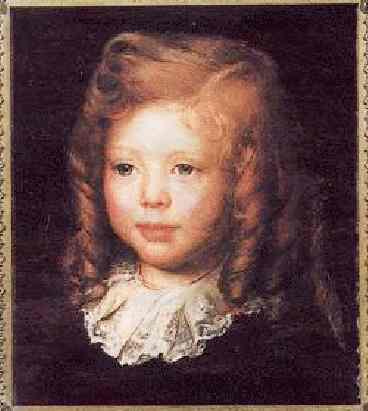
As a young boy Winston wore Little Lord Fauntleroy suits with lace collars. He was painted in this outfit in 1878, nearly a decade before Mrs. Burnett wrote her famous book, popularizing the style.
Winston also wore thick ringlet curls as seen in the P. Ayron Ward portrait. An HBC contributor remembers in 1960 as a school boy in junior school being on an outing to Blenheim and recalls seeing Winston's curls on display.
|
Churchill began his efducation at a prep school in Brighton. A school administrator said Winston was "regular in his irregularity," other faults he accused him of having were forgetful, unpunctual, and careless (1888). His parents finally visited him at school in Brighton when he contracted a serious case of pneumonia. While he did not do well at school, he did shine at history--his favorite subject. He wrote to his parents about his unhappines. They did not visit on the various open days like many of the parents of the other boys.
When Winston Churchill was 12 years old he started attending Harrow School, a prominent English secondary school. To his dismay, Churchill was listed under the S's as Spencer Churchill when he first attended Harrow. At that time Winston was a stocky boy with red hair who talked with a stutter and a lisp. Winston did so well on math in his Harrow entrance exam that he was put in the top division for that subject. In his first year at Harrow ge was recognized as being the best in his division for history. Winston entered the school, however, as the boy with the lowest grades in the lowest class, and he remained in that position. Winston never even made it into the upper school because he would not study the classics. Though he did poorly in his schoolwork, he grew to love the English language. He hated Harrow. As a school boy at Harrow, he requested his father's autographs in order to increase his pocket money. His father was not pleased. Winston's nickname at Harrow was "Copperknob" for his red hair. He wrote many times pleading with his parents to visit him on the various open days, but they almost never came.
After Harrow in 1893 at the age of 18, Winston entered the Royal Military College at Sandhurst. He trained as an infantry officer. He failed the entrance exam twice before finally passing it. Soon, however, he became the leader in his class on the two most important subjects, tactics and fortifications. When he graduated Churchill was 8th in his class of 150 students.
Churchill in 1895 (aged 21) he was commissioned in the Fourth Hussars and saw active service in both Cuba and India. He returned to England, became involved briefly in politics before returning to India to report for The Daily Telegraph. Churchill was sent to South Africa to cover the Boer war as the Morning Post's Correspondent (1898). The book Winston S. Churchill: War Correspondent 1895-1900 by his grandson Winston Churchill M.P. tells of these times. While there he was captured by the Boers and held as a Prisoner of War in Pretoria. However within a month he, along with two other prisoners, escaped. His book My Early Life covers these years.
Churchill returned to England and in the General Election was first elected to parliament (1900). He was ekl]elected Conservative Member for Oldham. After 4 years, however, because he disagreed with Joseph Chamberlain's tarif reform policy, he left the Conservatives and joined Herbert Asquith's Liberal Party (1904). He was chosen Secretary of State for the colonies. He was promoted to be President of the Board of Trade (1908). Churchill 2 years later was partly responsible for a split in the government resulting in a General Election (1910). The Liberals were returned to power and Churchill became Home Secretary. This was an extrenely productive time of his life, leading to speculation, as with his father, that he might be a prime minister. As Home Secretary he experimented with what at the time were seen as radical social reforms which made him powerful enemies among conservatives. (1910-11)
he used troops against strikers in South Wales which earned him the eminity of labor. He was appointed First Lord of the Admiralty (1911). In this post he helped strengthen the Rotal Navy. Through all this he pursued several beautiful women, finally marrying Clementine Hozier (1908). After all this frentic activity the primeminister post he so coveted disd not come. Changing parties hurt him and he made enemies with some of the policies he promoted.
One author sees Churchills subsequent career as attempting to achieve the promosise of his youth. [Sheldon]
Few if any British statesmen have served in as many governmental roles as Winston Churchill. And during the Wirld War I period he had many different posts and played an important role in British war policy. Nationalism was rampant in Europe at the turn of the 20th century. Massive sums were spent on an arms race. A variety of issues created tensions. The Serbs and other natinalists wanted to dismantal the Austro-Hungarian Empire. The Austrians wanted to put an end toSerb terror attacks and orevent Russian assistabcec to fellow Serbs. The bombastic Kaiser and Prussian militarists envied the English their colonies. The French wanted revenge from the Franco-Prussian War and the loss of Alsace-Loraine. The English feared Germany's naval building program. Russia and Austria ruled over a multiplicity of nationalities seeking independence. Storm clouds were beginning to gather over Europe. Some thought there might be war between Germany and France and because England had treaty obligations to France would have to help France. Churchill was made First Lord of the Admiralty to prepare in case of a war. He set to immediately to expand the fleet modernization program begun by First Sea Lord Jacki Fisher and where necessary replace Admirals. Finally the spark which resulted in World War I came in the Balkans with the assassination of Austraian Archduke Franz Ferdinand. Germany on August, 3, 1914, declared war on France and marched into neutral Belgium. In turn Britain declared war on Germany. After some early, but indecisive, naval successes in the North Sea, Churchill promoted the idea of taking an army through the Dardanelles to Constantinople (Istanbul) the capital of Germany's ally Turkey. The goal was to knockout Turkey and support the Russians. Russia was already reeling against German offensives and the Turks opened up new fronts against the Russians when they entered the War. Keeping the Russians in the war was vital to the Allies. Galiopli showed the visionary Churchill at his best, but also Churchill's not infrequent lack of judgement. The Galiopli offensive was a disaster and over 200,000 men were killed in the operation. Churchill was held responsible and excluded from the coalition government formed (1915). He rejoined the army and served in the front line in France, exposing himself to murderous artillery barages. He did pilot training, perhaps the most dangeros activity of the War. [Shelden] When Lloyd George was appointed Prime Minister he was brought back into the government as Minister for Munitions. In this role he played an important part in the development of the tank.
Churchill after the Armistace wanted to persue a war against the Bolshevicks in Russia who had murdered the Tsar. There was, however, no appetite in Britain for a new war. Lord George complained, "The trouble with Winston is tht he is always getting out his maps." in After World War I, Churchill served as Secretary for War and then Colonial Secretary. He lost his seat in the General Election of 1922 and the following year left the Liberal party. On a more positive note, in 1922 he bought his house Chartwell near Westerham in Kent. He ran for Parliament again, this time as a Conservative again.
Lady St. Helier, aka Lady Jeune, convinced Sir Evelyn Wood to get Churchill to the
Omdurman campaign and in March 1908 held a dinner party where Winston devoted all his attention to his beautiful neighbour, Miss Clementine Hozier. In the spring of 1908 Churchill met Clementine Hozier (1885 - 1977), who was the daughter of a retired army officer. Clementine and Churchill were married on September 12, 1908. Churchill would later write that after his marriage he "lived happily ever afterwards". When they married Winston was 33 and Clementine was 23. Clememtine was a spirited person in her own right--no doubt she had to be to live with Winston. Once when a suffragette was trying to push Winston in front of a train, Clementine wacked the suffragette with her umbrella. The pet names of Winston were 'pig' (initially 'pug') and Clementine was called 'kat'. They were very differemnt, people. Churchill could not have found a more supportibe soulmate. She was supportive, but an independent person in her own right. His mother once remarked when asked how her husband could have accomplished so much, Winston "never did anyting he didn't want to do, and left someone to clean up the mess afterwards". There is no doubt that Clementine provided the stable home environment that Winston could always rely upon during the ups and downs of his political career. She also produced a calming influence oin him, especially his tendency to browbeat his staff. [Soames]
Churchill became a devoted parent to his four children, no doubt remembering the lack of attention he received as a child. Clementine and Winston's children were Randolph (1911-68), Diana (1909-63), Sarah (1914-82), Mary (1922- ), and Marigold (d. 1921). Marygold's death crushed Churchill and Clemmi. It followed Churchill's loss of his mother. Clemmie and Winston had a pet name for Randolph before and just after he was born--"Chumbolly". Winston and Clementine's ten grandchildren were Winston (Randolph and Pamela Digby); Arabella (Randolph and June Osborne); Julian, Edwina & Celia (Diana and Duncan Sandys); Nicholas, Emma, Charlotte, Jeremy & Rupert (Mary and Christopher Soames). Churchill had a stormy relationship with his son Randolph. "You appear to be leading a perfectly useless existence," Churchill commented in 1929 to his son Randolph.
Churchill was a fixture in British Governments before abnd during World War I. He continued to be a fixture after the War.
The Inter-War period can be divided into two periods, roughly corresponding to the first period while Churchill continued to play an important role in Government. The second period he was excluded from Government and a back bencher, what Churchill called his 'wilderness years'. The second wilderness period roughly corresponds to the rise of the NAZIs in Germany. Churchill in 1924 he was elected to Parliament as a Constitutionalist and rapidly became Chancellor of the Exchequer in Stanley Baldwin's government. This put him tantalizingly close to becoming what he had dreamed of--the next prime minister. He played a prominent part in the defeat of the 1926 General Strike. He supported better conditions for the coal miners, but supported harsh action against the General Strike. He developed at this time the reputation of the embodiment of unfeeling conservatism. Churchill disagreed, however, with many Conservative policies. And with the Conservtives in opposition, he found increasing differences within the Party. This put him out of office from 1929 to 1939 (the wilderness years.) When a coalition givernment was formed, Churchill was not offered a cabinet post. Many thought that his political career was over. Even before Hitler seized power, Churchill began warning about the NAZIs. It is at this time he goes on his first lecture tour of the United Statres. Most political observers thought that Churchill's political career was over. A visit to Germany in 1932 was shoicking. Hitler had not yet seized power, but he saw the NAZIs on the street. After Hitler and the NAZIs seized power, Churchill was increasingly concerned with German rearmament. Churchill toured America and his constant topic was Anglo-American cooperation. He had sources in Germany and got secret ingormtion about NAZI rearmament. He spoke our increasingly about this in Britain. He became increasingly concerned with Neville Chamberlain's appeasement policy. Churchill was out of government and a back bencher. He was the one of the few important British political leaders urging action aginst the NAZIs and the rearmament of Germany. He seem to be one of the few English politicans of any stature to see the dangers of German rearmament or recognized the NAZI tyranny for what it was. He saw the terrible dangers of Chamberlain naivete. Chamberlain was determined to prevent another war and was convinced that no nationalleader could possibly desire another war. Chamberlain believed that he was uniquiely capable of reasoning with Hitler. Churchill correctly saw it as dangerous naivirty. He warned the British people anout disarmsnment, passivity, and pacifism. [Gilbert] At first he was seen as a crank, wanting to involve Britain in another War. After Munich, however, many Englishmen began to see him in a different light.
Churchill had been brought up in Victorian Britain. He came to see the Empire as a great force for good in the world. [Cannadine] Churchill for all his admiration of America, Churchill had conflicting views. He blamed President Wilson American idealism in large measure for the rise of the modern Totalitarian states. Churchill saw the great Continental Empires and aristocratic families as a forcefor stability. Dividing those empires on national and democratic lines was introducing dangerous American ideals. He was also disturbed by the hostile view of te British Empire in America. Churchill was an advocate of the Empire. He said upon becoming primeminister that he had not taken the office to oversee the disolution of the British Empire. One of the great ironies of World War I was that by refussing to deal with Hitler after the fall of France, Churchill was in fact dooming the Empire. It was not Hitler that was an enemy of the Empire. He in fact saw the Epire as a force for stability. What he wanted was for Britain to acceed to Germany's domination of the Comtinet and support or at least acquiesence for his crusade in the East. The enemies of the Empire were in fact Stalin and Churchill's great World War II partner, Franklin Roosevelt. Many would of course say that in choosing to defy Hitler and reject a British Vichy, Churchill was in fact choosing what was really great about Britain, a concept of liberty that had first been conceived by England's yeoman farmers. [Schama]
NAZI Germany posed a danger to Western Civilization unequaled since Gengis Kahn. For over a year it was only valliant Britain which opposed the NAZI juggernaught. It was at this time that Britain could have lost World War II. After the fall of France, victory was no longer possible and Britain's very survival ws at stake. It was at this time that Britain and America might have well lost the War. Chamberlain did not favor Churchill as his replacenment. He wanted Lord Halifax, but when Halifax wavered, he reluctantly turned to Churchill. Churchill was involved in most of the major Allied decesions of the War. There are probably three major contributions that Churchill made to the War. First, from the very beginning he saw the central importance of the United States. Second, even with German armies smashing into France, he was determined to resist the NAZIs. There would be no dealing with Hitler and the NAZIs, no British Vichy. Many thought that Britain like France had lost the War. Third, he tempered American enthusiasm for an early cross-Channel invasion with the realities of German military capacity. Churchill became primeminister just as the Grmans launched their Wester Offensive resulting in the fall of France. It was at the very low ebb of British power. He wa faced with terrible decesions and limited resources. Nio man in such a position could have failed to made decisions that historians woukd later ctiticise. And no historian could fail to find mistakes or questionable decisions. In real life, the only person who dies not make mistakes is an individual who dies niot make a real effort. A competebt hitorian will, however, consider his leadership as a whole and ask if with the limited resources Britain possessed could any one have done better. And Churchill accomplished the centrl British achievement of the War, to stand alone against Hitler until the German dictator turned East and America came into the War. Thanks tio Churchill there was no British Vichy with all the devestating consequences of making peace with Hitler.
Germany surrendered unconditionally and the war was finally over (May 8, 1945). Just 2-weeks later the war time coalition was ended and in July 1945 the Conservatives were defeated in the General Election. It should be emphasized that the British election in 1945 should not be seen as a reudiation of Churchill personally , but more a repudiation of the Conservative Party. [Lukacs] Churchill became leader of the opposition. Winstin Churchill's place in history will be for ever remembered for his inspired war leadership, especially dior the 12 months that Britain and the Domionions refused to make peace with the triumphant NAZI tyranny and with beager resources deal the NAZIs their first military defeat. The end of the war, however, did not end Churchill's contribution to the defense of Western Civilization. He delivered two speeches in 1946 that helped set in motion the two most important efforts of the post-War era: resistahce to Soviet aggression and European integration. After the struggle againstvthe Axis, the Western public was not ware of the Soviet threat as the Soviets had played a major role in the defeat of NAZI Germay. President Truman was having political problems and there was resistance to the hard line he was taking with Stalin. The first major statement dscribing the Cold War that Stalin had launched even before the Germans were defeated. He dlivered speech at Westminster College in Fulton, Missouri (Match 5, 1946). Churchill explained in graphic terms what Stalin was doing an introced the idea of the Iron Curtain. "From Stettin in the Baltic to Trieste in the Adriatic an iron curtain has descended across the Continent. Behind that line lie all the capitals of the ancient states of Central and Eastern Europe. Warsaw, Berlin, Prague, Vienna, Budapest, Belgrade, Bucharest and Sofia, all these famous cities and the populations around them lie in what I must call the Soviet sphere, and all are subject in one form or another, not only to Soviet influence but to a very high and, in some cases, increasing measure of control from Moscow." Less well known, but also vital was the role iChurchill played in Europeam integrayion. He was the first major Europeam leader to advocate integration, speaking at yje University of Zuriuch (September 19, 1946). "If Europe were once united in the sharing of its common inheritance, there would be no limit to the happiness, to the prosperity and glory which its three or four hundred million people would enjoy. Yet it is from Europe that have sprung that series of frightful nationalistic quarrels, originated by the Teutonic nations, which we have seen even in this twentieth century and in our own lifetime, wreck the peace and mar the prospects of all mankind." DeGualle still set on punishing the Germans went apopletic. At the time he said it was the worst speech he ever gave. Jean Monet convinced DeGualle he was wrong. The result was the Eurepean Coal and Steel Community--the first concrete step in Europea nitegration. [Watson] During the years in opposition he wrote his 5 volume history of the World War II which was published in 1950. It was a masterful account of the War. The General Election of 1951 returned the Conservatives to power and Churchill was again Prime Minister. Churchill in 1953 won the Nobel Prize for literature. He served as Prime Minister until 1955 when he resigned to be replaced by Anthony Eden. He died in January 1965 and was buried in Bladon Churchyard, Oxfordshire.
It is Churchill's magnificent speeches that are best remembered today. He personally wrote his World War II speeches, dictating to a secretary late ar night. He also delivered them. There was a great deal of time spent, both in the writing and revising as well as practicing the deliverance. There were in the 1930s three masters of radio as a political medium, Churchill, Roosevelt, and Hitler. Churchill's grandson Winston has published a very usefulmselection of those speeches. [Churchill, Never.]
Part of the reason that Churchill succeeded was that he recognized more than many other British politicans the importance of the relationship with America. Perhaps a vital factor here was that Churchill was half American, his mother Jennie being an American. He famouslt told the Congress on his first visit after America entered the War that had it been the other way around, his father being American "I might have gotten here on my own. Churchill even in World War Ireognizedthe importance of America. Bavck in Government by 1917, he assessed the military situation and is reported to have said, that there remained only two ways that the allies could win the War, "aereoplanes and the other is America". The Kaiser calculated just the oppisite, that the U-boats could win the War even if America came in. Britain was in even more desperate straits in 1940. This time Britain could probably not even survive without America. The result was the most remarkable political association of the 20th century that between the Churchhill and Fraklin Roosevelt. A few months before America ntered the War, the relationship and Allied vission of a free democratic Europe was sealed with the Atlantic charter. Thankfully for Western democracy, Roosevelt was prepared to risk the ire of the Isolatiinists to assist. After the War, it was Churchill who warmed Amerucans about the Russians an developing Cold War. When Churchill, his health failing, finally retired in 1955, his final message to his countrymen was, "never be separated from the Americans".
Alldritt, K. The Greatest of Friends: Franklin D. Roosevelt and Winston Churchill, 1941-1945 (London, 1985).
Bell, Christoppher M. Churhill & Sea Power (2013), 448p.
Cannadine, David. In Churchill's Shadow: Confronting the Past in Modern Britain (Allen Lane History).
Churchill, Jennie. Jennie: the Mother of Winston Churchill.
Churchill, Winston M.P. Winston S. Churchill: War Correspondent 1895-1900.
Churchill, Winston. (grandson) Never Give In (Hyperion).
Cohen, Eliot. Supreme Command (Free Press, 2002), 288p.
Gilbert, Martin. Winston Churchill: The Wildernes Years (2011).
Hertz, Chief Rabbi. "70th Birthday Message to Churchill" The Jewish Chronicle (December 8, 1944).
Humes, James C. Speak Like Churchill, Stand Like Lincoln (2002).
Luckacs, John. Churchill: Vissioary, Statesman, and Historian.
Martin, Ralph G. Jennie: The Life of Lady Randolph Churchill (Prentice Hall: Englewood Cliffs, NJ, 1971), two volumes.
Ringle, Ken. "George Bush and the words of war," Washington Post (March 9, 2003), pp. F1-2.
Schama, Simon. A History of Britain.
Schlesinger, Arthur Jr. "The Supreme Partnership," The Atlantic Monthly (October 1984).
Sheldon, Michael. Young Titan: The Making of Winston Churchill (2013), 400p.
Soames, Mary.Clementine Churchill (Mariner, 2003).
Trapani, Carol, "Letters cemented partnership," Poughkeepsie Journal (December 8, 2001).
Watson, Alan, Churchill's Legacy: Two Speeches to Save the World (Bloomsbury Publishing: 2016).

Navigate the Children in History Wbsite:
[Return to the Main biography page]
[Return to the Main biography C page]
[Return to the Main World War I biography page]
[Return to the Main World War II biography page]
[Return to the Main British aristocracy page]
[Return to the Main British prime minister page]
[Introduction]
[Biographies]
[Chronology]
[Climatology]
[Clothing]
[Disease and Health]
[Economics]
[Geography]
[History]
[Human Nature]
[Law]
[Nationalism]
[Presidents]
[Religion]
[Royalty]
[Science]
[Social Class]
[Bibliographies]
[Contributions]
[FAQs]
[Glossaries]
[Images]
[Links]
[Registration]
[Tools]
[Children in History Home]