|
Boys have been involved in the fine arts from an early age. Here there were great differences. Some artistic disciplines were uniquely suitable for boys at a young age, especially choral singing because of the physical characteristics of a youthful age. Many countries of Western and Central Europe have a long tradition of church boys' choirs dating back to the medieval era. Boys often at mom's urging have participated in various dance programs. Children need less encouragement to pusue the visual arts. In some areas child prodigies have achieved great fame. This is especially true of music. A fascinating quetion in connection with the arts is why has great achievemnent often been centered on a small number of countries or specific times. Music has been dominated by Germany and Austria which is part of the German tradition. Artistic acvhieveent has been more wide spread, but here the DUtch (including the Flemish) and French have exelled. Literature has been dominated by the English-speaking people (America and Britain). Dance has been dominated by the Russians. This is not to say that there have not been great achievements in oither countries. But the great achievements seem to be heavily centered in a relatively small number of countries. An importantvquesion is why this has occurred.
Boys have been involved in the fine arts from an early age. Here there were great differences. Some artistic disciplines were uniquely suitable for boys at a young age, especially choral singing because of the physical characteristics of a youthful age. Many countries of Western and Central Europe have a long tradition of church boys' choirs dating back to the medieval era. Boys often at mom's urging have participated in various dance programs. Many American boys somewhere between 10 and 13 take dancing lessons. Children need less encouragement to pusue the visual arts, although real achievement requires training. . The European tradition involves teaching music comprehensively. Individual instrumental skill training is combined with history and theory study, solfeggio, and ear training. Skill in other were acjieved only after years of study and practice. Here we are talking out perforance art such as music and dance. While only a rare number of prodigies were able to achieve competence as children, for many of these desciplines, especially dance, it was important to begin at a youthful age. Another important performance art was drama, but here beginning early seems to have been of little importance. In fact we notice that few child stars are successful as adult actors.
There are many famous child music prodigies. The most famous is certainly Mozart in the 18th Century, but there have been many others in the 19th and 20th Century. The clothing they wore for their performances were often examples of contemporary formal boys' clothing. Often as they began to grow up their parents liked to keep dressing them in juvenile clothes to emphasize that they were childhood prodigies. I've just begun this page, but would be interested in any comments or contributions by HBC viewers.
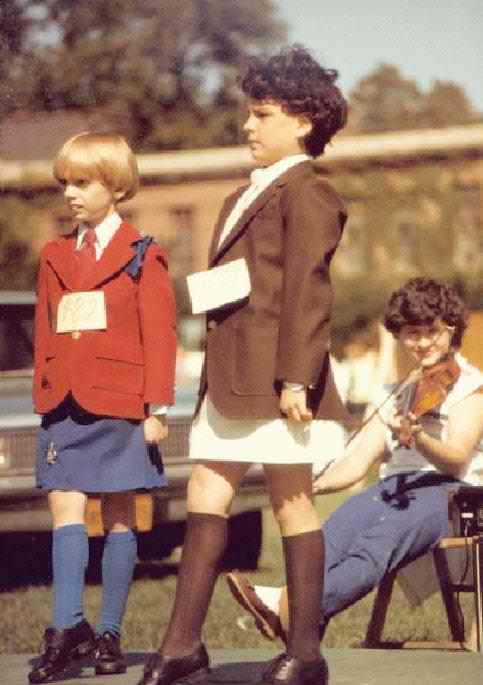
A popular activity in the 19th and and early 20th century was reciatations, although that is now seldom done. There was no uniform of course for such reciations, but boys often were dressed up in their finest outfits as mother wanted to ensure a good impression. Most children did these reciations. I think that they were more common for boys than girls who might instead play a piece of music. This requires further research. Some reciataions were also done in school classrooms and chosen children might do them at school asseemblies or presentations for parents. There were also competitions prganized by schools and civic organizations.
A fascinating quetion in connection with the arts is why has great achievemnent often been centered on a small number of countries or specific times. Here we are operating under the politically correct mantra that ability, in this case artistic ability, is evenly distributed across the globe aomong different races and nationalities. If this is in fact the case, it is fascinating that artistic achievement is so often centered in specific countries and in some case quite small countries. Music has been dominated by Germany and Austria which is part of the German tradition. Artistic acvhieveent has been more wide spread, but here the Dutch (including the Flemish) and French have exelled. Literature has been dominated by the English-speaking people (America and Britain). Dance has been dominated by the Russians. This is not to say that there have not been great achievements in oither countries. But the great achievements seem to be heavily centered in a relatively small number of countries. An importantvquesion is why this has occurred. Surely education is an important factor, but we suspect that there are other factors involved.

Navigate the Boys' Historical Clothing Web Site:
[Return to the Main activities page]
[Introduction]
[Activities]
[Biographies]
[Chronology]
[Clothing styles]
[Countries]
[Photography]
[Bibliographies]
[Contributions]
[FAQs]
[Glossaries]
[Images]
[Links]
[Registration]
[Tools]
[Boys' Clothing Home]