|
We note the formation of many town or village bands in the 19th and early 20th centuries. These bands were imortalized in 'The Music Man' and the River City marching band. Many American boy bands were maching bands, but not all. Many of the marching bands had unifirms, in ome cases elaborate uniforms. These appaer to have been all-male bands. We still have very limited informnation on these bands. We do not know yet, however, to what extent boys were involved in these bands. After World War I, these bands declined in importance as many high schools organized marching bands which tended to act as local community or civic bands. We believe that before World War I that high schools often had pep bands, but became much more elaborate after the War. Our information on these bands, however, is very limited at this time. We have some early 20th century images, but we are not always sure if these are civic or school bands. Most American high schools have marching bands and their uniforms vary widely, although military styles in the John Philip Souza tradition have perhaps been the most common. We also note some Scout bands in the 1910s and 20s.
Marching bands are probably as old as organized military formations. It was the perfection of valved brass instruments in the 1830s, however, that permitted the development of the modern matching band. As a result the size and sound of band changed dramatically. Brass instruments could play all the melodies once reserved for woodwinds and because of their more robust sound were perfectly suited for a marching band. The
keyed bugle required considerable study to achieve proficiency. The invention of matched valve brass instruments, saxhorns, made playing a brass instrument something an amateur musician, including children could master. We note the formation of many town or village bands in the 19th and early 20th centuries. These bands were imortalized in "The Music Man" and the River City marching band. After World War I, these bands declined in importance as many high schools organized marching bands which tended to act as local community or civic bands. We believe that before World War I that high schools often had pep bands, but became much more elaborate after the War. Our information on these bands, however, is very limited at this time.
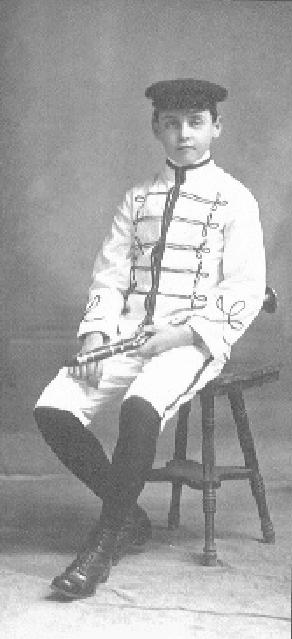
Some of these bands had elaborate uniforms. These appaer to have been all-male bands. We still have very limited informnation on these bands. Here towns varied considerably as to how they uniformed their municipal bands. The size and affluece of the town of course were critical elements. Most American high schools have marching bands and their uniforms vary widely, although military styles in the John Philip Souza tradition have perhaps been the most common. This often involved elaborate decorative braid on the jacket. Caps were much more varied. We have some early 20th century images, but we are not always sure if these are civic or school bands, or in some cases if they are band uniforms at all. This is especially the case, of course, if a boy is not holding his musical instrument. We have few images of early high school bands. Many high schools by the 1930s, however, had organized large, elaborately uniformed matching bands.
We do not know yet to what extent boys were involved in the civic bands of the 19th century and early 20th century. Many appear to be composed of both adults and youths. Some appear to have been all boy bands. They do appear to have been entirely or almost entirely male bands. We are unsure about early high school marching bands, they may have primarily been made up of boys rather than girls. The high school marching bands may in fact have changed the band tradition. Gradually girls began participating in the high school bands. We know very little about this process. I'm not sure when this began to vhange, presumably in the 1920s. We do note some children's bands with boys and girls in the 1920s, but they were not very common. Much more common were all boy bands.
We notive several different types of marching bands in America. The first to develop were military marching bands. The most famous was John Philip's Souza's Marine Corps band which became know as the "President's Own". Much more wide spread were municipal or civic bands, often sponsored by fraternal orders. Then there were school bands, primarily high schools and colleges. We also note some Scout bands iduring the 1910s and 20s. Gradually the school bands became the dominant type. Here the major factor was probably economics. The cost of operating aband could best be accomplished over the loing term by a government-financed institution like a school.
Associated with marching bands are baton groups. They are not necesarily a musical group. althouh they might have a drummer or trumpeter with them to help set a beat. We are not sure that the U.S. band page is the best place to link these groups, but we can think of a better place at this time. They would have participated in parades along with marching bands. The earliest baton groups we have noted were boys' groups. We have no information on the historical origins of these groups. Gradually baton marching groups became more of a girls' activity, we think because sports activities were for some time limited. We are entirely sure of the time line. As far as we know, by the time of World War II (1939-45), we only see girl groups.
The bands we see in the 19th century and the first half of the 20th century were almost always boy bands. American schools were coeducational. Thus gradually in the mid-20th century we begin to see coed bands. By the 1970s, the membership of school bands was normally about equally made up of boys and girls. We rarely see any girl bands.
We have begun to compile a list of American marching bands involving children. We have found civic, fraternal, school, Scout, and other bands. Many but not all are marching bands. We do not yet have many 19th century finds. We see a few portraits of individuak boys. Most of our infornation on 20th cetury bands come from the 20th century. School marching bands are the best known and are by far the most common. But there are many other youth bands bands such bands, including commercial ones. In the late 19th and eraly-20th centuries there were groups recruitingb boys from poor families to perform around the country. We see fraternal, muniipal, oeohange, and school bands. Some of the bands we have found include Ronmey's Boys (1908), the Independence Kansas Rotary Boy's Band (about 1920), Sutton School Band (1923), the D.Z. Phillips Boys Band (1925), and the Haddam School Band (1940s). We note quite a number of bands sponsored by various groups in the early-20th century. By the end of the 20th century, however, we only see school bands. This of course greatly increased the number of bands. Most high schools of any size have mrching bands.
Somewhat similar to bands are family music groups. These were commercial business operations, commonly family businesses. One such group was "The Tribe of Asa". This was a wildly popular musician family, led by Asa Hutchinson, that toured the northern states during the Civil War. They inspired men and women across the Union with patriotic songs. The Tribe performed The "Battle Cry of Freedom" at Madison Square to an estimated crowd of 50,000.
Oliver Dennett Hutchinson (1856-1940), also known as "Little Dennett," ws a popular boy singer in the group. He was eventually to lead the troop.

Navigate the Boys' Historical Clothing Web Page
[Return to the Main marching band country page]
[Introduction]
[Activities]
[Biographies]
[Chronology]
[Clothing styles]
[Countries]
[Bibliographies]
[Contributions]
[FAQs]
[Glossaries]
[Images]
[Links]
[Registration]
[Tools]
[Boys' Clothing Home]
Related Chronolgy Pages in the Boys' Historical Web Site
[Main Chronology Page]
[The 1880s]
[The 1890s]
[The 1900s]
[The 1910s]
[The 1910s]
[The 1930s]
[The 1940s]
[The 1950s]
[The 1960s]
[The 1970s]
[The 1980s]
Navigate the Historic Boys' Clothing Web style pages:
[Kilts]
[Caps]
[Sailor hats]
[Sailor suits]
[Knee pants]
[Long stockings]
[School uniform]
[Youth group bands]