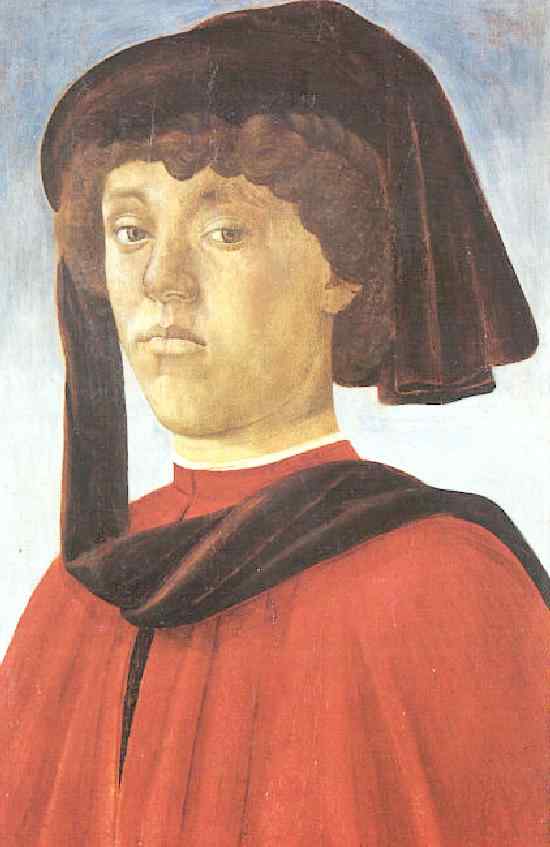
Figure 1.--This painting is one of his secular portraits--an important step carrying art away from an exclusivekly religious focus. The work is known as "Portrait of a Young Man" and was probably painted before 1480. The boy here has short hair. we note other paintings by Botticeli with subjects that have long hair. Note the destinctive had worn with a kind of scarfe.
Sandro Botticelli is one of the leading artists of the Italian Renaissance. His painting the "Birth of Venus" is considered one of the masterpices of the Floretinr Renaissance. He was born as Alessandro di Mariano Filipepi in Florence. He was the son of a tanner, a very low status trade. Botticello meaning "little barrel" was a nickname, but the name that he is widely known for today. Sandro was first appreticed to a goldsmith and later to the painter Fra Filippo Lippi. He also worked with the engraver Antonio del Pollaiuolo. He painted both Biblical and classical scenes as well as the increasingly popular portrait. Interestingly in sharp contrast to his his equisite lines and reaistic depictions, Botticelli clothed his subjects in contemporary Italian Renaissance clothing.
Parents
He was the son of a tanner, a very low status trade.
Childhood
He was born as Alessandro di Mariano Filipepi in Florence. Botticello meaning "little barrel" was a nickname, but the name that he is widely known for today. Virtually nothing is known about his childhood.
Childhood Clothing
Education
Training
Sandro was first appreticed to a goldsmith and later to the painter Fra Filippo Lippi. He also worked with the engraver Antonio del Pollaiuolo. It was here that he apparently acquired his wonderful sence of line. Another influence was Andrea del Verrocchio.
Career
Botticelli by the age of 25 in 1470 was working as an independent artist with his own workshop. His career is strongly associated with Florence. He proved popular with the leading figures of the city. He painted several works including portaits for the Medici, the most important family of the city. Lorenzo de' Medici sponsored one of the most brilliant courts of the 15th century amnd Botticelli was one of its prestigious adornments.
Body of Work
He painted both Biblical and classical scenes as well as the increasingly popular portrait. Studying his paintings is complicated by the fact that many are undated. Botticelli works are fascinating glimses of the transition during the Renasissance from the God-centered Medieval world to our more secular modern world. Boticelli did many religious works. He in 1481 was even chosen to decorate the Sistine Chapel in the Vatican. He painted "The Youth of Moses", the "Punishment of the Sons of Corah", and the "Temptation of Christ". Art historians still discuss two large panels commissioned by the Medici, "Primavera" (1478?) and "Birth of Venus" (after 1482). They are perhaps his best known works. The slim elegant figure of Venus has been variously viewed as a symbol of both pagan and Christian love. Botticelli's patrons were expelled from Florence in the 1490s. The Dominican monk Girolamo Savonarola became vert influential and taught a need for austerity and reform. Botticelli apears to have been influenced and his work shows a more pronounced religious passion. This was not in step with the temper of the High Renaissance that developed at the turn of the 16th century. He became less fashionable and died in obscurity. Only in the Victorian era did interest develop in him.
Assessment
Sandro Botticelli is one of the leading artists of the Italian Renaissance. His painting the "Birth of Venus" is considered one of the great masterpices of the Floretine Renaissance.
Clothing
Interestingly in sharp contrast to his his equisite lines and reaistic depictions, Botticelli clothed his subjects in contemporary Italian Renaissance clothing. Unfortunaely he painted few boys to help us undewrstand how boys dressed. The portrait of a youth here is helpful (figure 1). Notice in particvular the headwear. I'm not sure what it was called. He seems to be wearing some kind of red cloak with hius brown headwear.
We note several Botticelli paintings in which he paints youths with long flowing hair. The youth here appears to have relatively short longish hair. Note his ears are not coivered. This is proably a good reflection of contemporary hair styles for well-to-do youth. We think the difference between this portrait and some of the beautiful youth in his religious paintings is that the beautiful youth are in fact angels. Notoice thayt in these paointings, the ears are covered and the hsair hangs over their shoulders. This is a little difficult to tell because there are often no halos or wings. We believe that such long, beautifully curled hair was not common for contemprary boys. The long hsair was a convebntion many other Renaissance artists used for angels.