Biographical Details on Boys' Clothing Styles (D-F)
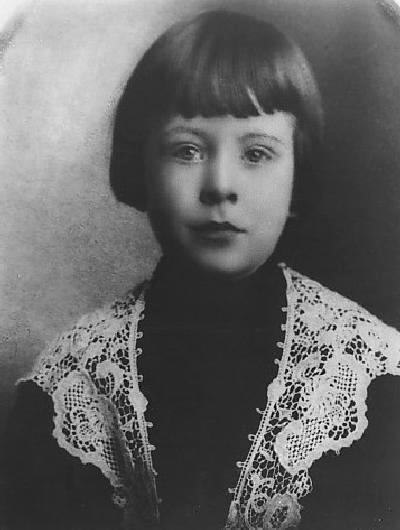
Figure 1.--Nelson Eddy was a noted movie crooner in the 1930s. We do not have much information on how Nelson Eddy was dressed as a boy. We do note one portrait of him wearing an elaborte lace collar 5 or 6 years old. His hair was cut in bangs and long at the side.
Many famous and not so famous men remember the clothing and hair styles they wore as boys. Not so many years ago it was all up to mom how junior was dressed. In some cases, especially in the late 19th and early 20th Century, moms in Europe and America let their imaginations run wild, choosing elaborate Fauntleroy and kilt outfits for their darling sons. The wife in affluent families rarely worked and thus she had a great deal of time, and in some cases the assistance of nannies and governesses, to see to the care and dressing of their children. The results were very little boys kept in dresses. Ever after they passed out of dresses, little and not little boys done up in dress-like tunics and kilts and lacy Fauntleroy suits and kilts as well as more manly sailor suits. Here is information on individuals from D-F. This page is still being developed. If you have any historical information to add, do let me hear from you.
D
D'Amboise, Jacques (U.S., 1934- ): Sharing the exhilarating experience of dance has been Jacques d'Amboise's gift to children for the past two decades.Famed teacher and choreographer Jacques D'Amboise was born in 1934 at Dedham, Mass. He became a soloist with the New York City Ballet in 1953. He is best known for American-theme works, e.g., Filling Station, Western Symphony, films,
e.g., Carousel (1956), and his own ballets, e.g., Irish Fantasy (1964). D'Amboise founded the National Dance Institute in 1976 to bring the teaching of dance into the New York city public schools. He conducted classes in New York during the 1970s and 1980s amd continues
to promote dance education.
Dalton, John (England, 1766-1844): John Dalton is one of the greatest English chemists. His work achieved advances in many areas. He described color blindness scientifically (1794), in part because he was aflicted withthe condition. Dalton focused his work on gases. He noted over 200,000 observations of the atmosphere in notebooks he kept. He analized mixed gases and the expansion of gases under heat. Dalton's Law continues to be an important scientific principle to explain the law of partial pressures in chemistry. His work on gases helped him to conceptualize the atom--at the time a highly theoretical finding. Dalton produced a scientifically based atomic theory of matter. He lectured extensively and published a detailed account of his theories in A New System of Chemical Philosophy in 1808. We have no details of his childhood at this time, but do have a image on children while he was an adult.
Dana, Richard Henry Dana Jr. (United States, 1815-82): Dana an American lawyer and politician from Massachusetts, a descendant from some of the earliest settlers. as a boy he had a strict schoolmaster named Samuel Barrett who regularly flogged the boys and nearly pulled off Richard's ear. His father then placed him with Ralph Waldo Emerson who Richard thought pleasant, but not strict enough to get the boys to focus. While attending Harvard College he developed eye trouble which made it difficult to read. He decided that ocean air would be curative. Although his family had means for a luxury sea voyage to Europe, he decided to sign on a merchant vessel as an ordinary seaman. And based on his experiebce wrote the seafaring classic, Two Years before the Mast (1840). Upon returning to Boston he enterred Harvard (Dane) Law School. He became a prominent abolitionist, helping to found the anti-slavery Free Soil Party (1848). He became a champion of the downtrodden, from humble seamen to fugitive slaves and their resuers, especially after the Figtive Slave Act was passed as part of the Compromise of 1850. The Law made assisting fugative slaves a crime. After the Civil War he defended freedmen.
Darwin, Charles (England, 1809-82): English naturalist Charles Darwin is one of the greates sciebtists of all time. His fabreled voyage on the HMS Beagle and encudsing book Origin of the Species fundamentally changed not only science, but philosophy as well as it so fundamentally altered man's outlook. Darwin's theory of evolution by natural selection is now the unifying theory of the life sciences, for the first time explaining how the the diversity of the natural world was a esult of adapting to their varying environments. We note modern fundamentalists criticism that Darwin made mistakes. Actually given the level of biological science, it is staggering how much Darwin got right. Charles' parents were Robert Waring Darwin and Susannah Wedgwood. Charles was born in Shrewsbury (1809). He was the fifth child and second oldest son. He showed an interest in natural history from an early age and proved to be an excellent student. His life was unremarkable for a boy from an affluent family. This all changed when he obtained a position on the HMS Beagle (1831).
Daubeville, Jean (France 18??-19??): This turn of the century French family dressed their little boy in dresses and pinafores. He was painted by a contemporary of Renoir. French painter Felix Vallotton was a contemporary of Pierre Renoir. A painting he did in 1906 was
included in a book on Renoir's Portraits and compared with Renoir paintings of children. the painting shows a little boy, Jean Dauberville, standing beside some kind of rocking toy. The painting demonstrates that well after the turn of the century, French mothers were still outfitting little boys in dresses.
Davies, James J. (United States, 1873-1947): James John Davis was a Welsh-born American businessman, author and Republican Party politician. He served as U.S. Secretary of Labor under three presidents (Harding, Coolidge, and Hoover). Although he was a steel mworker as a young man, he was not popular with organized labor after he became Secretry of Labor who saw him as insuficiently sympthetic to Labor. He did support a limited right to strike. And he convinced U.S. Steel to end the 12-hour working day. He was a strong supporter of eugenics which is one reason that he focused on immigration, at the time Labor Department responsibility. He established the United States Border Patrol and proposed the restrictions on immigration enacted after World War I (1920s). Davis played a significant role in helping the Administration settle a serious coal strike (1922) and had a role in ending of a nationwide railroad strike in the ame year. Both strikes resulted from problems resulting from the War. Davis' influence was ecliopsed by the rise of the more influential Secretary of Commerce, Herbert Hoover. At the same time he took an interest in food shortages in Germany. At the time, the United States was making loans to Geramny in an effort before the rise if the NAZIs to avert a crsis over reparations. After the stock market crash (1929) leading to the Great Depression, Davis's interests turn to politics and he is elected to the Senate from Pennsylvania (1930). While in the Senate, Davis introduced and engineered passage of the Davis-Bacon labor relations act. He was a moderare, not an outspoken critic of the New Deal. He voted for major New Deal reforms, but criticized President Roosevelt for expanding Federal power. In foreign affairs, he was not one of the Congressional Republicans that was outspokingly isolationist. He took an interest in the plight of European Jews as NAZI influence grew. He was an early supporter of neutrality legislation, but as the NAZI menace became increasingly obvious, generally supported Presideb=nt Roosevelt in both preparedness and Anglo-American cooperation. In the passionate debates over the New Deal anbd then isolrionism, Davis is rarely mentiined. He was narrowly defeated in his 1944 rrelection campaign.
De Gaulle, Charles (France, 1890-1970): Charles de Gaulle wore curls as a boy which was not uncommon for boys at the time. He developed his self confidence at an early age as saw himself as a great military leader. He is the most important French political leader of the 20th century. His name today is averywhere in France and the former colonies (airport, streets, places, ect.).
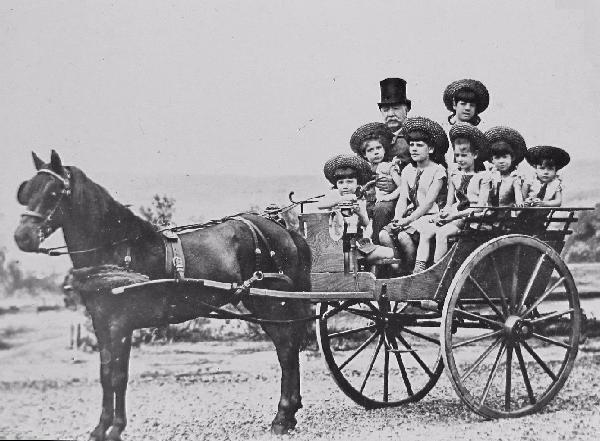
Figure 2.-- The Vicomte de Lesseps was one of the most famous Frenchman of the mid-19th Century
because of his role in building the
Suez Canal. He was not an engineer, but a great promoter. Even the failure of his Panama project and resulting financial crisis in his old age did not totally eclipse his great success at Suez. I am not sure how he was dressed as a boy, but the clothes wore by his prodigious family provide a glimpse of French boyhood
fashions in the late 19th Century. He fathered many children and the images of the family provide interesting insights into upper class French boys' fashions in 19th Century.
de Lesseps, Ferdinand Marie (France 1805-94): The Vicomte de Lesseps was one of the most famous Frenchman of the mid-19th Century
because of his role in building the
Suez Canal. He was not an engineer, but a great promoter. Even the failure of his Panama project and resulting financial crisis in his old age did not totally eclipse his great success at Suez. I am not sure how he was dressed as a boy, but the clothes wore by his prodigious family provide a glimpse of French boyhood
fashions in the late 19th Century. He fathered many children and the images of the family provide interesting insights into upper class French boys' fashions in 19th Century.
Debruyne, Michel and Maurits (Belgium, 1910s): The Debruyne brothers, Michel and Maurits, were young Belgian boys who lived through World War I--actually on the front line of the War. Their father was a mason. They were born about 1908 and 1912. Their experience was different than mist Belgians boys in that they lived in the small sliver of southwest Belgium that the Germams failed to occupy--Yser Pocket. It became the extreme left of the Allied Western Front. Unlike France, civilians were not evauated to safe areas as there was so little of Belgium left. They watched the refugees flow through, military maneuvers, wounded soldiers and field hospotals, foreign Allied soldiers, and lived in areas that the Germans shelled and attacked. Furnes became a German target. The Germans began gas attacks on Furnes. The civilians were issued gas masks. As the War was about to reach a climax in early 1918, the choldren were sent south for safety to a children's colony (camp). One historian describes the camp, "Their experience will be similar to that of hundreds of other children from the unoccupied zone, sent to school colonies: lessons, chores, strict discipline, regularly interspersed with mandatory activities. The colonies, run by teachers and strict educators, are not holiday camps and, though the children are cared for correctly, this is no replacement for the family home. The children can correspond with their parents but, even from unoccupied zone to unoccupied zone, the mail service is poor, and the authorities in charge of the children are stingy with news." [Cappart] The camp seems to have had a smock uniform.
Delta, Penelope (Greece, 1874-1941): Penelope Delta was born in 1874, and she was the third of the six children of Emmanuel Benakis and Virginia Choremi. She spent her childhood and teenage years in Alexandria, frequently visiting Greece and other countries. Although raised in affluent urban surroundings and offered every opportunity to cultivate her intellect, she was subjected to a very strict upbringing at the hands of her mother. She became perhaps the mosdt noted author of Greek children's literature
Dennis, Lonnie L., - (United States, 189?-19??): Lonnie was a 8-yearold boy was was known as a "Baby Preacher". While we know little about him, but a surviving photographic image does show how he was dressed. Hopefully HBC readers can provide additional information about him.
Devine, Andy - (United States, 19??-??): Andy Devine was a popular charact actor in Hollywood B films during the 1930s and 40s. His gravely voice was especially destinctive. He was best known as a sidekick in Western films. He had a son named Tad.
Dickens, Charles - (England, 1812-70): Charles Dickens is regarded by many as the greatest novelist in the English language. He is especially notable for the wonderfully diverse chracters he created. Among them are some of the most famous boy characters in literary history. Oliver Twist was in fact the first boy character to be the main character of a novel. Dickens authored 15 major novels and numerous short stories and articles. Oliver David, and Pip are the best known, but many other boys and girls populate his novels. The most memorable are those wounded and in some cases destroyed by poverty, in pat because of his boyhood experiences. The epitat on his tombstone in Poet's Corner, Westminster Abbey reads: "He was a sympathiser to the poor, the suffering, and the oppressed; and by his death, one of England's greatest writers is lost to the world".
Disney, Walt - (United States, 1901-66): Walter Elias 'Walt' Disney was born in Chicago, Illinois (1901). His father was Elias Disney, an Irish-Canadian. His mother, Flora Call Disney, was German-American. Walt was one of five children, four boys and a girl. He spent most of his childhood in Marceline, Missouri. He loved to draw. He began drawing, painting and selling his pictures to neighbors and family friends at an early age. His parents took the family to Kansas City, where Disney developed a passion for trains. Kansas City was of coure a major rail hub. Walt attended McKinley High School in Chicago, where he took drawing and photography classes. He became a contributing cartoonist for the school newspaper. At night he took courses at the Chicago Art Institute. When Disney was 16, amd America entered World War I, he dropped out of school to join the Army but was rejected for being too young. He joined the Red Cross and served in France as a ambulance driver. He went on to become the best known maker of annimated movies. Mickey Mouse first appearing as Stramboat Willie was Disney's first major sucess. Mickey and other Disney creatiins are some of the best-loved cartoon characters of all time.
Doisneau, Robert - (France, 1912-94): Robert Doisneau is one of France's most noted photographers. He is noted for the many playful and unsuposing images chronicling everyday French life. His prolific outbook over the course of several decades provides us a marvelous record of French life. His images don't seek to overcome the viewer. They are often modest in scope and playful. He is at his best with people. His images of French childhood are especially helpful for HBC. He was influenced by the work of Kertesz, Atget, and Cartier-Bresson who also provided wonderful images of childhood. He published ober 20 books providing realistic, but charming images of quiet, often personal moments in the lives of individuals. He wrote: "The marvels of daily life are exciting; no movie director can arrange the unexpected that you find in the street."
Donat, Robert - (England, 1905-58): British movie buffs will recall Robert Donat, a wonderful actor who appeared in a number of classic films. Donat was born in Manchester, England in 1905. We note a portrait of young Robert with quite a set of curls wearing what looks like a belted tunic suit with a velvet collar and matching wrist cuffs. He looks to be about 6-7 years old so the photograph must have been taken around 1911-12. In boyhood he was described as a tall, lean boy, with a pronounced stammer. All through his childhood and into adulthood he suffered badly from asthma. Donat is orobably best remembered for his role as Mr. Chips, the beloved schoolmaster in the MGM film 1939 'Goodbye Mr. Chips' (1939). Chipps is the legendary Latin teacher at Brookfield School, whose career began as a troubles teacher who could not at first keep discipline, but came to be well liked by his pupils, especially after his unexpected marriage. It is based on a book by James Hilton who also wrote the film script. Interestingly both the author and actor came from Lancashire. James Hilton was born in Leigh and Donat in the near by city of Manchester. In his last film completed just before he died in 1958 he said: 'We shall not meet each other again. I think ....'.
Doolittle, Jimmy - (US, late 1890s- ): American aviator and World War II hero. The Doolittle family moved to Alaska when he was 3 years old. There is a photograph of him, probably about 5 years covered in curls. I think he was wearing a sailor suit. The General who became bald remembers that "I hated that hair then. I had to put up a hell'a good argument before my mother finally agreed to cut it." Jimmy was small as a child. In another photograph he has written, "My name is Jimmy Dollittle. I am the smallest boy in the class." His mother was a spartan and his father was a strict disciplinarian. He is best known for the bomber attack on Japan from carriers which is celebratd at the Doolittle Raid (April 1942). He went on to play an imprtant role in the air war in Europe.
Douglas, Kirk - (US, 19 ): Movie star Kirk Douglas' autobiography (The Ragman's Son) apparently didn't reveal any thing particularky interesting about himself, but confirmed some of Christine Crawford's accounts about her movie star mother.
Downey, Morton, Jr. - (US, late-1930s?- ): Obnoxious, chain smoking host of a right-wing interview show during the 1980s. His father was a noted singer. There is a nice picture of him at 3 years old and his adopted brother about 5 years old, dressed in identical sailor suits, nice white middy blouses, dark shorts, and short socks. They were on their way to Europe. Later his mother ran off with another man and gave up custody. His father married. Mort was a difficult kid. The children were raised by their paternal grand parents. Dad eventually married an heiress. Mort was sent off to military school at 10.
Duclos, Jacques - (France, 1896-1975): Jacques Duclos was born in the small village of Louey, located in the High Pyrenees, between Tarbes and Lourdes (1896). His father was the village carpenter. His parents operated an inn. His mother was a seamstress. He had an elder brother, Jean, two years older his senior. Thgey lived a with their elderly grandmother. A younger brother, Louis, was born (1904). He was apreticed as a pastry baker's assistant when he was 12-years old (1908). He was drafted in World War I and fought in the apocoliptic Battle of Verdun. He was captured (1917) amd spent the rest of the War in a German POW camp. The tragedy of the War turned Duclos into a Communist and he joined the Party after the War. He was an early recruit to the Bolshevik School in Moscow and associated with Stalin and Stalin's French representative (Thorez). He proved adept at sectarian actions. When he returned to France he rose rapidly in the Party hierarchy as did many with backing from Moscow. He is described as the 'brain' behind political choices made by Maurice Thorez and Benoît Frachon. Duclos was a Comintern agent in Spain and ran the closely supervised Information Section. Moscow assigned him the task of exerting 'discipline' on Communist Movements in Spain (1930, 1935) and Belgium (1934-35). He was part of the the United Front which was formed in France to confront Hitler's rise in Germany (1935). When Hitler and Stalin signed the Non-Agression Pact (1939), Duclos as a loyal Stalinist justified it, but the Party was split. The Government banned the Communist Party. After the German invasion, Duclos met with Gestapo, hoping hat as a NAZI ally, the Party could be legalized. This did not occur and Duclos would become a resistance leader after the NAZI invasion of the Soviet Union (1941). After the War, Duclos would play a role in the Cold War. France like Italy hs a large Communist Party, and Stalin hoped that Communist governments could be voted in. Duclos had become a Comminist for idealistic/pcifist mptivations after World War I. We are unsure just when he became aware of the enormoust crimes of Stalin and the NKVD. It is often said that Communists in Western Europe were different than the willing lackeys Stalin placed in power in Eastern Europe. Duclos is one of many Western European Commuists more than willing to do Stalin's bidding and pursue his policies. Liberal Canadian politican Jean-Yves Duclos (1965- ) appears to be a grandson.
Dunlop, John Boyd - (Scotland, 1840-1921): Rubber became a major industry in the 20th century. Most of trave every day on pneumatic rubber tires. The industry was a very minor one in the 19th century, used to produce waterproof garmets or elastic. Mist people traveled on swood or metal wheels. Amazingly the transition came avout because John Boyd Dunlop wanted to make a better tire for his son's tricycle.
E
Eberle, Josef - (Germany, 1901-86): Swabian journalist and author Josef Eberle was born September 8, 1901 at Rottenburg on the Neckar, were he also went to school. Later he became an antiquarian, book seller and journalist. Actually, he trained at the same book shop (Heckenhauer) in T�bingen, were Hermann Hesse had learned 20 years before. As a book seller, he went to Berlin, Stuttgart, Karlsruhe, Baden-Baden and Leipzig, worked 1927-1933 at the radio Stuttgart. The NAZIs beginning in 1936 refused to allow him to write anymore. He was arrested and held in the Heuberg Concentration Camp (KZ) during May-June. Later he worked as an assistant at the American consulate. After Wold War II from 1945-1971 he edited the Stuttgarter Zeitung, oneof Germany's most important newspapers. He died September 20, 1986 in Pontresina/Swizerland and was buried in Rottenburg on September 25, 1986. He is best known as a journalist, but he also wrote beautiful Swabian and Latin poems an well as sevral books, including his autobiography: Aller Tage morgen, and two essays on the Romans. All he�s poems are humorous sometimes melancholic. He was honored as Dr. phil. h.c., Prof. h.c. and poeta laureatus. A bridge was named after him, too.
Eddy, Nelson - (United States, 1901-67): Nelson Eddy was born Providence, Rhode Island in 1901. We do not have much information on how he was dressed as a boy. His parents were musical and he grew up surrounded by music as a boy. He was a prodigt in that he showed musical talent from a very early age. He did not, however, perform as a boy. He was also interested in art and language and was an avid reader. He was a good student, but did not go to high school as he had to help support his mother when his parents separated. He was fired from his first job as a telephone operator for singing to the customers. Nelson was a brilliant baritone and is best remembered for the musicals he made with Jeanette MacDonald (America's singing swwehearts) during the 1930s. After his film career flagged he began working in night clubs.
van Eeden, Frederik Williem - (Netherlands, 1860-1932): Williem Van Eeden was an important Dutch philosopher. Van Eeden's works, according to the Encyclopaedia Britannica, "reflect his lifelong search for a social and ethical philosophy. A family snapshot shows and his first wife Martha (1856-1943) with their two sons Paul (1889-1913) and Hans (1887-1981). The photograph was taken in Holland in 1895 and is a good example of clothing styles in an affluent Dutch middle-class family.
Einstein, Albert - (Germany, 1879-1955): The great theoretical physicist and nobel prize winner was slow to speak and not regarded as a particularly apt pupil as a boy. He graduated as a teacher of mathematics and physics. His therory of relativity as a young physicist revolutionized the science. He was awarded the Nobel Price for Physics in 1921. He was thus a world renowned physcists when the NAZIs seized power in Germany during 1933. He was, as a Jew, among the many authors who books were burned. He escaped the NAZIs and in 1935 was granted residency status in America. His letter tomPresident Roosevelt in 1939 played an important role in the American decission to build an atomic bomb.
Engles, Friedrich - (Germany, 1820-95): Friedrich Engels was born in Barmen, Rhine province, Prussia (1820). He was the son of a wealthy businessman. His parents were fervent Christians. He would reject both capitalism and Christianity, but never broke with his family. Engles was an important German socialist philosopher and businesman. He became the friend of and close collaborator of Karl Marx in the founding of the modern communist movement. And after moving to Manchester publishd the ground-breaking 'The Condition of the Working Class in England'. The two men jointly published the 'Communist Manifesto' (1848). AEngels affter Marx's death edited the second and third volumes of Marx's great work --Das Kapital. Engels organised Marx's notes on the 'Theories of Surplus Value' which he then published as the fourth volume of .
F
Fallwell, Jerry - (US, late 1920s?- ): Fundamentalist TV evangelist apparently was a hell raiser as a boy. Once he and his twin brother thought the gym teacher in high school was unreasonable, so they got him down and took his pants off--locking him up and nailing his pants on the school bulletin board. Apparently the gym teacher was a bit off, the principal thought the incident was funny and just told the boys not to do it any more. He has two sons. The oldest (John) was born about 1969 and was cute as a button as a boy. He says his father was not particularly strict as a father. In one picture John was wearing shorts on a trip, he looked about eight. When he was a sophomore in high school, he got a friend (a girl I think) to take pictures in the girls locker room. All hell broke loose when her parents took the film to get it developed.
Federn, Paul - (Austria, 1871-1950): Dr. Paul Federn is a Vienese psychologist strongly associated with Sigmun Freud. Paul was born in Vienna (1871). His father was an important Viennese doctor. An uncle was a renounded Prague rabbi. Paul grew up in a family with a liberal outlook. He was a bright boy and a good student. He earned a medical degree (1895. He interned in general medicine under Dr. Hermann Nothnagel. He introduced him to ground-breaking works of psychoilogust Sigmund Freud. He was particularly impressed with Freud's Interpretation of Dreams. He changed his career from general mediciune to psychoanalysis (1904). Along with Alfred Adler, Wilhelm Stekel, and Rudolf Reitler, he became one of Freud's earliest and most important disciples. He developed a successful practice. He and his wife Wilma, a Catholic, had three children, Annie (1905- ), Walter (1911- ), and Ernst (1914- ). Freud made Federn and Anna Freud, his official representative and vice president of the Vienna Society. Federn held that position until the Anchluss (1938). With his international reputation and connections. Federn was able to get out of NAZI Austria (annexed to the Reich) Germany and emigrated to America (1938). The family except for Ernst accompanied their father to America. He became a Communist in his youth. As a Misching, associted with Freud, and a Communist, his life must have been difficult in Vienna after the Anchluss. Ernst was eventually arrested by the Gestapo, although we do not know the circumstances. He was interned in the Buchenwald Concentration Camp where he was liberated by the Amerucabns (April 1945). He became a noted author ficusing on the sociology and psychology of prison life.
Felini, Federico - (Italy, 1920-93): Federico Fellini is perhaps Italy's best known film director and scriptwriter. He came from a humble family. his middle-class mother marrying a father of peasant oigins.He was born in Rimii (1920). He had two siblings, Riccardo (1921�91) and and Maria Maddalena (1929�2002). Riccardo also became ca filmmaker. He began school in a Catholic primary school run by nuns and later attended a state public school. He was a excellent student and amused himself with drawing. He enjoyed American cartoons. He also enjoyed films and the circus. His parents incouraged his education and he was inrolled in a gyymnasiym (academic secondary school) (1929). Federico and Riccardo participated in the compulsory Bailla,Fascist youth group. It does not seem to have had an important impact on him. There were no scenes in his film about the experiences. And he failed his military xulture exam at school. He graduated (1938)after which he mived to Rome where he worked with drawing caraicatures in bars and entry level jons in newsppers and writing material for humor magazines. He then got involved with filkm making and was almost captured by the British in Libya where he was making his first film. Radio and film jobs got him draft deferments
An Allied air raid over Bologna destroyed his medical records helping him avoid the draft. Fellini and and e Giulietta Masina, his futurecwife, hid in her aunt�s apartment until Mussolini's (July 1943). The Allies liberated Rome (June 1944). He helped make ends meet by drawing caricatures of GIs in the diffult cinditions of war toirn Europe. Childhood and adolesent expeiences are an important part of his ilms., He is Known for a trademark style of blending fantasy and humor along with florid images with an Italian earthiness. He is seen as one of the most importnt filmmakers of the 20th century.
Fermi, Enrico - (Italy, 1901-54): talian physicist Enrico Fermi played a key role in the Manhattan Project, both in getting President Roosevlt's support and in the physics involved. One colleague described Fermi as, "one of the leading lights of he nuclear revolution that came bout in physics." Enrico was hooked on science and mchanics as a boy. He njoyedassembling electric motors for fun. It soon becane apparent tht his field would be physics. He first encountered physics while browsing an open air book market. It was there he spied a thick 900-page volume, Elenmentorum physicae mathematicae (1840). It was written in Latin and covered the phsics of acoustuics, astronomy, optics, and mathematics. So while other boys were playing ball and other ganmes in the streers of Rome, Enrico diveted himself by building gyroscopes anbd devising formulas measuring Earth's gravitational acceleration. He was an outstanding student and entered university at age 17 years, enrolling in the Scuola Normale Superiore. This was a university for especially gifted students in Pisa. He concentrated on advanced mathematica and and physuics, demonstrating an astonishing aptitude for both. He published hiss first paper duting his second year. Fermi was the first scholar to explore the practical application of Enstein famous equation--E=mc2. And this meant how to harness nuclear energy. After graduation, Fermi won a prestigious position at he Sapienza University of Rome. He was elected to the Royal Academy of Italy. Politics then entered Fermi's life. Fascist Dictator Benito Mussolini under pressure from Hitler, issued anti-Semitic laws (1938). Fermi wasn't Jewish, but his wife Laura was and because of that their children were half Jews, also affected by the laws. To protect her and the children, he took his family to America. In that same year he received the Nobel Prize in Physics for his work on radioactive elements which provided an excuse for leving Italy. Fermi would be involved in the earliest stage of the Manhattan Project. Fermi and Szil�rd built the world's first nuclear reactor in a squash court at the University of Chicago. They generated the first self-sustaining nuclear chan reaction (December 2, 1942). Thinking that the Germans were ahead in the race for the bomb, the United States then launched the massive effort to build an atomic bomb.
Fisher, Robert James - (US, 1943-2008): Robert James "Bobby" Fischer was born in Chicago (1943). His father Gerhardth Fischer was born in Berlin, Germany (1909) and emigrated to America. He was a biophysicist. Some speculate that his real father was a Hungarian Jew named Nemenyi. His mother was Regina Wender was an American citizen of Polish Jewish descent. She was born in Switzerland and raised in St. Louis, Missouri. Bobby renounced Judaism and became upset if anyone called him Jewish. His parents separated when Bobby was only 2 years old. Regina had custody of Bobby and his older sister Joan who was 7 years old at the time. Their mother was a qualified registered Nurse and wanted to take a Master's Degree at New York University in Nursing Education. She decided to move to Brooklyn. It is there that Bobby began to play chess. There was no tradition of chess in the famikly. Bobby and Joan received a chess set as a gift (1949). All they had to go on was instructions that came with the set. Bobby as a 6-year-old was fascinated with the game and his abilitity to deal with his complexities. His mother became worried about his obsession with the game. She is quoted as saying, "Bobby isn't interested in anybody unless they play Chess and there just aren't many children who like it." He won the World Chess Championship (1972). He declined to defend it (1975). He widely considered to be one of the most talented chess players of all time. Desspite disappearing from competitive play, he continues to be one of the world's best known chess players.
Fleming, Stanford - (Canada, 18??- ??): Stanford Fleming was the chief engineer for the Canadian Pacific Railroad. The Canadian Pacific was the railroad which connected Canada with a trans-conntinental line.
Flexner, James Thomas - (190?- ): In his biography (Maverick's Progress: An Autobiography, Fordham University Press, 1996), Flexner describes a poignant New York boyhood during the 1910s and 20s. He had a German governess and went to the unorthodox Lincoln School which was considered revolutionary because it did not enforce rules of discipline.
Forbes, John Ripley (United States, 1913-2006): John Ripley Forbes was a noted American naturalist, conservationist and educator who helped establish hundreds of small natural-science centers/nature museums for children throughout the country in over 30 different states. He established the Natural Science for Youth Foundation to support the centers. He had a way of convincing often total strangers to give him items for the museums or money to support them. He began his work during the late-1930s and except for a brief break for World War II military service, continued his work for children throughout his life. He worked with local community groups to establish natural-science centers. He worked for small fees or sometimes no pay at all. He helped find financial backers. He managed to find uses for old mansions. And he stoped development of some land so they could be used as nature preserves. He was particularly adroit at convincing widows to give up their husbands� trophy fish and hunting trophies for science. Many needed little encouragement. Forbes was not interested in large natural-history museums in big cities and their ubiquitous glass cases, stiff taxidermy , library-like hush. He wanted smaller centers in local communities that could delight and educate children. He wanted to hear their shouts and giggles and encourage them to climb all over the exhibits.
Forbes, Malcomb S. "Steve" Jr. - (US, 1947- ): Steve is the son of famed U.S. business publisher Malcomb Forbes. Steve is best known today as a Republican presidential candidate. Malcomb Sr. required Steve and his brothers to dress up in kilts for church and other special occasions. The father liked to wear kilts himself. I understand that the boys all objected. Steve reportedly hated it, even more than his brothers who were younger. It would be one thing
doing this in Scotland or even England, but in America it must have really been embarrassing. Commenting on it during a TV interview, he said rather sarcastically that his friends didn't ascribe to his father's multi-cultural principles. They apparently teased him and called his kilt a dress and a skirt, and probably had lots of other little jibes. Some fist fights reportedly resulted. His father also had the boys learn the bagpipes and perform in their kilts for business guests. Apparently they were awful, but the guests always clapped. Steve says the boys who knew they played badly didn't understand it at the time, but now believes the applause was gratitude for them stopping.
Ford, Henry - (US, 1863-1947): Few individuals have so impacted the lives of individuals in America and around the world as Henry Ford. Henry grew up in rural Michigan and as an adult remained nostalgic about the rural way of life that he experienced. He loved to tinker, but dislike the hard work involved in farming and academic study. He was as a result poorly educated and left scool at 15 nearly illiterare. He seems to have been rather lazy as a boy and that did not change as he grew older. [Brinkley] A rather surprising trait in a man who was to become a champion of American industry.
Forster, E.M. (Edward Morgan)
(England, 1879- ): The noted English author was born in London and educated at King's College, Cambridge University. He wore dresses through the age of 5 years. A picture of his at the age of 5 in 1884 shows him wearing a Fauntleroy dress with lace trimmed pantalettes. These Fauntleroy outfits and the long curls were reportedly insisted on by his wealthy aunt, Marianne Thornton. The party outfits worn by Morgan up until 9 or 10 are described by
the author as Fauntleroy suits. When his Aunt Marianne died she left him 8,000 pounds which enabled him to pursue a career as a writer. His first novel, Where Angels Fear to Tread appeared when he was only 26 in 1905, but displayed an unusual maturity of style. He had left-wing leanings and in 1920 was the literary editor of the Daily Herald, a Labour paper. He traveled to India in 1920 and in 1922 published A Passage to India. He fought against censorship in Britain and was given a Government post in 1939 to study the question. The primary them in his work is the conflict between those who live by convention and those who live by emotion; between the love of property and possessions, and human values and relationships. Several of his novels have been made into important movies and television productions. One of his lesser known works is a biography of his aunt's family, the Thorntons. (See Inglis Synnot Thorton below.)
Foxlee, Ludmila (Czech, 1885-1971): Ludmila Kuchar Foxlee immigrarted from Bohemia as a 4-year old girl (1890). Bohemia was the heart of the Czechs. At the time it was part of the Austro-Hungarian Empire. We do not have a photograph of her as a girl. We do have a photograph of Ludmila as a girl. We do have a photograph from the 1920s on Ellis Island with a young immigrant girl, perhaps another Czech girl. Czechoslovakia declared indroendence (1918). The U.S. Immigration Service allowed social workers to assist the immigrants on Ellisd Islsnd, Foxlee is the best known. She was hired by the YWCA to work on Ellis Island following World War I (1920). She assisted thousands of detained Christian European immigrants--Protestants, Eastern Orthodox and Catholics. Foxlee was perfectly suited for the job. Having lived through the immigrant experience herself as a young girl. She was familiar with the cultural values, customs, and traditions of these new arivals. She also understood American exceptionalism which created unprecented opportunuty for immigrants. Foxlee kept meticulous records and handled a huge number of cases. She was an ethuaiuastic singer and entertainer and ran the Ellis Island Annual Christmas parties and other festivities organized for the detainees and deportees. Foxlee was differenbt than the current crop of social workers. She saw America as a haven and beacon of opportunity, not as an evil, heartless state that needed to be fundamentally changed.
Franks, Bobby (United States, 1924) - One of the most notirious crimes of the 1920s in America was the senceless murder of 14-yearold Bobby Franks. Bobby was the victim of the sensational Leopold and Loeb thrill killing. They were teenagers from affluent families. The photograph of Bobby taken right before his murder is quite famous and has been reproduced many times in history and sociology books. Bobby wears the popular knickrs suit that ws so common at the time.
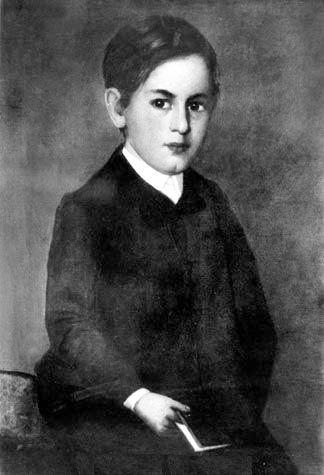
Figure 3.--Here we see a portrait Sigmund Freud, one of the great minds of the 20th century. He is about 7 years of age, probably about 1863. We can't tell much about his clothing, but notice he is holding a book. He loved to read and excelled in school. Unlike Einstein no one questioned his academic potential.
Freud, Sigmund (Austria, 1856-1939): Sigmund Schlomo Freud was an Austrian doctor specializing in neurology who became the towering figure is psychilogy, founding psychoanalysis. This was a clinical method for treating psychopathology using dialogue between a patient and a psychoanalyst. Freud was born to Galician (Austrian Poland) Jewish parents in the Moravian (Czech) town of Freiberg, then part of the Austrian Empire. He qualified as a doctor of medicine at the University of Vienna (1881). After completing his habilitation (university qualification to conduct self-contained teaching) (1885), he was appointed a docent in neuropathology. He set up a clinical practice there achiueving some renoun (1886). He became an affiliated professor (1902). Freud conducted his professional and family life in Vienna. Freud is best known for inventing psychoanalysis. He developed therapeutic techniques such as free association and discovered transference. These methods became central to the analytic process. Freud focus much of his work on sexuality. At the time his ideas on infantile forms led to great controversy. He formulate the Oedipus complex as the central tenet of psychoanalytical theory. While Freud was non-religious, his Jewish ancestry and controversy concerning his wirk made him a NAZI target. Freud later in life had to leave his beloved Vienna to escape the NAZIs (1938). He died in exile in the United Kingdom (1939).
Frost, David (England, 19??- ) David Frost went to Gillingham Preparatory School. The attached photograph is of him in 1948. He was and is still a keen cricketer. He became a television star in the 1960s on both sides of the Atlantic simultaneously. I remember him on "That Was the week That was". I know less about his English televison career.
Sources
Cappart, Marie. "The Debruyne family: Lifein the unoccupied zone," rtbf.be website.