|
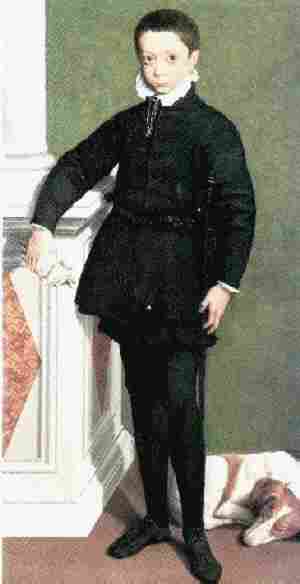
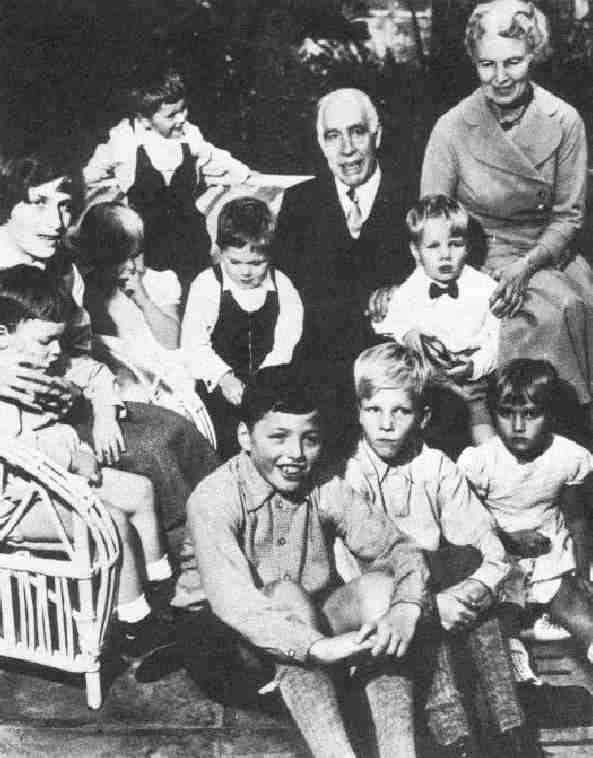
Many famous and not so famous men remember the clothing and
hair styles they wore as boys. Not so many years ago it was all up to mom how junior was dressed. In some cases, especially in the late 19th and early 20th Century, moms in Europe and America let their imaginations run wild, choosing elaborate Fauntleroy and
kilt outfits for their darling sons. The wife in affluent families rarely
worked and thus she had a great deal of time, and in some cases the
assistance of nannies and governesses, to see to the care and dressing
of their children. The results were very little boys kept in
dresses. Ever after they passed out of dresses, little and not little boys done up in dress-like
tunics and kilts and lacy Fauntleroy suits and kilts as well as
more manly sailor suits. Here is information on individuals from A-B. This page is still being developed. If you have any historical information to add, do let us hear from you.
Aga Khan: Aga Khan means something like "chief commander" in Persian. It is the title of the imam (spiritual leader) of an Islamic sect known as Nizari Ismailis. The title was originally granted by the Persian Shah (emperor) Fath Ali (1818). The Ismailis are Shias. The most famous Aga Kahn was Aga Khan III, a notable international figure.
Alexander the Great - Greece, 356-?? BC): Alexander is one of the most fascinating figures in history. As a boy he was schooled by the great Aristotle, one of the most revered thinkers in Western history. Alexander began military campaigning at the age of 14. In a decade he would proceed to conquer the known world. He is often claimed to be the greatest mikitary commander of history. This may or my not be true, but he certainly was one of the greatest. Western historins focus in his military genius, but he was also ruthless in his tretment bof those whobdared defy him. His life was very short. After his men forced him to end his conquests abd return west from India, he eems to have begin focusing on the sguftvfrom warrirr to statesman. His early death mens we will never know just how he woukd have fared with this effort.
Alexander, Harold - (England, 1891-1969): Field Marshall Alexander, Earl of Tunis was on of England's most successful army commanders. He was born in London in 1891. He grew up in a privlidged English-Irish family. A portrait of him at about 6 years of age show him wearing long gair and a white dress or smock with leggings. I'm not sure what other clothes he wore as a boy. He was educated at Sanhurst and commanded a battalion of Irish Guards. it was his survice in World War against Rommel in North Africa, the Japanese in Burma, and later the Germans in Tunisia, Sicily, and Italy. Less flomboyant than Montgomery, he was a commander of exceptional ability.
Allingham, Helen - (England, 1848-1926): English watercolorist Helen Allingham was born near Burton on Trent. Her family settling in Birmingham, after the untimely death of her
father in 1862. Allingham studied art at the Birmingham School of Design. She is widely recognized as an important English watercolor painter of the late 19th and early 20th Centuries. Most of her work is exteriors, but a few are of her children, often in informal clothes. This provides a rare insight into play clothes in the late 19th Century. As most of the available portraits and photographs show the children in their dress party clothes, Mrs. Allingham's charming informal paintings of her son Henry provide valuable information.
Aquinas (Italy, 1225-74): Thomas Aquinas was a Dominican friar and Catholic priest who was an immensely influential philosopher and theologian in the history of the Roman Catholic Church. He was born in Roccasecca into a once land-owning meaning a family of declining prosperity (1225). He became the foremost figure in scholasticism. He was the foremost medieval proponent of natural theology. His teaching became the basis of Thomism. His influence on Western thought is thus immense, although not always in a positiuve sense. Much of modern Western philosophy has developed in opposition to his teachings in ethics, natural law, metaphysics, and political theory. Thomas was a major figure at the onset of the Renaissance and led the introduction of classical teachings into Church scolarship and teaching. Thomas in particular advanced the teachings of Aristotle whom he described as 'the Philosopher'. It was Thomas who renwed the process began by St. Paul to synthesize classical thought (Aristotelian philosophy) with the principles of Christianity. He is best known for his Summa Theologica and the Summa contra Gentiles. He commented extensively on Sacred Scripture and on Aristotle. Thomas is also distinguished for his eucharistic hymns, which form a part of the Catholic Church's liturgy.
Artaxerxes II (Persia, 445/435-358 BC): Artaxerxes II was the long serving Pesian emperor reiging from 404-358 BC. This was much of the time between the end of Pelopenesian War and the beginning of Aleander's campaigms. It was a long, but not tranquil reign. Early in his reign, he defeated an attempt by his brother Cyrus the Younger who employed Greek mercenaries to usurp the throne. The issue was settled in the Battle of Cunaxa dep in the Persian Empire--Babylon (401 BC). The Battle was a draw, by Cyris was killed. The Greeks had to fight their way all the way back to Greece, an epic treck. The Greek historian Xenophon recorded the battle in the 'Anabasis', describing the struggle of the stranded Greek mercenaries. The long-serbing emperor struggled with inserections, satrap rebellions, Greek complications to the west and and an Egyptian rebellion to the south.
Asquith, Anthony - (England, 1902-68): Anthony was the son of Primeminister H.H. Asquith who made the fateful decession after the Germams invaded Belgium to declare war and enter what would become World war I. His mother Margot gave him the name Puffin, we are not sure just why. John Singer Sargent did a lovely drawing of Anthony when he was 6 years old about 1908. It is a little difficult to see what he is wearing. He went on to becone a very famous film director.
Astaire, Fred - (United States, ): Astaire's real name was Frederick
Austerlitz. His father was a dashing young Austrian emigre who settled in Omaha, Nebraska. His family was musical. His father played the piano and Adele, his older sister, fluttered like a tiny Titania through her classes at the local dance academy. Fredie was unimpressed. "Dancing was merely something little girls did," he wrote many years later. "I let it go at that and the hell with it." But his parents weren't about to let it go at that. When Adele was 6 and Fredie 4 �, mummy carted them both off to New York and installed them in the best dance academy she could find. "Adele has a real talent," his father said "and maybe Fred will come around to it someday too." He did not come around with out a struggle. For his stage debut, playing Roxane to his big sister's Cyrano, little Freddie was forced to wear a long blond wig that tickled his neck and a floor length satin dress that kept tripping him up. Mercifully, he was required to give only one performance and in the next school recital he had better luck. After less than a year of instruction, billed as the
Astaires ("because Austerlitz sounded like a battle"), Adele and Fred made their first professional appearance in Keyport, N.J. They were quite successful, and the act prospered until Adele grew and Fred, who remained a skinny kid, could no longer dance with her. They returned to school, the only schooling that Fred ever got, then danced again for a few years until Fred began to grow. One of my favorire Astaire movies is "Easter Parade" (1948). We note what we thinkmis a portrait ofvFred fancing with his son, Fred Astaire Jr.
Auden, W.H. - (England, 1907-73): Wystan Hugh Auden was a noted English poet. He was born in York during 1907. He attended prep school with Christopher Isherwood and they were close friends throughout theor lives. Auden was a committed anti-Fascist. He married Erika Mann, the daughter of noted German novelist Thomas Mann (1935). The marriage was a cover to enable Mann to escape NAZI Germany. There were no children. He was horrified by the Spanish Civil War and wrote a poem about it. Auden had a varied literary career. He wrote criticism and essays and co-authored a few plays with his prep school friend Isherwood. It is his poetry, however, on which his literary reputation rests. He wrote both traditional poetry as well as unstructured verse. He was influential in re-introducing Anglo-Saxon accentual meter to the main stream of English poetry.
Auden was associated with a group of writers including Edward Upward, Christopher Isherwood, and Stephen Spender. Auden moved to America as the World War II was beginning in Europe. Many British readers saw this a tantamount to disertion (1939). Auden lived in America for many years and became a U.S. citizen. At the end of his life he returned to England and lived briefly in Oxford. He died in Vienna (1973).
Augustus (Rome, 63 BC-14 AD): Gaius Julius Octavius was born into an equestrian family (63 BC). He is better known to history as the Emperor Augustus, the founder of the Romn Empire. His mother was the daughter of Julia, Julius Caesar's sister.
He was brought to Rome by Caesar as a young age and servedwith him in Spain, despote being of a declicate constitution. After Caesar's asasination, he joined forces with X=Cesar's main supporter and military commander, Mark Anthony. He proved to be a better politican than Anthony who weakened his public image because if his affair with Cleopatra. Augusta's victory brought peace to Rome, but replaced the Republic with he principate. Agustus ruled as emperor for an anazing four decades (27 BC - 14 AD). While destroying the Repiublic, he had many republican values, such as a strict moral code, at least for women. He exiled his daughter and his grand-daughter, both named Julia, for their loose morals. He brought a long era of peace and prperity to Rom and offending against these principles. It was during his reign that Caesar's expeditions into Germania were deciecely defeatd in the Teutoburg Forest (9 AD), leaving apermant cultural divide at the the Rhine and Danube. He was proud of his public works claiming with some accuracy that he found Rome a city of bricks and left it a city of marble. He also laid the foundation for the Empire, despite his disfunctional family (the Julio-Claudians), that would dominate Europe for five centuries and leave a permanent cultural imprint.
Bach, Johann Sebastian (Germany, 1685-1750): Johann Sebastian Bach is one of greatest musical composers of history. He is onr of the Geramn three Bs, regerring to the primacy of Johann Sebastian Bach, Ludwig van Beethoven, and Johannes Brahms in classical music. Johann was born in Eisenach, Thuringia in northern Germany (1685). He was the single most noted individual substantial family of talented musicians. He was the the youngest child of Johann Ambrosius Bach and Elisabeth Lämmerhirt. His father was a string instrumentalist employed by the town council and the ducal court of Eisenach. Eisenach was one of the many principalities among hich Germany was duivided. Johann began school (about 1692). He was a good stydent, but for some raeason was often absent. Nothing more his known about his musical childhood and musical education. He exhibited musical talent, but was not a prodigy. He almost inevitably must have learned about string music from his father. He would have attended the Georgenkirche in Eisenach where Johann Christoph Bach was organist (until 1703). Bach was a noted composer and musician of the late-Baroque period. He created a monumental body of work. His compositiions incude a wide variety of medium. They incvklude orchestral works ('the Brandenburg Concerto'), solo instrumental music (especially for cellos and violins), keyboard pieces ('the Goldberg Variations'), organ music ('Schubler Chorales'), and choral pieces ('St Matthew Passion). In addition to the brilliance of his music, his family raises interesting issues in the nurture/heredity debate.
He himself had an impressive 20 children and was wass a member of a remarkable extended family of musicians who were proud of their impressiove achievements. Bach even drafted a genealogy of te family (1735).
Baker, Bobby - (United States, 1928- ): Few people were more astute students of the United States Congress than Bobby Baker a protoge of President Lyndon B.Johnson. Bobby crew up in a small town in South Carolina and was very much impressed with himself until he found out when he first arrived in Washington during 1943 during World War II to serve as a Senate page that there were a lot of other boys as bright as himself. He arrived in Washington still wearing long-handled underwear. He was upset when he found that he would have to wear knickers--which he detested. He though at age 14 he was too old to wear knickers. The House pages had already switched to long pants.
Baker, Josephine - (United States/France, 1906-75): Josephine Baker is a fascinating and engaging figure with a huge heart and great courage that entered some of the most difficult strugles of the 20th century. She was a talented singer an dancer, rather excentric, but added aittle spice to life and made a difference. Josephine was born Freda Josephine McDonald in St. Louis, Missouri (1906). She grew up in poverty but was rescied by her skill and talent. She learned to dance and found success on Broadway, the first female black entertainer we know of to do so. There were limits to what blacks could accomplish in America, even black entertiners. She moved to France after World War I (1920s. She memmerized the French and quickly became one of Europe's most popular and highest-paid performers--some thing she could not have achieved in America at the time. She remained in France during the World War II German occupation (1940-44). And unlike many French movie and other entertiners, she worked for the Resistance, an incredible act of courage. Baker during the 1950s and 60s devoted herself to fighting segregation and racism in the United States. She adopted children after the war to prove that racial harmony was possible, 12 children from around the globe. She called them her Rainbow Tribe. Unfortuntely her nterest was not always in the children personally. She charged admission to watch them coexist. She began a stage comeback (1973). She died of a cerebral hemorrhage and was buried with full French military honors (1975).
Balanchine - (United States): The great dancer with the New York City Ballet got
his start in dancing after getting beaned playing street ball. His buddies
dumped him on his doorstop unconscious. The following week his mother,
feeling he needed more supervision, enrolled him in the ballet class his
sister was already taking. When his friends teased him, he fought them
into submission. A good biography is Edward Villella's Prodigal Son: Dancing for Balanchine in a World of Pain and Magic (Simon and
Schuster, 1992?).
Barrett Browning, Elizabeth- (England, 18??-??): Elizabeth Barett Browning and Robert Browning are two of England's most noted romantic poets. Elizabeth grew up in a priviliged, wealthy family. Their mother, like many mothers of the era, dressed her sons in the same dresses and pantalettes as
her daughters. Elizabeth and her siblings were schooled at home. She was an accomplished student. She led a closeted life until meeting Robert. The relationship was one of the great love stories of the Victorian era. Elizabeth and Robert had one child, Pen, who Elizabeth schooled at home and dresses with the same flair as her romantic poetry. Pen did not object as a younger boy, enjoying the attention and compliments from his mother's friends. As an older boy he began to object, but with little success in the face of his strong opinioned mother who had very definite ideas on the subject. Elizabeth is now best known for hautingly beautiful romantic poetry as well as her iterest in women's rights and social justice.
Barrie, Sir James Matthew - (Scotland, 1860-1937): Scottish author J.M Barrie is the beloved author of the classic children's story--Peter Pan. Barrie was a Scottish dramacist and novelist. He was born at Kirriemuir, Forfarshire. I have little information on his childhood or what he wore as a boy. James for the first 6 years of his life, lived in the shadow of his elder brother David. Just before his 14th birthday, David was killed in a skating accident. James soon realised that, by dying so young, David would remain a boy forever in the minds of all those who had known him--just like Peter Pan.
Bede - (England, 672/673-735): The Venerable Bede (Baeda in Old English) is believed to have been born in 672 or 673 AD. Actual Bede was not an actual name but the word for "priest" in the Old Saxon lanuage. He was raised in Northumbria. After the dparture of the Romans, England splintered into several different kingdoms. Nothumbria was an Anglian kingdom north of the river Humber. He was almost certainly not of a noble family. We have little information about his life, especially his child hood. We do know that when he was 7 years old that his family left him at the Wearmouth monestary which is located at the mouth of the river Wear. At the time a poor family inable to care forits children might turn some over to the Church. TheChurch was also one of the few ways in which a boy of humble birth might rise in the society.
Beeghly, Milford - (United States): PBS (Point of View) on July 9, 2002 ran a piece entitled "The man who loved corn". It was about a man who make a career out of creating hybrid corn. He started farming in 1936 so I guess he was born before World War I. His daughter gave a brief description y of his childhood showing several photos. He was the oldest of four boys. The daughter said that his Mother wanted a girl when he was born. She dressed him but not his younger brother in dresses and long curls until he started school. The
first photo is of the corn wizard and his brother. He is about a head taller than his brothers and wearing a white dress. His younger brothers are wearing shirts and pants. The second photo shows him at 6-7 years in a fancy white ankle length dress with petticoats visible at the bottom. His name was Melford but his Mother called him Meldred while wearing dresses. This is usual because you would think she treated the youngest
rather than the oldest like this.
Bell, Alexander Grahm (Scotland/United States: 1847-1922): Alexander Grahm Bell was home schooled and then attended a school in Edinburgh until he was 15 years old. He then spent 12 months living with his grandfather in London. It was at this time that he developed an appreciation for school-based learning. He is best known for inventing the telephone (1876). He formed the Bell Telephone Company (1877). In that same year, with financial security asssured, he married Mabel Hubbard and began a yearlong grand honeymoon tour of Europe in style. His inquiring mind led him to a long careeer pursuing new inventions in many different fields.
Benakis, Antonis - (Greece, 1873-1954): Antonis Benakis was a noted collector of Greek antiquities and brother of Peneope Delta, one of the most beloved authors of Greek children's literature. The two were close in age and grew up together in the 1879s and 80s. Antonis was often dressed in sailor suits.
Bernhardt, Sarah (France, 1844-1923): Sarah Bernhardt's actual name was Rosine Nernard. Her parents were were French and Dutch of Jewish descent, but she was raised in a Catholic convent. At age 13 she she entered the Conservatoire was soon astonishing her teachers with her acting skills. Bernhardt was perhaps the most accalimed actress of the 19th century, if not of all time. She was born in Paris in 1844. She had a spectacularly successful acting career in France and then went to England in 1876 where she soon became the leading actress of the London stage, making annual appearances. She made visits to America in the 1880s and there were two world tours during the 1890s. She asked Oscar Wilde in 1892 to write a play for her. Wilde wrote Salome for her, but the Lord Chamberlain banned it before it could be staged. She founded the Theatre Sarah Bernhardt in Paris during 1899. Her leg was amputated in 1914, but she continued to appear on the stage. She appeared at the front during World War I to entertain the troops and helped raise money in America and Britain. She had one child, Maurice (1864- ), after an affair with a Belgian nobleman, Charles-Joseph-Eugene-Henri, Prince de Ligne. She raised Maurice and spoiled himshamefully. She left his hair long and dressed him in fancy clothes until he was quite old. She continued working on the stage until her death. Maurice and Sarah were close their entire lives. She died in his arms during 1923.
Bernstein, Harry (England.America, 1910- ): Harry Bernstein grew up in Stockport, England. Harry was the youngest child in his family. He was raised on a poverty-stricken street in an English mill town where Jews and Christians were strictly divided. His parents were imigrants from Poland. His latest book, The Invisible Wall was published when the author was 96 years old. It is a memoir describing the anti-Semitic bigotry of which his family was a victim. It also tells the story of extreme poverty and the Romeo and Juliet romance of Berstein's older sister. Harry Berstein and his wife now live in New Jersey near the seashore. The family imigrated to the United States when Harry was 12 years old.
Bingham Family - (US): The Bingham family figured prominently in Kentucky history during the 1900s. The family owned and operated Louisville's main newspapers. The Judge was an early FDR supporter and a power in regional politics. One of the family members Barry Sr. dressed him family very smartly. In one 1941 picture, the boys are shown in short pants suits with kneesocks.
Bingham III, Hiram - (United States, 1875-1956): Hiram Bingham was in Honolulu, Hawaii before the United States annexed Hawaii (1875). His grandfather was descended from Deacon Thomas Bingham who immigrted from England to Connecticut in the early colonial period (1650). The Binghams were part of the 19th century missionary movement. His grandfather (1789-1869) was the first Protestant missionary in the Hawaiian Islands. His father, who was also a missionary, who worked in the Gilbert Islands. Hiram is best know as the archeologist who discovered the Inca settlement of Machu Picchu (1911). It was important because it was a rare Inca settlent that the Spanish had not found and destroyed. Bingham married Alfreda Mitchell (1900). They had seven sons. They subsequently divorced and married Suzanne Carroll Hill (1937).
Bismarck, Otto von - (Germany, 1815-??): Otto von Bismarck is one of the most significant political figures of the 19th century. He is considered the founder of the German Empire. He changed Germany from a loose grouping of conflicting kingdoms and principalities to a united Empire that dominated Europe by the end of the 19th century. He created this new German Empire under the Prussian monarchy and embued it with Prussian anti-democratic military traditions. While he began as a represenative of Prussian Junker interests, he sought to gain the support of Germany's rising industrial class. His primary goal was to unify German and once that was achieved he became a master of ballancing alliances to keep the European peace, primarily by isolating France. Bismarck was the first important European leader to champion a system of social security for workers. Kaiser Wilhelm who fired Bismarck was more interested in imperial expansion and less interested in the Bismarcian alliance system. He believed that the powerful Germany army and a new German navy could be used through bombastic threats to achieve German goals.
Bj�rling, Jussi - (Sweden, 1911-60): Johan Jonatan 'Jussi' Bj�rling was born in the provincial town of Borl�nge (1911). This was in Dalarna province, some 220 km NW of Stockholm. Jussi's father, David Bj�rling was a tenor and singing teacher and music was the center of his family life. He trained the voices of his children ata very early age. Jussi was child protegy. The three oldest children (Olle, Jussi and G�sta) made their first public performance in a church at the age of 4 years (1915). They sang as the Bj�rling Male Quartet. After World War I. David took his boys on tour (1919-20). The toured throughout Sweden and eventually reached the United States. They made six recordings (1920). This began Jussi's relationship with America. Unlike many child prodigies, Bj�rling had an enormously sucessful adult career--some times referred to as the "Swedish Caruso'. Jussi was a Swedish tenor, the greatest Swedish singer of the 20th century. He was also one the leading operatic singers of the 20th century, popular throughout Europe. Bj�rling delivered many performances at important European oper houses, but was most associated with the Metropolitan Opera in New York City. He married in 1935 and had three children in addition to an earlier son. He oldest, Rolf, also was an accomplished singer. His wide describes him as a loving husband and father, but family life was marred by alcoholism.
Block, Herbert - (US, 1910?-2001): Famed editorial cartoonist Herblock was born and raised in Chicago. His mother Tesse was a Catholic and like his bothers was expected to do a First Communion. This was normally done at about age 7. Herb had trouble learning his catecism. Poor Herb had trouble, so she releented. He remarked that she was a kindly sole. Later when he was about to graduate, she insisted that he do his First Communion or she wouldn't put him in long pants for graduation. I think he was talking about his highschool graduation, but am not positive. It could have been graduation from elementary (primary) school. He says that his mother again relented and he graduated in long pants.
Blok, Aleksandr Aleksandrovich (Russia, 1880-1921): Aleksandr Aleksandrovich Blok was an important Russian poet.
He was born in St. Petersburg (1880). His father was a law professor. His mother dabbeled as a writer and worked as a translator. Thus Blok was raised in a prosperous, upper-class family. And his mother's family in particularly introduced him to world of the fine arts. The family spent summers at Shakhmatovo, the Bloks' daccau (country home) near Moscow. The noted chemist, D. I. Mendeleev, lived closeby. There
Aleksandr played with Mendeleev's daughter who he latwr married (1903). Blok was interested in literature from an early age and began to to write as a boy. He began to study law, following his father's careeer, but his heart was not in it. He switched to philosophy and began to devote himself to writing. Blok at a young age became associated with the developing symbolist movement. His poetry was noted for is strongly rhythmic patterns and metaphysical imagery. He drew on both legend and history.
Bloomer, Amelia - (US, 1818-94): American reformer Amelia Bloomer (1818-94) was largely self-educated. At age 22 she married the lawyer Dexter Bloomer.
He was a Quaker with progressive views and encouraged Amelia to write for his newspaper, the Seneca Falls County Courier. Over the next few years she wrote articles in favour of prohibition and women's rights. She lectured and wrote to support the temperance movement and women's sufferage, two inter-linked issues. In 1850 or 1851 she introduced fellow temperance worker Susan B. Anthony to Elizabeth Cady Stanton, initiating a collaboration that would last half a century. Bloomer began publication of The Lily, a monthly temperance paper in 1851. Bloomer is best knowm for energetic promotion beginning in 1848 of the "bloomer" costume. Although bloomers wre conceived as rational ladieswear, they also influenced boys' clothing. Younger boys wore bloomer knickers under tunics and garments like Buster Brown suits. In the 1920s bloomer-like rompers proved popular for boys.
Blyton, Enid - (England, 1897-1968): Enid Blyton is probably the most successful children's author of all time--although not the most famous. She published an amazing number of children's or juvenile books, 600 by one
account. She certainly was the most prolific author of all time, and with over 700 books and 10,000 short stories to her name, she is likely to remain so for years to come. Her importance is that she wrote books that children loved to read and attracted them to books--much like J.D. Rowlings. Blyton's most famous series was The Famous Five. Blyton's works painted an idyllic vision of rural England and hearty Englishness and in recent years she has been criticized for this. It is interesting that Rowlings who also attracts children to books has been criticized for just the oppisite--a dangerous forbiding world of wizzadry.
|

Navigate the Boys' Historical Clothing Biography pages:
[Return to Main bio page]
[]
[Biographies C]
[Biographies D-F]
[Biographies G-L]
[Biographies M-R]
[Biographies S-Z]
Navigate the Children in History Website:
[Introduction]
[Biographies]
[Chronology]
[Climatology]
[Clothing]
[Disease and Health]
[Economics]
[Geography]
[History]
[Human Nature]
[Law]
[Nationalism]
[Presidents]
[Religion]
[Royalty]
[Science]
[Social Class]
[Bibliographies]
[Contributions]
[FAQs]
[Glossaries]
[Images]
[Links]
[Registration]
[Tools]
[Children in History Home]