
Roman Chronology: 2nd Century BC
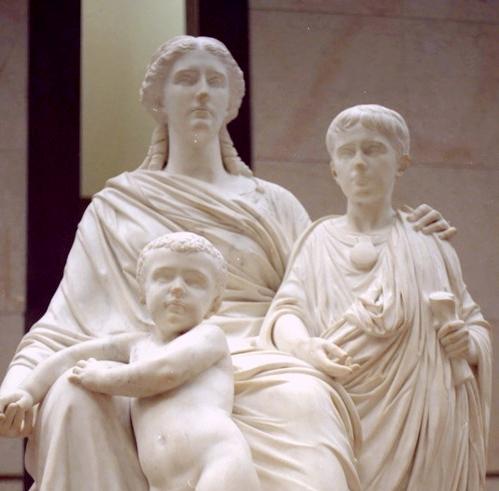
Figure 1.--Cornelia Africana (195–115 BC) was the second daughter of Publius Cornelius Scipio Africanus, the hero of the Second Punic War. She married Tiberius Gracchus the Elder. Cornelia was the mother of the Gracchi brothers, Tiberius and Gaius, who served as tribunes and attempted to enact land reform. They were both assassinated by patrician enemies of the reform. This is the work of French sculptor Pierre-Jules Cavelier (1814-94). While the clothing of Cornelia and Tiberius is quite accurate, Gaius' depiction is an artistic invention. A well-to-do Roman family would have never let a child go unclothed.
|
|
The Roman legions began the conquest of the Eastern Mediterranean in the 2nd century AD. They move north of the Rubicon. The Celts in the Po Valley were
conquered. They were judged inelible for Roman citizenship. The Second Macedonian War occurs (200-197 BC). King Philip V attempts to gain control of the Aegean, but was defeated by the Romans who proceed to 'liberated' the Greeks from the Macedonians. Thus Rome added Greece to their growing empire. The
Romans encountered in Greece a culture with literature and sculpture that surpassed their own. Greek art came to set the standard for Roman art. Roman sculptures were modeled on Greek forms. Rome enacted the Leges Porciae, a series of laws which granted all Roman citizens the right of appeal in capital cases, abolished the scourging of citizens, and summary execution during battle (199-184 BC). The coinquest of the Greeks brought Rome into contact with the Syrians. King Antochus III of the Seleucid Dynasty was defeated at Magnesia (190 BC). This added further possessions, including Asian Minor, to the Empire. Scipio the great victor over the Cartheginians died (183 BC). Another sumptuary law, the Lex Orchia, was enacted (181 BC). The war against King Perseus of Macedon known as the Third Macedonian War occurs (171-168 BC). The Lex Voconia was enacted which limited the land that can inherited by females (169 BC). The Battle of Pydna concluded the Third Macedonian War and King Persus' forces were routed at Pydna (168 BC). Macedonia ecentually became a Roman province. Another sumptuary law, the Lex Fannia, was passed (161 BC). The Greek philosophers were expelled (161 BC). Stoicism begins to become important among Roman intelectuals and influence the governing class in the mid-2nd century. The Third Punic War with Charthage was fought (149-146 BC). The war results in the complete defeat and destruction of Carthage. The Carthaginians were sold into slavery. The city is torn down and burned. A Greek revolt by the Achaean League was supressed and Cornith destroyed (146 BC). Large numbers of Greeks were enslaved. Many wealthy Romans used learned Greek slaves to teach their children. Rome as a result of the wars with Charthage and expansion into Greece acquired an extensive empire consisting of virtually the entire western Mediterranean as well as Greece, Asia Minor and a dominant position in Egypt, the granery of the Mediterraean. King Attalus III of Pergamum died and bequeathed his client kingdom to Rome (133 BC). It became the province of Asia. Rome's transition into a imperial state had many domestic consequences. Class conflicts intensifed, power struggles and assassinations occured, and slave rebellions. The severe class conflicts begin with the tribunes Tiberius Gracchus tribune of the plebs (133 BC). Gaius Gracchus tribune of the plebs (123 BC). The Gracchi brothers attempted to reform the Roman Republic to adjust to the new empire. The conservative patrician class resisted the reforms as a threat to their traditions and position. Gaius Gracchus is killed and his followers were executed by Opimius (121 BC). The Jugurthine War occured (112-105 BC). Marius became consul (107, 104-100). He ruled Rome through command of the army. Marius reorganized the Army (104 BC). A slave rebellion broke out in Sicily (104 BC). Marius campaiged in Gaul (103-100 BC).
Eastern Mediterrean
The Roman legions began the conquest of the Eastern Mediterranean in the 2nd century AD. They moved north of the Rubicon.
The Celts
The Celts in the Po Valley were conquered. They were judged inelible for Roman citizenship.
Macedonia
The Second Macedonian War erupted (200-197 BC). King Philip V attempted to gain control of the Aegean, but was defeated by the Romans. The war against King Perseus of Macedon known as the Third Macedonian War occured (171-168 BC). The Lex Voconia is enacted which limited the land that can be inherited by females (169 BC). The Battle of Pydna concluded the Third Macedonian War and King Persus' forces were routed Pydna (168 BC). Macedonia eventually became a Roman province (146 BC)
Greece
The Romans with the defeat of the Macedonians in the Second Macedonian War, procceded to 'liberate' the Greeks from the Macedonians. Thus Rome added Greece to their growing empire. The Romans encountered in Greece a culture with literature and sculpture that surpassed their own. Greek art came to set the standard for Roman art. Roman sculptures were modeled on Greek forms. A Greek revolt by the Achaean League was supressed and Cornith destroyed (146 BC). Large numbers of Greeks were enslaved. Many wealthy Greeks used learned Greek slaves to teach their children.
Syria
The conquest of Macedonia and Greece brought Rome into contact with the Syrians. King Antochus III of the Seleucid Dynasty was defeated at Magnesia (190 BC). This added further possessions, including Asian Minor, to the Empire.
Pergamum
King Attalus III of Pergamum died and bequeathed his client kingdom to Rome (133 BC). It becames the province of Asia.
Carthage
Scipio Africanus the great victor over the Carthagenians died (183 BC). The Third Punic War with Charthage occurs (149-146 BC). Even though Carthage has been humbled, Romans resented the city's commercial success. The war resulted in the complete defeat of Carthage in a campaign conducted by Publius Cornelius Scipio (Africanus Minor). The Carthaginians were sold into slavery. The city was burnedandleft in rubble.
Africa
Carthage becomes the Roman province of Africa. The Jugurthine War occured (112-105 BC). Consul Gaius Marius with Lucius Cornelius Sulla overthrows King Jugurtha of Numidia.
Gaul
After his success in Africa Marius campaigns in Gaul (103-100 BC). He defeats the Cinbri and Teutones in southern Gaul.
Western Mediterranean
Rome increased its grips in the colonies in the west seized from Carthage after the Second Punic War (202 BC). The Carthiginian colonies along the coast of the Iberian Peninsula were relatively easy to subdue. Controling the interior of the Iberian Peninsula proved a much more difficult undertaking.. Rome succeeded in pacifying the interiors of Corsica and Sardinia. Rome intensified in hold on the Iberian Peninsula. A series of campaigns there ended with the capture of Numantia. (133 BC).
Domestic Roman Affairs
Rome enacted the Leges Porciae, a series of laws which granted all Roman citizens the right of appeal in capital cases, abolished the scourging of citizens and summary execution during battle (199-184 BC). Another sumptuary law, the Lex Orchia, was enacted (181 BC). Another sumptuary law, the Lex Fannia, was passed (161 BC). The Greek philosophers were expelled (161 BC).
Philosophy
The varius Greek schools of philosophy were formally introduced into Rome during the mid-2nd century BC. Stoicism begins to become important among Roman intelectuals and influence the governing class in the mid-2nd century.
Empire
Rome as a result of the wars with Carthage and expansion into Greece and Asian Minoir acquired an extensive empire consisting of virtually the entire western Mediterranean as well as Greece, Asia Minor and a dominant position in Egypt--the granery of the Mediterraean. Roman power at this time became better established in the West than East. Rome's transition into an imperial state had many domestic consequences. Class conflicts intensifed, power struggles and assassinations occur, and slaves revolt.
Severe class conflicts begin in the late-2nd century and will finally result in the destruction of the Republic in the 1st century BC. The tribunes Tiberius Gracchus tribune of the plebs and Gaius Gracchus tribune of the plebs attempted to reform the Roman social system. The old patrician families and the newly enobleled wealthy plebian families combined to exclude all others from the higher offices (magistracies) and the Senate which now cntroled state affairs. This aristocratic ruling class now dominated Rome. Its members had become fabulously wealthy from the plunder of empire, but rather than sharing with the plebian class they arrogantly devoted themselves to untold luxury and resistance to the rise of plebians and a share in the bounty of empire. The admirably high standards and honesty of the early Republic was lost. In addition the small-scale peasant farmers found themselves unable to compete with the large estates worked by slaves obtained in Rome's wars. The indeopendent peasantry which had been the backbone of Rome was gradually being reduced to poverty, forcing them off the land and into the cities--becoming city rable, bitter and reduced to a magre living off a state dole. The Gracchi brothers attempted to reform the Roman Republic to adjust to the new empire. The conservative patrician class, however, resisted the reforms as a threat to their traditions and entrenched position. The Gracchus Brothers attempted to aleviate economic distress and pursue agraian reform and corn laws. Tiberius Gracchi were so popular with the Roman masses, that he ran for a second consecutive term for tribune which was unconstitutional. A group of conservative senators organized an armed band and attacked him in the Assembly. They killed him as well as 300 of his followers, beating them to death (133 BC). Gaius Sempronius Gracchus (Tiberius' younger brother) was elected tribune for two successive years Through the Assembly he challenged the power of conservative classes and the Senate. He also attempted the sweeping economic reforms his brother had promoted. Opposition between his followers and the Senate degenerated into street fighting and riots. He was killed in the rioting and his followers were executed by Opimius (121 BC). The sipression of the Gracchi in many ways began the decline of the Republic. Increasingly personalities began to dominate Roman politics and the major conflicts were no longer with foreign powers, but conflicts between Roman classes. Violence flared as never before in Roman life. Eventually Caesar would more efftively manage his popularity with the people. His assasinastion (44 BC) led to the end of the Republic and the principate under Augustus. Marius became consul (107, 104-100). He ruled Rome through command of the army. Marius reorganized the Army (104 BC). The Marian reforms would further weaken the Republic alreay being fractured by by rising class division. The Marian reforms opened careers in the Army to the landless masses and the established a standing army. This would lead to an armies loyal to their commanders rather than the Senate/Republic. The conflict between Marius and Sulla in the next century would rachet up the violence in Roman politics even further. A slave rebellion broke out in Sicily (104 BC).
We have developed some information on Roman children's clothing, we do not at this time have any details as to stylistic changes over time. as far as we can tell, Children's clothing was remarably unchanged during the Roman era.
Sources
CIH

Navigate the Children in History Website:
[About Us]
[Introduction]
[Biographies]
[Chronology]
[Climatology]
[Clothing]
[Disease and Health]
[Economics]
[Freedom]
[Geography]
[History]
[Human Nature]
[Ideology]
[Law]
[Nationalism]
[Presidents]
[Religion]
[Royalty]
[Science]
[Social Class]
[Bibliographies]
[Contributions]
[FAQs]
[Glossaries]
[Images]
[Links]
[Registration]
[Tools]
[Children in History Home]
Navigate the Historic Boys' Clothing Web chronological pages:
[Return to the Main Roman chronology page]
[Return to the Main chronology page]
[The 6th century BC]
[The 5th century BC]
[The 4th century BC]
[The 3rd century BC]
[]
[The 1st century BC]
[The 1st century AD]
[The 2nd century AD]
[The 3rd century AD]
[The 4th century AD]
[The 5th century AD]
[The 6th century AD]
Created: August 15, 2003
Last updated: 9:26 AM 1/28/2019