|
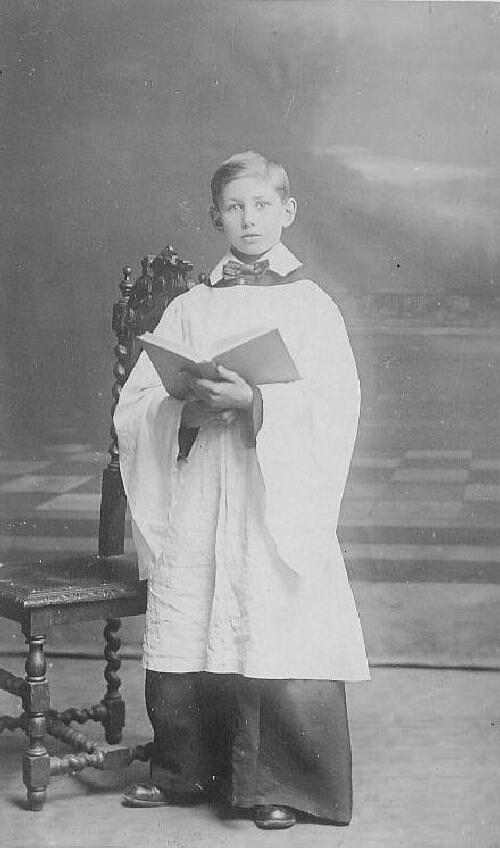
Henry VIII brought the Reformation to England. This was not his intention. He simply wanted to control the Church. His children Edward VI and Elizabeth II would turn Britain into a Protestant country. There remained a small and supressed Catholic minority. Over time this was increased with immigration from Ireland. Theology was a much disputed subject that was not fully resolved until the English Civil War and Glorious Revolution of the 17th century. While the Church of England is a Protestant Church, it retained more of Catholic liturgy than other Protestant Churches. The Church continued the traditions of altar boys. The Church of England in the 19th revived the tradition of boy choirs at the great cathedrals. We note children doing First Communions. We think these were Catholic children, but have little information at this time.
Britania was dominated by loosely related Celtic tribes. Religious rites were conducted bt Fruid priests. The Roman conquest (1st century AD) brought the religions of the Empire which overtime included Christianity. It is not well understood how widespread Christianity was established in Roman Britain, but there is reason to believe that it ws firly well established. The Legions departed and with them muh f the Roman elite (5th century). The invading Anglo Saxon tribes were pagan and drove the Romanized Celtic Britons to the westerly fringes of the island. This was a war of extinction. The Anglo-Saxons obliterated the Romanized Britons abd their cuture. Thus England was largely de-Chritianized. The Anglo-Saxon kingdoms obertime, however, were gradually converted. There were missoinaries from Catholic Ireland. Pope Gregory the Great dispached St. Augustine. under Archbishop Theodore, the Anglo-Saxons enjoyed a golden age of culture and scholarship before te arrival of the more pagan invaders--the Vikings. English missionaries, including Wilfrid, Willibrord, Lullus and Boniface would begin evangelizing their Saxon bretheran in Germany. Monastaries were oened throughout England and were a major force in the island's economy. Henry VIII brought the Reformation to England. This was not his intention. He simply wanted to control the Church. His children Edward VI and Elizabeth II would turn Britain into a Protestant country. The Angligan or established Church of England (COE) attempted to restrict the development of non-conforming sects. The Puritans objected to these restrictions. One group established the Plymouth Colony as awade of evading restrictions on their worship. The Puritans played a major role in the development of the United States. There remained a small and supressed Catholic minority. Over time this was increased with immigration from Ireland. Theology was a much disputed subject that was not fully resolved until the English Civil War and Glorious Revolution of the 17th century.
It is no accident that both democracy and capitalism developed at about the same time in England. Christianity played an important role in the development of both democracy and free market capitalism in England. It is notable that in the long annals of human history, that democracy emerged in very few socities. This was essentially the clasical world of Greek and Roman city states and European Chrustiant states, especially the Protestant states following the Reformation. The two are of course related. Thanks to the work of St. Paul the Jewish tradition was fused with the classical tradition creating the Christian ethic. The development of democracy in Christian Europe was not a straight line or a sure and rapid development. For more than a milenium, the Christian Church lent its institutional strength both to legitimize emperors and kings expousing absolute and divine right rule. The first challenge to absolutism came from the nobility. The pattern varied from country to country. In England the result was the Magua Carta and the development if parliament. The Roman Church while supporting divine right rule was opposed to absolutism because the popes had their own temporal and institutionl interests. (The Orthodoc Church had fewer problems with absolutism.) This opposition to absolutism provided a basis in England and Western Europe in which democracy could grow. The turning point was the Reformation.
Roman Catholics, Anglicans and Lutherans still generally supported the divine right of kings to rule although they differed on the authority of the papacy. This meant that they generally denied the right of resistance to the king by his subjects. Luthir was horrified when the peasants rose up in Germany. One of the many different streams of Protestantism was Calvinism which formed the basis for Presbyterianism. Calvin was not a believer in what we call democracy today, but he did believe in limitation on monarchial rule. He thought that there were mutual obligations of the ruler and the ruled and that the individual had the right if not the obligation to resist any interference by state or hierarchy between him and his God. Radical Calvinists were at the heart of Puritan Protestantism. While not the established Church, Puritans resisted the attemps by the Stuarts to impose French and Catholic styled absolutism. The resultuing Civil War and Glorious Revolutions toward the development of democracy in England. And this was the tradition brought to the American colonies.
Christianity also played a key role in the development of capitalism.
Many English boys have served as altar boys in church services. The Anglicn Church of England (COE) is a Protestant Church, but it retained more of Catholic liturgy than other Protestant Churches. Theologically except for the break with Rome, the COE was closer to the Cathloic than Luther's Protestant church. And of course the Catholic Church did not completely disappear in England. And after thePotato Fmine in Ireland actually grew as a result of Irish immigrants. The COE continued the traditions of priests, although they were allowed to marry. They also continued the tradition of altar boys. Each church had a group of boys serving as altar boys. We do not know a great deal about COE altar boys. Nor so we know if there are substantial differences between the altar boy experience in the COE and Catholic church. Hopefully English readers will provide us some information here. Basically COE altar boys were dressed like Catholic altar boys. They both wore an alb with a surplice. I'm not sure about the red scull caps Catholic altar boys used to wear. This required a considerable effot on the part of the boys. Normally the Church would plan various activities as a way of thanking the boys for their effort. We note the altars boys from St. Mary Magdalen Church in 1928 on a picnic and swimming party.
Many countries of Western and Central Europe have a long tradition of church boys' choirs dating back to the midevil era. One of the longest traditions is that of the English boy choirs. While the English cathedral choir is a readution umported by the early church fathers, the realtive stability in England has mean that the English boy cathedral choirs are some of the oldest in Europe. Historical references date from the end of the 6th century AD. English boy choirs often perform in liturgical choir robes. This is due to their association with the Anglican cathedrals and their primary purpose of providing choral music for church services.
A British reader tells us, "Regarding the age of Confirmation and First Communion. I think it is true that Roman Catholics take their First Communion at a preteen age. Confirmation is less important for Roman Catholics. Anglicans in the United Kingdom are Confirmed much later. Confirmation Classes at my school were conducted at 12-13. My daughter were confirmed at a similar age."
I do not yet have any information on First Communion suits in England during the 19th Century and early 20th Century. While a largely Protestant country, there is a substantial Catholic minority. Since Tudor ays the Catholics have been an opressed minority, only winning their civil rights in the 19th century. Cathloics have been largely working class Britons. Many Irish immigrated to Britain beginning with the Potato Famine of the 1840s. Thus money for an expensive First Communion suit was not always available. The Government eventually began to support Catholic schools and continues to do so today. Many schools had the boys use part of their school uniform for First Communion. An English contributor to HBC recalls in the 1960s getting a new short pants suit for First Communion. Some of his school mates got long pants suits. He does not recall boys wearing white suits, but all the girls had long dresses.
Since the fall of the Roman Empire, the Church throughout England became associated with education. This was at first to educate the clergy. Over time the Church became more deeply involved with education. The great European uiversities were founded by the Church. As commerce quickened merchants and artisans in the cities wanted their boys educated. Chruchmen were often involved in the schools which developed. The Protestant Reformation was a great boon to education because Prtotestant teaching required individual Bible study requiring literacy. The churches thus became centers if education although this varied from country to country. In the British Isle the Scottish kirk (church) led the way in what would eventualy become public education. The Anglican Church of England was slower to play the same role. And the English Goverment also lagged behind Germany in establishing a public school system. The Industrial Revolution began in England (mid-18th century). Modern writers blame this and child labor with the fact that poor children did not attend school and learn to read. This is simplistic because poor children in rural areas also worked and did not attend school. The idea that child labor brgan with the Industrial Revolution is absurd. Actually it is only with the Industrail Revolution that people began to see child labor as a social problem. Now it may be that there was a lesser degree of exploitation in rural areas, but we have not seen authors addressing his issue with actual data. Nor are we aware of any decline in litracy as a result of the Industrial Revolution. The first Sunday schools appear to gave focused more on literacy for poor cgildren than religion, although we do not have much information on this. Journalist Robert Raikes (1725-1811) founded the first Sunday School for poor city children in a kitchen (1780). This is generally seen as the foundation of the Sunday School Movemnent. It was located in Gloucester. His idea to teach poor children on Sunday when they were not working. He wanted to provide baic instruction in reading, writing and arithmetic. Bible study was not his intention when he launched his school. He hired a Mrs. Meredith to teach the children. The concept proved popular and spread. Baptist deacon William Fox suggested including Bible teaching in the new Sunday Schools. Raikes liked the idea and agreed. Thus, the first Sunday Schools from an early point combined both secular and religious teaching. At the time English churches were sending missionaries to far flung points of the Globe so it made sence to ensure that English children were both schooled and learned the Gospel. At the time there was no public school system or laws regulating, let alone pohibiting, child labor. The National Sunday School Union (NSSU) was founded (1802). Slowly as the Government began to restruct child labor and promote public education, sunday schools became more of religious education faccilities than schools teaching reading. The first modest attemps to regulare child labor came in the same year that the NSSU was founded (1802). Christian philanthropists desired to both ensure children learned to read and become God-fearing Christians. As Saturday was a workday, this cpuld only be done on Sunday. Ans as the public school system grew Sunday began to focus increasingly on Bible study and religious education. By the time Raikes died (1811), over 400,000 people, mostly children, were attending Sunday Schools in Britain. And hundreds Sunday Schools had opened in the United States. The American Sunday schools mostly emphasized Biblical instruction over swecular reading and writing. This was because from an early point, Amerucan states founded free public schools for all children, including girls. American churches were vocal advocates for free public schools and evenntually complulsory education. This varied sonewhat regionally. Almost all denominatiins adopted the idea of Sunday schools.
Marriage in England became involved in the religious controversied. A major wedding law for a century was the
The Civil Marriage Act (1653). The Puritans under Cromwell pushed it through Parliament. The Act required a civil ceremony before a justice of the peace after presentation of the certificate from the parish register which showed thst "banns" had been published. Age was a major concern. If either partner was under 21 years of age, parental consent was required. The wedding ceremony influenced by the Purtitan ethic was a simple formula to be repeated by the man and woman. This was accompanied by hand fastening. Wedding rings were strictly forbidden as too ostentous. A century later, mahor changes were mase as aesult of the Hardwicke Act (1753).
It required weddings, except formembers of the royal family, to be performed only after publication of "banns" or issuance of a license. They had to be conducted only during the morning hours (8:00 to 12:00).
The couple had to use an Anglican Church or chapel where the service was conducted by an Anglican clergyman. Two or more witnesses were needed and a register hadc to be kept . Parental consent was required if the "banns" had not been published.
Many modern wedding traditions originated in England during the Victorian era. This is certainly the case in the United states. This is a rather interesting phenomenon as politically throughout the 19thb century, Ameroca was often at odds with Britain. Despite this, America was culturally and economically closely tied to Britain.
As far as we can tell, the roles for children (ring boy, flower girl, and pages) are all of English origins during the Victoirian era. We believe that England also affected weddings on the Continent, but here, long established national traditions are more prominant.
We do not yet have much information about English weddings at the this time. We do note Derek North who was a page boy in a society wedding about 1930.
England is a largely Christian country. The Church of England (Anglicans/Episcopalians) is the established church and a Protestant denomination. There are several other Protestant denominations. The Puritans were a disenter group who helped found America. The Methodists developed in England and played a major role in the English abolitionist movement. The Pesbeterians devloped from Scottish origins. Another denominations were the Baptists, but they proved more important in America. There are also English Cath;lics. They included English who refused to acceot the Protestant Church of England during the Reformation. Since the Potato Famine, large numbers of Irish people, mostly Catholic, have emigrated to England. While most English people are culturaly Christian. Church attendance is very low and large numbers of English people are nom-believers. America and Britain are similar in various ways, but this is a basic difference. A small Jewish population established itself in England during the Middle Ages. They were eventually expelled in the late- Middle Ages. but gradually returned in small numbers. Larger numbers arrived with the Russian anti-Semetic campaigns (late-19th century). As a result of the British Empire, small numbers of colonial subjects emigrated to England. Most of the emigrants from South Asia were Muslims. Substantial numbers of people from South Asians emigranted after World War II when the British began to dissable the Empire. Because of the high birth rate of these comminities, the populations have been increasing. As a result, Islam has become an important English religion. And unlike Christians, the Muslims are often quite fervent in their religious convictions. They have also shown a disinclination to meld into the larger English society and culture.

Navigate the Boys' Historical Clothing Web Site:
[Return to the Main English activity page]
[Return to the Main religious country page]
[Introduction]
[Activities]
[Biographies]
[Chronology]
[Clothing styles]
[Countries]
[Essays]
[Bibliographies]
[Contributions]
[FAQs]
[Glossary]
[Images]
[Links]
[Registration]
[Tools]
[Boys' Clothing Home]