|
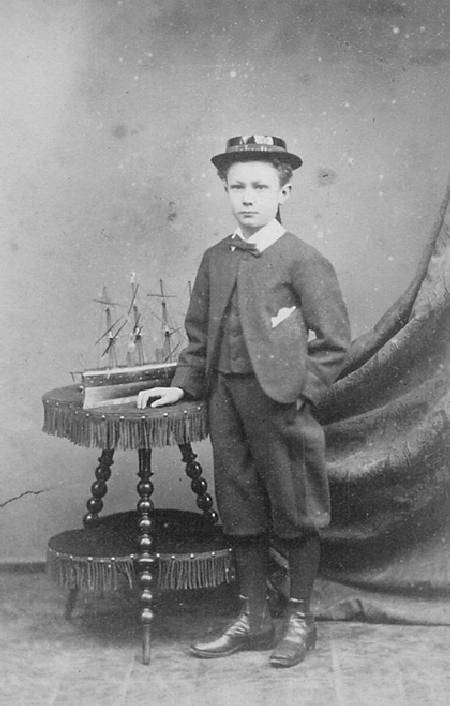
English boys have worn a wide variety of suits, in fact originating many of the basic suit styles. Here by suit types we are referring to primarily to the coat or jacket styles. Many if not most boys' suit styles originated in England, including the sailor suit, the Eton, and Norfolk suits as well as several other lesser known styles. The blazer was also an English creation, although it was a coat without matching trousers. Sailor suits used naval middy blouses. The Eton suit had a small, short jacket. The Norfolk suit had a jacket with strap-like belts and strap vertical vent-like elements. Suits with cut-away jackets were popular in the mid-19th century for younger boys. Older boys wore sack suits and these gradually became the sandard style. We also see suits that button at the collar. Boys wore both single and double breasted suit jackets. Single-breasted coats have been the major style worn by boys in England. Here the prevalence of the blazer and single-breasted jacket in school uniforms were probably a major factor.
The blazer was an English creation. Although it was a coat without matching trousers, we include it here because the most important part of a suit is the jacket and the conventions for wearing it are similar to that of a suit. The blazer was developed as smart summer wear for affluent Britons as was soon adopted by the country's elite Public Schools. Most of the blazers we see English boys wearing are school blazers. They were not only for school, but also rather than suits when away from school often worn for family outings are occasions like church. Even today the blazer is primarily associated with school uniforms. The developing preparatory schools also adopted the blazer. They were viewed as somewhat informal wear. More formal atire would be an Eton suit and hard collar. Blazers were worn with soft collars and the school tie. School blazers added great variety to the sometimes dowdy school uniform. State secondary schools like the private schools had highly varied and colorful blazers through the 1950s. Most have, however, for reasons of economy shifted to a plain blaack blazer with the school crest. Private schools, both primary and secondary, continue to have uniforms with coloful blazers--although less varied than in the 1950s and 60s. The school crest is worn on the left chest pocket. Often it is the initials of the school, but some schools have logos or elaborate crests. Assesing English schools can be quite complicated because of the many different types of schools. Most schools, except for primary schools, adopted blazers as part of the school uniform. There were even some primary schools, especially Anglican primary schools that had blazers. There were, however, many variations among schools and over time concerning blazers. The blazer is worn somewhat differently in England than America. A blue blazer was a standard item for American boys, but less so for English boys because it was seen primarily as a school garment.
Suits were primarily done with matching jackets and pants. Not all suits, however, were done with jackets. We see some blouse suits. These were suits done with matching blouses rather than jackets. We are entirely sure about the chronology, but we primary see them in the second half of the 19th centry. Most of the ones we have found so far date to the 1870s, but that is just a prelininary assessment based on a relatively small number of images. These were not the normal blouses done with light-weight shirting material. Styling varied, but ghey were mostly colar buttoning with long sleeves. Instead these blouses were done in the same color and heavier fabric used for the pants. There may also be matching detailing such as stripes or embroidery. There may also be coordinated buttons. These were suits done for younger boys up to about 10-11 years of age, but again we are just beginning our assessment.
We also see English boys wearing suit jackets that buttoned at the collar. We do not always see the actual button because of collar and neckwear, but the collar-buttoning style is apparent. We believe this was a very common style, although we are not sure just when it first appeared. Almost certainly it was in the mid-19th century. We are not sure about the origins, but it may have been influenced by military styles. It certainly was in America, we are less sure about England. Fashions generlly developed in England and France and other European countries and spread across the Atlantic to America. This may not be the case here. A lot of American collar-buttoning jackets were done with military styling like brass buttons. We do not see this in Britain, but we also do not have many English images from that period. Our very limited English archive from this period makes it difficult to assess with any percission. We have been able to archive very few English Dags (1840s-50s) and Ambros (1850s). We first begin to see the collar-buttoning jackets when CDVs become available in quantity (1860s). From this period we do have a cinsiderable archg=hive and information on English fashion trends. We see collar buttoning jackets throuhout the rest of the 19th century and into the early-20th century. They were a boys' style. We do not see men wearing them. This seems to have been a style common for low-cost suits fir boys, but we also see them done in velvet and thus there was not a sharp social class divided at play here.
Suits with cut-away jackets were popular in the mid-19th century for younger boys. We see them being commonly worn in the 1860s and 70s by younger school-age boys. We have little information about the 1850s. They may have been worn in the late-50s. We see cut-away jackets in the 80s, but mostly as part of Fauntleroy suits. Our information is still limited, but we think that they were most common in the 1860s and the early 70s. The jackets were worn open except for some kind of connecting tab at thectopnnear the collar. Mosdtvewere made ewithout collars. The jackets varied a great deal. Some were veet plain without any ornamentation. We note other jackes thsat were heavily decorated with emroidery. Vests (waistcoats) were common, but not compulsury. They were worn with all kinds of trousers, knee pants, bloomer knickers, and long pants. They suits were worn with a variety of accompanying clothing, including headwear, shirts/blouses, neckwear, and hosiery. Because of the chronological time involved, we mostly noice boys with small collars and neckwear. Out archieve is too limited at this time to develop these topics with much certainty.
The Eton suit had a small, short jacket. The Norfolk suit had a jacket with strap-like belts and strap vertical vent-like elements. It was in England that the Eton suit was created in the late 19th century and it was in England that the Eton suit reached its greatest popularity. For two generations a well dressed English boy was expected to wear an Eton suit for formal occasions. Many boys also wore them as a school uniform. The haracterisyically short jackets have been worn with a variety of pants.
We see younger boys wearing a variety of fancy juvenile suits. We use this term for want of a better term at this time. We think these suits were popular in the mid-19th century. Our assessment is limited because we have few photographic images from the 1840s-50s. We know much more about the 1860s-70s. The suits came in many different styles. Most of the styles probably originated in Britain or perhaps France. Many were button-on suits. The waist buttons are often hidden by a cloth waist belt. Stripes were commonly employed in the detailing. The styling on the jackets might be repeated on the trousers. The suits with stripes might have been called sailor suits even though they do not have the iconic "V" fromt blouse. Early sailor suits were quite varied and the traditional styles we now know were not well established. We are not sure what other terms may have been used for these suits in comtemporary catalogs. Thdy seem to have been worn by boys 4-8 years of age, although this is only a rough assessment at this time. These suits were worn in many other European countries and America at about the same time. They were worn with knee pants or bloomer knickers. Some were worn with long pants that often look like long knee pants.
Fauntleroy suits were widely worn in England, but I believe the style was less popular for working-class families than was the case of America. In adiition, the convention of sending boys off to boarding prep schools at about 8 years of age was becoming established in the 1880s--the same time of the Fauntkleroy craze. Few boys after they left for their prep schools would condescend to wear Fauntleroy suits when they came home. There also were some stylistic differences. Wide brimmed sailor hats were less common as were ringlet curls. Also we have noted many English boys wearing bloomer knickers rather than kneepants as were most common in America. One major difference is that English boys less commonly wore the huge bow tied in elegant classic bows. English suits often had knicker pants and the boys did not often wear the boot-like high button shoes. Rather English boys more commonly wore patent leather shoes like pumps, strap shoes, and buckle shoes even before the turn of the century.
Frock coats were a major style throughout the 19th century. It was mostly an adult style. We do not see maby boys wearing it. It was a standard man's suit style with a very long jacket, often knee length. Most were done with double-breasted coat. With the turn-of-the 20th century and the increasing popularity of the sack suit, the frock coat began to be seen as old fashioned.
The Norfolk suit was created in England and no where was it so widely worn as is England. The Norfolk jacket is modeled after the hunting suit worn on the estate of the English Duke of Norfolk in the early-19th century. (One source said 18th century, but I don't believe I have ever seen Norfolk jackets in 18th century paintings. Sportsmen on the Duke's estate reportedly first wore what we now call the Norfolk jacket. Guests included the Prince of Wales who became King George IV. Tradition has it that the Prince himself ordered a garment from his tailors that would allow him to swing a gun with grater ease that the tightly fitting, tailored suit jackets he wore. The Norfolk desisign had a loose, comfortable fit accross the soulders and chest. The jacket also had box pleats, two in the front and one in the rear which opened and clothes as the individual swivels about. It was a rare garment that was specifically designed rather than adapted for use in sports. It was also a waist-length jacket, We are not sure if it originally had matching trousers. Knickerbocker pants becme associated with it. We have less access to English clothing catalogs than in America, but we note many avialable British photographs showing boys commonly wearing Norfolk jackets. HBC has noted it being commonly worn in Britain during the late-19th century. It was initially an adult style for country wear, but became a popular styles for boys. Early images show vertical pleatrs. We do not begin to see the horizontal belts until the 20th century.
HBC believes that Rugby suits were being marketed in England at the turn of the century. No information, however, has yet been obtained on this style in England. We believe te term was used more in America and Australia.
Sack suits were a style appearing in the Victorian era in the mid-19th century. It was created by the French (late-1840s). It was a great sucess and was rapidly adopted by the British and Americans as well as the rest of Europe. It quickly became the standard boy boys' suit. It was seen as a more informal style for men than the standard frock suit that men were wearing. It was widely adopted for the workplace by working and business wear for both skilled workers and clerks (1850s). Sack suits became standard for general purpose outdoors wear (1860s). It was not intended as a boys' outfit. but it was adopted by British public (private boarding) schools which were very influential in setting boys' fashions at the time. The term is misleading. Sack does not refer to the jacket being oversized, loose, or baggy as the word sack/sacque suggests. Rather it appears to refer to
the cut--the straight-hanging drape of the back. The was formed of only two pieces which were cut basically straight down. The frock coat which was still stanndard at mid-century was constructed from four curved pieces often including hidden pockets in the tails. The same was true as the related tail coats, morning coats, and frocks. The term sack coat was not universal. Trade magazines used fifferent terms, but sack coat was the most common. It is not commonly in used today as it is so misleading. A bettern modern term is probably something like a standard suit. The simpler two piece construction made in more adaptable for mass oroductionj -- meaning the ready-made trade. The jackets varies in different ways, including the length of jacket and sleeve, number and style of pockets, collar, lapels, and the cut of the front. We see close cuts, full cuts, single breasted, and double breasted jackets.
Sailor suits used naval middy blouses. Few garments are more associated with boyswear than the sailor suit. While no longer commonly worn, the sailor suit was worn by boys in Europe and America for a century. The origins of the boys' sailor suit or vague. Apparently it was in England during the first quarter of the 19th century when someone had the inspiration that boys should wear sailors' trousers. (Some sources suggest an even earlier appearance of the sailor suit as boys' atire, but as yet I cannot confirm that.) It is not known who first conceived of the idea. It is known with certainty, however, who popularized it--Queen Victoria. It was a clevely designed effort to associate the monarchy which had declined in popularity with the most popular institution in Britain--The Royal Navy. The result was a stunning success for the monarchy and a fashion that dominted boyswear like no other style for a century. The English styles have influenced naval uniforms around the world. Most of the sailor suits worn by boys have been influenced diretly or indirectly by British uniforms. Despite the popularity of the sailor suit with the Royal Navy, as a boys outfit, it was more popular in America, France, Germany, and other countries than in England.
Skeleton suits werecfthe first outdits mean specifically to be worn by boys. Before the skeleton suit appeares in the late-18th century. boys wore dresses like their sisters and after breeching scaled down outfits based on the styles their fathers were wearing. Skeleton suits seem especially popular in England and even mentioned in Dickens novels, like David Copperfield. we see more boys wearing skelton suits in England than any any oyher country. In the era before photofgraphy, g=hiwecer, this is diffucult to assess wih any balidity. Many portaits of children painted in the late-18th and early-19th century show the boys wearing skeleton suits. Often brothers were dressed in identical suits. There do not appear to have been specific national styles, but rathr atyule worn by boys from well-to-do familes across western Europe and the United states. We are not yet sure about the age range. we see a lot of younger boys wearing skeleton suits, but believe they were fairly common for pre-teen boys.
Navigate the Boys' Historical Clothing Web Site:
HBC

[Return to Main English suit page]
[Introduction]
[Activities]
[Biographies]
[Chronology]
[Clothing styles]
[Countries]
[Photography]
[Topics]
[Bibliographies]
[Contributions]
[FAQs]
[Glossaries]
[Images]
[Links]
[Registration]
[Tools]
[Boys' Clothing Home]
Created: 5:15 PM 9/16/2007
Last updated: 2:03 AM 8/25/2021