
German Boys Clothes: Family Trends--The 1930s
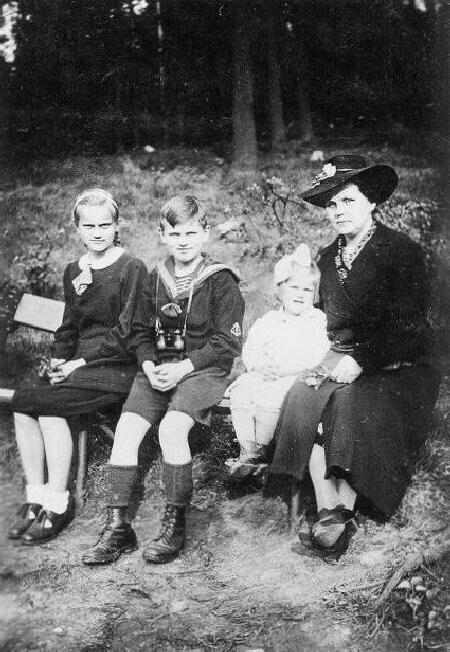
Figure 1.--Here we see a German family out for a country walk. Notice the boy's binoculars. Does this mean that they were bird watchers. The snap shot, presumably taken by father, looks to have been taken in the 1930s. The boy wears a traditionally styled sailor suit.
|
|
Younger German boys in the 1930s might wear button-on outfits as well as suspender or H-bar shorts. We see German boys still wearing sailor suits, especially in the early 1930s. Sailor suits were especially common in middle-class families. The Schiller collar was still popular in the early 1930s, but the popularity declined later in the decade. It was popularity the dress children in the family alike. Long stockings were very common for cold-weather wear for both boys and girls. After the NAZI take-over we see more and more children wearing Hitler Youth uniforms. We see relatively few family photographs with the children in their uniforms. We are not sure if that was uncommon or stemming from the fact that after the War many families destoyed photographs that would suggest a NAZI connection.
Dr. Abraham Pins (1865-1943) was a respected Jewish veternarian who practiced in Hoexter. This is an area in central Germany. Hoexter is located on the east bank of the river Weser. Today it is part of eastern North Rhine-Westphalia. It is about 50 km north of Kassel.
Here we see Frau Pins with their two sons Jacob (12 years old) and Rudolph (9 years old) in 1930. The two boys are shown in the photo wearing the popular sailor suits with short trousers and black long stockings. Jacob and we assume Rudolf attended a Catholic school in Hoexter. Hoexter was too small for a Jewish school, but did have a synagogue. Jacob does not recall any problems until the NAZIs seized power (1933). As part of the campaign against Jews, a major effort was to make it impossible for Jews to make a living.
Jacob managed to emigrate to Palestine (1936). We are not sure about Rudolf, he may have been to young to go with his brother.
After the outbreak of World War II, the NAZIs gradually deported German Jews east. Many went through Theresienstadt. Dr. Pins and his wife were eventually sent to the Riga Ghetto which had been largely emptied by shooting the Latvian Jews that had been concentrated there. One source suggests Dr. Pins and his wife perished there in 1944. As the Ghetto was reduced in 1943, they probably died in that year. Jacob once in Palestine disregarded his father's advice, studied the art of woodcuts, becoming a world-famous artist in this medium and also assembling an important collection of Japanese
woodcuts, actually founding a museum to house and display them. He donated his collection to his native town of Hoexter.
Here we have a middle-class Berlin family on an outing to a city park. It presumably is a weekend, probably Sunday as father is with the family. It is a small family, only one boy who wears a short pants sailor suit with long stockings. The sailor suit suggests a middle-class family, but the boy's close-cropped hair by the 1920s was not common for middle-class families. We at first thought that this portrit was dated about 1930, but we think the late 1920s may be more likely. Again notice the small size of the family.
Here we see a German boy at home with his father during the late 1920s or early 30s. We are not at all sure about the radiator in the rear. The boy wears a traditionally styled sailor suit, a very popular style in Germany at the time. Note how the boy's sailor scarfe is tied. This tight tie and white string was the most common approach. Many images archived on HBC are interesting, but some are especially poignent. It is often not exactly clear to me just why some of these images are especially powerful images. The snapshot here is one of those images. I think it captures the atmosphere of a German middle-class family.
Here we seee a family with tennis equipmet in their back yard. No provinance comes with the photograph, but we elieve it is a German family in the early 1930s. Terecare three children, two boys and their sister. One boys wears a short pants sailor suit, apparently with shoes but no socks. The girl wears a blouse and skirt.
Here we see three generation in a German family in a photograph presumably taken by the father. Grandmother, mother, sand two children are photographed by the family car. The women are holding onto the girl, but the boy stands apart from the group. It is quite a car, a sporty convertable. The family is standing in the driveway with their home in background. The car tells us that the family was affluent. Most German families at the time did not have cars. The children look about 11 and 14 years old. The girl wears a white dress. The boy wears a shirt with a Schiller collar, a light-colored double-breasted jacket, dark short pants, light-colored knee socks, and low-cut shoes.
Here we see what looks like a staunchly proper German middle-class family dressed up in the winter. All we know about the photograph is that it was dated 1931. We would guess that the family is going to church on sunday, howevder, we are a little confused by the sled. The parents looked dressed for church rather than a winter outing as do the children. The boys wears his chool cap, an overcoat, short pants, and black long stockings. The overcoat and especially black long stockings are not what might be excpected for a normal ski outing, but precisely what would be expected for formal church wear. But that leaves the question of taking the sled to church. Perhaps the children were allowed to do thst as a treat. Notice how high the sled is. My sled about 1950 was not nearly as high off the ground. Seeing images like this and how experienced with cold winter weather the Germans were, one can only wonder how it is possible that the Wehrmacht would have found itself deep in Russia during the dead of winter fighting the Red Army in light summer uniforms. Given the age of the boy here, he was likely one of those soldiers.
Here we have a snapshot portrait of the Kipping family in 1933. We are not ure if it was taken in the Spfing or fall. This of course was a very significant date, Afolf Hitler was appointed chancellor (January 1933). And many changes began very rapidly. Arthur Kipping and his wife Johanna are pictured with their two sons (11 years) and (14 years). This means that both woyld be drawn into the malstorm of World war II. The older boy is pictured in his Hitler Youth uniform. Membership was not yet mandatory. This means that he was attracted to the movement or his father was imoressed wuith th movement. Note that the father does not wear NAZI pin, so the former may be the case. This is confirmed by gthe fact that the younger boy has not yet joined. He wears brown cotton long stockings with the uniform--not officially part of it but commonly worn in the early years and in rural areas because German boys often wore long stockings to school with their ordinary civilian clothes. His younger brother is in normal school clothes with a sweater (with zipper at the neck), short trousers, and black long stockings with woolen anklets as additional protection. Anklets were often worn over long stockings in Germany as part of a sporty, hiking style that was widely popular with both boys and girls. Arthur Kipping, the father, was a teacher and educational director in his region, Hermsdorf, Germany. Presumably the parents were enthusiastic supporters of Adolf Hitler. Hitler and the NAZIs were very suspicious of the school system when they seized power. An early priority was to NAZIify Germany's very fine educational establishment. An orduinary teacher could usually keep nhi post by keeping his mouth shut and go along with instructions. This was not th ase with school administfrators. they were subjected to greater scrutiny and expected to denonmstate a dfre of commitment to the Party. It is posible that having his son join the HJ was a step taken to build his NZI credentials.
Virtually every German family had a photograph album in the family parlor. The pgotographs of course varied, dependong on the interest of the family. Not every family had a camera, but most did. Generally it was the father who was the photographer. The ablums in the 1930s were generally composed of heavy [aper on which photographs were pasted. They were mostly snapshots taken by the father, but other items may be included as well. The album her seems to be entirely fmily snapshots. The first page includes some writing describing the contents, but we can not yet make it out. Hopefully it will tell us the name of the family and the name of the village. We can make out the date, February 26, 1934.
We have an undated portrait of a German family probably taken in the mid-1930s. The mother wears a plain, but smart dress. Hr husband a fashionable suit. The boys wear matching blue sailor suits with only vert minor differences. The younger brother wears a short pants suit with dark long stockings. We are not sure about his older brother.
We have found an interesting snapshot from rural Germany. Unfortunately we gave no information about the photography. We think it is very clear that the photo comes from a rural community or small village. We do not know, however, just where the snapshot was taken or when. We would guess that it was taken in the 1930s, but the early 40s is possible. Here dating rural images is complicated because people in the country often do not wear more easily dated fashionable clothes. Nor do we know the name of the family. We think the snapshot is of three children, we believe brothers, and their parents, but the lack of clarity makes even this difficult to assess. All three boys appear to be wearing short pants with long stockings. The tallest boy on the left seems to be a bit taller than his father who seems to be wearing plus-fours or perhaps boots. The figure on the right looks like a boy to us because of the boy's short haircut and short trousers, although he seems to be wearing a white sleeveless garment comparable to apinafore. We seen boys commonly wearing these garments in Germany during the 1920s and 30s, but not the 40s.
Here we see an extended family portrait of the Hildebrandt family in the 1930s. They are celebrating the Konfirmation of Friedel Hildebrandt. We believe Friedel is the girl in the center of the photograph. She seems to have flowers in her lap. The two boys in the fronr wear short pants suits with long stockings. They may represent formality as it does not seem cold, but also not a summer portrait. Notice the older boy wears long underwear under the brown long stockings. We get a good idea of the clothing worn by the different age groups. Friedel seems to have several older brothers,
We note a photograph of a large German family gathering. We are not sure what the occassion was, but we can guess that it was the anniversary of the family patriarch. There is one extra elderly lady, perhaps an aunt the family is caring for. It looks like the family including several sons and daugters have come hime to honor their eldely parents bringing along the grandkids. The home looks to be in a village and reflects the rural or small town origins of the increasingly urbanized German population. The youngr children are all in the front. The boys mostlywear sweaters rather than suits. They all wear short pants and mostly knee socks. One boys looks to be wearing a new pair of Lederhosen, suggesting this may be in Bavaria.. One somewhat older boy seems to be wearing a long pants suit. One girl wears a long dress, reflecing the importance of the event. The photograph is undatd, but we would gues it was taken in the mid-1930s, surely before the War.
This photograph of the Gompertz family was taken in Gelsenkirchen, Germany during 1930. We see the parents, Leo and Betty Gompertz and their three boys, Albert (8 1/2 or 9 years old), Fred (nicknamed Fritz, 6 1/2), and
Rolf (2 1/2). They were a middle class family with a comfortable life. The father had a furrier business in Gelsenkirchen. The two older boys seem to be almost identically dressed in short trousers with long stockings and blouses with open collars. Fred (and probably Albert also) are probably wearing Leibchen (notice the hose supporter clasp which shows on Fred's upper leg). The Gompertz family were Jewish and suffered under the Nazis. Albert had some bad experiences in school. His gym teacher wore a Stormtrooper (SA) uniform. The music teacher had the children sing song with anti-Semrtic lyrics like "When the Jewish blood runs from our knives. He and other Jewish children had to be constantly alert to avoid being being up by Hitler Youth boys. The family managed to avoid major trouble until Kristallnacht. After that they managed to escape to America through the Netherlands. Most of their relatives in Germany perished in the Holocaust.
This portrait shows what looks like a prosperous, middle-class city family-- the parents and their teenage son. Unfortunately the portrair is not dated. We would say that it was taken in the early or mid-1930s, although the late-1920s is possible. The interesting aspect of this portrait to us is that how similar the parents are dressed to American adults. This portrait could have easily been taken in the United States--except for the sailor suit the boy is wearing. American boys did wear sailor suits, but only younger boys in elementary (primary) school. American teenage boys did not wear sailor suits, although we see girls of all ages wearing sailor outfits.
Here we see a large German group. We are not sure what the group of children and adults is. They are set up in front of a non-descript building. It is clearly not a school portrait. The only possibility we can think of is a family reunion. Perhaps the occassion is a new-born baby. The children are all placed in front, dressed up in their best clothes for the occassion. We see the boys wearing sailor suits, a fauntleroy suit, a striped blazer, and a doublr-breasted suit. The post-card back portrait is undated. We would guess it was taken in the mid-1930s.
Family snapshots provide some glimeses of a summer being enjoyed by an unidentified German family. The psnapshots are unidentified, but it looks to us like they were taken in the mid-1930s, although the late-30s/early 40s is quite possible. The photographs give a good idea as to how German children dressed during the 1930s. We see boys wearing short pnts, Lederhosen, and rompers. Girls wore light-weifgt dresses. The boys wore a kind ofcasual strap shoe. The Lederhosen suggest they may have klived in Bavaria. Lederhosen at the time were primarily worn in Bavaria.
A rather charming domestic scene in 1936 Germany--Mother washing dishes with her two children, approximately 8 and 10, helping to dry the dishes. I wonder if this could have been a propaganda photo to show how happy family life was under the Nazi Third Reich. It seems almost too good to be true. But the clothes of the children are very accurate, historically speaking. The boy wears suspender short pants, long brown stockings, obviously held up with a Leibchen and Strumpfhalter (bodice and garters), and what look like sandals. He seems to be wearing a checked shirt that buttons only half-way down his chest with a white shirt underneath of which only the white collar is visible. I'm not sure I've ever seen before this wearing of two shirts--a white one underneath a patterned one. At first I thought the shirt just had a white collar, but we can see the patterned collar underneath the white collar, so there must be two shirts. Is the boy protecting his white shirt by wearing a colored shirt on top? Notice the very short hair cut with bangs. (The British would call this a short back and sides.) The girl wears a pinafore over a dark blouse and the same kind of dark brown stockings as her younger brother. Notice the girl's blond hair in pigtails, a common German style. The kitchen seems to be typical of a middle-class German home in 1936.
Here we see a German family out for a country walk (figure 1). Notice the boy's binoculars. Does this mean that they were bird watchers. The snap shot, presumably taken by father, looks to have been taken in the 1930s. The boy wears a traditionally styled sailor suit. A reader writes, "I cannot tell for certain, but the boy's stockings look as if they are long stockings that were folded down due to warm weather." Yes that is difficult to tell. There is no knee cuff. Is it possible that they were turned down all the way to the ankles. Another reader writes, "I wondered about these socks myself. They look like dark grey woolen knee socks to me, but they have slipped down just a bit to look
like three-quarter socks, and there is a bulge on the left leg under the sock which could have been caused by a bandage of some sort. But it's a bit puzzling. The socks are too early to have any elasticizing in the tops, and they have slipped down the boy's leg a little bit since, apparently, he wears no garters."
This is a very interesting family image taken in the living room of what looks like a lower-middle class family. Unfortunately there is no inscription on the back identifying the family or dating the image. Even so, it illustrates some very important trends in Germany at the time. We believe the snap shot was tken in the late 1930s, although the early 40s is possible. The family consists of a mother and father with two teenage sons--both Hitler Youth boys. The couple to the left may be an older son and his wife. Note the phonograph and rafio in the background. This was the family's livingroom and the phonograph and radio were a very important part of it. The sparseness of the room suggests a lower-middle class or working-class family. They seem to be having some kind of celebration. As the one boy is at the center of the photograph, perhaps it is his birthday. The fact that he has a HJ armband on, suggests he is dressed up a bit. Note that both boys are wearing their HJ uniforms, even for an intimate family celebration.
August Heissmeyer was a a decorated World War I soldier and an early recruit to the NAZI Party and became a geberal in the Waffen-SS. His wife, Gertrud Scholtz-Klink, was an eminent NAZI herself--the "Reich Women's Leader" ("Reichsfrauenführerin"). They were the perfect NAZI family. There werec10 children, including children from earlier marriages. We do not know a great deal about the children. A photograph shows the older boys dressedin the uniform of one of the NAZI Party boarding academies. The girls and youngest boy are all dressed in brighly colored tracht. A nephew was a SS doctor who planned and crried out medical expeiments on children at the Neuengamme Concentration Camp near Hamburg. Both were tried as war criminals. It is these family photographs of ardent NAZIs surrounded by their adoring children thatare perhaps the World War II images that are most difficult to understand.
This is a portrait of what looks like an ordinary middle-class famoly. All we know for sure is that the portrait was taken in 1938. We see wjat looks like mother and grandmother with two children. We are not sure where father is. Normally we might speculte that father took the photgraph, but this looks like a studio portrait. The children are dressed somewhat informally as was becoming more common. The little girl looks to be about 5 yesars old. She wears a blouse and a very high-set suspender kilt. We sususpect it was ought in a large size so she could wear it several years. She has a hair bow. Her older brother lloks to be about 11-12 years old. He wears an open-collar shirt, similar to, but smaller than a Schiller collar. He also wears a sleeveless sweater, short pants, and knee socks.
This photograph is similarto ones being taken all over Germany during the late-1930s. The snapshot is undated, but looks to us to have been taken in the summer of 1938 or 39. We see two parents with their proud son outfitted in his Hitler Youth uniform. They look like a middle-class family. Most younger boys we think were excited about joining. Older boys had more varied opinions. This boy seems very pleased with himself. He is a DJ boy who is probably 10 years old and joined the movemnent a few month earlier. Or perhaps he is 11-years old and been in the FJ for a year. Notice his knife. How the boys felt can often be read on their faces. This boy is obviously proud and pleased weith himself. The parents are hearder to read. The boy looks to be their only son so their dreams and future happiness are all wrapped up in this boy. Some parents were committed NAZIs and would have thus been pleased. Many others had not supported the NAZIs, but were impressed with the results of NAZI rule. Both ending the Depression and regaining international stature. (Few Germans were aware that NAZI economic policy was unstainable and had Hitler not chose war in 1939, the country faced a massive economic crisis.) And there of course were others who were anti-NAZIs, but were prident enough to keep quiet. Just where these parents fell into this spectrum we do not know. They do not look too pleased. But of course even ardent-anti NAZIs could have predicted what was about tgo occur. And this boy is old enough that he would probably be in the War at the end.
This looks to be a comfortable middle class family which was photographed in 1939. We have little informationa bout the family, but the father looks to be a professional or businessman. His wife is stylishly dressed and she had carefully outfitted their three sons in identical outfits, colorful folk blouses and H-bar suspender short pants.
HBC

Navigate the Boys' Historical Clothing Web Site:
[Return to the German 20th century family page]
[Return to the Main German family page]
[Introduction]
[Activities]
[Biographies]
[Chronology]
[Clothing styles]
[Countries]
[Bibliographies]
[Contributions]
[Essays]
[FAQs]
[Glossaries]
[Images]
[Links]
[Registration]
[Tools]
[Boys' Clothing Home]
Navigate the Boys' Historical Clothing German pages:
[Return to the Main German page]
[German choirs]
[German movies]
[German royals]
[German schools]
[German military schools]
[German youth groups]
Created: 10:52 PM 3/16/2006
Last updated: 1:42 AM 2/21/2018