
German Boys' Clothes: Garments--Costumes (Faschingskostüm)
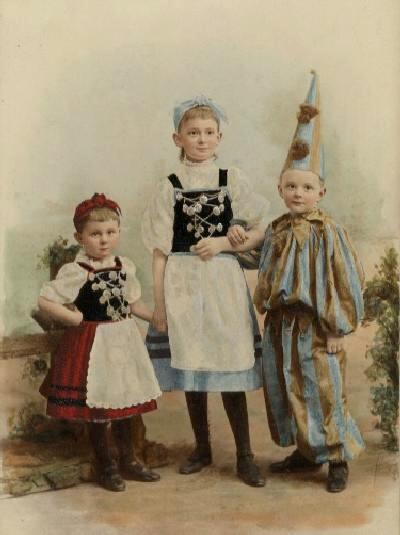
Figure 1.-- Here we assume are some brothers and sisters dressed up in folk costumes and a harlequin outfit. I am not sure about the children's gender. The children in the girls' folk costumes look rather like boys. The portrait was taken by Axtmann in Plauen. I'm not sure about the date, but would guess the 1900s.
|
|
We have noted German boys wearing a variety of costumes. We do not know much asbout this subject yet, but we have begun to collect some basic information. Folk dress or tracht appears to have been especially popular in the late 19th and early 20th century. We suspect that these costumes may have been more popular with the parents than the children. We notice quite a number of German children outfitted in elaborate folk outfits for formal portraits. We are unsure to what extent the children wore these outfits other than for the portraits. Did they attend church or go to parties in these outfits. We notice various other costumes such as clowns or harelequins. One costume we do not notice is that of Red Indians, yet we know that German children loved to play Indian. We do nogtice German children by the 1920s with a few items of Indian costume. This appears to have been plasy costume items rather than the more elaborate costumes in which the children were costumed. Hopefully our German readers will provide us more information about costume trends and conventions.
We note two kinds of folk outfits in Germany. One were elabotate outfits that children in cities were dressed. We think that this was primarily for formal portraits. Folk dress or tracht appears to have been especially popular in the late 19th and early 20th century. We suspect that these costumes may have been more popular with the parents than the children. We notice quite a number of German children outfitted in elaborate folk outfits for formal portraits. We are unsure to what extent the children wore these outfits other than for the portraits. Did they attend church or go to parties in these outfits. We also notice folk outfits being worn in rural areas and villages. This often occurs during festivals.
Fancy Dress
As in other European countries, we notice people, both adults and children, in fancy dress costumes during the 19th abd very erarly-20th century. We do not yet know a great deal about fabcy dress in Germany.
We notice various other costumes such as harlequins which might be translated as clowns. The two are different. American clows are strongly influenced by the circus experience. The harlequin evolved from a character commedia delle'arte. They were commonly dressed in colorful costume with multi-colred tights done in a diamond pattern. The harlequin characters often have a wooden (play) spear or magic wand. I think this was normally a costume for a boy. The children's harlequin costumes are generally done differently, with long bloomer like pants. Again these harlequin costumes do not look like play costumes. We do note several examples of children wearing them. Some of the costumes worn by children varied from country to country. These harelequin portraits were also popular in several countries. We note them in several different countries, including America, Britain, Canada, and we think France as well. Most of the harlequin outfits seem to be portraits taken before World War I. They are much less common after the War.
Renaissance
One fancy dress option was Renaissance outfits. We notice a CDB portrait of two unidentified boys. One boy even has a lute to complete the outfit. In this case we are not sure if these are fancy dress outfits or theatrical costumes.
Play Costumes
Play costumes were primarily a 20th century innovation. They were much less elaborate and less expensive outfits than the primarily 19th century fancy dress outfits. Play costumes might be done b\by mother. In some cases the children actually created them. Ad they were often incomplete, perhaps just an item or two of clothing rather than a complete, elaborae costumne.
Red Indians
One costume we do not notice is that of Red Indians, yet we know that German children loved to play Indian. We do nogtice German children by the 1920s with a few items of Indian costume. This appears to have been plasy costume items rather than the more elaborate costumes in which the children were costumed. Hopefully our German readers will provide us more information about costume trends and conventions. A reader writes, "Westerns were popular in Germany especially stories. Karl May was the best known writer. He wrote many stories with Native Americans as protagonists. Even Hitler was a fan even though May was a pacifist." Yes, Hitler's sister relates how they played Red Indians as children. Her brother Adolf always insisted on being the chief. That would have been in the late 1880s.
HBC

Navigate the Boys' Historical Clothing German pages:
[Return to the Main country costume page]
[Return to the Main German garment page]
[German art]
[German catalogs]
[German choirs]
[German movies]
[German royalty]
[German school uniforms]
[German youth groups]
[German sailor suits]
[Lederhosen]
[Ethnic]
[Tights]
[Long stockings]
Navigate the Boys' Historical Clothing Web Site:
[Return to the Main Costume page]
[Introduction]
[Activities]
[Biographies]
[Chronology]
[Clothing styles]
[Countries]
[Bibliographies]
[Contributions]
[FAQs]
[Glossary]
[Images]
[Links]
[Registration]
[Tools]
[Boys' Clothing Home]
Created: 4:15 AM 12/2/2005
Last updated: 12:49 AM 3/30/2010