
German Boys' Clothes: Suit Chronology
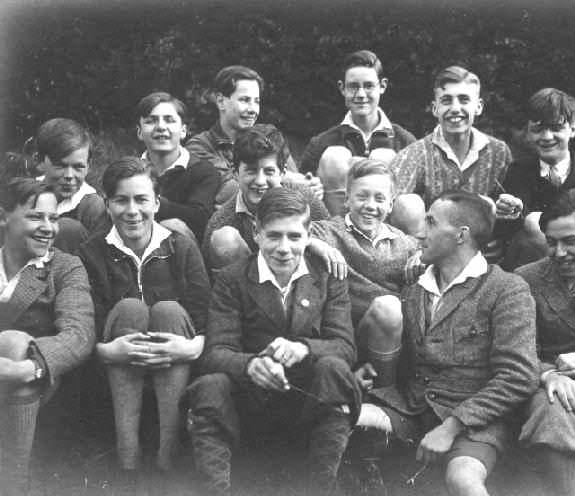
Figure 1.--We believe this unidentified photograph is German, probablu taken in the 1930s. Note that several boys wear casual jackets or sweaters rather than suit coats. We suspect that it is a school group as the boys all look to be younger teen agers about the same age. They wear both short pants and knicker suits. The adult youth leader for some reason wears a short apnts suit with a Bavarian jacket.
|
|
We are just beginning to develop a reasonable chronology of German suit styles, but we have begun to collect some information. We have noted both single and double breasted suits. Some boys wore Bavarian styled jackets instead of suit coats, but we are not sure about the chronology yet. Boys in the late 19th century and early 20th century commonly wore kneepants. After World War I, shortpants became increasingly common. Older boys might wear knicker and then long pants suits. We note that by the 1930s that some boys had begin to wear casual jackets rather than suit coats. Also boys common wore open necked shirts rather than ties with their suits, except for formal occassions. After World War II (1939-45), short pants suits were still common, but by the 1960s many boys began wearing long pants suits, but suits were becoming less common--reserver parimarily for special occassions.
Limited Information
We do not yet have sufficent information to develop a reasonable chronology of German suit styles, but we have begun to collect some information. We do not yet have sufficent information to develop a reasonable chronology of German suit styles. We have noted both single and double breasted suits. Some boys wore Bavarian styled jackets instead of suit coats, but we are not sure about the chronology yet. We have begun to select some information on specific centuries.
We still have limited information on German 19th century suits, although we have begun to develop some information. Some information is available from paintings and drawings for the erly 19th century. Photography was developed in France during 1939. We have not yet managed to find images of German boys during the 1840s and 50s. Daguerreotypes and other early hotographs do not seem as common in Germany as is the case in America. And we have not yet been able to archive any. Beginng in the 1860s with CDVs we do begin to find subtantial numbers of photographic portraits. German boys in the 19th century almost always wore suits for studio portraits. We are just beginning to assess these images. We see boys wearing cut-away jackets with both long pants and bloomer knickers. We note many boys wearing collar-buttoning jackets. We also notice a variety of lapel jackets. Norfolk jackets were a popular style.
Suits were still commonly worn by German boys in the first half of the 20th century. We see them in studio portraits. Of course in the 20th century we now have snapshots to add to the photograophic record. The styles were much more uniform than in the 9th century as most were mass produced in the ready-war trade. Younger boys in the very early 20th century wore collar-buttoning jackets. We also see single- and double breasted dack suits. These became the dominant style after Wotld War I. Boys commonly wore knee pants in the early-20th century, but short pants became more common after the War. Older boys might wrar knickers. Afyter Wirld War II, short pants were still common. Wearing suits declined sharply in popularity during the 1950s. And by the 1960s more boys were wearing long pnts, especially with suits. By the late 20th century, suits were only worn for formal occassions and almost always with long psnys, except for very young boys.
HBC

Navigate the Boys' Historical Clothing German pages:
[Main German suit page]
[German choirs]
[German scouts]
[Hitler Youth]
[German school uniforms]
[German royalty]
[German sailor suits]
[Lederhosen]
[Ethnic]
[Tights]
[Long stockings]
Navigate the Boys' Historical Clothing Web Site:
[Introduction]
[Activities]
[Biographies]
[Chronology]
[Clothing styles]
[Countries]
[Topics]
[Bibliographies]
[Contributions]
[FAQs]
[Glossaries]
[Images]
[Links]
[Registration]
[Tools]
[Boys' Clothing Home]
Created: October 9, 2002
Last updated: 9:12 PM 6/19/2011