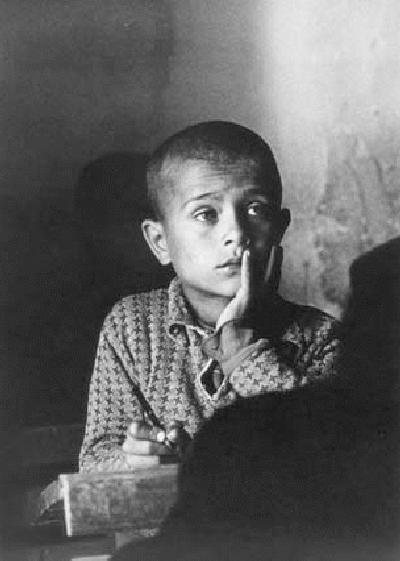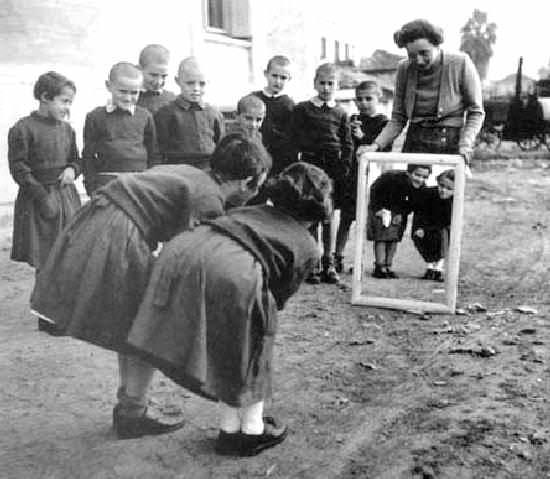
Figure 1.--This photograph by Voula Papaioannou was probably taken in the 1950s. The children appear to be wearing school smocks, some with sweaters over them. |

|
Photography was first perfected in France. Greece was one of the first foreign countries that French photographers visited to take their pictures. In 1839, Joly de Lotbiniere took the first photographs of Acropolis. Since the mid-1800s Greek photographers started making their own pictures. The first was Filippos Margaritis who also photographed the
first royal family of Greece. During the first half of the 20th Century there were numerous photographers in Greece that they had studios in the big cities. Almost all prosperous families of these times had their portraits and childrens portraits taken. The most famous
photographer of early 20th century is Periklis Diamantopoulos. In the 1910s through the 30s many photographers started to take pictures of important events such as Wars, demostrations and other political events. At the same time many Greek photographers started taking the first artistic pictures.
Photography was first perfected in France. Greece was one of the first foreign countries that French photographers visited to take their pictures taking technology. The alure of the archeological sites of ancient Greece was the allure. Joly de Lotbiniere took the first photographs of Acropolis (1839). French photographers also began setting up studios. We habe notbyet found examples of early formats like Dags and Ambros. We are sure they exist, but they do not seem to be very common so that we can archive them for our site. The first Greek photographs we have found are cabinet cards. Since the mid-1800s Greek photographers started making their own pictures. The first Greek photographer we have found is Filippos Margaritis who also photographed the first royal family of Greece. Our 19th century archive is very limited. We believe this reflects the fact that Greece is a small country and rather poor. We do begin to msee Greek phoographers active in the Middle East, especially the Ottoman Empire which at the time included Turkey, the Levant, Egypt, and Libya.
We have a much larger archive of 20th century photograpghy. More studios were opened and we begin to msee snap shots. Some economic improvement meant that more Greeks could afford studio prtrtaits and familynsnapshots. During the first half of the 20th Century there were numerous photographers in Greece that they had studios in the big cities. Almost all prosperous families of these times had their portraits and childrens portraits taken. The most famous photographer of early 20th century is Periklis Diamantopoulos. In the 1910s through the 30s many photographers started to take pictures of important events such as Wars, demostrations and other political events. At the same time many Greek photographers started taking the first artistic pictures. We see many active city studios during the inter-War era (1920s-30s). Many of the studio portraits were done as postcard back prints. Family snapshots were also done as postcard-back prints. The 1940s was a disaster both with World War II invasions and the civil war. This of course affected the photographic industry and the photographic record. Greece began to recover in the 1950s. The economy was aided with increasing access to the European Union. Greece became a full member (1981). The resulting prosperity means that the Greek phothraphic industry becomes more like that of the prosperous countries of Western Europe.
Greece was not involved in the research and experomentation that ent into the development of photography. This was mostly dome in France and Britain and subsequently the United States and later Germany. The first successful photographic process was invented by Louis Daguerre in France (1839). Mostly French photograpgers brought the techbimigy to Greece (1840s). Pierre Gustave Joly de Lotbiniere (1798–1865, Canadian) and Joseph-Philibert Girault de Prangey (1804–1892, French) were among the first such individuals to open studios in Greece (1840s). Philibert Perraud (1815-1863, French), came to Greece and taught photography to Filippos Margaritis (Greek painter). He is this bekkieved to be first Greek photographer. He ooened a Daguerreotype studio in (1853). Soon there were akso tun-tyoe and anbrotypr studios. . Oetros Moraites opened his photo studio in Athens with Athanasios Kalfas (1859). They became the leading Athens studio, photographing the Royal family and other luninaris (1870s) As in other countriesm the ambrotype came to dominate photograohy for several decades, meaning CDVs and cabinet cards. It is at this time that several Grrrl photographers began setting up studios in the Middle East. One spirce reports that there ere 21 studios in Greece (1891). Most American cities of any size had more than that amount. At the rurn of the 20th century, the Kodak Bownie revolutiomized photograpy making the snapshot possible (1900). This brought the snapshot out of the photpgaphic studio. Many of these various photographic prints were undated, but the characteistics of the cards and prints can help date the photograph.
Some of the most noted Greek photographers have been women.
Elli Seraidari (known as Nelly's) is by far the most famous Greek photographer of all time. She was born in Aidini of Asia Minor Asia (link here) and after 1922 she went to study photography in Germany. Her teachers were the most famous German photographers of the era. In 1924 she came to Greece where she opened her studio. From 1927 until the outbreak of World War II Nelly's travelled throughout Greece, documenting the entire panorama of Greek
life. Nelly's went to the opening of the 1939 World exposition of New York where the Greek pavillion hosted a big collage of her photographs and stayed there as a self exiled artist when the NAZIs invaded and occupied Greece in 1941. She returned to Athens 27 years later.
Nelly's received numerous international awards (in Brussels, Canada, Stockholm, Paris etc). Perhaps her most famous work are the nude photographs of the Russian ballet dancer Nicolska
in Parthenon of Acropolis (1920s) and the cover of Life Magazine (December 16, 1940). Nelly's also took a lot of childrens portraits in her studios in Athens and New York. She also photographed a lot of boys working as shepherds in rural Greece. One of her most
important album is the one with the life of refugees (mainly the children)
of Asia Minor in Greece (1925). Nelly's left a body of work which remains exemplary from both an artistic and a technical viewpoint and which represents a valuable legacy to the photographers of today.
Dimitris Charisiadis is one of the most important photographers of the 1940-60s era in Greece. He used to work as a chemist but quit his work for the profession of photographer. Throughout his professional career, Charissiadis maintained a personal interest in photographing Greek towns and landscapes and everyday life in agricultural and
urban surroundings, believing that mankind was "the most interesting subject
in the world". The predominantly American influences that can be detected in his work, are the result of his association with foreign photographic agencies and his familiarity with international trends in photography. His photographs were highly acclaimed abroad and took part in many international expositions like "The family of man" in The Museum of Modern Art, New York (1955) and also "Greece by eleven photographers" (Chicago, 1957) and "The face of the European" (Munich, 1959). Like Nelly's, he also worked for Life Magazine. Charisiadis was laterawarded with the bronze medal of FIAP. In the photographs of Charisiadis we can see a lot of children almast always wearing their ordinary play or working clothes, rather than dressed up for a formal portrait.
Voula Papaioannou is a very significant Greek photographer. She was one of the pioneer women photographers in Greece and a contemprary of Nelly's. She began working as a photographer during the 1930s, concentrating at first on studies of landscapes, monuments and archaeological exhibits. She photographed the Greek-Italian War (1940-41) and after the end of World War II, the Greek Civil War (1948). Her most important work is the hand made-4 copies only "To lefkoma tis peinas" (The album of starvation) with photographs of emanciated children in Axis (German and Italian) occupied Greece during World War II. The images of children in Axis occupied Greece (along with those of the concentration camps) are
among the most shocking we have ever seen. She later portrayed a realist view of the post war Greece. Voula Papaioannou's work represents the trend towards "humane photography"
that arose as a result of the abuse of human rights during the war. Her camera captured her compatriots' struggle for survival with respect. She is often compared to Lewis Hine and his work of working children. All her unpublished photographes were donated by her to
Benaki Museum in Athens.
Four photographers in 1946 opened a studio under the name "United Photoreporters" in Athen's Stadiou Street. Dimitris Floros (1911-1970), Evripidis Martoglou (1898-1978), Dimitris Fotinopoulos (1912-1993) and Dimitris Triantafyllou (1915-1996) all worked together under this name. Along with a couple of others, they are considered as the most important photoreporters in Greece. Their work consisted of photographs of political subject,
demonstrations, royal family and simple people, sports, popular entertainment and others. With their cameras they managed to capture the essence of post-World War II (1946-66) Greek life. As one might think, they often photographed children. Children of the royal
family, or rural, poor, rich and bourgeois families, pictures that portrayed the fashion of the times. In 2001 a book with selected photographs of children was
published by Potamos Editions in Greece. United Photoreporters - N.E. Tolis
Collection, Ta paidia, 1946-1961 (Athens: Potamos, 2001).
Giannis Patmios was born in Samos Island in 1906 and went to Athens in 1927. He first exposed his work in the International Exposition of Thessaloniki in 1938. He worked for full 42 years and took part in 462 International expositions in 37 countries with 94 of his photographs. He won several medals and awards along the years of his course. He is considered as the most hard working of all Greek photographers.
Kostas paraschos was born in Kydonies in Minor Asia in 1912. After the Greek-Turkish war his family settle in Athens. He worked as a journalist in numerous Greek newspapers and as a reporter in many countries abroad. During the World War II Occupation, Paraschos
managed to secretly take about 1,000 pictures in the streets of Athens with at the risk of his own life. The authorities were suspicious of street photography. From 1957 to 1970 he was the editor of "I diaplasis ton paidon" the most prominent magazine for school children. His photographic work was published in two albums: I katoche: photografika tekmiria (Athens: Hermes, 1973) and I apeleftherosi (Athens: Hermes, 1983).
Dimitris Tloupas began working in 1940 in his hometown Larissa in Thessaly region. He first presented his work in Larissa in 1951 and since then he traveled around Thessaly region documenting the life and the customs of the people a well as the landscapes of the region. The characteristic of his photography is the harmony between the people and their surroundings. His work is often presented in exibitions in Greece and abroad and he is considered as one of the most important Greek post-war photographers. One of his most inspired works was the photography of monks and monasteries of Meteora.
|
Giorgos Boukas portraits are considered among the best ever taken in Greece. Nelly's considers him as the most important pre-War Greek photographer. Boukas studied photography abroad and came to work in Athens since the 1920s. He did mainly portraits of a classical style. His way of work was, however, very progressive. It is while worth to quote Pavlos Nirvanas (a Greek writer who also wrote essays on the aesthetics of photography). "The little boy is fully dressed in velvet and silk clothes and has an unatural expression for his young age. Boukas approaches the boy and in front of the amazed parents takes off the shoes and silk clothes. He leaves the boy wearing only a white shirt. The parents expect to set their chid for a picture but instead he gives the boy a toy-dog and lets him play on the
carpet. Then he photographs the boy in a natural expression."
There are many other Greek photogfraphers that have made important contributions. Some of these include: Periklis Diamantopoulos, Spyros Meletzis, Thanassis Tsagris, Kostas Balafas, and Kostas Manos.

Navigate the Boys' Historical Clothing Web Site:
[About Us]
[Introduction]
[Activities]
[Biographies]
[Chronology]
[Clothing styles]
[Countries]
[Girls]
[Theatricals]
[Topics]
[Bibliographies]
[Contributions]
[FAQs]
[Glossaries]
[Images]
[Links]
[Registration]
[Tools]
[Boys' Clothing Home]
Navigate the Boys' Historical Clothing Greek pages:
[Return to the Main Greek page]
[Return to the Main European countryphotography page]
[Return to the Main photographer page]
[Greek choirs]
[Greek folk costumes]
[Greek movies]
[Greek royals]
[Greek schools]
[Greek youth groups]