|
HBC has not yet had the opportunity to develop much informtion on Sweden. Sweden was one of the scandnavian countries. It was settled by the Northern Germanuc tribes. And in the medievl era an important center of Niking activity, but unlike Norway and Denmark, ficused in the east rather than the West. They had a major impact in the Rus. Sewden was an important military power as Europe emerged from the medievl era. At times it dominated both Norway and Finland. Sweden became Protestant and eventully adopted a neutral foreign policy. There was an imprtant Swedish migration to america. It managed o stay out of both World War I and World War II. Boys' fashions in Sweden during the 19th Century were similar to other European countries. This began to change somewhat in the 1920s, it was just to cold to wear short pants during the winter like the British and French. Some boys wore shorts with long over-the-knee stockings. Older boy wore knickers and long pants were more common than in more southerly countries. Since the 1970s there has been little difference between the clothes worn in Sweden and other countries.
Sweden occupies the eastern and largest proportion of the Scandinavian Peninsula. It is the fourth-largest country in Europe, although much of the territory is in the far north and less productive area of the continent. The country slopes eastward and southward from the Kj�len Mountains which is a major feature of the Norwegian border. The peak elevation is Kebnekaise at 6,965 ft (2,123 m) in the north or Lapland. North of Kebnekaise are mountains and many lakes. To the south and east are the country's central lowlands. Further south are fertile areas of forest, valley, and plain which is the productive agricultural land of Sweden. Sweden's rocky coast is broken by bays and inlets and a large number islands. The largest are of Gotland and �land. To the west is the Gulf Bothnia which separates Sweden and Finland. To the southeast is the Baltic Sea. To the southwest is Denmark. There are no land borders, but the sea channels between Denmark and Sweden are only a few miles wide. The Kattegat/Kattegatt is a 30,000 km2 sea area bounded by the Jutland peninsula in the west, the Danish straits islands of Denmark to the south and the provinces of V�sterg�tland, Scania, Halland and Bohusl�n in Sweden in the east. The narrow �resund strait now spanned by an imposing bridge is the sea border between between Sweden and Denmark. The Copenhagen Convention of 1857 made the Danish straits between the North Sea and the Baltic Sea an international waterway.
The eastern half of the Scandinavian Peninsula during Roman times was inhabited by two great Germanic tribes, the Suiones or Swedes in the north (Svealand) and the Gothones or Goths in the south (Gothia). These tribes, although united in religious belief were generaly at war with each other. Previous to the 10th century, details of Swedish history or obscure. Not until about 980, are historians sure about the names of Swedish kings. Frankish misionaries in the 9th century began teaching christianity which slowly became established. Olaf Skutkonug ruling from 993-1024 was the first Swedish to become a Christian. One of Sweden's most powerful monarchs was Eric IX ruling from 1150-60. He became the patron saint of Sweden. Eric invaded Finland, forcing Christianity upon the conquered population. Eric was killed in an attack by Denmark, initiating an extended series of wars between the two countries. The power of the nobility grew in the 14th and 15th century as fedualism became the dominate force in the country as the power of the monarchy wained. A historic painting shows the wife of King Magnus Ericson, Queen Blanka, with her son Crown Prince Eric. The nobility deposed King Albert in 1388 and offered the crown to Margaret, Queen of Denmark and Norway. The Union of Kalmar united the crowns of the three Scandinavian kingdoms in 1397. The union endured for more than a centurry, but was characterized by constant tension between the Danes and Swedes. King Christian II invaded Sweden in 1520 to enforce his authority. His brutal methods, including the execultion of Stockhom nobels, caused a rebelion led by Gustavus Vasa in 1521 who became Gustavus I of an independent Swedish Kingdom. Gustavus I became an hereditary monarch and severly limited the power of the nobility. Luthernism was established as the state religion. Parts of Estonia requested protection frpm Sweden. After a war with Poland, Sweden acquired all of Estonia. Gustavus Adolphus, generally considered the greatest Swedish king, suceeded to the throne in 1611. He expanded Swedish territory during wars with Russia and Poland. His intervention in Germany helped to ensure the victory of protestant forces during the Thirty Years War. Charles X-XII achieved spectacular military successes, but Swedish military power was finally broken by Peter the Great of Russia at the Battle of Poltava in the Great Northern War. Sweden was in fact a small country and did not have the capacity to compete with a huge state like Russia. Charles XI had also tried to strike at fundamental Swedish political standards and impose an absolutist regime. As in most other European countries, the 16th and 17th centuries in Sweden were characterized by the emergence of an increasingly efficient and centralized administration.
Sweden in the early 19th century was still largely an agricultural country, untouched by the Industrial Revolution. Sweden had no tradition of primogenature. Over generations family farms were divided into smaller and smaller parcels. This put increasing pressure on the land and marginal land was tilled. Despite the agricultural situation, the population continued to grow. Swedish bishop and
poet Esaias Tegne'r explained why the population expanded so significanly, "peace, vaccination and potatos." Some parishes reported the population tripling. As a result, the population of tenant farmers and landless laborers increased enabling large landowners to obtain labor at low cost and reducing many Swedes to abject poverty. This helped fuel large numbers of Swedes to emigrate, many to the United States. Along with the emigration, Sweden after the mid-19th century began to industrialize. Important changes and reforms finally led Sweden into the industrial era. Sweden for many decades achieved the highest economic growth rate in the world, only exceed by Japan in many decades. As a result, Sweden transforned itself from one of the poorest to one of the richest countries in the world (measured in terms of GDP per capita). Beginning in the 1970s the rate if growth and the relative wealth of Sweden has declined. A major factor here has been the growth in government.
We do not yet have much chronological information on Swedish clothing. We have virtually no information on the 19th century. We do have some information on the 20th century. The information we have gathered so far suggests that Swedish children wore basically the same styles that were popular in other European countries at the time. Sailor suits in particular were a popular style. Most boys at the turn of the 20th century wore knee pants. Long stockings were commonly worn, in part because of the climate. Children often went barefoot in the summer, especially in rural areas. British and especially German styles appear to have been influential. Sweden is located in northern Europe and this of course afected fashion and this impact has not changed over time. We notice knickers persisting in Sweden longer than in many other European countries, although by the 1950s they were commonly worn almost to the ankles. A French reader writes, "I remember a visit to Sweden when I was about 14 years old in June 1958. We stayed at a nice hotel in Stockhom. I remember noticing that the children were dressed rather the same as adults. The boys mostly wore long pants which was still not the case in France at the time."
A Swedish reader tells us that in the early 20th century that British and German boys' clothing styles were very influential in Sweden. Since World War II, American styles have become increasingly important. Televisions and the movies appear to have been important factors.
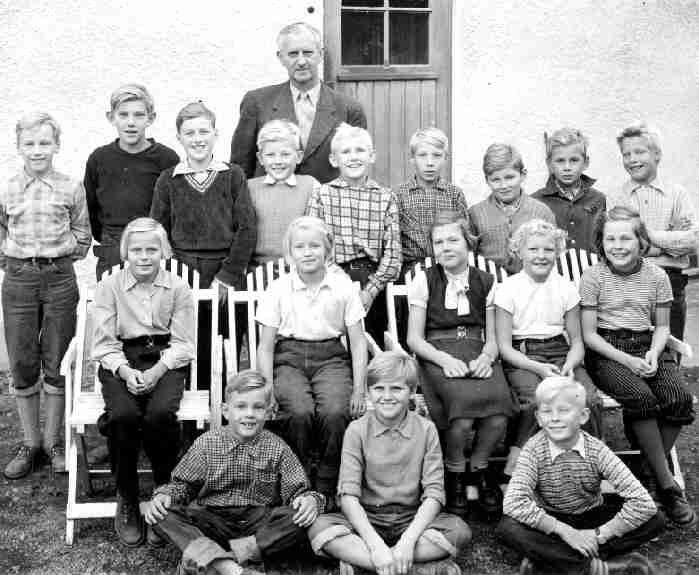
Our information on Swedish boys garments is very limited. We note many boys wearing military-style caps to school. Sailor caps were also worn. Many Swedish boys wore sailor suits as in the rest of Scandinavia, but perhaps not as common as in Denmark. The time line seems generally compaeable throughout Scandanavia. At the turn of the 20th century, kneepats were common. We see boys in the 20th century wearing knickers and long pants. Short pants were worn diring the short Summer season, but were not as common as in some other European countries. We rarely see Swedish boys wearing H-bar pants. Swedish boys beginning in the late 1930s begin wearing plaid shirts, which I suspect may be due to the influence of American
cowboy movies. Boys beginning about 1945-50 began wearing T-shirts and jeans. That would seem to be another American influence. I'm less sure about how the American fashion impact arroved in Sweden other than the movies. Knickers were cimmonly worn in Sweden, even into the 1950s. Then in the 1950s you see boys in blue jeans. For some reason they liked to roll up the cuffs until their jeans were knicker length, maybe because that's a good length for trousers when one does a lot of cross-country skiing. Long stockings were common in the early w0th century.
There are two different types of Swedish folk costumes. The first type is the traditiinal clothing of the Lapps/Sammi in the north. Lapland lies in a geographically interesting position. Lappland is a vast area of northeastern Europe, largely within the Arctic Circle. It is part of the northernmost region of Fennoscandia known as the 'Calotte'. Its southern border roughly follows the Actic Circle. Lappland covers northern Norway, northern Sweden, northern Finland, and Russia's Kola Peninsula of Russia. Relations with Sweden and Norway are close, and there are numerous border crossing points. The route to Europe's northernmost spot, the North Cape, runs right through Finnish Lapland. Contact with the Lapps in the Soviet Union was closed early in the Soviet era. We do not yet have much information on them specifically in Sweden. The second type of folk costumes are the tradition clothing of the Swedes. Here we are not talking about the medieval Vikings, but the peasant clothing worn in the 18th and 19th centuries. Actually a German princess played a major role is establishing standards for folk dress or what she called national costume. German Princess, Z�hringen Victoria of Baden married Crown Prince Gustavus (1881). They lived in Tullgarn Castle. She became involved in the Nationalist movement. This was in the tradition of European royalty in which a newly married princess was expected to embrace the culture and tradutions of her new country. She deccided that it would be a good idea for the female staff at the Castle to wear national costumes. A horticulture student named M�rta Palme came to to study the gardens at the Castle. M�rta wore a version of the costume that belonged to the region of Ving�ker-�ster�ker in the province of S�dermanland. M�rta eventually married the royal gardener's son and moved with him to the province of Dalarna as Mrs. M�rta J�rgensen.
As a result of her experienes, she had developed an interest in Swedish folk costumes. M�rta and other interested women formed a Swedish Woman's National Costume Association (1902). Section one of its by-laws states: "The purpose of the association is to bring about a liberation from the domination of foreign fashion among Swedish women through the introduction of a more common use of national costumes". We see similar developments in other European countries. One aspect of this trend was to outfit children in these outfits for portraits.
We know very little about Swedish hair styles at this time. Our relatively small Swedish archive has not allowed us to develop much hair styling information at this time. Much of what we notice in our Swedish sction looks very similar to German styles. We have almost no Swedish images from the 19th century. We suspect cropped hair was common as in Germany, but we do not yet have the images in our small archive to confirm this. We know more about the 20th century band hair styles do seem similar to Germany. We nore rural boys wiyh bowl hair cuts. Bangs seem very popular. Parted hair syles seem very similar to Germany, but our assessment is still tentative. Longer hair lengths appeared in the 1970s and were similar to those elsewhere in Germany. We notice cropped hair again in the 1990s.
HBC has collected information on a variety of activities in which Swedish boys have participated in over time. Many of these activiities involve specialized costumes. Often the children. however, just wore their ordinary clothes. The available images thus show trends in Swedish boys' clothing over time. The activities
include choir, dance, games, music, religious observation, school, sport, and many others. Sweden is located in northern Europe, extending from the Baltic toward the Arctic Cirle. The cold climate of course affect activities, especially outdoor activities.. Some of these images are interesting because they depict life-style information in addition to fashion. We have begun to develop some information on Swedish schools. We also are developing some interest on religion in Sweden. The country played an important role in the Protestant Revolution. The most important holiday in Sweden in Chtristmas. Sedish Christmas is best known for the St. Lucia celebration.
We have begun to collect some in formation on Swedish families, but our information is still very limited. These images are very useful because they help to put boys clothing in the context of what girls and adult members of the family were wearing at the time. The background and context of the portraits and other family snapshots also provide a lot of other useful sociological information. Unfortunately for many of these images we do not have the family names.
Sweden was one of the many European countries that played an important part in the population of America through immigration. A far as we know, America and to a lesser exrent Canada are the only countries to which significant numbers of Swedish emigrants went. Sweden estblished a colony in the North america (Deleware) during the 17th century, but the great bulk of swedish immigrants came in the late 19th and early 20th century. Most Swedish immigrants camr to the United States and settled in the Midwest where they left and indelible imprint. Small numbers ofindividuals came to America in the late 18th and early 19th century. It was note until the 1840s, however that signoficant numbers of Swedish immigrants began arriving in America. The first organized group of Swedes arrived in New York and settled in Iowa and Illinois. By the 1930s nealy 1.3 million Swedes had reached America, making Sweden the seventh most important country in terms of American immigration.
We do not have information on Swedish literature at this time. We do have some limited information on Swedish children's literature.
Sweden has a well developed film industry, although we know little about it at this time. One reviewer with a rather unkind site about Sweden writes, " The Swedish movie industry revolves entirely around the rather revolting practice of Swedish people making lots more little Swedish people. If it weren't for their movie industry, the Swedes would have died out long ago." One serious problem faced by the industry is that the Swedish speaking public is so limited. This of course limits the money which can be spent on a film and thus the production values. It also means that it is difficult to afford major international stars. Perhaps the best known Swedish film showing boys' fashions is Fanny and Alexander. I am sure that there are more important films. Hopefully a Swedish reader will tell us more about their country's film industry and individual films of interest.
Most of Western Euroee learned about the invention of photography in France very quickly and by the end of the year the technical details were known with the publication of Daguere's manual in Swedish (1839). Swedish chemists followed the developments. The Swedish Academy of Science published papers on photography. Sweden would not make ban imprtant technical contribution to photography, but as in most countries created an imprtantnbody of work depicting their peoole and landcape over time. The Swedish phoographic pioneers, however, were not scientists, but G.A. M�ller, a stage desihner, and U.E. Mannerhjeerta, a lithographer. Another lithographr, Lt. L.J. Benzelstierna obtained a Daguerreotyoe apartus, sent by the Swedish Ambassadir in Paris. All three nen began exhibiting the first Swediish photograohs at thr Royal Museum --views of Stockholm (1840). A French merchant named Neubourg was also active. Benzelstiern emerged as Sweden's first professional photographer, althogh he did not st up a studio but organized a traveling demonstration. Gradually Dahuerreoitypists began to set up in the cities and itinerate Daguerreotypits, including many Danes and Germans, began to work the rural areas. J.W. Bergstr�m emerged as Sweden's geatest Dauerreotypist, producing masterful portraits. Ambrotyoes appeared (1850s). Dabid Gibson in Gothenburg was a pioneer Amnrotypists. There were also experiments with albumen paper (1851). The painter C.G. Carleman also worked with albumen paper. He also worked with half-tone lithograph, publishing the first photographic lithographic in a Swedish magazine (1871). There were only about 12 studios active and the number of the early photographs was limited. Immigrants palayed an important role and some Swedish photograpohers worked abroad like painter Oscar Gustav Rejander who did art photography in Engkand (1850s). As in other countries, improved negatives and the CDV created a boom (1860). For the first time really large numbers of photograhs began to appear. The CDV would dominate Swedish photography for several decades. And the number of studios mushroomed. In only a few years some 65 photographic studios were operating in Sweden (1865). This is a fractioin of the studios in America, but Sweden is a much smaller country. For the first time we begin tom see large numbers of photographic images. The most important studio was founded by Johannes Jaeger, who began as a an itinerate photographer and finally settled in Stockholm (1863). Anna Jonason in Gothenburg was also important. Soon we begin to see artisictic experimebts and amaturs becoming interested as well as individuals using photography in their works. Dr. Carl Curman who was a pioneer in bathing resorts used photograpohy to depict nature. Severin Nilson was one of the first photographers to dovument living conditions of the urbam poor and the developing slums. Otto Wegener compted with Nadar in Paris (1880s-90s). Swedish photographers left important iontributions in North America. John A. Anderson photographed workers in California (lumbrerjacks and railroad workers). Eric H�gg craeted images of the Klondike Gold Rush. Gustaf Nordenski�ld was fascinated by the Native american Mesa Verde cliff site. As Europe developed an imprtant btourist indistry came into existence. The Swdish Toourist Association was founded (1885). They contracted phoitographers to create images of the country's landscape, wildlife and people. This of course required photograohers to get putsidethe studio, not an easy ufertaking until the 20th century. As in other western Europoean ncountries, the CDV continued to be important into the 20th century. In America and Eastern Europe the cabinet card largely replaced the CDV by the 1870s. The reasoms for these Photographers took an interest in folk costumes, but women and girls dominte the images left. Postcards became pooukar (1890s). At first the postcards were printed, but after the turn-of-the 20th century we begin to see photo postcard. Photography as much else was male dominated field. Important female photographers were Maria Lundb�ck, Josefina Rydholm or Amalia Olsson. A wonderful collection of mostly 20th century photographs can be found at Bohusl�ns Museum.
We do not know much about Swedish art history and artists yet. We have found a few wonderful artists. Karl Larson painted many beautiful images of children during the late-19th and early-20th centuries that provide great detail about period clothing. Hugo Fr�d�rick Salmson created wonderful realistic genre pieces depicting Swedish life in which children are featured. Johan August Malmstr�m include wonderful, simwhat more idealized gentre pieces, among his varied boy of work. This provides us an excellent range of images with which to augment the photograpic record. We do not know, however, nuch about the early-19th century.
The primary institution affecting Swedish children as children with other countries is school. We have collected some information on Swedish schools. There are a number of other institutions, especially charity institutions. We know noting about poor houses or orphanages in Sweden. There does appear to have been a foster care program designed to find farm homes for orphaned city children, although we have few details about the program at this time.
Swedes see themsleves as a humanitarian nation. They have unquestionably in recent years engaged in humanitarian efforts. The historical record, however, is more mixed than most Swedes would like to admit. This Swedish claim to humanitarianism is based on two pillars: first anti-war policies and second assistnace to the undrprivlidged around the world. As to anti-war policies, it is true that Sweden did not enter either World War I and World War II. But Sweden was not particularly neurtral either. Sweden support the german war economy in both wars. Swedish iron ore was essentially to German steel production. In World War I, Swedish public opinion sided with the Germans which was the agressor nation. This was not the case in World War II, but it is alo true that that the NAZIs could not have waged war without Sweduish iron ore. Now it is true that if they had denined the NAZIs, they wold have been invaded. But that is not the same as speaking from the moral highground. And what the swedes rarely mention is that if Britaina and Ameica had not gone to war, Sweden and Finland would today be part of either the repressive NAZI or Soviet empire. As to hmanitarianism. The Swedes refused to offer sanctuary to refugee Jews flleing the NAZIs. This only changed in 1943 when the NAZIs moved against the Danish Jews. They did attempt to save Scandanavian Jews at the end of the war with the White busses. After the War Sweden's modern humanitarian efforts began with efforts to assist people first in war-torn Europe and then in developing world as de-colonization unfolded. In recent years they have begun accepting refugees from the Middle East. Pubkic opinion on this have changed, hih\ghligyed by riots broke out in a heavily immigrant suburb of Stockholm (February 2017). The American mainline media mocked President Trump's comments on this, sayin there were no immigrant-related problems in Sweden. Swedish officilas of course began to unsrtatand, reaching the conclusion. Sweden welcomed a historic number of asylum-seekers proportionate to its population. This embarked the country on a vast social experiment that wasn't well thought out and has not gone well. The unrest in the Stockholm suburb of Rinkeby occurred after police made an arrest underscored the problems inherent in Sweden's immigration surge. The violence was beyond the capaciy of officials to hide as they they had been doing in other incidents.
We have found some interesting portraits of individual Swedish boys. Hopefully Swedish readers will also contribute their own experiences. Carl Gustof Fodd (Sweden, 1892?-): We
notice a portrait of a boy about 10 years old taken on November 27, 1902. We know little about him. We believe that the portrait is from Sweden. On the bottom it reads H Cederin (presumably the photographer) Katrineholm (the location in Sweden). The family may have emigrated to American or the portrait was sent to family members who did emigrate. Carl wears a very plain, but heavy dark wool sailor suit. There is very hard to see dark detailing on the sailor collar. There is a dickey, but the boy's undershirt seems to show above the dickey. The lapel of the "V" collar front has a non-traditional shape. We know very little about the boy, but so often images are not dated, it is useful having a precisely dated image. He has a short hair cut. We see Arne Sohlstrom in his school clothes with his cousin in 1928. We have some pages on a Scandinavian boy who we think is Norwegian, but he might be Swedish.
Related Swedish Pages in the Boys' Historical Web Site Related Style Pages in the Boys' Historical Web Site Navigate the Boys' Historical Clothing Web Page
Art
Institutions
Humanitarianism
Individuals
HBC

[]
[Swedish art]
[Swedish catalogs]
[Swedish choirs]
[Swedish hairbows]
[Swedish movie page]
[Swedish royalty]
[Swedish schoolwear]
[Swedish youth groups]
[Long pants suits]
[Knicker suits]
[Short pants suits]
[Socks]
[Eton suits]
[Jacket and trousers]
[Blazer]
[School sandals]
[School smocks]
[Sailor suits]
[Pinafores]
[Long stockings]
[Return to the Main country page]
[Introduction]
[Activities]
[Biographies]
[Chronology]
[Clothing styles]
[Countries]
[Girls]
[Bibliographies]
[Contributions]
[FAQs]
[Glossaries]
[Images]
[Registration]
[Tools]
[Boys' Clothing Home]
Created: March 1, 2002
Spell checked: August 9, 2002
Last updated: 2:57 AM 11/15/2019