
Swiss Boys' Clothes: Garments
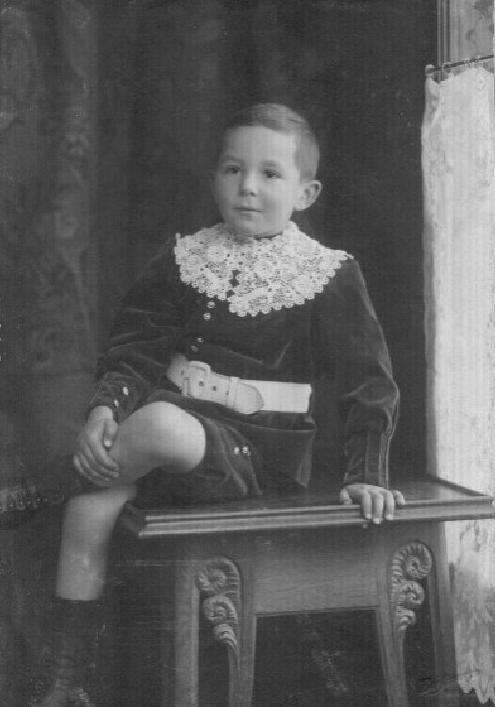
Figure 1.--This French-speaking Swiss boy had his portrait taken in Geneva, probably in the 1900s. He is wearing a velvet outfit. I think it might be a tunic suit, but I am not sure. He is wearing his tunic with knee pants. Note especilly the very elaborate lace collar.
|
|
Swiss boys wore many of the same garments as boys in neighboring countries, especially Germany and France. The fact that the two major linguistic groups in Switzerland are French and German is a factor here. Clothing styles seem more dtermined by language than the fact that the boys are Swiss. Boys are best known for wearing leerhosen, but they are now more folk dress than garments commonly worn by moern Swiss boys. Young Swiss boys in the 19th and early 20th century were commonly outfitte in dresses, as was the case of other European countries an America. Sailor suits were a popular style for Swiss boys as was the case in most European countries. They were commonly worn by boys in German, French, and Italian speaking areas of Switzerland. Switzerland is a multi-cultural and linguistic country. Smocks were commonly worn by Swiss-Italian and Swiss-French boys, but less so than the Swiss-German boys. They were mostly worn to school. As far as boys clothing is concerned, the French speaking part of Switzerland was comparable to France. HBC knows of no specific Swiss style for Swiss boys suits. Presumably Swiss boys in the early 19th century wore skeleton suits like boys in other European countries. Swiss boys by the mi-19th century were wearing suits with more modern styling an long pants. Gradually by the 1870s, kneepants suits had become more common for boys. I'm not sure when knicker suits began to be worn. Short pants suits with modern styling appeared in the 1910s and were wiely worn by the 1920s. Gradually suits became less commonly worn and were much less common by the 1940s. One European readers tells HBC that lederhosen were not worn in Switzerland. Unlike other Alpine countries, lederhosen were not commonly worn in Switzerland. Some readers, however, tell us that some Swiss boys did wear lederhosen. This appears to have been especially true among Swiss boys of German ancestry. Younger Swiss boys, especially in the French-speaking areas, commonly wore closed toe sandals, both English-style school sandals and single bar sandals. HBC is not sure when Swiss boys began wearing sandals, probably the 1920s. They were commonly worn until the 1960s. Swiss boys like German boys also continued wearing long stockings in the 1920s as they were declining in popularity in other
countries. Swiss boys also wore tights.
Young Swiss boys in the 19th and early 20th century were commonly outfitte in dresses, as was the case of other European countries an America. HBC has no details about this custom in Switzerland. It was presumably similar to the fashion in neighboring countries, especially Germany and Framce.
Switzerland is a multi-cultural and linguistic country. Smocks were commonly worn by Swiss-Italian and Swiss-French boys, but less
so than the Swiss-German boys. They were mostly worn to school. As far as boys clothing is concerned, the French speaking part of Switzerland was comparable to France. It was compulsory for boys to wear a smock until 9-10 in the years 1930-1960, about one third would then continue up to end of primary school around 12 years. The style and colors of these smocks were left to the parents discretion, there was no uniformity but a wide variety in mainly three styles: back buttoning, side buttoning, and a pinafore style.
Pinafores
Pinafores were widekly worn in Switzerland into the 1960s, commonly as a school garment. Children wore noth smocks and pinafores. A British visitor provides some details.
Tunics
We do not have a lot of information on Switzerland yet. We note the younger boy in the Swiss Kessler-Trümpi family wearing a tunic outfit in 1840. We suspect that Swiss tunics were essentially the same as Germn tunics. The French minority may have been more influenced by France. We note Swiss children like many European children wearing a variety of tunic suits in the early 20th century. The Geneva boy here is an example (figure 1).
Sailor suits were a popular style for boys throughout Europe. Unlike many of these countries, however, land-locke Switzerland had no national navy on which to base the style of boys' sailor suits. Even so, we see some Swiss boys wearing sailor suits. They do not seem nearly as common as in many other European countries. Switzerland is a diverse country with German, French, and Italian speaking areas. Fashions in these areas were influenced by fashions in the larger neigboring countries. And sailor suits were very popular in all those three countries. The styles worn in Switzerland probably reflected the styles popular in these three countries, but HBC at this time has few details about such stylistic differences. Actually we do not see all that many Swiss boys wearing sailor suits. As far as we can tell, sailor suits were less common in Switzerland than in most other European countries, although our information is still relatively limited.
Switzerland is a moutaneous country with cold winters. The sweater is thus a popular garment in Switzerland. We are not sure yet about the chronology. The sweater is a casual garment and ths not commnly worn for studio portraots in the 19th century. We do much more about the 20th century with the appearance of damily snapshots. We norice a lot of boys wearing them throughout the 20th century. They were commonly worn to school. This depended on both the school and family. Many boys wore suis to school. But we also notice many boys wearng sweaters to school, mostly pull-overs. Sweaters seem more popular wih boys than girls. We see boys wearing sweaters with bright colors in the inter-War era. Some boys wore belts over their sweaters. We see the same style in Germany. We are not sure why this was so popular. Long sleeve sweaters were almost iniversal until after World War II. Sweaters were normally made od wool until well after World War II.
HBC knows of no specific Swiss style for Swiss boys suits. Presumably Swiss boys in the early 19th century wore skeleton suits like boys in other European countries. Swiss boys by the mi-19th century were wearing suits with more modern styling an long pants. Gradually by the 1870s, kneepants suits had become more common for boys. I'm not sure when knicker suits began to be worn. Short pants suits with modern styling appeared in the 1910s and were wiely worn by the 1920s. Gradually suits became less commonly worn and were much less common by the 1940s. Knicker suits disappeared in the 1950s and short pants suits became much less common in the 1960s. Today modern Swiss boys, as other European boys, do not commonly dress up, but when they do, they normally wear a single breasted, longpants suits.
We notice Swiss boys wearing many different types of pants trousers. Long pants were commoin through much of the 19th century. We begin to see knee pants and other shoetenbed-length pants like bloomer knickers at mid-century for younger boys. Older boys began wearing them lsater in the century. Knee pants were common in the early 20 century. We see many boys wearing short pants after World War I (1914-18). Knickers seem nore common in Switzerland than other European countries, perhaps because of the cold weather in a very mountaneous country. In other countries we see mostly teenagers wearing knickers, but we see many school-age boys wearing them in Switzerland. Short pants were very common after World War II. but gradually we see more boys wearing long pants. Like knickers we see quite a number of younger boys wearing long pants in Switzerland before it became common in the rest of Europe.
Swiss boys like German boys also continued wearing long stockings in the 1920s as they were declining in popularity in other countries. Swiss boys also wore tights. A Swiss reader from a french-speaking family reports that going to primary school in the 1940s that boys mostly wore short pants under their smocks. During the winter some boys switched to knickers. The other boys that kept wearing shorts would commonly wear over-the-knee stockings. HBC is unsure at this time as to when tights began to replace long stockings. Tights were weorn by younger boys in several European countries. Most of the countries were northern ones, but the high elevations in Switzerland means that the weather there canb also be quite cold. HBC has only limited information on long stockings in Switzereland. Readers have provided varying accounts, and HBC is unable to assess the situation in Switzerland at this time.
Support Garments
A Swiss reader tells us, "You will have to use controsions to pronounce the Swiss word for Waists.
It is "Gschtaeltli". Even in the Jelmoi catoalog the name it like that. They do not even use the German word, which is "Leibchen".
Shoes and Sandals
Younger Swiss boys, especially in the French-speaking areas, commonly wore closed toe sandals, both English-style school sandals and single bar sandals. HBC is not sure when Swiss boys began wearing sandals, probably the 1920s. A good example are St. Gallan Kindergsrten children about 1950. Swiss boys wore them until the 1960s.
HBC

Navigate the Boys' Historical Clothing Italian pages:
[Return to the Main Swiss page]
[Swiss choirs]
[Swiss school uniforms]
[Swiss youth groups]
Navigate the Boys' Historical Clothing Web Site:
[Introduction]
[Activities]
[Biographies]
[Chronology]
[Clothing styles]
[Countries]
[Bibliographies]
[Contributions]
[Countries]
[FAQs]
[Glossaries]
[Images]
[Links]
[Registration]
[Tools]
[Boys' Clothing Home]
Created: 8:44 AM 3/8/2010
Last updated: 3:00 AM 3/9/2010