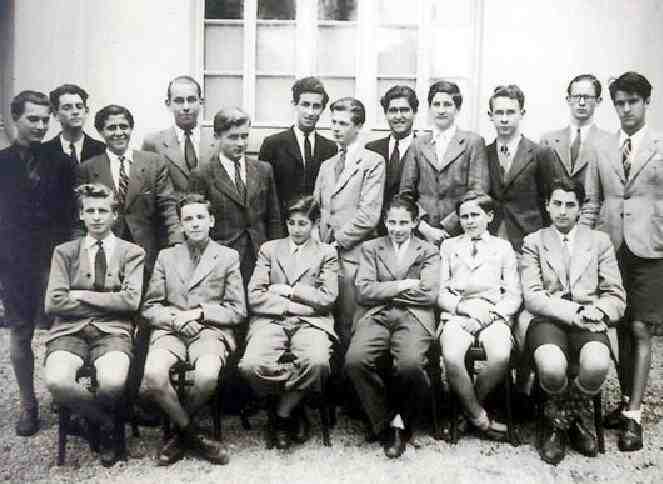
Figure 1.--This was the Villa Saint Jean, a private Catholic school located at Fribourg. It was founded by Les Marianistes-a Catholic order. This is the Second Class at the school in 1942-43. There was no school uniform, but the boys wore suits. |
|
Switzerland is a multi-ethnic and mult-linguistic country. There were not just kinguistic differences, but the various lanuages reflected a more profound cultural divide. Until the 1960s, schoolwear was heavily influenced by the different national groups making up the Swiss union. Boys at schools in French catons, for example, commonly wore French styles like smocks. In contrast, boys at schools in German catons generally did not and wore German styles. Swiss boys did not normally wear school uniforms. Many French schools required that the younger children wear smocks, which is somewhat like a uniform, although there was not normally a srtandard school smock. State schools did not normally establish a specific style, but some private schools did. Today in Swiss schools there are few differences from caton to caton. And the children wear the same pan-European styles that becane popular in the 1970s. Readers have sent us quite a few images of individual Swiss schools.
Switzerland is a multi-ethnic and mult-linguistic country. Until the 1960s, schoolwear was heavily influenced by the different national groups making up the Swiss union.
Boys at schools in French cantons, for example, commonly wore smocks while boys at schools in German catons generally did not.
We note the same activities in Swiss schools that were commom in schools throughout Europe. We have found many Swiss school photographs, but most are posed class portraits and not images illustrating activities. Classroom activities were fairly standard. Most Swiss children walked to school. Most villages of any size had primary schools. Secondary schools were more limited. Many children did not pursue their education beyond primary school. Children in rural areas who wanted to go to secondary school, had to be taken in by relatives in the cities . Some schools were better equipped than others which of course affected activities.
We do have a question about Swiss school lunches. The activity program at Swiss schools tended to be somewhat different than in America. Swiss and other Europan schools had a more academic orientationn than in America. American schools developed extebsive extra-curricular activity programs. Spoets foe example becane very important in American schools, but we do not see that in Swiss schools. Not that it was all academics, but the extra-curricular activity program was much more limited. One activity we note is school hiking trips. We note school groups in various areas of the country. Both boys and girls participated, although in separate groups.
Swiss children did not normally wear uniforms. There may have been a few private schools with uniforms, but even at private schools uniforms were not common. The dress code at these schools was often more strict, but uniforms were not common. For the most part Swiss children did not wear uniforms to school. Many French and Italian schools required that the younger children to age 10 commonly wore smocks which was a kind of uniform. I'm not sure when this was first instituted. We note German-speaking boys wearing smocks as well, but this may have been most common in the predominately French-speaking areas. A German-speaking Swiss reader tells us that he did wear a smok at his school, but only in class. I'm not sure if there were actual national school regulations on this. There does not seem to have been any specific style or color of smock, apparently any type of smock would do. After age 10 many French-speaking parents continued to have their boys wear smocks to school, although this became much less common in secondary school. This rather had the appearance of a uniform. Smocks were not common, however, in the German-speaking cantons.
We do not yet have sufficient Swiss school images to assess chronological trends in schoolwear. We have, however, begun to collect images and hope to eventually be able to make an assessment. We do not yet have sufficient Swiss school images to assess chronological trends in schoolwear. We have, however, begun to collect images and hope to eventually be able to make an assessment. Schoolwear styles as best we can tell wee bascally the same as popular styles in France and Germany. Switzerland had a mixed population consisting of mostly French and Germn speakers. We note a charming 19th century scene by Swiss artist Marc Louis Benjamin Vautier. He dsepicts a mother bringing her little boy for his first day of school at a small rural school.
Swiss schools did not commonly gave uniforms, although the smock was used like a uniform for many years. There may have been a few private schools with uniforms, but our information is still very limited on Switzerland. Swiss boys did not wear school caps like English boys. French-Swiss boys may have wore berets, but I am not sure how commonly. Swiss boys did not wear blazers. I believe, however, that many boys did wear suits to secondary school until the 1960s. Ties were not commonly worn at Swiss elementary schools. but they were much more common at secondary schools until the 1960s. Switzerland is a multi-cultural and linguistic country. Smocks were commonly worn by Swiss-Italian and Swiss-French boys, but less so than the Swiss-German boys. They were mostly worn to school. As far as boys clothing is concerned, the French speaking part of Switzerland was comparable to France. Regulations varied from school to schhol, but at amny schools it was compulsory for boys to wear a smock until 9-10 in the years 1930-1960, about one third would then continue up to end of primary school around 12 years. The style and colors of these smocks were left to the parents discretion, there was no uniformity but a wide variety in mainly three styles: back buttoning, side buttoning, and a pinafore. Elementary schoolboys commonly wore short pants through the 1960s. Boys in German speaking cantons may have worn lederhiosen to some extent. Some boys switched to knickers during the winter, but others continuting wearing shorts. Boys commonly wore both short socks and kneesocks. Short socks were common during the warmer months. Younger boys wearing shorts in the winter might wear them with long over-the-knee stockings. In the 1960s long stockings were replaced with tights. Many elementary children wore close toe sandals, especially during the warmer months. These sandals were more common in the French (and probably the Italian) cantons, but were less c ommon in the German cantons. Sandals were not commonly worn in secondary schools.
State schools did not normally establish a specific style, but some private schools did. There are quite a lot of private schools in Switzerland of various sizes from tiny to very big. Most of them are Catholic, many being as well boarding schools which explains why most of the schools were single gender schools. Some are only for primary level, some include primary and secondary level. In any case they have to follow strictly the cantonal education program, except for religious education that obviously is included in program. They would also accept pupils of another religion which of course was unusual as the parents did choose such private school for the quality of the human and religious education. The private schools never had specific uniform clothing requirements except in the French speaking part where smocks were sometimes compulsory (either same style/colour or free choice) for both boys and girls, even at secondary levels. This practice has now disappeared (around 1980). Today in Swiss schools there are fewer differences from canton to canton.
Some information is available on individual Swiss schools, showing both the various styles worn by the boys and available
information on the school regulations. The information is abstracted from the available images, but some information is available
on the several different schools. These schools are mostly from the French-speaking catons. It is likely that boys in the Italian
catons also wore smocks, but HBC at this time does not have any information on these schools.
We do not have many personal experiencds contributed by Swiss readers yet. A German speaking boy, Tom, growing up in a French speaking village provides us information on his school experiences. A British reader tells us about his German-language Swiss boarding school and his friend Mathias.
Related Links: Careful this will exit you from the Boys' Historical Clothing web site, but both sites are highly recommended
Boys' Preparatory Schools: Lovely photographic essay of British preparatory schools during the 1980s containing over 200 color and black and white photographs.
New Zealand Schools: The Apertures Press e-Book on New Zealand schools is available to interested readers.
British Preparatory Schools: Volume I: Apertures Press e-Book vol. II on British preparatory schools is now available
British Preparatory Schools: Volume II: Apertures Press e-Book vol. I on British preparatoty schools is available.

Related Chronolgy Pages in the Boys' Historical Web Site
[Main Chronology Page]
[The 1900s]
[The 1910s]
[The 1920s]
[The 1930s]
[The 1940s]
[The 1950s]
[The 1960s]
[The 1970s]
Navigate Related Boys Historical Clothing Style Pages
[Main country page]
[Long pants suits]
[Short pants suits]
[Lederhosen]
[Kneesocks]
[Eton suits]
[Jacket and trousers]
[Smocks]
[Blazer
[School sandals]
Navigate the National HBC School Section
[Main National School Uniform Page]
[Main School Uniform Page]
[Australia]
[England]
[France]
[Germany]
[Ireland]
[Italy]
[Japan]
[New Zealand]
[Poland]
[Scotland]
[South Africa]
[]
[United States]
Navigate the HBC School Section
[Activities]
[Chronology]
[Clothing styles]
[Countries]
[Debate]
[Economics]
[Garment]
[Gender]
[Hair]
[History]
[Home trends]
[Literary characters]
[School types]
[Significance]
[Transport and travel
[Uniform regulations]
[Year level]
[Other topics]
[Images]
[Links]
[Registration]
[Tools]
[Return to the Historic Boys' School Home]