
Economics: Middle-Eastern and North African Development--The Arabs
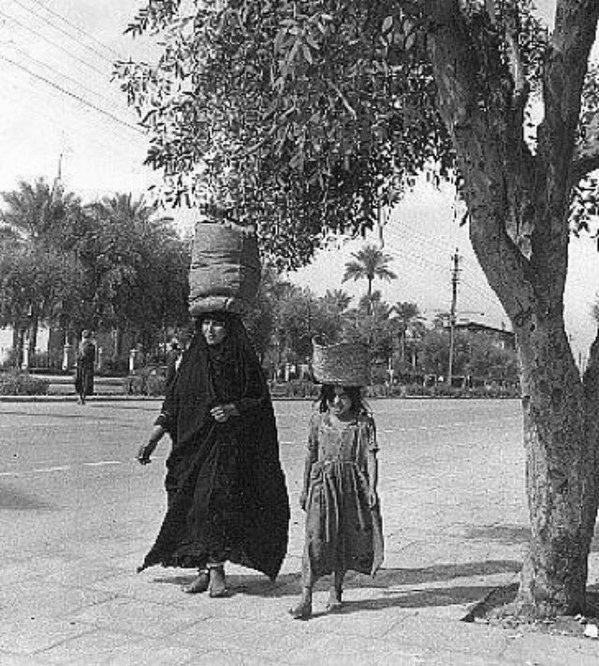
Figure 1.--Petro-dollars after World War II flowed into some of the poorest most backward countries in the world. Living standards began to increase, but none of the Arab countries have developed modern economies, creating and manufacturing goods of any technological complexity. The press caption here read, "New Oil Wealth Makes Iraq a Land of Contrasts: Oil, the liquid gold which flows abundantly below its soil, has made Iraq, like other countries of the Middle East, of tremendous future importance. Bagdad, the capital, presents a strange contrast of the old East abd the new west, wide streets with modern buildings are filled with British and american cars, but just behind these buildings are ranmshackle Arab dwelings. Hotels are modern, but sewage and sanitation are practically nill. Washing mchines, vacuum cleaners, and wireless setsare poring into the country for the new rich, but the peasants still live in mud huts, are illiterate and for life has chnged little . But Harrow-educated King Feisal and his Ministers are planning to spend some of the enormous oil royalties on schools, hospitals and for the general improvement of the people. Bagdad stands near the traditional site of the Garden of Eden, wise spending and planning might very well result in a modern Garden of Edenfor the people of 20th century Bagdad." Unfortunately this would not prove to be the case. King Feiel was overthrown and killed (1959). Saddam Husein seized power and lavished Iraq's immense oil welth on palaces, weaponty, and war. Some countries have attempted to use the petro-dollars more wisely, but none have yet suceeded in developing a modern economy.
|
|
The most notable observation emerging from the Middle East is the lack of economic progress since World War II and the end of the colonial era. This failure is especially notable in the Arab world. In fact, with the exception of the oil producing countries, the Middle Eastern countries are almost uniformily poor and getting poor. And even in the oil producing countries there has been a general failure to build producive economies. These countries in several instances consume along Western patterns, but have not built industries capable of producing and marketing products in the international market. Given the extrodinary amount of available invest capital this is an extremely puzzeling observation. The question is why have Middle Eastern leaders so badly failed their populations since World War II. he League of Arab States as of 2006 had 22 members. The 22 Arab states are in many ways remarkable for their diversity in both ethnicity and political structures. The Arab states include traditional monarchies (Bahrain, Morocco, Kuwait, Oman, Qatar, Saudi Arabia, the United Arab Emirates) and various states giverning through various levels of authoritarian rule, including some very repressive regimes. There are also many similarities. There are throughout the regions to varying degrees legal and social structures limit individual liberty. Limits are to varying degrees placed on free expression, democraic rule, reigious diversity, women's rights, education, the rule of law, and property rights and free enterprise. After World War II leaders like Nasser who attracted a large following persued Arab socialism believing that it was the colonial powers that impaired economic development. With the failure of Arab Socialism, some Arabs have turned to fundamentalist Whahbi-style Islam. No where in the Arab world does their seem to be a willingness to adopt the secular, liberal traditions of Europe that have brought such unprecedented prosperity.
Economic Progress
The most notable observation emerging from the Middle East is the lack of economic progress since World War II and the end of the colonial era. This failure is especially notable in the Arab world. In fact, with the exception of the oil producing countries, the Middle Eastern countries are almost uniformily poor and getting poor. And even in the oil producing countries there has been a general failure to build producive economies. These countries in several instances consume along Western patterns, but have not built industries capable of producing and marketing products in the international market. Given the extrodunary amount of available invest capital this is an puzzeling observation. The question is why have Middle Eastern leaders so badly failed their populations since World War II.
The Arab States
The League of Arab States as of 2006 had 22 members. The countries streach from Morocco in the west all the way east to Iraq.
Diversity
The 22 Arab states are in many ways remarkable for their diversity in etnicity and other factors.
Political Systems
The Arab states include traditional monarchies (Bahrain, Morocco, Kuwait, Oman, Qatar, Saudi Arabia, the United Arab Emirates) and various states giverning through various levels of authoritarian rule, including some very repressive regimes.
Similarities
There are also many similarities. The overiding similarity is the Islamic faith of the population. The Islamic dominat Islamic sect, however, varies from country to country as well as the toleration of other Islamic sccts and other religions. There are also many similarities. There are throughout the regions to varying degrees legal and social structures limit individual liberty and basic human rights. Limits are to varying degrees placed on free expression, democraic rule, reigious diversity, women's rights, education, the rule of law, and property rights and free enterprise. After World War II leaders like Nasser who attracted a large following persued Arab socialism believing that it was the colonial powers that impaired economic development. With the failure of Arab Socialism, some Arabs have turned to fundamentalist Whahbi-style Islam. No where in the Arab world does their seem to be a willingness to adopt the secular, liberal traditions of Europe that have brought such unprecedented prosperity.
Repressive Regimes
There are few democratic states in the Arab world. The one democratic state is Lebanon and democracy there is currently under attack. Most of the other Arab regimes are authoitative states, and some (Algeria, Libya, Saudi Arabia, Sudan, Syria, and Tunisia) are pariculasrly repressive. A good idea of the situation can be seen by their map of freedom which shows a sea of purple (depicting "not free" countries) throughout the Niddle East and North Africa. A few countries (Morocco, Jordan, and Yemen) are in the "partly free category. [Freedom House] The United Nations Commission on Human Rifgts has also addressed this question, but U.N. materal has to be treated with caution. So nany U.N, nembers are countries with authoritarian givernments that the U.N. is under political pressure to temper its actions on this subject.
Economic Productvity
Productivity rates in Arab countries are increasingly negative. [World Bank; Arab Development Report)." As a result, throughout the Arab world thre are stagnat economies. Arab countries do not produce manufactured goods that can compete on the international market. Young people leaving schools and universities can not find jobs. Unemployment levels are very high. The result is that the average income in theAran world is about $5,000 annually.
The Middle East and North Africa other than Africa entered the 20th century as the poorest region in the world. Photographs in the late-19th and early-20th century shw a refion vurtually untouched by time nd modernuity. I recall a Bible my grandmother bought usbout 1950. It included photographs of the region and there was no way of telling that they could not have neen taken in Jesus' time. One has to ask how the region and the Arab people could have defied modernity for such a long period of time. The region entered the 20th century in abject poverty and with a largely uneducated, illerate population. There were few schools and hospitals. Electricity was virtually unknown, except in a few major cities. At about the same time, the industrial world (America and Europe) began a transition from coal to oil. Oil was particularly important for tranportation fuel. Ameica was the first great oil power. And oil not only fueld America's indutria; expansion, but helped win World war II, helping to save Western Civilization. Oil had been found in the Middle East at the time of World war I, but at the time production had only began. After The War as american prodution peak,ed, Middle Eastern production declined. The Arabs helped organize The Organization of Petroleum Exporting Countries (OPEC). And as American oil production declined, Middle eastern oil production increased. This not only affored great importance to the oil producig countries, but bought great th to the region. Small sheikdoms vurtually unknown, became known to the rest of the world. Theoretically the oil welth could have been used to finance the development of modern counties. This has not occurred. Rather it has been used to but arms and to buy a modern life style, but not to devlop a modern economy. In many countries the oil money has been used to prevent moderizaion. Some of the countries look modern with high-rize modernistic building and modern air ports, but they do not have modern economies that create and manufacture products. Rather industrial proucts like cars, computers, loomtives, pharmaceuticals, ect. are all imported, not produced locally. All paid with by petro-dollars. And as the owr of OPEC increased, oil prices rose from $3 a barel to over $100 barrel. This resulted in the greatest transfer of wealth in hyman history. The countries are governed by a collection of autocrats, theoctats, and dictators. As oil money flowed directly into the treasury, they aew unaccountable to their preople which are then bought off with a share of the oil money. In some of the petro states, the oil has allowed the leaders to maintain medevil systems. The dictators habe had more modern gials, but largely wasted the money on excesses, arms, and wars. The one petro-state that has had some success at modenizing is Iran, thanks primarily to the modenizing efforts of the Shah before he was deposed. The ecomny of the Middle east is today undergoing a major change. American enegy companies have developed new technologies for extracting oil. As a result the income of the Middle eastern [tro-states has been cut by moe than aand it is still not clear where the oil orices will level out. This willmean major changes in the Middke east that can not yet be forseen.
Education
Some Arab countries like Saudi Arabia have adequately funded a modern education system. Most Arab countries have not. There are high rates of illiteracy, especially among womem. The situation is even worse when assessing universities. There is not one internationally respected university within the Arab world. At Arab universities there is little real academic freedom. Not only do Governments restrict academic freedom, but professors who attempt to confront issues that may anger Islamicsts invite attack from the students. And there is no Arab universities that have made any substantial contribution to any major academic desiplines or adding substantially to the body of knowledge. There are virtually no scienntific papers of any importance published in the Arab world. Rather Arab Governments have erected a range of religious, social, legal, and cultural barriers to creation and diffusion of knowledge.
Brain Drain
Many of the most educated people in the Arab world are fleeing their countries so they can persue their careers. One report indicates that between 1998 and 2000 more than 15,000 Arab physicians emigrated. A World Bank report estimates that "roughly 25 per cent of 300,000 first degree graduates from Arab universities emigrated. Roughly 23 per cent of Arab engineers, 50 per cent of Arab doctors and 15 per cent of Arab BSc holders had emigrated." The reason for this varies, but is most commonly the lack of any economic oportunity in their countries.
Women's Rights
Most Arab countries have legal systems which establish a range of gender based differences. Almost uniformly these gender provisions restrict the rights of women in areas such as (marriage, divorce, clothing, civil rights, legal status and education). This varies substantially from country to country. Gender based differences were most pronounced in Taliban Afganistan, but are substantial in countries like Saudi Arabia, but exist to varying degrees in virtually all Arab countries.
Publication
The publication of books is very limited in Arab countries. This is especially the case of books not related to religious themes. This would be understandable in a small country in a languge spole by a limited population. But Arabic is one of the major world languages with more than 300 million speakers.Also a small number of non-Arabic books are translated into Arabic. This is particularly important because so few books of any importance are published by Aran scholars on any important discipline. Thus translations are especially needed in the Arab world. Amazingly Spain alone translates more books in a single year than the Arab world has in the past 1,000 years since the
Abbasid Caliphate rule of Caliph Mamoun (813-833).
Sources
Freedom House,Map of Freedom 2006. Since 1972, Freedom House has published Freedom in the World, an annual comparative assessment of the state of political rights and civil liberties in 192 countries and 14 related and disputed territories. Widely used by policy-makers, journalists, and scholars, the 700-page survey is the definitive report on freedom around the globe.
World Bank. "Arab Development Report".
A special report to the 59th session of the UN Commission on Human Rights.
Academic Ranking of World Universities - 2006.
HBC

Navigate the Boys' Historical Clothing Web Site:
[Return to the Main Middle Eastern economic page]
[Return to the Main Middle Eastern economic page]
[Return to the Main Middle-East economic development page]
[Return to the Main economics page ]
[About Us]
[Introduction]
[Biographies]
[Chronology]
[Climatology]
[Clothing]
[Disease and Health]
[Economics]
[Freedom]
[Geography]
[History]
[Human Nature]
[Law]
[Nationalism]
[Presidents]
[Religion]
[Royalty]
[Science]
[Social Class]
[Bibliographies]
[Contributions]
[FAQs]
[Glossaries]
[Images]
[Links]
[Registration]
[Tools]
[Children in History Home]
Created: 11:25 PM 12/17/2006
Last updated: 1:46 AM 2/2/2016