***
war and social upheaval: The Cold War -- Later Phase
The Cold War: Later Phase (1961-91)
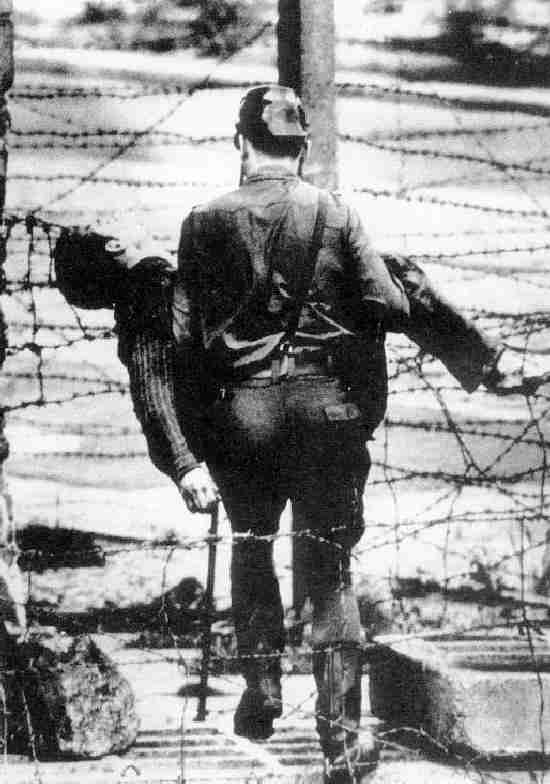
Figure 1.--The most vissible and chilling aspect of the Cold War was the Berlin Wall. East German border policemen on August 17, 1962 shot East Berlin Peter Fechter as he tried to make it to West Berlin. He was shot in the stomache and did not die immediately. The East German police refused to go to his assistance as he slowly bled to death. He wasonly 18 years old. A crowd of West German sgathered and accused the East Germans of muder and the American for cowardice.
The most visible aspect of the Cold War was the Berlin Wall - the Wall the Communists built between East and West Germany. The Wall changed this. It did stop the flow of people West, although heart rending sights of small numbers of people braving the increasingly lethal dangers of the Wall moved West Germans.
President Kennedy visited Berlin in 1962 to demonstrate American resolve in this vulnerable outpost of freedom. The most dangerous point of the Cold War was the Cuban Missile Crisis. The Soviert Union secretly began installing balistic missles in Cuba capable of hitting Atlantic coast American cities. A major development in the Cold War was the split between the Soviets and Chinese in 1964. There were efforts to pursue detente during the 1970s. Vietnam is the most controversial war in American history. Even after several decades the debate over the war continues. American Presidents Kennedy and Johnson committed American combat troops primarily as part of a Cold War commitment to fighting Communism. The reality in Vietnam was much more complex. American officials failed to perceive the nationalist dimensions of the War. The developing fissures in the Communist world were also not appreciated. Perhaps the most serious miscalculation was the military assessment of the ability of North Vietnam to resist American military power. The Indonesian military in 1965 overthrew the Sukarno regime claiming that the Indonesian Communist Party (PKI) was planning an uprising. The actual plans of the PKI are still murky, but over 1 million Indonesians were killed by the military
for expected PKI sympathies. It was one of major attrocities of rhe 20th century. Another major even more radical change occurred during the Cultural Revolution (1966-76), one of the most violent and tragic episodes in modern Chinese history. It was inspired by China's leader Mao Tse Tung and known as the Great Proletarian Cultural Revolution. Mao thought that the Chinese people were losing their revolutionary zeal. He thus conceived of a cultural revolution to destroy once and for all the culture of pre-Communist China. Pol Pot and the Khmer Rouge, after years of struggle, defeated the Cambodian military and seized the Cambodian capital of Phnom Penh on April 17, 1975. What followed was one of the most sinister and senseless acts of genocide ever committed by a government on its own people. The Soviets invaded and occupied Afghanistan in 1979. Unlike the other major conflicts in world history, in the end the Cold War was not settled by force of arms. It was the example of the West, especially the success of free market economics and political democracy that defeated Communism. [Mandelbaum] The Soviets in Western Europe used the growing pasifist movement in Western Europe to promote isarmament--disarmaament of the West. Stalin once asked mockingly how many divisions the Pope had. In fact the entire edifice of Stalinist in Eastern Europe began to unravel in Poland. The two principal forces were the
Polish Catholic Church and an illegal free trade union movement--Solidarity. Soviet Premier Mikhail Gorbachev played a central role in ending the Cold War. The Soviet economy was clearly failing. With a faltering economy, the Soviets could not successfully compete with America and the West. Gorbachev sought to
rationalize the Soviet system through Glasnost and Perestroika. The relaxation of the police state role and the openness that he sought in effect destroyed the Soviet Union and its Eastern European Empire. Gorbachev was unwilling to use the instruments of state security to suppress the people of Eastern Europe and the nationalities within the Soviet Union. In the end the Soviet Union itself collapsed in 1991. This was not Gorbachev's intention, but he inadvertently launched a new undivided and much freer Europe. [Hitchcock] Ronald Reagan envisioned a smaller Government, a greater America. At the end of his two terms in office, Ronald Reagan viewed with satisfaction the achievements of his innovative program known as the Reagan Revolution, which aimed to reinvigorate the American people and reduce their reliance upon Government. He felt he had fulfilled his campaign pledge of 1980 to restore "the great, confident roar of American progress and growth and optimism." It is difficult to assess to what extent this stress or the internal weakness of the Soviet system resulted in its demise. Probably a combination of the two. Some view Reagan as genial, but poorly informed and unengaged. Others credit him with the destruction of Soviet Communism.
Ike
Historians have generally not given President Eisenhower the credit he deserves. This may be in part because the press depicted him as an amiable, but bumbling figure. We have severe reservations concerning Ike's leadership on the Civil Rights movement, but on foreign affairs and strategic thinking he was an unsung genius. [Geeenstein] There were those at the time of the Korean War who wanted to put America on a war footing, an enormously expensive proposition. Rather Ike made two major decissions. First he decided to limit a costly conventional buildup and instead persue must less costly nuclear deterence. Secondly he decided to play on America's strength--science. The weapon systems which now give America military dominance (nuclear subs, missles, nuclear carriers, and other have their genesis in the Eisenhower years. [P. Taubmam] The Soviet Union on the other hand decided to continue massive militsry spending which placed the much smaller Soviet economy under great stress. [Reed] Eisenhower approach was to deter the Soviets with military expenditures that did not over burden the American economy and rely on the inherent strengths of the West to undermine the Soviet Union.
John Birch Society
Businessman Robert Welch founded a group to fight Communism--the John Birch Society (JBS). He named it after a U.S. Air Force pilot killed by the Chinese Communists in 1945. The JBS's conspiratorial charges attracted many menbers--some 0.1 million in the earl-1960s. They included many comnservatives like retired military men, journalists, professionals who believed America was imperaled from international Communism. Ameica at the time was the primary force confronting the Soviet Union and other Communist powers. The outcome of the Cold war was still very much in doubt. The JBS differed from many other groups supporyting the opposition to Communism, they believed that the threat was internal, that the U.S. Government itself was influenced, even controlled by Communists and 'fellow travelers'. They objected to the welfare reforms of the Democratic New Deal and the failure of the Republican Eisenhower Administration to roll them back. It wasnot just President Roosevelt and Truman that was attacked, but of all people war hero Dwight Eusenhower. Welch saw Eisenbhower as a craven, compromising insider. He promissed the Blue Book with the JBS code and goals. And was outraged with the passage of Medicare during the Johnson Administration. The JBS ran a hate Kennedy page in the Dallas Morning News the day Preidet Kennedy was shot (Novembr 1963). That did not lead to the demise of the JBS. Former B=Vice President Nixon rejected the JBS when he ran for Califirnia Governor and had been defeated Senator Goldwater endorsed many of theor ideas when he r for president, t a distance. He won the Reublican nomination, but split the party. The result was one of the most resomding political defeats in American history (1964). That did drscredit the JBS. [Mulloy]
The U-2
President Eisenhower wanted to mke sure that there would never again be another Pearl Harbor. Given the closed Soviet society, he placed great emphasis on aerial surveilance. He authorized overflights of Soviet territory with B-47 bombers, in effect an act of war. He launched the U-2 program which provided surveillamnce at such high altitudes that the planes could not be shot down. Delays in the missle program led to him authorizing U-2 overflights even though the Soviets were rapidly upgrading their air defense systems. The Soviet efforts to shoot down a U-2 was costly. Migs would shadow the U-2 at their maximum alditude. As the Soviets would fire off missles at the U-2, several migs were shot down. Finally the U-2 flown by Frances Gary Powers was shjot down. He was eventully exhanged for a Soviet master spy. More importantly Khrushchev used the incident to wreck the Paris summit. Eisengower had hoped to end his presidency with steps toward disarment and a reduction of tensions.
The most visible aspect of the Cold War was the Berlin Wall - the Wall the Communists built between East and West Germany. Until 1961, East Berliners and other East Germans could take a subway car to flee to West Berlin and on to West Germany. The number of East Germans fleeing to the West was an embarrassment to the Communists who after all claimed to be creating workers' paradises. The glaring differences between the vibrant economic life of Berlin and the gray, drudgery of a Communist People's Republic was particularly apparent. The number of trained professionals in particular threatened the economy of East Germany. The Wall changed this. It did stop the flow of people West, although heart rending sights of small numbers of people braving the increasingly lethal dangers of the Wall moved West Germans. President Kennedy visited Berlin in 1962 to demonstrate American resolve in this vulnerable outpost of freedom. He told Berliners. "There are many people in the world who really don't understand, or say they don't, what is the great issue between the free world and the Communist world. Let them come to Berlin. There are some who say that communism is the wave of the future. Let them come to Berlin. And there are some who say in Europe and elsewhere we can work with the Communists. Let them come to Berlin. And there are even a few who say that it is true that communism is an evil system, but it permits us to make economic progress. Lass' sie nach Berlin kommen. Let them come to Berlin. Freedom has many difficulties and democracy is not perfect, but we have never had to put a wall up to keep our people in, to prevent them from leaving us." The Wall effectively separated Germans for nearly 30 years. Once completed only small numbers succeeded in crossing it. Many died in the process.
The most dangerous point of the Cold War was the Cuban Missile Crisis. The Soviert Union secretly began installing balistic missles in Cuba capable of hitting Atlantic coast American cities. American surveillance photographs detected the missle sites and President Kennedy ordered a naval blockade to prevent further
deliveries. The President considered an invasion if the Soviets did not remove the missles. This was the closest the two sides came to nuclear war. American stategists were astounded that Khrushchev would take such a risk. Khrrushvhev later claimed in his memoirs that it was to protect Cuba. Many scholars dismiss this as a cover story. Khruschchev was a high-stake gambler, but not demented. His peasant shrewdness in the end led him to back down. [Tauubman] We know now that the world came much closer to a nuclear exchange than was no at the time. Russian forces in Cuba had tacticl nuclear weapons and probably would have used them if the Unitd states had invaded. Also U.S. destroyers assigned to the blockade were forcing Soviet submarnes around Cuba to the surface. Two of the submarines involved came very close to using nuclear-tipped torpedos. Either action could have very possibly resulted in full-scale nuclear exchange.
Chinese-Soviet Split (1960)
One might expect the Soviets to have been strongly supportive of the Chinese Communisdts. Stalin's early relationwith the Chinese Communists were mixed. There were a ange od crosscurrents that complicated fraternal ideological afinity. National interests led Stalin to question the growth of a strong Chinese state which would border lightly populasted Siberia. And Stalin sensed from an early stage that he would not be able to control the Chinese Communist Party, unlike the Communist parties in Europe and other countries. And as concern with the Japanese grew, Stalin saw the Kumoingtung as a way of resisting Japanese military expansion. The Comminist victory in the Civil War was, however, presented to the world as another step in the inevitable triumph pf Communism. Mao traveled to Moscow to negotiate the Sino-Soviet Treaty of Friendship, Alliance, and Mutual Assistance (1950). China under the agreement confirmed certain rights to Soviet Union. One example was continued use of the naval base at Luda in Liaoning Province. The Soviets committed to military support, shipments of modern weapons, and a major economic and technological assistance program. This included technical advisers and machinery. China did not question Soviet leadership of the world communist movement. Many Chinese Communists at the time saw the Soviet Union as the model for development, especially because the Soviets turned largely rural Russia into an industrial power. China's participation in the Korean War (1950-53) strengthen China's position in the Communist world as they and not the Soviets intervened directly to support the North Koreans. The U.N.-sponsored trade embargo forced China to trade primarily with the Soviet Bloc. At this stage in their relationship, the Chinese were more closely associated and dependent on a foreign power than at any early period in history. Gradually strains in the Sino-Soviet alliance gradually began to surface. A range of issues were involved, including ideology, security, and economic development. Ironically one factor was the death of Stalin (1953). While Stalin's approach was to control other Communist movements, in China Stalin had immense prestige because of his defeat og Hitler and confrontaltionazl approch to the Western capitalist countries. Chinese leaders were disturbed by Nikita Khrushchev policies, especially deStalinization announced at the 20th Party Congress (1956). The idea of peaceful coexistence with the Capitalist West was another problem. The Soviet Sputnik launch seems to have strongly impressed Mao as did other early Soviet successes in the Space Race. Like many in the developing world, Mao saw these Soviet achievements as proof that Marxism was a scientific system and that because of this, the world balance of power had shifted in the communists' favor. As he phrased it, "the east wind prevails over the west wind". As a result, rather than Khrushchev's peaceful coexistencem Mao wanted a more militant policy toward the Capitalist West. And other aspects of the Soviet relationship alienated Msao and other Chinese leaders. High on the list was what was seen as a lack of support for the recovery of Taiwan. The Soviets made no effort to placate the Chinese. A Soviet proposal for a joint naval arrangement offended the Chinese (1958). It was couched so as to put China in a subordinate position. The Soviets (who had close relations with India) maintained strict neutrality during the Sino-Indian border disputed (1959). An centrally, the Siviets proved reluctant to honor its commitments to provide nuclear weapons technology. One indication of declining Soviet influnce was Mao's Great Leap forwards, a significant deoasrture from the Soviet economic model (1957-60). The first major step in the break between the two Communist powers was the Soviet decesion to withdraw military and technical advisers (1960). For China, the break with the Soviets was not unlike its break with the West after its victory in the Civil War. The Chinese were determined to pursue a policy of self-reliance and independence of action. This was more important than the benefits of technical and economic assistance. And Mao no longer was willing to be seen as Moscow's junior partner.
The Soviet Union opened a brand new front of the Cold War with the launching of Sputnik (Otober 4, 1957). Often accounts of the Cold War focus on ideological differences between East and West. Technology played a critical role in the Cold War which is often overlooked. Marxists proclaimed Communism as a new, scientific approach to organizing human society. As a result, science assumed an important ideological status in the Cold war. Obviously if Marxism was the optimal organization of human society, the Soviet Union should be able to produce the best science. And Soviet propaganda trumpeted Sputnik as a symbol of the superiority of Soviet science. President Kennedy understood both the scientific and ideological importance of the space race and committed the Unitesd States to land on the moon. Both America and the Soviets mobilized their sciebtific and industrial resources for a race to the moon. In the long run, superior Western technology played an important role in the West's victory. The West's superiority was, however, not apparent in the 1950s.
An interesting topic is what life was like in the Soviet Union during the Cold War. This includes approximately four decadeds, more than half of the span of the Soviet Union. The first decade included the beginning of the Cold War and the rule by Stalin. Stalin died (1953) and was repudiated by the 20th Party Congress (1956). This ended Stalinism, but what followed was periods of relative liberalism and conservative reaction. Even so there was never a teturn to Stalinist Terror. While this meant change the underlying political reality was that the Soviet system did not trust the people. Governernt was retained in the hand of Party aparatchecks which the public had no role in choosing. Economically there were improvements. The life style of the acerahe citizen improved substantially in the 1950s and 60s. His living circimstances, access to consumer goods and diet improved through the 1960s. After that there was little improvement and Soviet citizens had libing conditions far below that of Western Europe. This was not altogether apparent to Soviet citizens, except for people in the Baltics--especially the Estonians who had the cgreatest access to Western media. Despite the imprivements, living conditions were poor. There were longlines at food stores and the choice and quality of both food and consumer conditions was far below that of Western Europe.
Agriculture remained a major weakness with poor yields. Industry was hearalded as a great sucesss, but the inefficenes of Soviet industry did not become generally apparent until the fall of the Soviet Union and manufacturers had to compete with foreign companies. These inefficeines were of course the reason that living standards during the Soviet era were so faer below Western Europe. The comparison with Western Europe is the best insex because both Russia and SWestern Europe has well educated populations. Most urban residents lived in aparment blocks. There were many reports of shody construction and poor maintenance. Most people did not have private cars. Health care was free, but in many ways poor. There wee high levels of alcoholism and life spans were below European levels and unlike the West, not improving. Travel was limited even with the Soviet Union. Some citizens were able to take cacations, usually through work place/factory arrangenments. The Soviers put considerable emphasis on education. Educational standards were high, but had a high political content. Access to higher education was based on a mixture of ability and political reliability.
Economic and Scientific Failure
The Space Race is generally viewed as a minor footnote to thecCold War. The Soviet failure in the race to the moon, however, signaled a basic weakness in the Soviet System. The Soviets carried out a remarkable transformation of their economy from a agfrarian to an industrial society. As a result, they were able to resist the NAZI miltry onslaught armed with the weapons produced by German science and industry. The T-34 tank is generally regarded as the superior tank of the War. In the early years of the Cold War the Soviets competed well. The Mig-15 in Korea was comparable to the American Sabre . The Space Race, however, signalled a major change in the world econnomy from the industrial to the information age. Here the Soviet system seemed unable to cope. Seemingly with a huge emphasis on sceince and enhineering in the schools, the Soviet should have competed well. But the infleibility of the Soviet command economy was unable to compete with the American market economy. Nor did the closed Soviet system prove condusive for science. Thus throughout the 1960s and 70s the Soviets in terms of technology fell further and further behind America, depite enormous spending that increasingly stressed Soviet society. [Reed]
Vietnam is the most controversial war in American history. Even after several decades the debate over the war continues. American Presidents Kennedy and Johnson committed American combat troops primarily as part of a Cold War commitment to fighting Communism. The reality in Vietnam was much more complex. American officials failed to perceive the nationalist dimensions of the War. The developing fissures in the Communist world were also not appreciated. Perhaps the most serious miscalculation was the military assessment of the ability of North Vietnam to resist American military power. The role of the American press is one of the most intensely debated aspects of the War. President Nixon's strategy in withdrawing from Vietnam had also been intensely debated. The war was waged at great human and material cost. The impact on the American economy was significant. There was also a powerful impact on American culture and society.
The Infonein Communist Party (PKI gradually grew in importance, unbalancing the tiad that Sukarno had crafted. Sukarno appears to have decided to ally himself with the PKI and help launch a Communist coup to destoy the power of the conservative, Muslim influenced Army (1965). The PKI had plans to kill Army commanders and non-Communist leaders. They struck (September 30, 1965). A definitive history of the coup has not yet been written, im part because the Army has not allowed an open discussion and the PKI was destroyed. The official Army version lays the responsibility for the attempted coup entirely on the PKI. PKI survivors claim that it was an internal Army action. We know that members of PKI's central bureau were involved as well as PKI supporters in the Army. The complete story of Sukarno's role has never been fully revealed presumably as a esult of Sukarno's popularity and internationalm prestige. The coup plotters suceeded in killing seven high-ranking Army generals and in some cases their families. They did not suceed, however, in destroying the Army's high comand. General Soeharto launched a bloody campaign to eliminate the PKI and its suporters, a modern day pogrom of communists. The death toll will never be known. A conservative estimate is that 0.3-0.5 million PKI members and supporters were killed. The ctual number may be much greater. In many instances this meant destroying whole villages that were sympthtic to the PKI. General Soeharto, was a major general and commander of the Army Strategic Reserves Command. He took over leadership of the Army. He deposed Sukarno, but did not have him executed.
Another major even more radical change occurred during the Cultural Revolution (1966-76), one of the most violent and tragic episodes in modern Chinese history. It was inspired by China's leader Mao Tse Tung and known as the Great Proletarian Cultural Revolution. Mao
thought that the Chinese people were losing their revolutionary zeal. He thus conceived of a cultural revolution to destroy once and for all the culture of pre-Communist China. Major Chinese traditions such as respect for one's elders and the value of scholarship in particular were attacked. Children were often forced to renounce their own parents. Mao sought to reinvigorate party cadre with a revolutionary commitment, to replace many in positions of rank and privilege who were not sufficiently inspired, to punish the cadre for the criticisms that were lodged against Mao's disastrous Great Leap Forward experiment, and to continue attacks against the intelligentsia who he thought were not sufficiently committed to the Revolution. Important leaders including Peng Zhen to Liu Shaoqi and Deng Xiaoping who were not sufficiently loyal to Mao suffered during the Cultural Revolution, now just as the intelligentsia and those who hadn't embraced Mao's grand plan. Mao's power reached unprecedented levels during this period in a xenophobic and often irrational cult of personality, symbolized by a Little Red Book consisting of his quotations, ubiquitous buttons that bore his portrait, and statues virtually deifying him that were raised near any buildings of social significance throughout China. The attacks on people made during the Cultural Revolution were all done in Mao's name. Red Army style uniforms became very popular for boys.
Pol Pot and the Khmer Rouge, after years of struggle, defeated the Cambodian military and seized the Cambodian capital of Phnom Penh on April 17, 1975. What followed was one of the most sinister and senseless acts of genocide ever committed by a government on its own
people. The Khmer Rouge's first step was to force all the inhabitants of Phnom Penh no matter what their age or health into the country to work in labour camps. Their goal was to create a Cambodian state of pure communism. One step to achieve that goal was to eliminate all class enemies, meaning virtually every Cambodian with any kind of education. Not only were the adults killed, but also their children. Some were killed outright in infamous prisons and the work camps. Others died of starvation and overwork. The Khmer Rouge killed an estimated 2 million Cambodians, 30 percent of the country's population. The Khmer Rouge closed all the normal institutions of a modern country, including banks, hospitals, schools, and stores. Temples and any exercise of religion was banned. Everyone had to work in the
fields for 12-14 hours daily. Children were separated from their parents so that they could be better indoctrinated. The children were recruited as soldiers or worked in mobile work gangs.
Czechoslovakia was the first country seized by the NAZIs. It was liberated by the Allies, but fell into the Soviet ares of control. A soviet inspired coup
imposed a Stalinist state (1948). After the 20th Party Congress (1956), the capricious nature of Stalinist terror was regularized, but Czechoslovakia and the other Soviet Eastern Europeans satellites contunued to be governed as a police state, strictly controlling people's lives. Fear gradually diminished and social and artistic freedoms increased in Czechoslovakia during the 1960s. This led to increasing discussion of political freedom. The Prague Spring (Pražské jaro) refers to a brief period of political reform and liberalization began in Czechoslovakia (1968). It is a term first coined in the West, but adopted by the Czechs themselves. It in part refers back to the Springtime of Peoples--the Revolutions of 1848. Czech Communistl leader Alexander Dubcek who came to power January 5, 1968 initiated a series of liberal reforms. Dubchek replaced hard-line leader Antonin Novotny as First Secretary of the Czech Communist Party. Dubcek was a relatively unknown Slovak Communist. Dubchek and his associates Novotny loyalists. Novotny finally resigned (March 28, 1968). Ludvik Svoboda who had served as Defense Minister became the new Czech president. A new government under Oldrich Cernik was appointed (April 8). Dubcek argued along with Western European Communists believed that Communism was not synonmamous with repressive police state rule. The Sovietswere unsettled by both the directon and speed of the reform program. In the end, the Soviet settled the debate--with Red Army tanks. The Prague Spring ended with and the invasion of 650,000 Soviet and Warsaw Pact troops (August 20, 1968). Only Romania refused to join the Soviets. Dubcek was arrested and transported to Moscow.
Sports, Chess, and Ballet
The Cold War was fought on many different planes. Every 4 years began a predictable comparison of Soviet and American medal tallies occurred at the Olympics. It was the NAZIs that had turned the genteel Olympic competition into a propaganda-infused struggle at the 1936 Berlin Olympics. The Soviets and their Eastern European empire picked right ub where the NAZIs left off after World War II. Several issues developed. The judging in some areas was suspect. In addition the Soviets turned there athletes into professionals in all but name. East Germany became a sports powerhouse. We now know about the use of drugs. The East German Government permitted the use of body-building steroids for their athletes. In addition other drugs were given to youthful athletes to delay normal development. Then there was the stunning hockey event--the Miracle on Ice ice when a little-regarded amateur American team somehow defeated the power house Soviet professional team (1980). One area of special interest to the Soviets was chess. Perhaps the greatest chess match of all time became a Cold War event--the contest between Boris Spassky and Bobby Fischer (1972). Staged in Reykjavik, Iceland, the KGB insisted on testing Spassky's chair to be sure the CIA was not trying to drug him. The Soviets were shocked when after Fischher lost the first game and defaulted the second, in the end he defeated Spassky.
Sports
The Cold War was fought on many different planes. Every 4 years began a predictable comparison of Soviet and American medal tallies occurred at the Olympics. It was the NAZIs that turned the genteel Olympia competition into a propaganda-infused struggle at the 1936 Berlin Olympics. The Soviets and their Eastern European empire picked right up where the NAZIs left off after World War II. Several issues developed. In addition the Soviets turned their athletes into professionals in all but name. East Germany became a sports powerhouse. We now know about the use of drugs. The East German Government permitted the use of body-building steroids for their athletes. In addition other drugs were given to youthful athletes to delay normal development. Then there was the stunning hockey event--the 'Miracle on Ice' when a little-regarded amateur American team somehow defeated the power house Soviet professional team (1980). It was perhaps the most dramatic upset in Olympic history and argruably the most celebrated match-up in Cold War sports history. The U.S. hockey team was composed of legitimate amateur university athletes. They unexpectedly defeated the Soviet team which were experienced professionals in all but name. The Soviets were the four-time defending gold-medal winning team. This all occured at at the XIII Olympic Winter Games in Lake Placid, New York. The Soviet team which had been described as the finest in the world was defeated by the enthusiastic, but largely dismissed American team 4-3 before a frenzied home town crowd of 10,000 spectators (February 22, 1980). Then 2 days later, the Americans defeated a talented Finnish team 4-2 to win the hockey gold medal. Soviet Olympic successes were in part achieved by throwing a lot of money at many events that were of only limited interest. Hockey was different. Hockey was a Russian national passion, rather like baseball at the time in America. The Soviet Union was shocked.
In the midst of the Cold War and all the issues with Jews in the Soviet Union came a furor over of all things --chess. The Soviet Union was a largely hermetically sealed state, but did like to engage in a range of international competitions to demonstrate their superiority. Here they had an advantage in competitions because they could support their athletes in a way that other countries clinging to amateurism could not. (Not to mention drugs and dishonest judges). Of course the Olympics dealt with athleticism. The Soviets also wanted to demonstrate intellectual superiority. This was more difficult. The greatest demonstration of intellectual prowess is Nobel Prize awards. But this would mean releasing important scientific advances to the world. And the Soviets did not want to share their scientific advances. A poor second to Nobel awards was international chess competitions. Here the Soviets had other advantages--a long tradituin iof chess mastery abnd their large Jewish population. And Jews over time have dominated the chess world--before the Soviet Union existed. The so called 'Match of the Century' took place in 1972. And it occurred between Soviet and American grand masters--a perfect Cold War showdown. Less mentioned was that both grand masters were Jewish which was probably more important than Soviet-American differences. As with the Olympics, the Soviet grand masters (Boris Spassky) had a huge advantage. He had the full support of the Soviet state. He did not need to have a job and could devote himself full time to chess. A team of Soviet grand masters studied the American Bobby Fischer's chess games and helped to advise Spassky. Fisher was on his on with no state support--in many ways a kind of David versus Goliath event. The 1972 World Chess Championship took place in Reykjavik, Iceland and proved to be the most celebrated chess match in history. Spassky was the defending champion. Chess Grand Master Raymond Keene describes it, "Inevitably a clash within representatives of Russian and American might became overladen with symbolic and political overtones, which attracted the glare of the world media." The Soviets were confident of a propaganda win. Chess was part of Soviet political system. And the Soviets had dominated international competitions for over two decades. Fischher was seen as an American upstart. The KGB was present to monitor the event. They insisted on testing Spassky's chair to be sure the CIA was not trying to drug him. The match began as the Soviets expected. Fischer lost the first game and defaulted the second. The turning point in the 21 game competition came early--Game 6 which Fischer won spectacularly ending Soviet dominance. This seemedto have destroyed Spassky'scofidence. Many chess experts see the Reykjavik evenht as one of the most powerful matches in chess history. The fact that a a little-regarded young upstart from American with no great tradition of chess defeated Russia's famed grand master is what was so shocking. [Edmonds and Eidinow] And occurring at the height of the Cold War only added to the spectacle.
Ballet
Ballet in Russia has a history going back mire than 300 years. The beaut of ballet became a national treasure and an integral part of Russian culture. Russia before the Revolution was a world leader in Ballet. The choreographers and composers involved had artistic freedom and produced many of the world's great ballets. With the Revolution, the Communist Party began demanding that ballet reflect the values of the Party and new regime. (Artists and composers would be subjected to the same demands.) The first new ballet was 'The Red Poppy' (1927). It depicted brave Soviet sailors leading the downtrodden Chines to a glorious socialist future. The critics panned it, but it was applauded by the Party ideologues and the critics fell in line. The Chinese setting was because the Soviet Union was aiding the Nationalists in its fight with Japanese aided war lords (1920s). Then Chiang turned on the Communists and the Chinese setting became problematic, but it was the most widely performed opera in the Soviet Unions for years. Gradually it fell out of favor. The Soviet Union to secure its dominance of ballet began seeking children with the right body structure and coordination for future ballet dancers. Special schools were set up to train the children from an early age. Ballets was primarily produced for Soviet audiences. And under Stalin everyone toed the line. There was no experimentation, but the technical performances were flawless. After Stalin died (1953), changes gradually began. There was attempts to revive 'The Red Poppy', but the Soviets were surprised that the Chinese found it offensive to be depicted as a second class nation. The new Soviet leaders expanded the Soviet foreign outbreach to compete in the Cold Warr. Soviet ballet was a useful tool. The worldd was dazzled. But all was not well in Soviet ballet. Some of their most talented dancers felt stifled by the heavy hand of Soviet orthodoxy. They wanted to be allowed to express themselves and display their prodigious talent. And as a result, we begin to see star performers defecting. Performances in the West were precious opportunities to defect. There were not large numbers, but the defectors were some of the greats of Soviet dance: Rudolf Nureyev (1961), Natalia Makarova (1970), and Mikhail Baryshnikov (1974).
Directorate T
Many Soviet officials assumed that their Communist system would create a technological giant and gradually out produce America and the West. At the dawn of the Space Age when the Soviets launched Sputnik (1956) numerous analysts described the huge Soviet commitment to science, including training many more engineers in numerous scientific fields than America, as a national security threat. And responded with the first National Defense Act (1961). America's victory in the Space Race to the moon was a shock because Soviet propaganda had givenn it such prominance. The continued American leadership in most scientific fieldswas notv ass obvious, but of even more imprtance. Given the extent of Soviet Government support, the lack of scientific achievement has to be considered a great failure of Communism. The Soviets had for years conducted espionage programs to acquire Western technology, building a substantial espionage apparatus in America. The most prominent success was obtaining atomic bomb technology. The KGB created a new section called Directorate T to acquire Western technology. The covert arm to steal high value technology was Line X. This effort successfully obtained technology on aviation, computers, metallurgy, radar, semiconductors, computers, and other areas. The United States had no idea as to the effectiveness of the Soviet effort until French President François Mitterand offered President Reagan information obtained from a Soviet spy secretly opposed to the regime--Col. Vladimir Vetrov who worked for Directorate T evaluating the information that had been obtained. Vetrov turned over the names of more than 200 Directorate T agents. The CIA came up with a way of defeating the Soviet operation which was authorized by Preside Reagan. Vetrov provided Directorate T's technology priorities. The CIA then surreptitiously provided defective software that was used in a gas pipeline. The result was perhaps the most massive non-nuclear explosion in history. Not only did it disrupt a major project designed to generate hard-currency earnings, but the Soviets were put in a position of having to reassess the technology acquired through Directorate T--a costly undertaking. [Reed]
The Cold War which began in the aftermath of World War II, at least Western reaklization of Sovier policy, included various periods of rising and falling tensions. Both the United States and the Soviet Union had by 1970s built up massive and very expensive nuclear aresenals. Arenals that were capable of destroying the other country. President Nixon advised by Secretary of State Kissengr, while winding down the Vietnam War, decided to pursue Détente with the Soviet Union. The two can be seen as the architects of Détente. This was at the time surprising because Nixon was known as a Cold War warrior. At the same time China emerged from the Cultural Revolution as an increasingly independent actor. This was a key development as it allowed the United States to play each off against the other. Détente refers to Soviet-American relations, but occurred at the same time accomdations were reached with Communist China. The Soviets increasingly concerned with China and a lagging economy, decided to do business with the United States. One of the first steps was the massive Russian Wheat Deal (1972). This was testimony to the failure of Soviet agriculture. The cornerstone of Détente was the Strategic Arms Limitation Treary (SALT) (1972). The Yon Kippur War (1973) almost derailed Détente. President Nixon wrecked his presidency in the Waergate svandal, nut Preidents Ford (1973-77) and Carter (1977-81) decided to contine the effort. And there was support in the Democrat-dominated Congress. Another major achievement of Détente was the Helsinki Accords (1975). The Soviets probably underestimated the impact of the human rights provisions. The Soviets mnade concessions on Jewish emigration which had become a major human rights issue. President Carter was committed to continuing Détente. Détente ended with the Soviet invasiion of Afghanistan which shocked President Carter (1979). This was followed by other provative soviet ininiatives, especially forcing Martial Law on Poland to control worker unrest (1981). And finally President Reagan was elected who was committed to more forcibly opposing Soviet provocations, especially introducing IRBMs in Europe. This essentially ended what was left of Détente
Ostpolitik in German means 'Eastern Policy’. It was a major reversal in the Cold War foreign policy of the German Federal Republic (BRD-West Germany) toward the Soviet Empire (East Bloc), especially the German Democratic Republic (DDR--East Germany). This was a major reversal in BRD policy formulated by the new Chancellor, from the Socialist SPD, former West Berlin Mayor Willy Brandt. The BRD had refused to recognize the legitimacy of DDR as formulated in the Hallstein Doctrine (1955). Amajor step in Brandt's Ostpolitik was the General Relations Treaty (1972) which normalized relations between the two Germanys. Additional treaties the BRD and both the Soviet Union and Poland formaly recognized the Oder-Neisse border between Germany and Poland imposed by the Soviets at the end of World War II (1970–72). Brandt also pursued trade deals with the DDR and East Bloc countries. Brandt conceived this as a realistic policy to the Soviet control of Eastern Europe. There was no apprecaiation of the economic weakness of the Soviet Union and its Empire. There was a willingness to downplay the moral issues of human rights. Others supported Ostpolitik on the margin such as Pope Paul I and American President Jimmy Carter, The policy finally began to unravel with the elevation of Polish Cardinal Karol Wojtyla to the papacy as John Paul II (1978), the election of Margaret Thatcher in Britain (1979), the election of Ronald Reagan in America (1980), and the election of CDU Chancellor Helmet Kohl (1982). All four were determined to elevate personal freedom and human rights to a central policy toward the Soviet Union and its satellites.
Soviet Economic Decline (1970s)
Unlike the other major conflicts in world history, in the end the Cold War was not settled by force of arms. It was the example of the West, especially the success of free market economics and political democracy that defeated Communism. [Mandelbaum] Basically in the competition with America and the West the Soviets simply went broke. Soviet authors see the 1970s and early 80s as the Era of Stanation. The Soviets looked at it as stagnation. The economic decline was essentially a market reaction. The laws of economics can only be defied for so long. The Stalinist system created large segments of the economy that was not economic. Siberia for example was developed on the foundation of slave labor--the Gulag. When the steady stream of slave labor ended, the economic underpinings of the Siberian economy colapsed. Russia today struggles with the continuing consequences of the Soviet economy.
Andrei Sakharov
Soviet physicist Andrei Sakharov for 20 years worked in the Soviet nuclear weapons program. He olayed a key role in developing the Soviet hydrogen bomb. He weites, "I worked under conditions of the highest security and under great pressure, first in Moscow and subsequently in a special secret research centre. At the time we were all convinced that this work was of vital significance for the balance of power in the world and we were fascinated by the grandeur of the task." He became the most resprected scientist in the Soviet Union. He gradually became concerned with moral problems concerned with nuclear weapons. It was one thing to have personal concerns in the Soviet Union. It was quite another matter to express them in private. His article "Progress, Peaceful Coexistence and Intellectual Freedom" shocked the Soviet scientific community (1968). The Soviet press ignored it. Colleagues moved away from h\im, considering him naive or dangerous to be associated with, especially as he began to take on the Soviet establishment on human rights. He was awarded the Nobel Peace Prize (1975) which infuriated Soviet officialsHe helped found the Committee for Human Rights. Colleagues were arrested. He was harrassed by the KGB, but because of his enormous prestige was never arrested.
The Pogroms inspired by Tsar Alexander III made drove many Jews from Poland abd other areas of the Pale where Jews were allowed to live in Tsarist Russia (1880s). It made the Tsar and the Tsarist regime a subject of fear and hated. Jewish raducals turned to revolutionary politics. These were ethnic Jews often without any religious afiliation with the Jewish community. Many Jew put there faith in socialism and were active in the Russian Revolution. The most famous was Trotsky, but there were many other prominant Jews. The same was true in the socialist movements in other European countries as well. After Stalin seized control of the Soviet Union, supression of all religious groups became more intense, but gradually unwritten restrictions on Jews developed. Historiand generally believe that the Dictor's Plot was the beginning of a major anti-Semetic campaign Stalin was planning at the time of his death (1953). This was never launched, but Soviet Jews were desciminated against and decined basic religious and cultural rights. And they like other Soviet citizens with rare exceptions were not allowed to emigrate. The issue of Jewish immigration first received international attention durung the Nixon Administration. Two Jews who had been denied exit visas began plotting to hijack a plane. They were arrested, tried and sentenced to death (December 1970). The press picked up on this and it caused an international outcry. The Soviets backed down and decided not to execute the two men. This brought the issue of Jewish emigration tothe internstional spot light. It was a difficult issue for them, because if Jews were allowed to emigrate it would make it difficult to deny similar rights to other Soviet citizens and to explain why people whould want to leave the 'workers' paradise. The Nixon Administration was primarily interested in bilasteral relations with the Soviets and pursued detente. Senator Henry Jackson made human rights an element in that relationship. The passage of the Jackson-Vanik Act (1974) forced both the Soviets and American administrations to address the civil rights issue as part of the bilateral relationship. Authors disagree as to the importance of Jewish emigration. Secretary of State Henry Kissenger seems to have seen it as more of an irritant in United States-Soviet relations. Another author writes, "It armed Soviet citizens with the greatest weapon against their closed society: the opportunity to vote with their feet and leave." [Beckerman]
Helsinki Accords (1975)
Another major achievement of Détente was the Helsinki Accords (1975). The Soviets probably underestimated the impact of the human rights provisions. After more than 2 years of difficult discussion, the representatives of Canada, the United States, and 33 European countries met in Helsinki, Finland. The expressed purpse was formalize the post-World war II borders. The formal name of the occssion was the Conference on Security and Cooperation in Europe. The Helsinki ccords consisted of three 'baskets'. The first basket consisted of practical measures regarding security. The existing borders were confirmed and the parties pledged peaceful settlements of any future disputes. The second basket dealt with cooperation in trade, culture, science, and industry. The third bsket addressed humanitarian concerns and called for free movement of peoples and circulation of ideas. The first two baskets were largely acceptable to all sides and resulted in substantial benefits to all sides. The third basket was very different. The United States and the Soviets viewed the three baskets differently, especially the thirdd basket. The United states, especially after the election of President Carter, was very serious about the third basket. The Soviets were fairly pleased with the first two baskets, deeing benefits for the struggling economy. And they considerefd the third backet a public relations exercise. It could be useful in criticizing the West in its propaganda and simply ignored behind its own inukated borders. After all Stalin had pledged democratic elections during the Yalta Conference at the end of World war II. Soviet negotiators saw no reason why they could not do the same. The agreement was signed (August 1, 1975). American negotiators about essentially recognize Soviet hegemony in Eastern Europe and annexation of the Baltic Republics, but believed on balancethat the Treaty would have a positive impact. Many in the human rights community, however, greeted it with skepticism if not open cynicism. They argued that the Soviets had obtained their political objectives of non-interference and would simply ignore the provisions of the Agreement which addressed human rights. This certainly was what the Soviets thought that they had achieved. Something entirely unexpected occurred. The human-rights provisions resulted in the creation of Helsinki Watch committees throughout the Soviet Union and the Eastern European satellites. This inspired dissent which developed into important movements that gradually represent major challenges to Communism. Natan Sharansky argues that dissent was not possible under Stalin. The cost of dissent was death. That is why there was no notable dissenters during the Stalinist era. Once the cost of dissent became less draconian, a human rights movement could develop. [Sharansky and Dermer] The movement took various forms in different countries. In Czechoslovakia Charter 77 was created which launched a human rights campaign beginning with a declaration signed by 243 intellectuals, journalists, and reform communists who had been purged during the 1968 Soviet intervention.
Pope John Paul II (1978)
The popular Karol Wojtyla, the Archbishop of Krakow, who fought for a church at Nova Huta is elected Pope. As John Paul II, he is the first non-Italian pope in almost nearly 500 years and further strengthens the Polish Church (1978). The Soviets and Polish Communiss are unsure as to how to respond.
Afghanistan (1979)
The Soviet Union invaded Afghanistan to support the beleagered Afghan communist regime (1979). President Carter was shocked. His response was to boycott the Olumpic Games held in Moscow. The Soviets and their Afghan allies proved both brutal and increasingly unpopular. The Soviets were able to control the cities, but at first not the countryside. Soviet airpower gradually gained increasing control and wreaked heavy casualties on the Mujahideen. An unlikely partnership between Texas congressman Charlie Wilson and the CIA saw to it that the Mujahideen got stinger missles. This erased the Soviet airpower factor. And without it the Soviets could not extert effective control beyond the cities. After 10 years of bitter fighting, the Soviets finally withdrew (1989). They left their Afghani allies to their fate.
Poland: Solidarity
Poland geographically stood between Germany and Rssia. Historically it was very difficult geography to occupy. In the Cold War it became a linch-pin of Soviet Policy. The continued Soviet presence in East Germany was untenable without a pliant Communist Poland. But Poland proved to be the least pliant country of the Soviet Empire. Stalin once asked mockingly how many divisions the Pope had. In fact the entire edifice of Stalinist in Eastern Europe began to unravel in Poland without a single dividion. The two principal forces at play in Poland were the Polish Catholic Church and an illegal free trade union movement--Solidarity.
Ronald Reagan envisioned a smaller Government, a greater America. At the end of his two terms in office, Ronald Reagan viewed with satisfaction the
achievements of his innovative program known as the Reagan Revolution, which aimed to reinvigorate the American people and reduce their reliance upon Government. He felt he had fulfilled his campaign pledge of 1980 to restore "the great, confident roar of American progress and growth and optimism." Overall, the Reagan years saw a restoration of prosperity, and the goal of peace through strength seemed to be within grasp. Reagan also challenged the Soviet Union which he called the Evil Empire. President Reagan's role as well as that of the United States in the collapse of the Soviet system his a controversial issue among scholars. Reagan's policies of military expansion and pursuit of a missile shield stressed the Soviet system. Rapid advances in American tevhnology were another key factor as well as the success of Western capitalism. It is difficult to assess to what extent this stress or the internal weakness of the Soviet system resulted in its demise. Some scholars believe that internal pressures within the Soviet system itself were the key factors. Probably a combination of the two and a ange of other factors played a role. Some view Reagan as genial, but poorly informed and unengaged. Others credit him with the destruction of Soviet Communism.
The Intermediate-range Ballistic Missile (IRBM) confrontation initiated by the Soviet Union has to be one of the great strategic miscalculations of history. The IBRM confrontation began with the Soviets establishing nuclear superority in Europe, but which backfired with first German unification and ultimately the implosion of the Soviet Union itself. It proved to be decisive moment of the Cold War. Soviet nuclear strategy was to build more and larger nuclear weapons. President Richard Nixon and Soviet General Secretary Leonid Brezhnev signed the ABM Treaty and interim SALT agreement (May 1972). This had placed limits on the two countries number arsenals for the first time. SALT did not totally resolve the nuclear issue because it only covered ICBMs. The two countries also had older Intermediate-range Ballistic Missile (IRBM) systems deployed in Europe before ICBMs were developed (1950s-60s). These aging IRBM systems were becoming obsolete and both sides had greatly improved technology. One alternative was to just let the systems go obsolete and rely on the ICBM systems allowed under SALT for deterence. It would have been the Détante approach. The Soviets decided, however, to abandon Détante and go for nuclear superiority in Europe. The Soviets began deploying the RSD-10 Pioneer (ракета средней дальности -- РСД/ Пионер» tr.: Raketa Sredney Dalnosti --RSD). The RSD-10 Pioneer was an advanced intermediate-range ballistic missile with a nuclear warhead (1976). The NATO designationnwas the SS-20 Saber. The internal policy debates in the Kremlin are unknown. Western analysts have postulated various reasons for the Soviet decision. Certainly the strength of the American anti-War/withdrawl from Vietnam and the anti-War/Bomb movement in Europe helped tempt the Soviet hard-line leaders. How to respond became a point of contention between Democrats who tended to prefer a soft line toward the Soviets and Reublicans who tended to orefer a hard line. Advisers around future President Ronald Reagan such as Richard Perle saw the Soviet SS-20 as a part of a Soviet bid for global power. [Cant, p. 243.] There were other possibilities, but there is no doubt that the SS-20 gave the Soviets nuclear superiority in Europe. The Soviets apparently believed that the Americans an their Western Allies would not respond. There was widespread anti-nuclear sentiment in America's NATO allies. There was of course no protest against the S-20s in the Soviet controlled Warsaw Pact nor in Western Europe. The possible American response to the Soviet SS-20 was deployment of the Pershing II and Ground Launched Cruise Missles (GLCMs). The Dmocratic Carter Administration (1977-81) did not immediately reciprocat with American deployment of upgrded IRBMs. The United States rather sought a diplomatic solution, offering not deploy either Pershing IIs or GLCMs if the Soviets ceased their SS-20deployment and withdrew those alreasy deployed. The Soviets not only rejected the the American offer, but continued to deploy more SS-20s. As a result, Presient Reagan within months of his inaguration began deploying the short-range MGM-52 Lance nuclear missile (July 1981). They were met with protests at Engstingen, West Germany. Much larger protests follow in Bonn (October 1981). This was in part because of support for Willy Brandt's Ost-Politik and wide-spread Ban the Bomb sentiment throughout Europe. The Soviets ordered Communisrs Paries in Europe and allied groups to support the protests. The protests only escalated increased when the United States began deploying Pershing II (November 1983). Presidenr Reagan was criticised by the Democrats, but the individual bearing the brunk of the protest effort was West German CDU Cancellor Helmut Kohl who took office in the midst of the controversy (1982). Kohl was strong proponent of European integration and French–German cooperation and a steadfast ally of the United States and supported Reagan's polices of confronting the Soviet Union. The protests were especially strong in Grmany because of deployment there. The result was that Kohl's Government weatered the protests and the American missles deployed. Buttheir were far greater consequences. The hard-line Soviet leaders had spent vast sums trying to reach nuclear superority over the United States, stressing the weak Soviet economy. And the result was total failure. The Inited States matched their efforts, first with ICBMs and now IRBMs. As a result of the failure of the hard-liners, a more modernistic leader Mikhail Sergeyevich Gorbachevto be the eighth leader of the Soviet Union (1985). Gorbechev was determined to avoid another costly arms race with America and was not inclined to use coersive force like other Soviet leaders. He was willing to dealto prevent another costly arms race, in this case Reagan's Strategic Defense Iniative (SDI). In a stunning series of events that fllowed, and which no one anticipated, Germany was unified (1989) and the Soviet Union collapsed (1991).
KAL-707 (September 1983)
Korean Air Lines Flight 007 (KAL 007) on a routine flight from New Yotk City via Anchorage, Aleasks to Seoul Kempo. It was civilian airliner shot down by Soviet interceptor Su-15 (September 1, 1983) over the Sea of Japan, near Moneron Island after accidentally crossing over Sakhalin Island. There were no survivors, all 269 passengers and crew aboard were killed. Among those killed was Lawrence McDonald, U.S, Congressman. a sitting member of the United States Congress. Sakalin Island was prohibited Soviet airspace. The United States would fly reconnaissance mission around Sakalin, but not over the island. The United States flew a reconnaisance mission was flow at about the samne time. Soviet authorities at first denined all knowledge of any shoot down. [Young and Launer, pp. xiii, 47.] For decaded Soviet officials employed this method and incidents behind the Irin Curtain coulkd be hushed up. KAL-007 was different. It was shit down in the Sea of Japan and bodies and plane wreckage were foiund in the morning. As a result of the international outcry, Soviet sdpokesmen were forced to admit they shot down KAL-707, but wiuthout axshred of evidence claimed it was on a spy mission. [Pearson, p. 145.]
The Soviet Politburo issued a statement chsrging that it was a deliberate provocation by the United States to test the Soviet Union's air defense system or even to actually provoke a war. American officials charged that the Soviets were obstructing search and rescue operations which they were. The Soviets were anxious to find spying equipment which they did not. They did find, but hid the flight data recorder that aviation disastor investigators always try to find. This was pribably because it revealed no evidence of soying, but only of normal commercial operations. (Russian officials would release it 8 years later after the collapse of the Soviet Union.) The incident attracted less attention in Europe, but it confirmed for many Americans the evil nature of the Soviet Union. The release of the Flight Data recorder provided investigators a much better understanding of what occurred than was possible at the time because of soviet secrecy.
It is probably unfair to use the KAL-007 shoot down as evidence of Soviet aggressiness and and willingness to use military force. Some of the more sinister charges appearing in the American press are probbly unfair, but it is no accident that wre no similar shootdowns by Western forces. The pilot involved seems truly convinced that KAL-007 was a spy plane. It occurred at night and there is every reason to believe the pilot's account. The orders to fire came from ground controllers who also concluded it ws a spy mission. Rather the incident illustrates the results of the Cold War propaganda convincing Soviet officers that the United States was a mortal enemy leaving nervous fingers on triggers. In addition, Soviet officers had to worry about repercussions if they allowed a plan to pass unscated over Sakalin. In the end, KAL-007 lent support for President Regan's policies of strengthening American millitary preparadness, includung what came to be called Starwars. And concern over Starwars would prove to be a major factor in General Secretary Gorbechov's clculations. There were non-Cold War repercussions. The United States improved tracking procedures for aircraft departing Alaska and chnges were made in cockpit navigational procedures, including equipment redesigns. President Reagan also ordered the U.S. military to make the developing Global Positioning System (GPS) available for for civilian use.
Disaramament Protests in Western Europe (1980s)
The United States through NATO deployed the Pershing intermediate range nuclear missiles in West Germany during the 1970s and '80s. The deployment was controversial. Some Europeans believed that the American nuclear shield over West Germany was bluff and that America would never endanger its cities by resonding to a Soviet Union attack with a nuclear attack. While some Europeans felt safer with the Pershings deployed in Europe, others did not. As fear of the Soviets subsided in the 1970s and 80s, many Europeans began to fear nuclear weapons more than a Soviet invasion. Ban the Bomb protests began to attract rising support, esopecially among the younger generation. The Soviets and the Western Communist Parties strongly supported this movement. The Communist goal was Western disarmament, not global disarmament. There were disarmament marches in Eastern Europe, but their demands were aimed at America and its NATO allies, not the Soviet nucklear buildup. The during the height of the Ban the Bomb movement in Western Europe deployed a new generation of the mobile SS-20 missiles. This was an especially provocative step as their mobility made them difficult to detect and monitor, increasing the potential danger of a first strike. The United States and NATO in response bregan replacing the Pershing 1A with the Pershing II in Germany. The response was wide-spread public opposition throughout Europe, including some of the largest and most volotile Ban the Bomb demonstratioins throughout Europe. President Reagan and Chancellor Kohl were villified by the protestors. Even so this was the beginning of the end of the nuclear arms race. The Soviet SS-20 deployment had been costly and the only result was the deployment of a new generation of American missles which put even more Soviet cities in danger. Soviet leaders finally concluded that further development of nuclear weapons to achieve superority ober the West was fruitless and self-defeating. After the Pershing II deployment, Soviet negotiators began to talk seriously about real reductions in nuclear weapons.
Soviet Premier Mikhail Gorbachev played a central role in ending the Cold War. The relaxation of the police state role and the openness that he sought in effect destroyed the Soviet Union and its Eastern European Empire. Gorbachev was unwilling to use the instruments of state security to suppress the people of Eastern Europe and the nationalities within the Soviet Union. In the end the Soviet Union itself collapsed in 1991. This was not Gorbachev's intention, but he inadvertently launched a new undivided and much freer Europe. [Hitchcock]
As the Soviet elite became increasingly aware of the faltering economy. they were confronted with a new challenge--Starwars. The American Strategic Defebnse Inititive (SDI) terrified Soviet leaders. [Reed] The Soviets had made hume investments to build up a molitary advantage over the fensese with a much smaller economy that was faltring. And the result of those investments, the Soviets wrere nore vulnerble to American ttack than at any point in the Cold War. There was no way that they would be able to match the SDI program. Not only was economy faltering, but thediscplines involved such as electrinics were not Soviet strong points. The IRBM disaster seems to finnaly convince the Soviets that they were not goung to be able to our spend the United States. When the Soviet launched the Cold War, they firmly believed that Socialism was a superior economic system, by the 1970s, that ship had sailed. They did not understand why, but ckearly the United States economy was superior to the Soviet ecinomy and the superority was increasing. The inability to keep up with the American SDI effort would mean a fundamental change in the strategic ballance. They also realized that America had emerged victorious in every technolgical race with the Soviet Union. The military was already consuming the Soviet economy and competing in huge additional SDI expenses could break the Soviet economy.
Soviet Reforms
The Soviet economy was clearly failing. This was a shock to the new generation of Soviets. They had been brought up to believe that that a Socialist economy was an advanced stage of economic development, so how could they fail in an economic competition. The very idea threatened the ideologic underpinnings of Soviet society. With a faltering economy, the Soviets could not successfully compete with America and the West. Gorbachev sought to rationalize the Soviet system through Glasnost and Perestroika. He was a true believer. He ws convinced that Communism could be made to work with reforms, including more humanitarian policies. Thisreflected his personal desire to avoid the brutality of previous Soviet leaders and to improve relations with the West. To accomplish his reforms he needed more than anything to avoid another costly arms race with the West.
Geneneral-Secretary of the Soviet Communist Party Mikhail Gorbachev had embarked on reforms of the Soviet Union and wanted to reduce military spending. Gorbachev between 1985 and 1990, sought to reform Soviet society by introducing perestroika (Russian, “restructuring”) of the economy and glasnost (Russian, “openness”) in political and cultural affairs. He augmented the authority of the Soviet presidency and transferred power from the Reagan and other Americans were unsure what to make of the new Soviet Sectretary General. Gorbachev wanted to reduce military spending to address pressing domestic problems. He also did not believe that the Soviet economy would permit the Sovits to match the Americans in another arms race. Here the American matching of SS-20s with Pershings IIs in Europe appears to have been a major factor in convincing Gorbachev to reach an accomodation with the West.
Estonia
Just as the Soiviet Empire began to unravel in Poland, the Soviet Union itself began to unravel. This process began in Estonia. Stalin occupied Estonia in 1940 and the country suffered under the Stalimnist persecutions. It was in Estonia the men, women, and children faced down bully boys with authmatic weapns. The Soiets could have destroyed the independence movement just as had been done in East Germany, Poland, Hungary, and Czecgoslovakia. Here Gorbachev hadthe humanity that would not permit him to give the order,
End of the Cold War (1989-91)
The Cold War for all practical purposes end with the fall of the Berlin Wall (1989) and the Communist satellite governments in Eastern Europe. The process of course began in Poland. Poland was the largest of the satellite countries with a long border with East Germany. Once the Communist Government fell in Poland, the continuation of a Communist police state in East Germany became untenable. As East German crowds converged on the Wall, German Communist officials wanted to use foirce to supress them. Gorbechov made it clear, however, that the Soviet Army in Germany would not support such actions. As a result, the East Germans surged through the check points in the Wall and crowds on both sides wre soon commenced desmantling the Wall. Other Communist Governments also soon fell. Most collapsed peacefully, exccept in Romania where Nikolai Cesecasneu ordered his security forces to fire on surging crowds. He was executed a few days later after a perfunctory trial. The capstone to the end of the Cold War was the disolution of the Soviet Union at the end of 1991.
Disolution of the Soviet Empire (1989-92)
The end of the old Sar came as a surprise to the Western intelligence community, academi and and the media. The history of the whole process is still not fully understood and the fefinitive history has nit yet been written. A range of problems including ideology and the closure of Soviet-era archives ar both barrietrs to a full understanding as to what occurred. We believe that key to the whole process was Gorbachev;s reluctance yo use force which from the beginning was what creatd the Soviet Union and held it together. It is likely that Gorbachev did not fully unserstand what the full implications of turming away from violence were. The prevalent view in the United States is a kind of American triumpphalism. This view emphasizes the stresses placed on the Soviet system, by President Reagan military revitalization and policies aimed at matching Soviet military buildups such as the mobile SS-20 missiles. This required a level of military spemding that the weak, Socialist plannec Soviet economy could not sustain. This dynamic should not be dismissed. The ability of America to affect changes in the Soviet Union, hpwever, should not be overstated. There were clearly deep-seated problems within the Soviet Union. The Soviet Union was essentially the last of the great 19th century empires (Ausro-Hungary, Germany, Ottoman, and Russia). They were of course all destroyed in World Wat I. The Bolsheviks after the War managed to piece together the Soviet Empire with Communist ideology. One historian writes, "... imperail rule is incompatible with electoral democracy, and that the conflict between them led to fall of the world's last great empire." [Plokhy]
Europe
American uthors, especially those toward Presiden Reagan, tend to stress the American role in Cold War. The American role was clearly important if not critical. The European role should not be dimissed. Here there were several important contributions. The resistance of the Polish people to Communism was critical. The Pope plyed an important role.
Yeltsin
Soviet hardliners in an effort to stop the spiraling reforms and the disolution of the Soviet Union. They arrested Gorbechev. The coup plotters. however. were faced down by Yeltsin and the Russian people in front of the Russian Parliament. In the turmoil the military commanders unplugged the nuclear briefcase.
Kursk (2000)
Some authors have suggested that the tragedy of the soviet super-submarine Kursk, named after the World War II tank battle, was the final episode of the Cold War. The submarine sank because a poorly maintained torpedo exploded within the sub. (The Soviets were using a very dangerous form of propulsion based on hydrogen peroxide, a technology dicontinued by the American and Royal Navies because of its inherent dangers.) The Kursk tragedy occurred because the Russian Navy, poorly funded, was not able to properly maintain the fleet. Another example of this was that their deep-sea resue capability was limited. The Riusian Admirals followed the established Soviet pattern, first claiming that there was no real problem and then that the problem was under contol. A mother who complined to loudly at a public meeting had a hyperdermic needle thrust into her thigh. Then they claimed that the Americans had sunk the Kursk. The admirals in charge first did not ask for needed foreign assistance and then when it arrived delayed using it--all vestages of the lingering Cold War mentality. Some of the crew of the Kursk as well as other Soviet sailors were well aware of the saftey defincies--yet they went to sea as part of what they preceived to be their patriotic duty.
Russia today is a very different state than the Soviet Union. Te terrible attrcitities of the Stalinist era no longer occur. It is not, however, a Western democracy. The West's concern with Islamic Fundamentalistrs, perhaps better called Islamo-Fascists, have taken the focus off Russia. There is concern that Russia was headed toward a Fascist state. Post-Cold War Russia has many similarities with post-World War I Germany. Tghere are prevalent attitudes toward race and nationalism in Russia that are troubling. There are also prevalent attitudes that Russia has a right to cintrol political trends in neigboring countries. It is unclear at this time where President Putin is taking Russia. It seems clear now that Putin is moving Russia toward an authritarian state, just how authoritarian we are not sure. Just how auhoritative is unclear. His suppression of independent media is troubling as is his suppression of oposition political parties and an independent judiciary. Some authors contend that he sees economic integration with the West as essential. But yet he seems to believe that Russia requires a different political and social political structure than the West.
Sources
Beckerman, Gal. "Kissinger's distortion: The true story of Soviet Jewish emigration," The Washington Post (December 28, 2010), p. A13. Beckerman addresses the subject of Jewish emigration in much more detail in his book, When They Come for Us, We'll be Gone: The Epic Struggle to Save Soviet Goal (2010).
Cant, James. "The SS-20 Missile – Why Were You Pointing at Me?" in Ljubica Erickson and Mark Erickson. Russia: War, Peace and Diplomacy (London: Weidenfeld & Nicolson, 2005), pp. 240–253.
Deutscher, Issac. Deutscher is Trotsky's biographer.
Edmonds, Dvid and John Eidinow. Bobby Fischer Goes to War: How the Soviets Lost the Most Extrodinary Chess Match of All Time (New York: Ecco, 2004), 342p.
Gray, William Glenn. Germany's Cold War: The Global Campaign to Isolate East Germany, 1949-69 (University of North Carolina), 251p.
Harrison, Hope. George Washington University. Library of Congress Panel, March 5, 2003.
Greenstein. The Hidden Hand of the Presidency.
Hitchcock, William I. The Struggle for Europe: The Turbulent History of a Divided Continent (Doubleday), 513p. This is a thought provoking,
well researched book. He has gained access to never before used Soviet archives. We do not agree with all of his conclusions. The author
in many instances, for example, tends to explain Soviet actions as response to American policies rather than the inherent nature of brutal
regime.
Hudson, G.F. The Hard and Bitter Peace: World Politics Since 1945 (Praeger: New York, 1967), 319p.
Kennan, George. Foreign Affairs.
Mandelbaum, Michael. The Ideas that Conquered the World: Peace, Democracy, and Free Markets in the 21st Century.
Mulloy, D.J. The World of the John Birch Society: Conspirity, Conservatism, and the Cold War (2014), 296p.
Pearson, David Eric. KAL 007: The Cover-up (Summit Books: New York, 1987).
Plokhy, Serhll. The Last Empire: The Final Days of the Soviet Union (2014), 520p.
Prados, John. Lost Crusader: The Secret Wars of CIA Director William Colby (Oxford Unicersity, 2003), 380p.
Reed, Thomas C. At the Abyss: An Insider's History of the Cold War (Ballantine Books: 2004).
Sharansky, Natan and Ron Dermer. The Case for Democracy: The Power of Democracy to Overcome Tyranny and Terror (2004).
Stafford, David. Spies beneath Berlin (Overlook), 211p.
Taubman, William. Khrushchev: The Man and His Era (Norton), 876p.
Taubmamn, Philip. Secret Empire: Eisenhower, the CIA, and the Hidden Story of America's Space Espionage.
Young, Marilyn J. and Michael K. Launer. Flights of Fancy, Flight of Doom: KAL 007 and Soviet-American Rhetoric (University Press of America, 1988).