
American Civil War: Musicians--Individuals
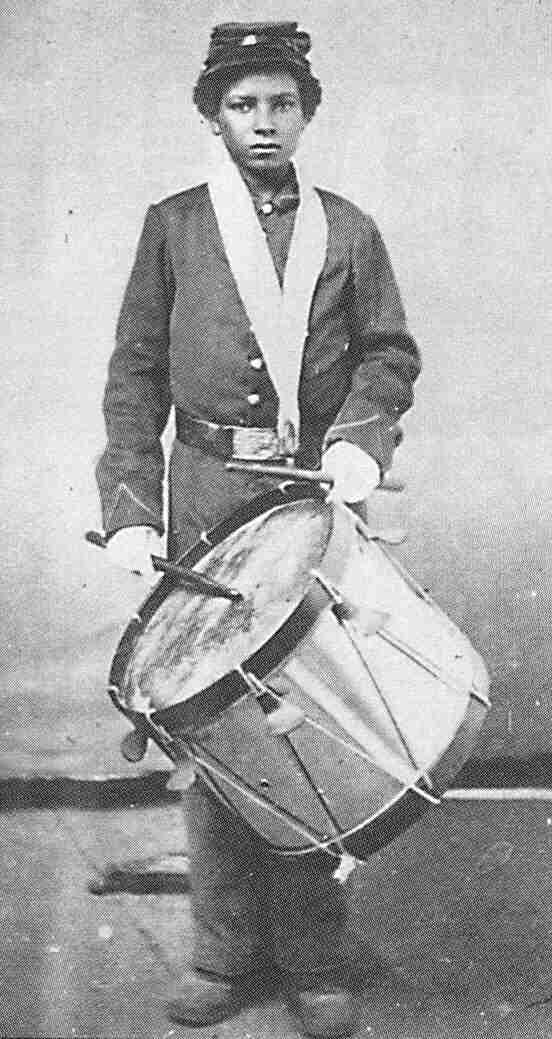
Figure 1.--The Federal Army began enlisting blacks after the emancipation Proclamation. So this portrait of a Federal drummer boy was taken sometime in 1863-65. All we know about him is that his name was Jackson. To see what he looked like before he enlisted, click on the image.
|
|
We have begun to collect acounts and images of drummer boys in the Civil War. Here we are looking for accounts of actual boys. Most joined the colors for adventure and excitement. This they found and for the most part more than they ever could have expected. Perhaps the most famous is Johnny Clem, but thousands of boys served as musicians with both the Federal and Confederate Armies and most because of their age lived into the 20th century. Unfortunately there are all to few who left detailed accounts. Some told their stores, but many did not. One boy who only left his portraits to history is known only as Jackson and we know very little about him.
Edward Black (Iowa)
There seem to be two Federal drummer boys name Black with connections to Indiana, Iowa, and Lousina. The two are often confused becuse of their same last name. A blogger writes,"I wrote about a young drummer from the 21 Iowa named Edward Black some years ago in my Battle of Baton Rouge series. It provoked an inquiry from another poster who shall remain nameless and he sent me the following in a PM about the boy in a Thomas Richey work about the battle. 'Thomas Richey is a good source for identifying locations of the battle in modern Baton Rouge. He also wrote a fair description of the battle. (I enjoyed your work more than Richey's.) However, his info on Edward Black is somewhat erroneous. Black was in the Field & Staff of the regiment and not in Company L, which did not exist at the time. My information does not indicate he had any need to be paroled, but he was discharged, as were most of the musicians in the regimental band, in September, 1862. Why Richey used the term paroled, I don't know. I also have no records that he ever reinlisted as Richey says he did. There is no record to that effect in the National Archives, and there is none in the Indiana Adjutant General's Reports. The rest of Richey's information is correct. Edward's father, George H. Black. was commissioned as a lieutenant in Company L in 1863. He resigned in December, 1863.'" We can not determine the blogger's name.
William Black was born (1853). Some sources seem to combine the Edward and Willian, suggesting his first name was Edward, but called William, just one boy variously valled Edward and William. Others saw that there were two boys. He appasrently was only 9 years old when he joined the 21st Indiana as a musician. He enlisted with 21st Indiana Volunteers (July 21, 1861). He was made to leave but then re-enlisted with his father and both served at Battle of Baton Rouge. He became a drummer boy. Some sources say he became a soldier. We are not sure if this was the case, but is classified as a soldier because he was wounded. If so, he would be the youngest Civil War casualty. Three years later when he was 12 years old , his left hand and arm was shattered by an exploding shell. He seems to have had a twin brither. The Children's Museum of Indianapolis has an originl Civil War drum which they identify as belonging to Edward. We know that William was woinded. He was photographed by Mathew Brady after the injury and apparently identified as William. Unfortunately as far as we know the portrait is not dated. He died at at a very young age (1872). We are not sure if his early death was related to his injury. Edward died at age 19. He is buried in Crown Hill Cemetery in Indianapolis. He had a twin brother .Despite this destinction, we have been unble to find much information about him.
Avery Brown
Here we have a tin-type of Thomas Camp. He was a drummer boy in the 11th Wisconsin, Co. F. His uniform is particularly interesting because the unit was Zouaves. It was known as the Harvey Zouaves. Harvey was presumably the officer who organzed the unit. Unfortunastely we know virtuslly nothing about Thomas' service. A note with the tin-type reads, "Thomas Camp. Mother Wismer's youngest brother. Drummer boy in Civil War."
John Joseph Klem, often refered to as Johnny Clem, was probably the
most famous boy who served in the Civil War. He is known to history
as the "Drummer Boy of Chickamauga" and also "Johnny Shiloh." He
was one of the youngest, but not the youngest to do so. Like most
younger boys who participated in the War, he served as a musician.
The Federal Army alone had places for 40,000 muscians. Many of the
boys given the turmoil of battle became involved in the actual fighting. Johhny was the most famous Union boy soldier. He became a drummer in the 22nd Massachusetts Infantry at age 11 years. He fought in the battles of Shiloh, Perryville, Murfreesboro, Chickamauga, and Atlanta. He was eventually promoted to serve as a mounted orderly on the staff of General George H. Thomas, with the "rank" of lance sergeant.
Charley Common (Ohio)
"Other boy musicians had less spectacular careers than Clem, but many followed his example of swapping drums for guns in the heat of the conflict. The colonel of the Fifty-second Ohio Regiment told of one such
instance in his official report of Perryville where 'Charley Common, a little drummer boy, having lost his
drum, took a musket and fought manfully in the line.' [Wiley, p.?.]
Johnny Cook (Ohio)
John Cook served as a bugler in Battery B, 4th U.S. Artillery. Johnny was born in Hamilton County, Ohio.
He entered service at Cincinnati when he was 13 years old. Boys that young were usually not buglers. This was because buggles were how ordered were issued to a unit in the heat of battle. But ling capacitt was important in creating a loud buggle call and younger boys did not have it. Johnny turned 15 years of age
days before the Army of Northern Virginia collided with the Army of the Potomac at Antitem Creek (September 17, 1862). This would result in the bloodiest single day of the War. During the battle several of the canoneers were hit and put out of action. Johnny volunteered to act as a cannoneer, and took over operations of the cannon under a terrific fire of the enemy. He helped Fight off three Confederate attacks. He later joined the Navy and fought on a gunboat until the end of the war. Four decades after the War, he ws awarded the Congrsssional Medal of Honor (1894). He lived until 1915
Chauncey H. Cooke (Wisconsin)
Wiley quotes from: Martha N. McLeod, editor, Brother Warriors, The Reminiscences of Union and Confederate Veterans (Washington, 1940), 47). "Chauncey H. Cooke of the Twenty-fifth Wisconsin Regiment, whose letters home are among the best of Civil War sources, wrote thus of his mustering-in experience: 'Every one he suspicioned of being under 18 he
would ask his age. He turned out a lot of them who
were not quite 18...Seeing how it was working with the
rest, I did not know what to do...I saw our Chaplain
and he told me to tell the truth, that I was a little
past 16, and he tho't when the mustering officer saw
my whiskers he would not ask my age. That is what the
boys all told me but I was afraid. I had about made up
my mind to tell him I was going on 19 years, but thank
heaven I did not have a chance to lie. He did not ask
my age. I am all right ... but the sweat was running
down my legs into my boots when that fellow came down
the line and I was looking hard at the ground fifteen
paces in front.'((Wiley quotes from Chauncey H. Cooke,
"A Soldier Boy's Letters to his Father and Mother
(1912), 2. These letters were published serially in
the Wisconsin Magazine of History, IV (1920-1921),
pages 75-100, 208-217, 322-344, 431-456, and V
(1921-1922), 63-98.) [Wiley, p. ?.]
Charles Hay (Alabama)
The youngest Confederate enlistee was Charles Hay, who joined an Alabama regiment when he was 11 years old.
Anna Glud/Tom Hunley (California)
There was apparently at least on Civil War drummer girl. Anna Glud of Oakland, California apparently put on a Federal uniform and went off to war. She served in the Federal Army for 2 years. She gave her name as Tom Hunley. She kept her secret for about 50 years. She claims that General U.S Grant of all people found out about it. Grant was inspecting Tom’s regiment and upon seeing the diminutive drummer boy, ordered him mustered out as too young for service.
Anna's father pleaded with Grant, telling him that his daughter was motherless and that he did not want to leave her home alone.
The general swore himself to secrecy and canceled his order to muster him out. Yhe account of Grant seems difficulkt to believe. And we only have Anna's account. Anna later wrote, "During all the time that I was in the Army many remarked that I looked more like a girl than a boy. But not one soldier actually found it out." She writes, "Father and I kept so constantly together that I was always protected. Had I not had his assistance at all times, I doubt that I could have stood the rigors of a soldier’s life.
Why, in a battle near Davisville, where 7,000 Confederates and Northerners were killed, our little body of men literally had to climb over the bodies of dead soldiers in order to fight our way out. My little feet were red with blood. And when we were mustered out in the fall of 1864 there were but 17 members of our company left.”
After the war Anna still sesguised as Tom and her father attempted settled down on a farm in Indiana. The War was apparently difficult on her father. He died six months later. His wife and four sons had already died. At this time, Tom became Anna once again.
Another noted drummer boy was Robert Henry Hendershot who became known as 'the Drummer Boy of the Rappahannock.' He was a drummer boy for the Eighth Michigan. His regiment was stationed near the Seventh Michigan during the Battle of Fredricksburg, Virginia. On December
11, 1862, the Seventh was trying to cross the Rappahannock River under fire. Robert answered a call for volunteers and ran to help push the boats. He had crossed the river when a shell fragment hit his drum and broke it into pieces, so he picked up a musket.
We note lyston's story publoshed in a newspaper, "IT HAPPENED on Shermap's march to the sea. The boy was 13 years old I and an experienced member of the Union army. He had become separated from his company and now he had been captured by a Confederate lieutenant. The boy did not stay a captive long. Possibly the southern officer was con- fused by the turmoil caused by Sherman s men. Anyway, he did not guard the boy too well. He turned his back once. The boy saw his chance, leaped on the lieutenant's horse, and took himself -and the horse-back to his lines. The boy was Lyston D. Howe of Wau kegan and his story has not been pubished. In fact, the boy was forgotten. A box full of Civil war photographs was discovered recently inthe basement of the state capitol in Springfield. One of the pictures was of Lyston D. Howe, a member of company I of the 15th Itlinois volunteers infantry regiment. The picture bore the following notation, Lyston D. Howe, youthful Union soldier.
Born Aug. 27, 1850. Age 10 years 9 months and 9 days at enlistment." He was a drummer boy. The picture now is in the Illinois State Historical society li- brary in Springfield. WHO WAS Lyston D. Howe, and what happened to him? Did the army experience blight his life? We are happy to report that the army didn't hurt Lyston one bit. He did all right. Here is his story, or as much of it as can be learned today, gathered from a dozen sources. He was born in Hiram, O., and the date on the photograph, which coincides with the family records, is correct. His father, William H. Howe, was a mili- tary man who served in the war with Mexico and came out of it a major. When Mrs. Howe died in 1852, Maj. Howe took his two sons, Lyston and Orion, who was two years older than Lyston, to Waukegan. Maj. Howe settled on a farm in or near Waukegan mainly to be near his sister, Mrs. Samuel Shaw, so that she could help care for the motherless boys. WHEN THE Civil war broke out Maj. Howe enlisted in company I of the 15th Illinois, composed largely of men from the Waukegan area. Lyston and Orion joined the same outfit to be with their father. Lyston was a pretty good drummer, but he had a little trouble keeping up with the marching, being only 5 feet 2 inches tall. When he got the measles he was discharged Oct. 21,1861, as a minor. As soon as he was able, Lyston ran away from his nurses and showed up in Paducah, Ky., where he reenlisted in company B, 55th Illinois volunteers. When you inquire what a drummer boy did in the army of Maj. Gen. Wil- liam T. Sherman on its march thru Georgia to the sea, you learn the youngster helped out in the signal corps. That means he saw all of it. That march was not child s play. "Sherman's bummers" cut a path of death and desolation 30 miles wide and 300 miles long. Lyston saw homes go up in flames, with only the chimneys remaining. WHAT DID the boy think of these experiences? Not much, it is to be understood. Perhaps that is the best way. Or he may have felt, as Gen. Sherman expressed it years later, that 'war is war, and you can make nothing else of it." When the war ended Lyston was a veteran, 14 years old. He had been wounded once, but not enough to talk about, he said.
The family moved to Braidwood, Will county, where Lyston eventually became yardmaster of the Alton railroad. When the old Pekin railroad was extended to Streator, Lyston became its first yardmaster there. He married a Streator girl in 1873.
Lyston later entered the coal mining business and invented a coal washer. The Jefferson Coal company was glad to buy that patent. Lyston then became a hardware merchant in Streator and was assessor of Bruce township for two terms. He also was active in Masonic events. He died Jan. 11, 1937, leaving three sons, one of them a doctor who figures in La Salle county history." [Randolph. p. 16.]
Orion P. Howe (Illinois)
Orion P. Howe, a drummer boy with the 55th Illinois Regiment, was awarded the Congessional Medal of Honor for gallantry at Vicksburg. His citation stated: 'A drummer boy, 14 years of age and severly wounded and exposed to heavy fire from the enemy, he persistently remained upon the field of battle until he had reported to Gen. W.T. Sherman the necessity of supplying cartridges for the use of troops under command of Colonel Malmborg.' [Wiley, p. 298.] Orion and his younger brother Lyston served as a drummer with the 55th Illinois Volunteers. He was wounded in the leg during the battle of Vicksburg. Even so, he delivered a message to General Sherman with an urgent request for ammunition. Sherman commended Orion for his bravery.
The portrait of a run-away slave before and after he enlisted in the Federal Army are two of the most moving photographs of the Civil War. Unfortunately we know little more about him than that his name was Jackson. Probably this was his owner's name and from the look of the boy, maybe even his actual father. All that we know about Jackson was that he joined the 79th U.S. Colored Troops in Louisiana.
Charles 'Charly' King was from West Chester, Pennsylvania. He was the oldest child in his family, but only 12 years old when the Civil War began and northern units began to organize and train. Charley was fascinated by all the activity and he also loved to make music. He begged his father tyo allow him to enlist as a drummer boy. Attitudes toward children were different at the time, but even for Civil War parents, 12-years old was very young to enlist in the Army. Boys that age, however, can be very persistent. And Charley managed to gain an ally. Company F Captain Benjamin Sweeney noticed him practicing his drumming near the camp where the 49th Pennsylvania was training. Sweeney was not only involved with the training, but also recruiting soldiers. Sweeney was impressed with both Charley's determination and drumming skills. He had a talk with Charley's father that drummer boys were non-combatants andc not really in danger. He said the boys were usually behind the lines and in safe poositions helping with the woiunded rather than on the battlefield. He promised he woukd keep Charley safely away from danger anhd look after him. Of course there was no way that he could possibly ensure this. But in fareness to captain Sweeney, very few people at the time realized what alood bath the Civil War would become. Most had highly unrealistic, romatic ideas about battle and thought the War would soon be over. So Charley's father gave his permission. We are not sure if mother had any say in this. Charley immediately became a big hit with the men as they trained.
Charley was a very talented drummer and got on well with the men who took him under their wing. His drumming was so impressive with Compny F that the commanding officer of the 49th promoted him as the drum major of the field music of the Regiment.
Charles Monell was a drummer boy with the 165TH New York, 2ND Battalion, Duryee Zouaves. He served most of te Civil War. He had a CDV portrait taken in his Zouave uniform. It was once archived in a famiy album. Charles' home residence was not limited. He was 15 years old, I think when the portrait was taken. He first enlisted at New York City as a Musician (September 10, 1862). The 165th, the 2nd battalion, Duryea's Zouaves, was originally recruited for a 9 months' term. Even in 1862, few people undrstood how long the War would last. The unit was called Duryea's Zouaves because an officer named Duryea was responsible for forming the unit--I think Lieut.-Col. Hiram Duryea,. The enlistment was subsequently changed to 3 years. Only six companies were recruited, principally from New York city and Brooklyn, and were mustered into the U. S. service between August-December 1862, for 3years. He then mustered into "A" Co. NY 165th Infantry (November 28, 1862). The battalion left the state sailing for New Orleans (December 2, 1862). On its arrival was assigned to the 3d brigade, 2nd (Sherman's) Division, 19th corps, Department of the Gulf. Four new companies joined the battalion in the field and were consolidated with the original six companies (1864). Charles mustered Out at Charleston, SC still in the 165th Infanry (September 1, 1865). The officers were: Lieut.-Cols., Abel Smith, Jr., Governeur Carr, William R. French; Majs., Governeur Carr, Felix Angus, William W. Stephenson.
John M. Raymond was a drummer boy with the 11th Michigan Volunteer Infantry. Unfortunately we do not have any details about his service or a photograph during the War. We have found a portrait of him years after the War as an elderly man, orobably about 1900. He wears a complete Grand Army of the Republic (GAR) uniform and sporting various Civil War badges. For Raymond and many others who survived the War, it was the adventure of a life time. Obviously it was for Raymond which can clearly be seen in this portrait.
William C. Richardson (Ohio)
"The diary of William C. Richardson, drummer boy
of the 104th Ohio Regiment, shows that he supplemented
his musical activities with barbering, carrying water
for the soldiers, honing the surgeon's instruments,
assisting in removal and care of the wounded, helping
bury the dead, and drawing maps. Another drummer boy
sold cakes, nuts, watermelons and other delicacies to
the soldiers at a profit which infuriated the men and
which permitted him send home in one lump the then
fabulous sum of sixty-five dollars." From Diary of WIlliam C. Richardson, 1862- 1865, 4
vols., passim, manuscript, Western Reserve Historical
Society; J.H. Kendig to his brother, August 10, 1863,
manuscript, Historical Society of Pa.) [Wiley, p. 296.]
Gustav Schurmann
Gustav was a bootblack. He enlisted for adventure and served as both a drummer and buggler. He is best known for making friends with President Lincoln's youngest son Tad.
Private Franklin Searis (sp??). Franklin was the drummer boy for Company E of the 19th Wisconsin Volunteers and perished during the Civil War in December 1862. Unfortunately we do not know anything more about Franklin. Hopefully HBC readers will forward us any additional information that they may require.
Here we have two Civil War drummer boy paintings. They appear to be contemporary water color portrait on paste board. Thus this is an important color contribution to our archive of drummer boy portraits as well as a camp scene background. Unfortunately we are not sure of the boy's name. The back of one portrait is signed "Stengel". We are not sure, however, if this is the boy's name or the artist. The portraits were found in northern Ohio, so it is likely that the boy was wih an Ohio regiment. The portraits were done for oval frames. The drummer boy is accompanied in one of the portraits with an adult soldier. We also do not know who he was.
Johnnie Walker (Wisconsin)
"Private Harvey Reid in a remarkable letter to a very young brother gave the following delightful glimpse of little Johnnie Walker, 12-year old drummer in the 22nd Wisconsin Regiment: Johnnie is drummer for the band, and when they play at dress parade every evening lots of gentlemen and ladies come from the city to hear them play and see the little drummer and when we are marching, and the ladies see the little soldier-boy they always give him apples, cakes, or something ... When we are
marching Johnnie always keeps up with the big men, and
is always singing and laughing but when he gets tired
the big Colonel or Lieutenant Colonel or Adjutant will
let Johnnie have his horse to ride. Everybody in the
regiment likes Johnnie because he is a good little
boy, is always pleasant and polite and not saucy like
a great many boys. His mother sent him a suit of
clothes made exactly like officer's clothes, and
Lieutenant Baumman says he will get him a pair of
shoulder straps with silver drum sticks upon them.
Johnnie used to live in Racine and he has a half
brother who is corporal in our company (but he is a
mean bad man, don't take care of Johnnie, who lives
with the Captain of Company B). (Harvey Reid to his
brother Charles (1862), manuscript, Wis. Historical
Society. [Wiley, pp. 296-297.]
Other
We have noted many other names, such as: C.W. Bardeen, Jerry Collins, Delavan Miller, and Otto Wolf. We do not have many details about their experiences.
Sources
Randolph, John. "The littest Yank," Chicago Tribune (May 25, 1958). part 1, p.16.
Wiley, Bell Irvin. The Life of Billy Yank: The Common Soldier of the Union (Louisiana State University Press, 1952. (The edition quoyed here is the 1978 reissue.)
CIH -- Civil War

Navigate the CIH Civil War Section:
[Return to the Main Civil War musicians page]
[Return to the Main Civil War page]
[Return to the Main military service page]
[Return to the Main U.S. 1860s page]
[About Us]
[Biographies]
[Campaign]
[Causes]
[Emancipation]
[Families and youth]
[Fiscal policy]
[Formations and units]
[Law]
[Railroads]
[Reconstruction]
[Slavery]
[Soldiers]
[Uniforms]
[Weaponry]
[Return to the Main Civil War page]
[Lost Cause]
[Segregation]
[Civil Rights movement]
[Return to CIH Home page]
Navigate the Historic Boys' Clothing Web chronological pages:
[The 1820s]
[The 1830s]
[The 1840s]
[The 1850s]
[The 1860s]
[The 1870s]
[The 1880s]
[The 1890s]
Created: 3:41 AM 9/2/2005
Last updated: 11:03 PM 3/28/2016